Search results for The

20131008_112648

He’s makin’ more money than you’ll ever see.

That was the preferred argument of my friend, Tommy, a classmate who lived across the street when I was a kid.  I sometimes would disagree with Tommy about the talents or behavior of some celebrity — a rock star or an actor.  Today’s equivalent might be Ke$ha or a Kardashian. Tommy’s response was usually, “He’s makin’ more money than you’ll ever see.”  And that settled the issue as far as Tommy was concerned.  A huge income trumped just about anything.

In sociology, we talk about values. Introduction to Sociology texts usually define values as abstract ideas about what is good, ideas that people use as guides to action.  Maybe. But the definition I prefer sees values as “legitimations” — ideas about what is good that people use to justify behavior or to win arguments.  For Tommy, money was this kind of ultimate legitimation. His behavior did not evidence a strong value on money — we were only about eleven at the time — but his judgments did. Values are what we use to evaluate.

I thought of Tommy and values today when I read the transcript of a CNBC interview with Alex Pereene.  Pereene has recently gone on record criticizing Jamie Dimon, the CEO of JPMorgan. That bank currently faces an $11 billion fine for having dealt in shoddy mortgage-backed securities.  JP Morgan can afford it, of course, but $11 billion begins to be real money.  The question on CNBC was whether Dimon should continue as its CEO.

Pareene says no. The CNBC anchor, Maria Bartiromo then says.

Legal problems aside, JP Morgan remains one of the best, if not the best performing major bank in the world today. You believe the leader of that bank should step down?

Or as Tommy Fiedler would have put it, “His bank is makin’ more money than you’ll ever see.”

Here’s Pareene’s response:

If you managed a restaurant, and it got the biggest health department fine in the history of restaurants, no one would say “Yeah, but the restaurant’s making a lot of money. There’s only a little bit of poison in the food.”

CNBC then brings in a Dimon booster, Duff McDonald. Asked to respond to Pareene’s charge of corruption, McDonald says,

It’s preposterous. The stock’s touching a ten-year high. It’s a cash-generating machine. Sure they’ve had their regulatory issues . . .

In McDonald’s view, the charge of corruption is preposterous because JP Morgan is makin’ more money than you’ll ever see.

Bartiromo’s reaction is especially telling. She seems to take Pereene’s criticism of JP Morgan personally. I thought that anchors were supposed to be neutral and try to  draw guests out. But Bartiromo is openly hostile. She loudly interrupts Pereene and demands evidence of the bank’s questionable tactics. When Pereene gives an example, she defends Dimon by again appealing to the value on profits above all else.

Even with all these losses, the company continues to churn out tens of billions of dollars in earnings and hundreds of millions in revenues. How do you criticize that? [emphasis added]

Her assumption is that anyone who makes so much money cannot be criticized. Such criticism is immoral. The reporting about JP Morgan’s shortcomings is, she says,  “a witch hunt.”

The problem with legitimations is that they work only if everyone in the room shares the same values. Members of the same culture, almost by definition, share values, and effective arguments apeal to those values. Americans, for example, are suckers for arguments based on appeals to individual freedom. We find them very hard to resist. But people in other cultures might not find those arguments so persuasive.

This brief CNBC interview hints at cultures or moral worlds in collision. In the CNBC world, people take the value on making money for granted. When they encounter someone who does not share that value, who is not persuaded by arguments based on it, they act as though threatened by some uncomprehending and dangerous alien, a creature from another world. It is a clash of cultures, a clash of values, and the way we discover those is not by watching what people do (values as guides to action)  but by listening to how they justify what they and others do (values as legitimations).

Cross-posted at Montclair SocioBlog.

Jay Livingston is the chair of the Sociology Department at Montclair State University. You can follow him at Montclair SocioBlog or on Twitter.

*trigger warning for sexual violence; not safe for work*

In a wonderful article called It’s Only a Penis, anthropologist Christine Helliwell talks of how her time with the Dayak community of Gerai in Indonesian Borneo changed her perceptions of the sexual body.  She writes of a time when a man crept through a window and into the bed of a sleeping woman.  She continues:

[She] awoke, in darkness, to feel the man inside her mosquito net, gripping her shoulder while he climbed under the blanket… He was whispering, “be quiet, be quiet!” She responded by sitting up in bed and pushing him violently, so that he stumbled backward [and] became entangled with her mosquito net… His hurried exit through the window, with his clothes now in considerable disarray, was accompanied by a stream of abuse from the woman and by excited interrogations from wakened neighbors in adjoining houses.

The next morning:

I awoke… to raucous laughter on the longhouse verandah outside my apartment where a group of elderly women gathered… They were recounting this tale loudly, and with enormous enjoyment… one was engaged in mimicking the man climbing out the window, sarong falling down, genitals askew… both men and women shrieked with laughter.

Helliwell was appalled.  It sounded to her Western ears like a case of attempted rape.  It was frightening, not funny.  But, when she explained to the local women that what he did was bad, one replied, “No, no bad, simply stupid.”  Helliwell turned to the woman who had been approached by the man and said, “He was trying to hurt you.”  She replied, “It’s only a penis. How can a penis hurt anyone?”  The Gerai had no word for “rape.”

I often think of this story when observing the way that women’s and men’s genitals are represented in Western culture.  I find the Gerai’s perspective intuitively pleasing.  Penises are, in fact, very sensitive dangly bits imbued with much importance. I can imagine a culture in which their vulnerability was front-and-center, so to speak.  I’m reminded of an observation made by my colleague Caroline Heldman regarding the seemingly secret pact of all men not to fight “below the belt” so as to never draw attention to men’s obvious and uniquely male physical weakness.

Yet, in Western cultures, we do imagine the penis to be a potentially threatening piece of anatomy.  In contrast, Helliwell writes, the vagina is often “conceived of as a delicate, perhaps inevitably damaged and pained inner space.”  Accordingly, we have collectively agreed to somehow believe that penises are potentially brutalizing and vaginas easily brutalized.

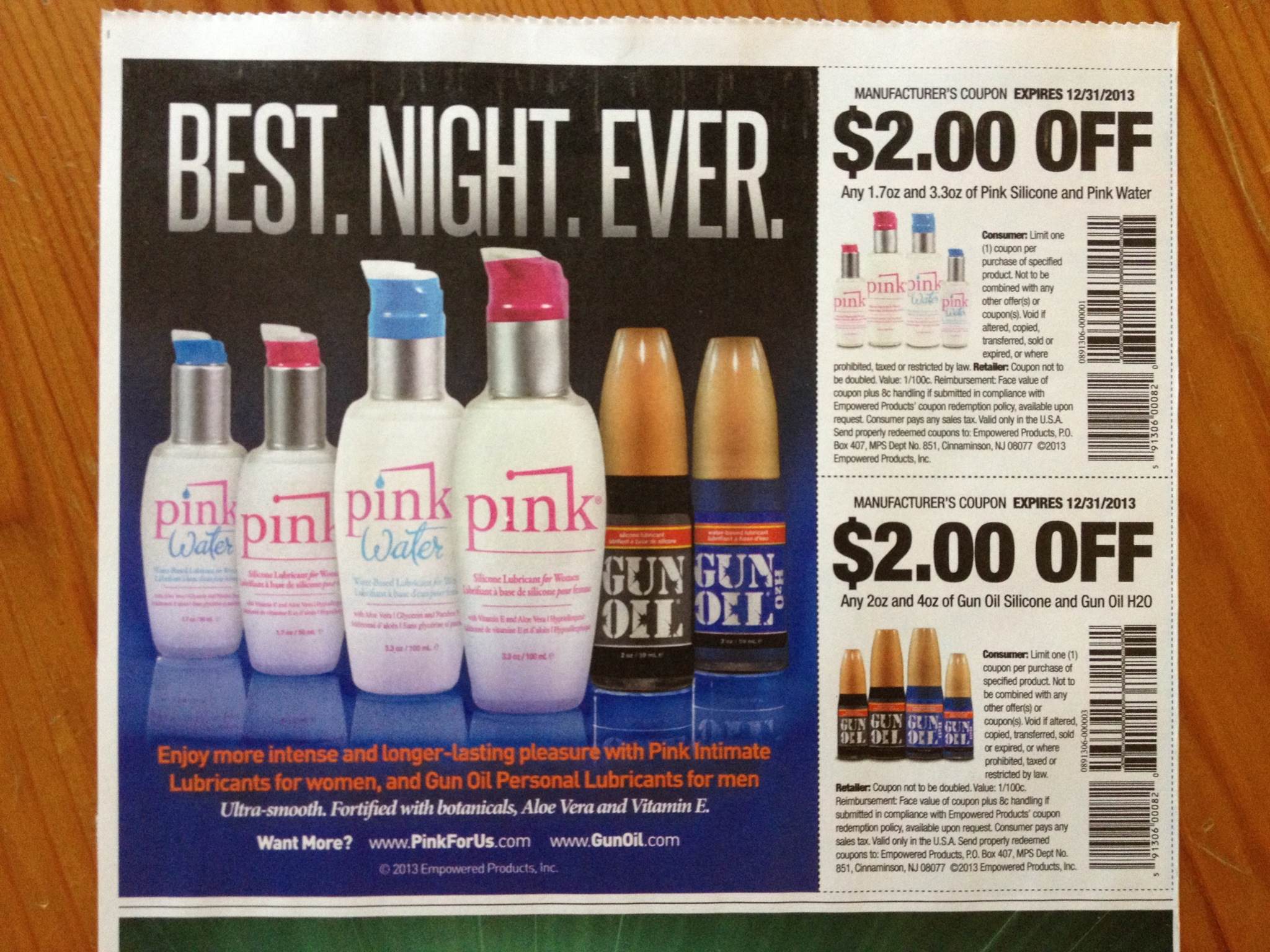
Where do these ideas come from?  Well, here’s a clue: the frequency with which penises are represented, literally, as weapons.  Kira recently sent in this example: a lubricant with the name “Gun Oil” advertised in the San Jose Mercury News (this is also going straight to our pointlessly gendered products page).

photo

A while back, we received this safer sex ad from Germany:

SafeSexPSA-Germany

And Julie C. sent along a link to a set of safer sex ads that included these three:

mtv_shot_bullet4795
mtv_shot_condom3938

mtv_shot_girl4613

While I am all for encouraging sexual pleasure and safer sex, I would prefer that such efforts not conflate the penis with a weapon.  Doing so only contributes to the idea that the penis is inherently useful for enacting violence and women’s bodies naturally vulnerable to violation from men.  Moreover, Helliwell’s experience suggests that this isn’t simply imaginary, but may also contribute to the enactment of violence or lack thereof.

Cross-posted at Pacific Standard.

Lisa Wade, PhD is an Associate Professor at Tulane University. She is the author of American Hookup, a book about college sexual culture; a textbook about gender; and a forthcoming introductory text: Terrible Magnificent Sociology. You can follow her on Twitter and Instagram.


Compared to some European countries, the United States has a weak tradition of labor-based activism.  All too often, this leads to the invisibility of labor issues.  Take for example, this commercial for Simply Orange® brand orange juice. In an attempt to present their product as a natural alternative to other brands, Simply Orange juxtaposes images of natural orange growth with common phrases relating to the structure of a manufacturing organization. The tree is their “plant” (a marvelous pun), the orange blossoms are the “workers” that produce the fruit, and the sun itself becomes “upper management.”

Even though this commercial is humorously centered on the process of producing orange juice, there is not a single human being present in any of the images. It is a story about making a product in which nobody actually makes anything! This message cleverly sells the product, but it also obscures the real labor that went into growing, picking, and juicing the oranges and downplays the contributions to the process made by real people. All that productive effort is condensed into the image of an orange blossom, as if it can be assumed that such production will just naturally occur like an annual blooming.

The reality of orange juice production is much less sunny. According to statistics recently compiled by the Southern Poverty Law Center, there are roughly 20,000 undocumented workers in Florida that are subjected to harsh working conditions as growers compete with imported oranges in a “race to the bottom” for a cheaper production process. The illegal status of many of these workers makes them easily exploited for substandard wages, because they are often afraid to challenge the policies of their employers.

In a Marxist theoretical perspective, the way that these workers are rendered invisible by the public image of the commercial is a prime example of alienation: a tension in modern capitalism in which the workers in a mass-producing industry are separated from the fruits of their labor. Where at first it was merely the physical product that was taken from those who produced it to be sold in the market, now the credit for even participating in the process is being abstractly torn away.

This commercial also challenges the realities of the labor process, associating modern concepts of work organization such as “the plant” and “upper management” with images of natural growth. These associations allow the commercial to imply that their methods of labor organization are somehow rooted in a simpler way of doing things that is more harmonious with the natural order. By hearkening back to these roots, the organization is rendered harmless, as if to say the complexities of modern labor relations do not apply to the simple production of orange juice. All together, the choice to portray the associations in this commercial serves to hide the realities of agricultural production in the United States and limit the viewer’s potential curiosity about the way the process really works.

Evan Stewart is a Ph.D student at the University of Minnesota studying political culture. He is also a member of The Society Pages’ graduate student board, and you can follow him on Twitter

If I have one thing to say about Holly Grigg-Spall’s new book, Sweetening the Pill: How We Got Hooked On Hormonal Birth Control, it’s that it brings together ideas in creative ways and comes out with conclusions that are new to me.

The book is an interrogation of the popularity of hormonal birth control in the U.S.  In one argument, Grigg-Spall begins with the fact that women’s bodies are a fraught topic. For hundreds of years, the female body has been offered as proof of women’s inferiority to men.  Feminists have had two options: (1) embrace biological difference and claim equality based on essential femaleness or (2) reject difference and claim equality based on sameness.

Largely, Grigg-Spall argues, the latter has won out as the dominant feminist strategy. Accordingly, all things uniquely female become suspect; they are possible traitors to the cause.  This includes ovulation, menstruation, and the mild mood swings that tend to accompany them (men have equivalent mood swings, by the way, they’re just daily and seasonal instead of monthly-ish).

Hormonal birth control, then, can be seen as a way to eliminate some of the things about us that make us distinctly “female.”  “Science is making us better,” the message goes.  By getting rid of our supposedly feminine frailties, “we are [supposedly] becoming better humans…”  A quick look at birth control pill advertising reveals that this goes far beyond preventing pregnancy.  Commercials frequently claim other benefits that conform to socio-cultural expectations for women: reduced PMS, clearer skin, and bigger breasts.  This Yaz commercial, for example, claims that the pill also cures acne, irritability, moodiness, anxiety, appetite, headaches, fatigue, and bloating.

Screenshot_4

To add insult to injury, Grigg-Spall notes, advertising then frames consumption of the pill as liberation.  In this commercial for Seasonique, the pharmaceutical company positions itself as women’s answer to a mysterious oppressor.  “Who says?” is repeated a full eight times.

Others have criticized Grigg-Spall for, among other things, essentializing femaleness: utilizing  that strategy for equality that embraces women’s difference from men and asks others to do so as well.

I’m coming down on the side of “huh!?”  The Pill made an immeasurable difference for women when it was introduced as the first effective, female-controlled birth control method.  There’s no doubt about that.  Her book asks us whether our designation of The Pill as a holy pillar of women’s equality still applies today.  I think it’s worth thinking about.

Cross-posted at Pacific Standard.

Lisa Wade, PhD is an Associate Professor at Tulane University. She is the author of American Hookup, a book about college sexual culture; a textbook about gender; and a forthcoming introductory text: Terrible Magnificent Sociology. You can follow her on Twitter and Instagram.

The partial U.S. map below shows the proportion of the population that was identified as enslaved in the 1860 census.  County by county, it reveals where the economy was most dominated by slavery.

1

A new paper by Avidit Acharya, Matthew Blackwell, and Maya Sen has discovered that the proportion of enslaved residents in 1860 — 153 years ago — predicts race-related beliefs today.   As the percent of the population in a county accounted for by the enslaved increases, there is a decreased likelihood that contemporary white residents will identify as a Democrat and support affirmative action, and an increased chance that they will express negative beliefs about black people.

Avidit and colleagues don’t stop there.  They try to figure out why.  They consider a range of possibilities, including contemporary demographics and the possibility of “racial threat” (the idea that high numbers of black people make whites uneasy), urban-rural differences, the destruction and disintegration caused by the Civil War, and more.  Controlling for all these things, the authors conclude that the results are still partly explained by a simple phenomenon: parents teaching their children.  The bias of Southern whites during slavery has been passed down intergenerationally.

Cross-posted at Pacific Standard.

Lisa Wade, PhD is an Associate Professor at Tulane University. She is the author of American Hookup, a book about college sexual culture; a textbook about gender; and a forthcoming introductory text: Terrible Magnificent Sociology. You can follow her on Twitter and Instagram.

Screenshot_1Last month I had the pleasure of writing a really fun essay about sexual dimorphism for Salon.  The phrase refers to the degree to which males and females of a species are different.  I offered a bunch of fun examples of strong dimorphism and imagined what humans would be like if we were like those animals.

Men would be 11 feet tall, for example, if we were as dimorphic as the elephant seal; they’d be the size of a walnut if we were like the blanket octopus.  And don’t we all think that glistening iridescent skin, like the feathers on male birds, would make men more fabulously attractive?  It’s a no-brainer.

In any case, coincidentally the New York Times put together an animated video about one of my favorite examples: the green spoonworm.  The male spoonworm is very small compared to the female, equivalent to a human male being about the size of a breath mint.  And he lives his entire life inside of the female’s digestive tract.  Now that’s sexual dimorphism!  Enjoy:

Lisa Wade, PhD is an Associate Professor at Tulane University. She is the author of American Hookup, a book about college sexual culture; a textbook about gender; and a forthcoming introductory text: Terrible Magnificent Sociology. You can follow her on Twitter and Instagram.

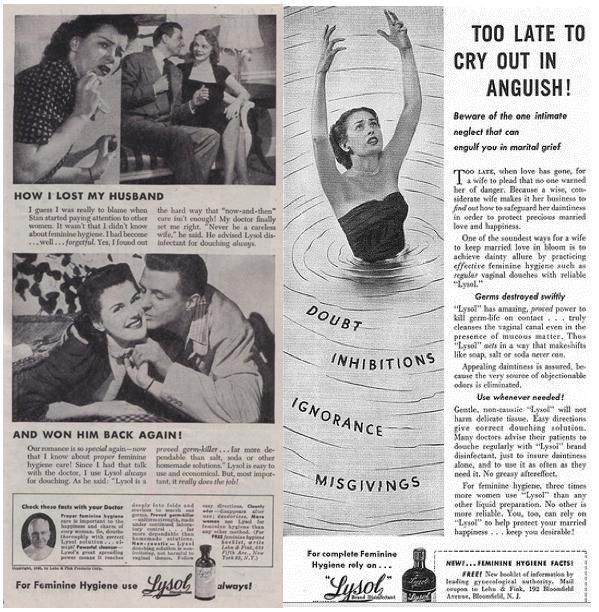
Every once in a while the internet is abuzz being horrified by vintage ads for Lysol brand douche.  The ads seem to suggest that women are repulsing their husbands with odorous vaginas caused by neglected feminine hygiene.  In fact, it only looks like this to us today because we don’t know the secret code.

Screenshot_3 Screenshot_4

These ads aren’t frightening women into thinking their genitals smell badly.  According to historian Andrea Tone, “feminine hygiene” was a euphemism.   Birth control was illegal in the U.S. until 1965 (for married couples) and 1972 (for single people).  These Lysol ads are actually for contraception.    The campaign made Lysol the best-selling method of contraception during the Great Depression.

Of course, we’re not wrong to be horrified today.  Lysol was incredibly corrosive to the vagina; in fact, it’s recipe was significantly more dangerous than the one used today.  Hundreds of people died from exposure to Lysol, including women who were using it to kill sperm.  It was also, to add insult to injury, wholly ineffective as a contraceptive.

Here’s to safe, legal, effective contraception for all.

Via Buzzfeed and @CreativeTweets.

Lisa Wade, PhD is an Associate Professor at Tulane University. She is the author of American Hookup, a book about college sexual culture; a textbook about gender; and a forthcoming introductory text: Terrible Magnificent Sociology. You can follow her on Twitter and Instagram.

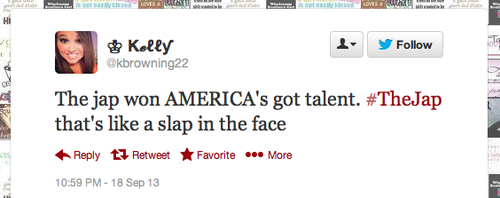
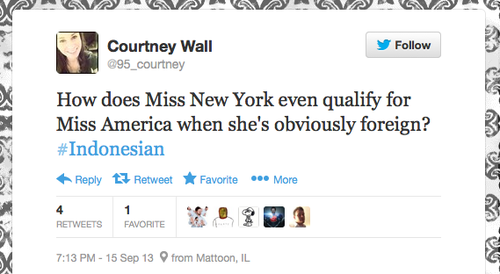
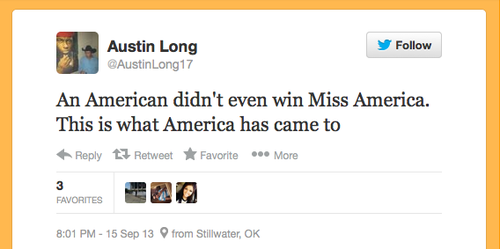
Two recent events had a strikingly similar theme.  Kenichi Ebina won America’s Got Talent and Nina Davuluri won Miss America.  In both instances, other Americans objected to their victories, claiming that they were not really American because Ebina and Davuluri are of Japanese and Indian origin respectively.   Still other Americans objected to this reaction.  And yet, as I’ll argue below, most of us share their bias.

First, thanks to Public Shaming, we have examples of the reaction on Twitter.  Reactions to Ebina’s win:

1 2 4

Reactions to Davuluri’s win:
14 12 13

These are stark examples of people who believe that only white people count as American.  It’s a bizarre position, of course, because people of European descent are immigrants to America, and an overtly racist one as well.  I don’t lose any sleep over publishing their identities on this blog.

But, the truth is, the majority of us — even those of us who oppose racism and embrace the idea that the U.S. is a nation of immigrants — hold the belief that America = white.  We just believe this subconsciously.

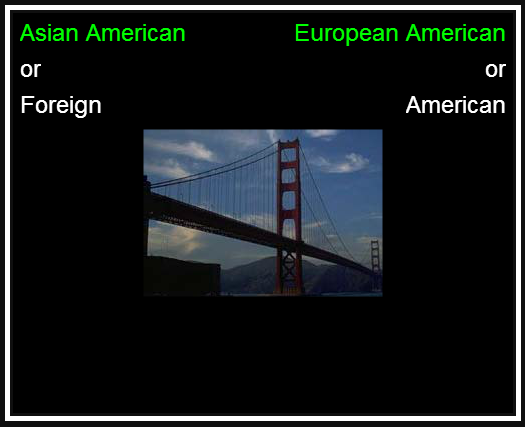
Project Implicit is an online psychological test that measures implicit beliefs, ones we hold that we’re not necessarily conscious of holding.  One test is of the association of Asian-ness with American-ness.  It works by measuring how long it takes us to sort Asian and European faces and American and Foreign famous sites into the proper categories.

First they ask you to sort faces and places with Asian and Foreign together on the left and European and American together on the right. Like this:

Screenshot_2Then they switch the bottom designations so that Asian and American are on one side and European and Foreign are on the other.  For most people, the harms their ability to sort faces and places: it slows down and includes more errors, revealing that their brain implicitly sees Asian and foreign as one category and American and European as another.

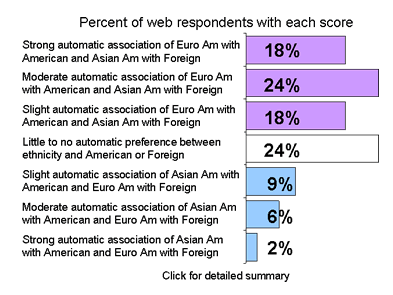
Here’s the aggregate data.  Almost a quarter of people make no association either way, 60% implicitly believe that Asians are less American than Europeans, and 17% think the opposite.

Screenshot_3The take home message is: even though it’s easy to condemn the twits making overtly racist comments, this is a problem that is much more pervasive and pernicious.  Even those of us who are horrified by those tweets likely carry the bias behind them.

Cross-posted at Pacific Standard.

Lisa Wade, PhD is an Associate Professor at Tulane University. She is the author of American Hookup, a book about college sexual culture; a textbook about gender; and a forthcoming introductory text: Terrible Magnificent Sociology. You can follow her on Twitter and Instagram.