Search results for The

We’re celebrating the end of the year with our most popular posts from 2013, plus a few of our favorites tossed in.  Enjoy!

Hip-hop music is frequently described as violent and anti-law enforcement, with the implication that its artists glorify criminality.  A new content analysis subtitled “Hip-Hop Artists’ Perceptions of Criminal Justice“, by criminologists Kevin Steinmetz and Howard Henderson, challenge this conclusion.

After an analysis of a random sample of hip-hop songs released on platinum-selling albums between 2000 and 2010, Steinmetz and Henderson concluded that the main law enforcement-related themes in hip-hop are not pleasure and pride in aggressive and criminal acts, but the unfairness of the criminal justice system and the powerlessness felt by those targeted by it.

Lyrics about law enforcement, for example, frequently portrayed cops as predators exercising an illegitimate power.  Imprisonment, likewise, was blamed for weakening familial and community relationships and described a modern method of oppression.
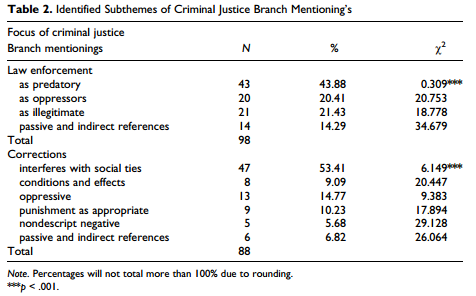
Their analysis refutes the idea that hip-hop performers are embracing negative stereotypes of African American men in order to sell albums.  Instead, it suggests that the genre retains the politicized messages that it was born with.

Steinmetz and Henderson offer Tupac’s “Crooked Nigga Too” (2004) as an example of a rap that emphasizes how urban Black men are treated unfairly by police.

Yo, why I got beef with police?
Ain’t that a bitch that motherfuckers got a beef with me
They make it hard for me to sleep
I wake up at the slightest peep, and my sheets are three feet deep.

The authors explain:

Police action perceived as hostile and unfair engenders an equally hostile and indignant response from Tupac, indicating a tremendous amount of disrespect for the police.

Likewise, Jay-Z, in “Pray” (2007), raps about cops who keep drugs confiscated from a dealer, emphasizing a “power dynamic in which the dealer was unfairly taken advantage of but was unable to seek redress”:

The same BM [‘‘big mover’’—a drug dealer] is pulled over by the boys dressed blue
they had their guns drawn screaming, “just move or is there something else you suggest we can do?”
He made his way to the trunk
opened it like, “huh?”
A treasure chest was removed
cops said he’ll be back next monthwhat we call corrupt, he calls payin’ dues

Henderson offers Jay-Z’s “Minority Report” as a great overall example.

Of course, the rappers — in their collective wisdom — are absolutely correct to suspect that the treatment that their communities receive from the police, corrections, and courts are unfair.  People of African descent are routinely targeted by police (see the examples of New York City and Toronto), even though racial profiling doesn’t work; Blacks are are more likely to be arrested and sentenced than Whites, regardless of actual crime rates; schools and juvenile detention systems are increasingly intertwined in inner citiesimprisonment tears families apart, disproportionately harming families of color; and even Black children don’t trust the police.

Steinmetz and Henderson conclude:

We actually found that the overwhelming message in hip-hop wasn’t that the rappers disliked the idea of justice, but they disliked the way it was being implemented.

These communities, then, have a strong sense of justice… rooted in the sense that they’re not getting any.

Cross-posted at Racialicious and PolicyMic.

Lisa Wade, PhD is an Associate Professor at Tulane University. She is the author of American Hookup, a book about college sexual culture; a textbook about gender; and a forthcoming introductory text: Terrible Magnificent Sociology. You can follow her on Twitter and Instagram.
We’re celebrating the end of the year with our most popular posts from 2013, plus a few of our favorites tossed in.  Enjoy!

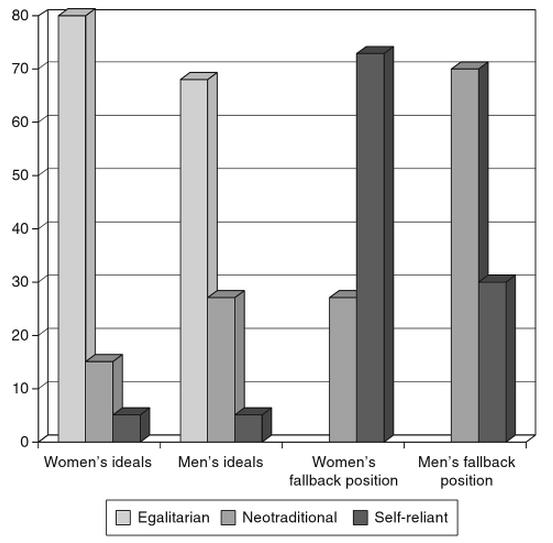
Here’s some great news.  The vast majority of young people — about 80% of women and 70% of men across all races, classes, and family backgrounds — desire an egalitarian marriage in which both partners share breadwinning, housekeeping, and child rearing.  The data come from Kathleen Gerson‘s fabulous 2010 book, The Unfinished Revolution.

In practice, however, egalitarian relationships are difficult to establish.  Both work and family are “greedy institutions,” ones that take up lots of time and energy.  Many couples find that, once children arrive, it’s impossible for both to do both with equal gusto.

With this in mind, Gerson asked her respondents what type of family they would like if, for whatever reason, they couldn’t sustain an equal partnership.  She discovered that, while men’s and women’s ideals are very similar, their fallback positions deviate dramatically.

Men’s most common fallback position is to establish a neotraditional division of labor: 70% hope to convince their wives to de-prioritize their careers and focus on homemaking and raising children.  Women?  Faced with a husband who wants them to be a housewife or work part-time, almost three-quarters of women say they would choose divorce and raise their kids alone.  In fact, despite men’s insistence on being breadwinners, women are more likely than men to say they value success in a high-paying career.

Look at this absolutely stunning data (matching ideals on the left; clashing fallback positions on the right):

One of Gerson’s interviewees, Matthew, exemplifies the egalitarian willing to fallback on a neotraditional family form:

If I could have the ideal world, I’d like to have a partner who’s making as much as I am—someone who’s ambitious and likes to achieve.  [But] if it can’t be equal, I would be the breadwinner and be there for helping with homework at night.

And this is what women think of that:

My mother’s such a leftover from the fifties and did everything for my father. I’m not planning to fall into that trap. I’m really not willing to take that from any guy at all.

Alas, what appears to be a happy convergence between men’s and women’s ideals — both are egalitarians — can turn into an intractable situation: a man who won’t give up his role as the breadwinner and a woman who would rather do anything than be a housewife.

Cross-posted at Ms.PolicyMic, Footnote, and The Huffington Post.

Lisa Wade, PhD is an Associate Professor at Tulane University. She is the author of American Hookup, a book about college sexual culture; a textbook about gender; and a forthcoming introductory text: Terrible Magnificent Sociology. You can follow her on Twitter and Instagram.

We’re celebrating the end of the year with our most popular posts from 2013, plus a few of our favorites tossed in.  Enjoy!

Over at his blog, The Ethical Adman, Tom Megginson asks us to consider the “power symbolism of fellatio.”  His post was prompted by this sign for an Android store (next door to an Apple store) in China:

Get it? Apple is fellating Android, so Apple is inferior. <sarcasm> Obvious right? </sarcasm>

The variations on the insult “you suck” — “suck it,” “suck my balls,” “suck my dick,” “cocksucker,” and Tom’s colorful addition, “this sucks donkey balls!” — are so commonplace that it’s easy to forget where it comes from.  Like the sign implies, and the more elaborate insults make clear, “you suck” works as an insult by positioning the male or female receiver in a position in which they are sexually servicing a man.

This cultural association of power and sex is pervasive throughout our insult vocabulary.  “Fuck you” is an excellent example, as is “fuck off,” “motherfucker,” and “go fuck yourself.”  Sexualized body parts used as insults are part of this too: “cunt,” “pussy,” “dick,” and “prick.”  “Scumbag” is a word that originally meant condom and suggests that sperm is somehow contaminating; sexual partners who receive or are covered with sperm can be seen as exposed to a disgusting or filthy substance.  Even “douchbag” may fall into this category (think about it).

People get pretty creative (or not) with this stuff.  Here’s one of my very favorite pieces of hate mail (in response to this post):

Just a tipoff, to let you filthy feminazi CUNTS know that we are exposing you, you fucking pieces of shit… see [name and organization redacted], a leading men’s rights magazine site, and boy does it expose you and your fucking feminazi cunt blog for what you are…. nothing but awful screaming feminazi harpy cunts who need to suck a dick and calm down… you evil twats…

Aside from this tipoff, all I will say to such feminazi CUNTS like you is, suck my fucking dick you awful feminazi cunts. FUCK I HATE YOU, AND EVERYTHING YOU STAND FOR!!!!! DOWN WITH FEMINAZI COCKSUCKING CUNTS WHO I HOPE GET BREAST CANCER.

So it’s interesting, right, to notice how often attempts to hurt other people come in the language of sexuality.  This reveals why sex can be scary, especially for women who are so often positioned as the one who “gets fucked.”  And this, of course, is what rape is all-too-often about.  It’s also part of how we demean and marginalize gay and bisexual men.  In the language of sex/power, they’ve voluntarily made themselves into lesser human beings, making homophobes feel justified in denigrating or assaulting them.

For my part, I try to avoid all of this language and I encourage you to do so too.

Lisa Wade, PhD is an Associate Professor at Tulane University. She is the author of American Hookup, a book about college sexual culture; a textbook about gender; and a forthcoming introductory text: Terrible Magnificent Sociology. You can follow her on Twitter and Instagram.
We’re celebrating the end of the year with our most popular posts from 2013, plus a few of our favorites tossed in.  Enjoy!

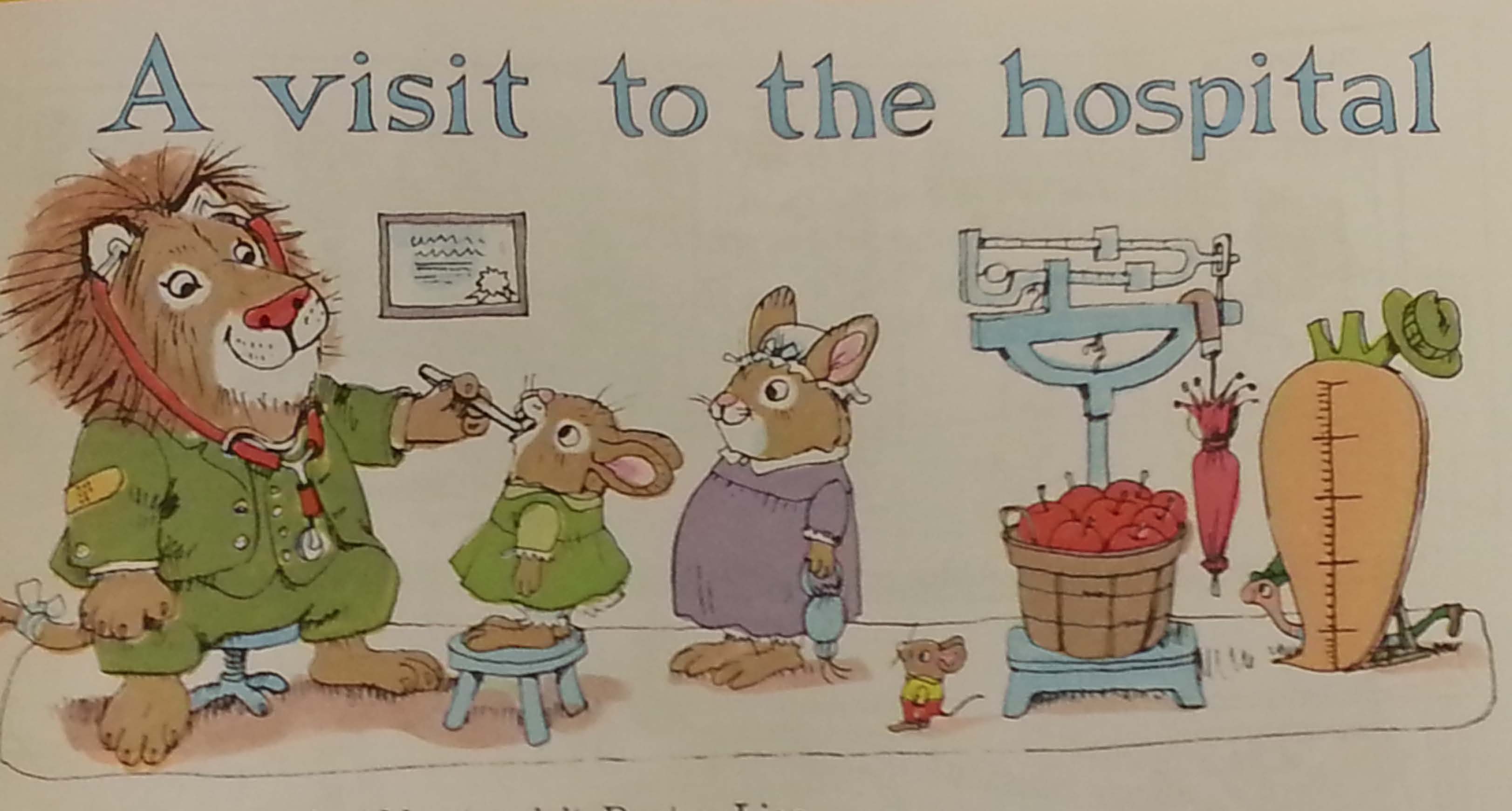
As children, many of us encountered Richard Scarry’s book, What Do People Do all Day?  A classic kid’s book, it uses animals to represent the division of labor that exists in “Busytown.”  The book is an example of a brilliant piece of analysis by sociologist John Levi Martin.

To oversimplify greatly: Martin analyzes nearly 300 children’s books and finds that there is a marked tendency for these texts to represent certain animals in particular kinds of jobs. Jobs that allow the occupant to exercise authority over others tend to be held by predatory animals (especially foxes), but never by “lower” animals (mice or pigs).

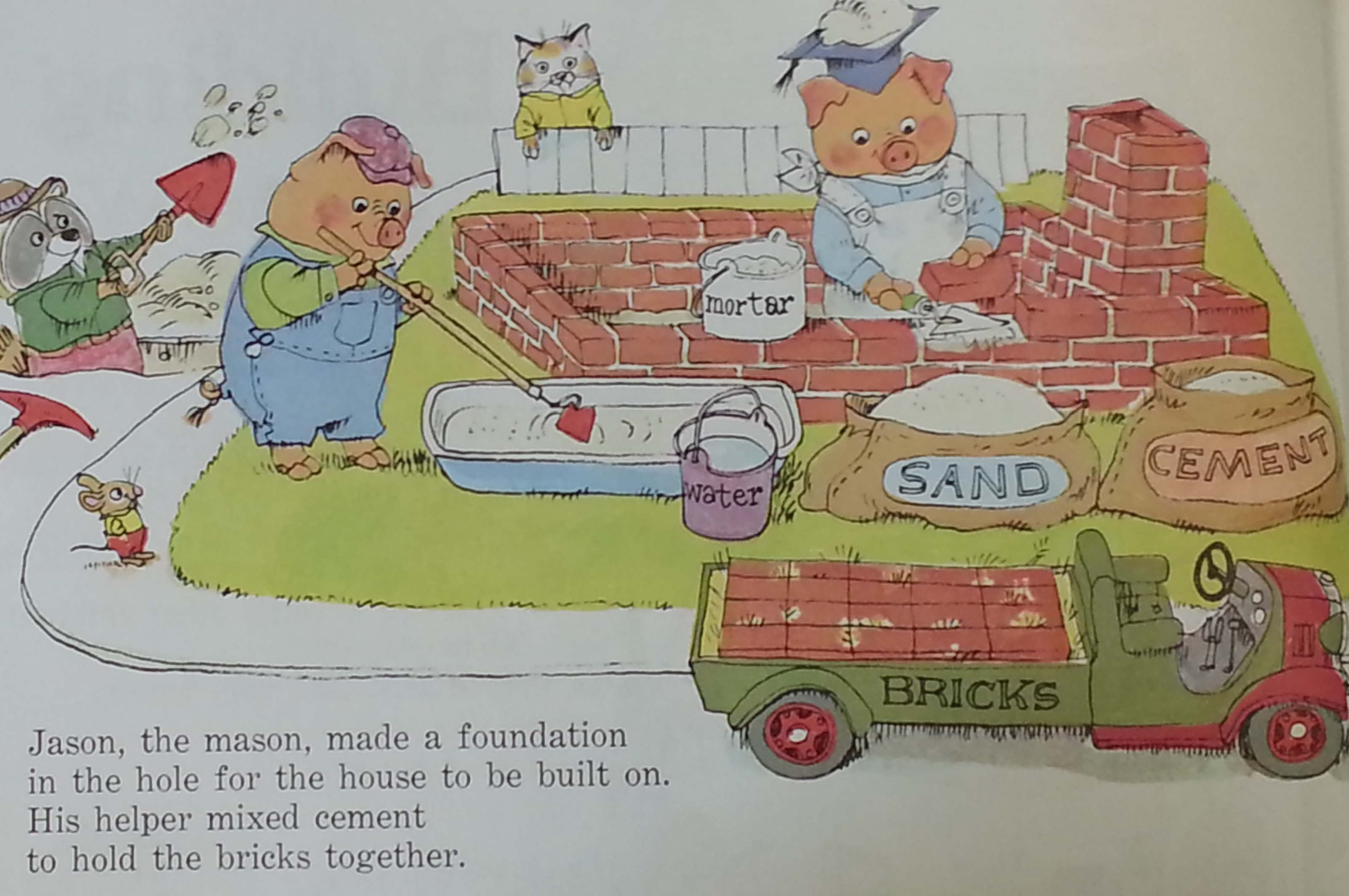
Pigs in particular are substantially over-represented in subordinate jobs (those with low skill and no authority), where their overweight bodies and (judging from the plots of these books) congenital stupidity seems to “naturally” equip them for subservient jobs. Here, see this additional image from Scarry’s book, showing construction work being performed by the above-mentioned swine.

In effect, Martin’s point is that there is a hidden language or code inscribed in children’s books, which teaches kids to view inequalities within the division of labor as a “natural” fact of life  — that is, as a reflection of the inherent characteristics of the workers themselves.  Young readers learn (without realizing it, of course) that some species-beings are simply better equipped to hold manual or service jobs, while other creatures ought to be professionals. Once this code is acquired by pre-school children, he suggests, it becomes exceedingly difficult to unlearn.  As adults, then, we are already predisposed to accept the hierarchical, caste-based system of labor that characterizes the American workplace.

Steven Vallas is a professor of sociology at Northeastern University.  He specializes in the sociology of work and employment.  His most recent book, Work: A Critique, offers an overview and discussion of the sociological literatures on the topic.  You can follow Steven at the blog Work in Progress.

Cross-posted at Work in Progress.

We’re celebrating the end of the year with our most popular posts from 2013, plus a few of our favorites tossed in.  Enjoy!

Philosopher Sandra Lee Bartky once observed that being feminine often means using one’s body to portray powerlessness.  Consider: A feminine person keeps her body small and contained; she makes sure that it doesn’t take up to much space or impose itself.  She walks and sits in tightly packaged ways.  She doesn’t cover the breadth of the sidewalk or expand herself beyond the chair she occupies. This comic from Chaos Life illustrates the point well..

Likewise, burping and farting, raising one’s voice in an argument, and even laughing loudly are considered distinctly unfeminine.  A feminine person doesn’t use her body to forcefully interact with the world, she lets others do for her when possible.  “Massiveness, power, or abundance in a woman’s body is met with distaste,” Bartky wrote.

Stunningly, when you think about it, these features of feminine body comportment are, in fact, not uniquely feminine, but associated with deference more generally.  Bartky again:

In groups of men, those with higher status typically assume looser and more relaxed postures; the boss lounges comfortably behind the desk while the applicant sits tense and rigid on the edge of his seat.  Higher-status individuals may touch their subordinates more than they themselves get touched; they initiate more eye contact and are smiled at by their inferiors more than they are observed to smile in return.  What is announced in the comportment of superiors is confidence and ease…

Acting feminine, then, overlaps with performances of submissiveness.  Both men and women use their bodies in more feminine ways when their interacting with a superior, whether it be their boss, their commander, a police officer, or their professor.

New evidence suggests that this is not pure theory.  Psychologist Andy Yap and his colleagues tested whether “expansive body postures” like the ones associated with masculinity increase people’s sense of powerfulness and entitlement.  They did.  In laboratory experiments, people who were prompted to take up more space were more likely to steal, cheat, and violate traffic laws in a simulation.  A sense of powerfulness, reported by the subjects, mediated the effect (a robust finding that others have documented as well).

In a real world test of the theory, they found that large automobiles with greater internal space were more likely than small ones to be illegally parked in New York City.

Research, then, has shown that expansive body postures that take up room instill a psychological sense of power and entitlement.  The fact that this behavior is gendered may go some way towards explaining the persistence of gender inequality and, more pointedly, some men’s belief that they have earned their unearned privileges.

Cross-posted at Jezebel and Pacific Standard.

Lisa Wade, PhD is an Associate Professor at Tulane University. She is the author of American Hookup, a book about college sexual culture; a textbook about gender; and a forthcoming introductory text: Terrible Magnificent Sociology. You can follow her on Twitter and Instagram.
We’re celebrating the end of the year with our most popular posts from 2013, plus a few of our favorites tossed in.  Enjoy!

Studying up on the literature on gun marketing for a recent interview with the New York Times, I found a 2004 article on the topic with some really interesting findings.

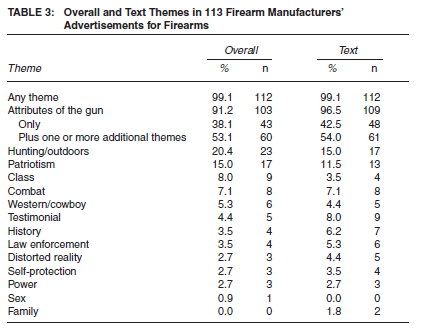
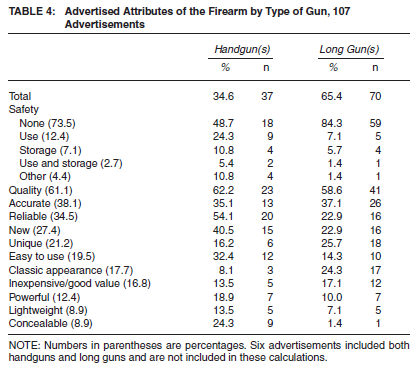
The study — by public health scholar Elizabeth Saylor and two colleagues — asked what tactics marketers use to sell guns in a single month of advertising.  In contrast to what you might imagine, only a small minority of gun ads emphasized self-protection (3%) or a Western cowboy lifestyle (5%). Zero percent mentioned protecting one’s family. Only 15% of gun ads linked ownership to patriotism.  The most common substantive theme was hunting, but even that was a theme in only 20% of ads.

So what are gun advertisers highlighting in their ads?  Technical attributes.  The majority of gun ads (91%) emphasize the things that make one gun different from the next.  For example, they discuss the quality of the gun (61%), its accuracy (38%) and reliability (35%), and its innovative features (27%) and uniqueness (21%).

Why are gun manufacturers using this marketing strategy?

Here’s where the statistics get really interesting.  At the time of the study, 44 million Americans owned firearms.  Three-quarters of these owned more than one gun. In fact, 20% of gun owners are in possession of 55% of all guns (excluding law enforcement and military).

In other words, guns are not evenly distributed across the U.S. population, they are concentrated in the hands of a minority.  Most people that don’t own a gun are never going to buy one, so the best strategy for gun manufacturers is to convince people that they need lots of guns.  Differentiating the technical attributes of one from another is their way of telling the buyer that any given gun will do something different for them than the guns they already have, enticing the gun owner to own a range of guns instead of just one.

Cross-posted at iVoter.

Lisa Wade, PhD is an Associate Professor at Tulane University. She is the author of American Hookup, a book about college sexual culture; a textbook about gender; and a forthcoming introductory text: Terrible Magnificent Sociology. You can follow her on Twitter and Instagram.
We’re celebrating the end of the year with our most popular posts from 2013, plus a few of our favorites tossed in.  Enjoy!

We’ve seen a real shift in support for the issue and acceptance of homosexuality in general.  Since 2011, the majority of Americans are in favor of extending marriage to same-sex couples and the trend has continued.

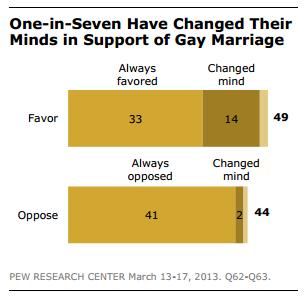
What is behind that change?  The Pew Research Center asked 1,501 respondents whether they’d changed their minds about same-sex marriage and why.  Here’s what they found.

The overall trend towards increasing support is clear in the data.  Fourteen percent of Americans say that they used to oppose same-sex marriage, but they now support it.  Only 2% changed their mind in the other direction.

2

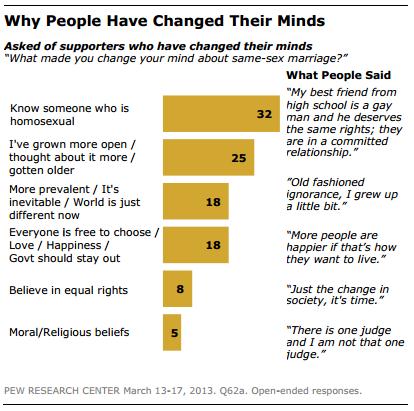
People offered a range of reasons for why they changed their minds.  The most common response involved coming into contact with someone that they learned was homosexual.  A third of respondents said that knowing a gay, lesbian, or bisexual person was influential in making them rethink their position on gay marriage.  This is consistent with the Contact Hypothesis, the idea that (positive) experiences with someone we fear or dislike will result in changes of opinion.

3

As you can see, lots of other reasons were common too.  A quarter of people said that they, well, “evolved”:  they grew up, thought about it more, or more clearly.  Nearly as many said that they were simply changing with the times or that a belief that everyone should be free to do what they want was more important than restricting the right to marry.

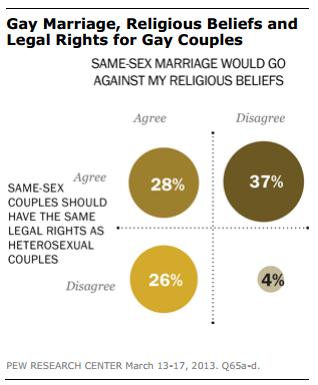
I thought that the 5% that said they’d changed their minds for religious reasons were especially interesting.  Support for same-sex marriage is rising in every demographic, even among the religious.  Following up on this, Pew offers an additional peek into the minds of believers.  The table below shows that 37% of the religious  both believe that same-sex marriage is compatible with their belief and support it, but an additional 28% who think marriage rights would violate their religious belief are in favor of extending those rights nonetheless.

1


While we’ve been following the trend lines for several years, it’s really interesting to learn what’s behind the change in opinion about same-sex marriage.  Contact with actual gay people — and probably lovable gay and lesbian celebrities like Ellen and Neil Patrick Harris — appears to be changing minds. But the overall trend reflects real shifts in American values about being “open,” valuing “freedom” and “choice,” extending “rights,” and accepting that this is the way it is, even if one personally doesn’t like it.

Cross-posted at BlogHer and Pacific Standard.

Lisa Wade, PhD is an Associate Professor at Tulane University. She is the author of American Hookup, a book about college sexual culture; a textbook about gender; and a forthcoming introductory text: Terrible Magnificent Sociology. You can follow her on Twitter and Instagram.
We’re celebrating the end of the year with our most popular posts from 2013, plus a few of our favorites tossed in.  Enjoy!

Like many people, I’ve been following news about the crash landing in San Francisco. It’s a frightening reminder of the risks that come with air travel, but an uplifting one thanks to the small number of casualties.  The Mayor of San Francisco was quoted saying: “We’re lucky we have this many survivors.”  And the Chief of the San Francisco Fire Department said that it was “nothing short of a miracle…”  At CNN, after mentioning the two confirmed fatalities, the reporter writes, “Somehow, 305 others survived.” Sheryl Sandberg, COO of Facebook, wrote that it was a “serious moment to give thanks.”  But to whom?

Screenshot_1

There’s a kind of person who is trained to maximize survival in the case of a plane crash: the flight attendant.  Airlines don’t advertise the intense training their flight attendants receive because it reminds potential passengers that air travel is risky.  As a result, most people seriously underestimate the skills flight attendants bring on board and the dedication they have to the safety of their passengers.

Flight attendants have to learn hundreds of regulations and know the safety features of all of the aircraft in their airline’s fleet. They must know how to evacuate the plane on land or sea within 90 seconds; fight fires 35,000 feet in the air; keep a heart attack or stroke victim alive; calm an anxious, aggressive, or mentally ill passenger; respond to hijackings and terrorist attacks; and ensure group survival in the jungle, sea, desert, or arctic.

It isn’t just book learning; they train in “live fire pits” and “ditching pools.”As one flight attendant once said:

I don’t think of myself as a sex symbol or a servant. I think of myself as somebody who knows how to open the door of a 747 in the dark, upside down and in the water (source).

This is why I’m surprised to see almost no discussion of the flight attendants’ role in this “miracle.” Consider the top five news stories on Google at the time I’m writing: CNNFoxCBS, the Chicago Tribune, and USA Today.  These articles use passive language to describe the evacuation: “slides had deployed”; all passengers “managed to get off.”  When the cabin crew are mentioned, they appear alongside and equivalent to the passengers: the crash forced “dozens of frightened passengers and crew to scamper from the heavily damaged aircraft”; “passengers and crew were being treated” at local hospitals.

Only one of these five stories, at Fox, acknowledges that the 16 cabin crew members worked through the crash and its aftermath.  The story mentions that, while passengers who could were fleeing the plane, crew remained behind to help people who were trapped, slashing seat belts with knives supplied by police officers on the ground.  The plane was going up in flames; they risked their lives to save others.

I don’t know what the flight attendants on this plane did or didn’t do to minimize injuries or save lives, but I would like to know.  Instead, they are invisible in these news stories as workers, allowing readers and future passengers to remain ignorant of the skills and dedication they bring to their work.

Cross-posted at JezebelPolicyMic, Huffington Post, and BlogHer.

Lisa Wade, PhD is an Associate Professor at Tulane University. She is the author of American Hookup, a book about college sexual culture; a textbook about gender; and a forthcoming introductory text: Terrible Magnificent Sociology. You can follow her on Twitter and Instagram.