Search results for The

What separates those with a criminal record from the rest of the population?  According to lawyer Emily Baxter, not a whole lot.  Baxter’s new project “We Are All Criminals” examines the illegal activities committed by people without a criminal record.  In Minnesota, 1 out of 4 residents has a criminal record, but Baxter’s project, she says on her website, is about the 75% that “got away, and how very different their lives may have been had they been caught.”

By emphasizing the crimes of the unconvicted, Baxter blurs the lines between criminal and noncriminal and draws attention to the detrimental effects that a criminal record has on the lives of those who are convicted.  Many of the undocumented and unpunished transgressions confessed through her project were committed when the perpetrators were juveniles, many of whom are now lawyers, doctors, and professionals.

Executive director of the Legal Rights Center in Minneapolis Michael Friedman is intrigued by the project, saying:

“I don’t think I’ve come across anybody who has not committed crimes as a juvenile,” Friedman said. “Allowing society to use juvenile criminal records as a marker for someone’s potential success, or risk for employment or opportunity, is not scientific. It’s dangerous and discriminatory.”

The most intriguing part of her project lies in its look at society as a whole.  Imagine if we had all been prosecuted for every crime we committed, even as a juvenile.  What would the crime rate look like then?

The author, Kat Albrecht, is an editorial assistant for The Society Pages. She is currently an undergraduate student in the department of sociology at the University of Minnesota. The artist, Emily Baxter, is the Director of Public Policy and Advocacy at the Council on Crime and Justice.  Cross-posted at Citings and Sightings.

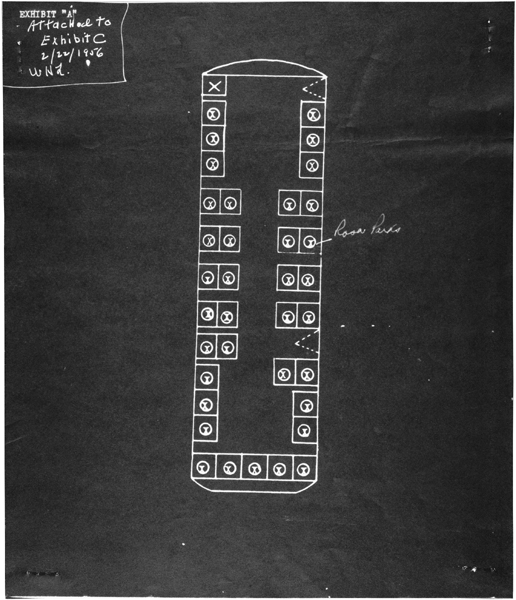
Fifty eight years ago today, Rosa Parks kicked off a plan to bring down Jim Crow segregation by refusing to move to the back of the bus.  @ShawneeSoc sent us a link to the Washington Post, where they featured her original arrest documents.  A very cool piece of history.

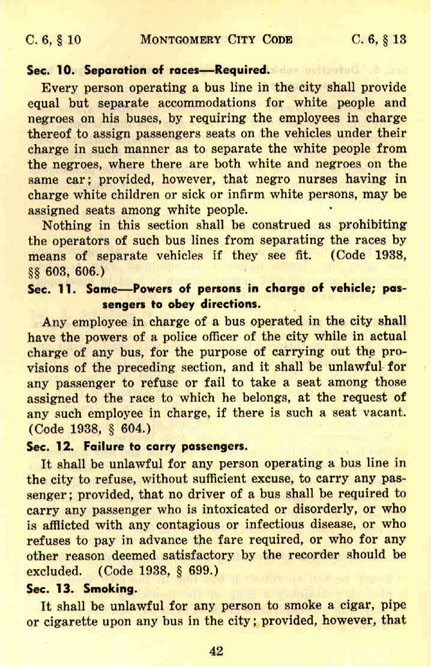
rosa-parks rosa-parks-busBonus, here’s the law that Parks was arrested for violating and an explanation (thanks to Martín A. for the link):

Montgomery-City-Code


Lisa Wade, PhD is an Associate Professor at Tulane University. She is the author of American Hookup, a book about college sexual culture; a textbook about gender; and a forthcoming introductory text: Terrible Magnificent Sociology. You can follow her on Twitter and Instagram.

This summer I went hiking several times in California’s Eastern Sierra. Each time I went I counted the number of male to female hikers and ended up with a 5:1 ratio. This reflects many women’s experience of the wilderness and outdoor sports such as rock climbing or mountaineering. These are male-dominated arenas.

One of the reasons for that is because these activities are advertised to women as an escape from their stressful lives, not as a sport meant to challenge their physical ability. Outdoors equipment marketed towards women, then, consistently focuses on comfort and style, in contrast to men’s marketing. Moreover, much of the gear that is produced for women assumes less of a desire to do activities that are as physically demanding as men — the gear is often less hardy and more decorative.  The assumptions behind these marketing strategies reinforce stereotypical ideas of gender: that women are physically weak, that women are fascinated by fashion, that there is one specific female body type, and that women are “soft.”

Exhibit #1: Women’s backpacks

Osprey is generally acknowledged as the maker of the best backpacks for hiking and backpacking. Their top-of-the-line backpack for long multi-day backpack trips for men, the Xenith, can hold 105 L and between 60-80 lbs. The women’s pack, the Xena, on the other hand, can hold 85 L and between 50-70 lbs. This is because the women’s pack is shorter. Osprey is betting that most women have a shorter torso and thus need a shorter pack. While this might be true for some women, they could attempt to engineer another type of pack that would allow women to carry the same poundage as men. Moreover, it is unclear why these packs are labeled “men’s and women’s.” Plenty of women have longer torsos and men shorter ones. And, indeed, on backpacking forums on the internet, you constantly see stories of people buying gear of the “wrong sex” so that it actually fits.

Exhibit #2: Choose your sex!

Many hikers and backpackers buy gear online and oftentimes the structure of the websites of the major companies who sell gear reveals the companies’ assumptions about the interests of their consumers. Some, such as Arc’teryx, open their websites with gender distinctions. One must choose men’s or women’s products immediately upon going to their site. Other companies, such as REI, open their site with the opportunity to choose an activity, such as hiking, climbing, cycling, running, etc. or sex category, which is better. By so dividing their products, Arc’teryx is making it harder for those who need to buy gear from the “wrong” sex or to market unisex gear while REI is making consumers feel part of a larger community of climbers or backpackers or hikers.

ArcteryxSite-Ex2

Exhibit #3: Playful gear

The marketing of backpacking gear is itself highly gendered, with women’s gear being presented as comfortable and stylish. Oddly, it is not marketed with an eye towards serious wilderness excursions. Take, for example, the Yumalina pant manufactured by Mountain Hardwear. The men’s version is described as “Durable softshell seriously protects on the outside, while lightweight fleece on the inside keeps you warm on those chilly hikes” while the women’s version is described as “Serious on the outside and soft on fuzzy on the inside. Perfect for work or play during the winter.” The women’s pant is thus not seen as for someone who is serious about backpacking.

Exhibit #4: Decorative, sexy climbing

The naming and color palette of much women’s gear also reflects the idea in the backpacking industry that women needed to be treated delicately. Black Diamond, which manufactures popular rock climbing harnesses, has named their women’s harnesses “Primrose,” “Siren,” “Aura,” and “Lotus,” emphasizing the stereotypical connection between women and flowers and sexuality. Women are connected to passive agents. The harnesses themselves are typically in pastel colors as well. This is in contrast to the men’s harnesses, which are named “Chaos,” “Focus,” “Flight,” and “Momentum,” which are strikingly active words in comparison and are designed in bright, bold colors.

Screenshot_10

As Brendan Leonard points out in his post, Girly Girls and Manly Men, “No company feels like they have to do anything special to men’s gear, or ‘masculinize it’ it. Yoga is arguably maybe the most feminine (or just female-dominated) of any active pursuit, but you don’t see any companies making yoga mats with patterns on them that look like cascades of hammers or football helmets or beer mugs, to encourage men by saying, ‘It’s OK, dude. You can own one of these and still love Home Depot.’” Why do companies thus feel that women cannot be serious backpackers, hikers or climbers without feminized gear?

Cross-posted at The Huffington Post.

Adrianne Wadewitz, PhD is a Mellon Digital Scholarship Postdoctoral Fellow at Occidental College specializing in emerging media from the 18th-century to the present. Peter James is an avid outdoor photographer and wilderness traveler.  You can follow them at @wadewitz and @PBJmaesPhoto.

The current economic recovery officially began June 2009 and is one of the weakest in the post-World War II period.  This is true by almost every indicator, except growth in profits.

One reason it has offered working people so little is the contraction of government spending and employment.  This may sound strange given the steady drumbeat of articles and speeches demanding a further retrenchment of government involvement in the economy, but the fact is that this drumbeat is masking the reality of the situation.

The figure shows the growth in real spending by federal, state, and local governments in the years before and after recessions.  The black line shows the average change in public spending over the six business cycles between 1948 and 1980.  Each blue line shows government spending for a different recent business cycle and the red line does the same for our current cycle.  As you can see, this expansionary period stands out for having the slowest growth in public spending.  In fact, in contrast to other recovery periods, public spending is actually declining.

government spending

According to Josh Bivens:

…public spending following the Great Recession is the slowest on record, and as of the second quarter of 2013 stood roughly 15 percent below what it would have been had it simply matched historical averages… if public spending since 2009 had matched typical business cycles, this spending would be roughly $550 billion higher today, and more than 5 million additional people would have jobs (and most of these would be in the private sector).

The basic stagnation in government spending has actually translated into a significant contraction in public employment.  This figure highlights just how serious the trend is by comparing public sector job growth in the current recovery to the three prior recovery periods.

figure21

As Josh Bivens and Heidi Shierholz explain:

…the public sector has shed 737,000 jobs since June 2009. However, this raw job-loss figure radically understates the drag of public-sector employment relative to how this sector has normally performed during economic recoveries… [P]ublic-sector employment should naturally grow as the overall population grows. Between 1989 and 2007, for example, the ratio of public employment to overall population was remarkably stable at roughly 7.3 public sector workers for each 100 members of the population. Today’s ratio is 6.9, and if it stood at the historic average of 7.3 instead, we would have 1.3 million more public sector jobs today.

In short, the challenge we face is not deciding between alternative ways to further shrink the public sector but rather of designing and building support for well financed public programs to restructure our economy and generate living wage jobs.

Martin Hart-Landsberg is a professor of economics at Lewis and Clark College. You can follow him at Reports from the Economic Front.

olden days a glimpse of stocking
Was looked on as something shocking,
But now lord knows —
Anything goes.

— Cole Porter, 1934

Poor Richard Cohen, columnist for the Washington Post. He’s being raked over the liberal coals for this recent observation:

Today’s GOP is not racist, as Harry Belafonte alleged about the tea party, but it is deeply troubled – about the expansion of government, about immigration, about secularism, about the mainstreaming of what used to be the avant-garde. People with conventional views must repress a gag reflex when considering the mayor-elect of New York – a white man married to a black woman and with two biracial children. (Should I mention that Bill de Blasio’s wife, Chirlane McCray, used to be a lesbian?) This family represents the cultural changes that have enveloped parts – but not all – of America. To cultural conservatives, this doesn’t look like their country at all.

As Ta-Nehisi Coates points out, gagging at a Black-White couple and their biracial children is, in fact, racist. So let’s focus on the word that Cohen uses to avoid that obvious conclusion – conventional.

Conventional:  conforming or adhering to accepted standards; ordinary rather than different or original.

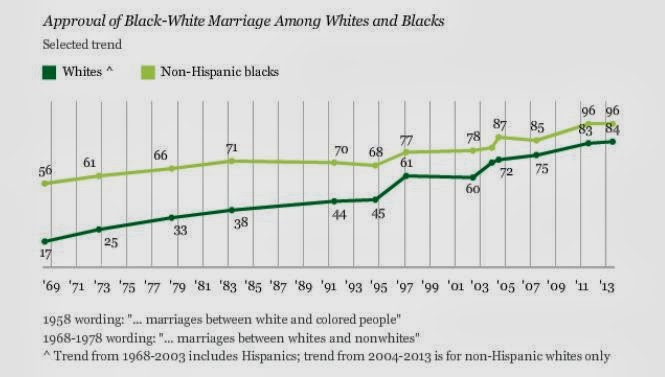
Matthew Yglesias at Slate seizes on that word and those “people with conventional views.” Yglesias too calls Cohen’s column “racist,” but more to the point, he provides some Gallup-poll evidence that interracial marriage is the new conventional.

1

Or as Cole Porter put it in a 1935 production:

When ladies fair who seek affection
Prefer gents of dark complexion
As Romeos —
Anything goes

Porter was bemused; Cohen is troubled. My spider sense tells me that if he’s not actually one of those people with conventional views repressing a gag reflex, he at least feels some strong sympathy for them. But they are on the wrong side of 21st century history, and not only on interracial marriage.  Consider that parenthetical comment:

(Should I mention that Bill de Blasio’s wife, Chirlane McCray, used to be a lesbian?)

First, this is a pretty good example of one of my favorite rhetorical devices, paralipsis (or is it apophasis?) – saying something while saying that you’re not saying it. “To keep this discussion one of principle and not personalities, I won’t even mention that my opponent was arrested for wife-beating and has been linked to the Gambino crime family.”

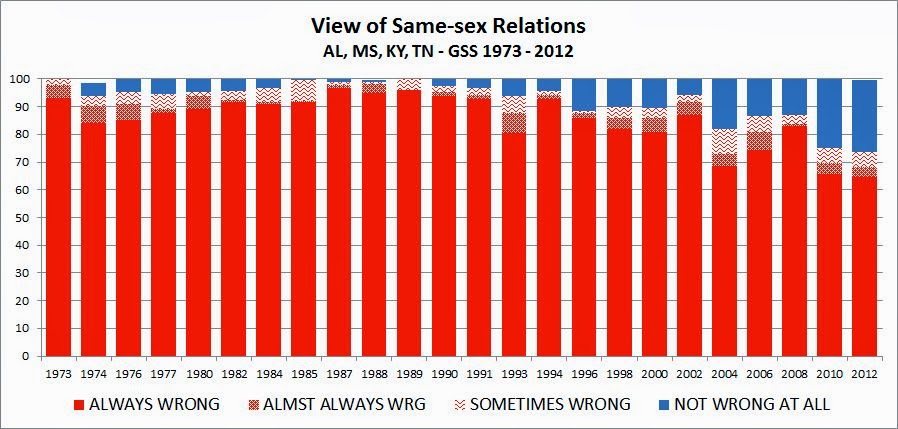
Second, as with interracial marriage, opinion on homosexuality has shifted considerably.  Here’s the GSS data.
2
In less than twenty years, the Always Wrong delegation has shrunk from more than three-fourths to less than half.  As Cohen says, this change has “enveloped” only parts of America.  The gag reflex is still strong in the East South Central, which comprises Alabama, Mississippi, Tennessee, and Kentucky – the most unenveloped (unreconstructed?) of the GSS regions.
3
Despite the recent liberalizing trend, the Always Wrongs outnumber the Never Wrongs by more than two  to one.

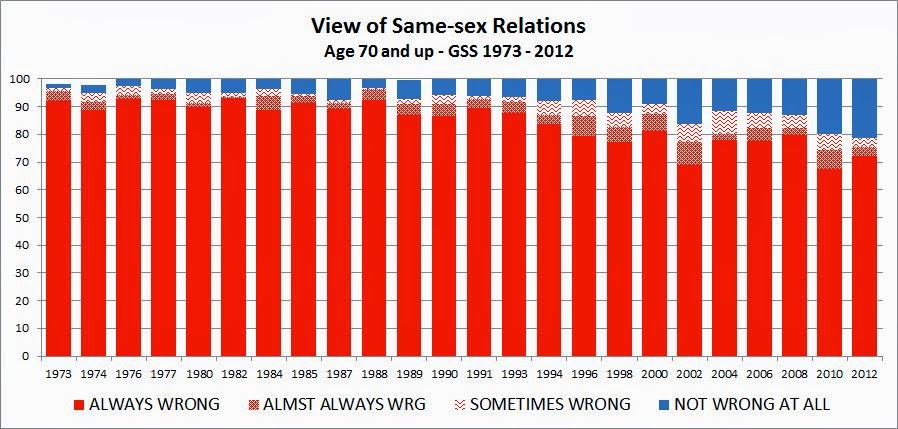
But wait, Cohen is not from the South or Appalachia. Like Bill deBlasio, he’s a New Yorker born and bred. (DeBlasio is from Manhattan, Cohen from Far Rockaway, Queens.)  But there might be one other demographic source of that gag reflex – age.  Cohen is 72.  Here’s how his peers feel about people who share Cole Porter’s sexual orientation.
4
Among septuagenarians and their elders, those gagging at gays have a large 3½-to-1 edge.

Cohen is probably making the mistake that many of us make – projecting our own views as more widely held than they actually are. Journalists may be especially prone to this kind of projection, preferring to write about what “the public” or “the voters” want or think, when simple first-person statements would be more accurate. So when Cohen says, “to cultural conservatives, this doesn’t look like their country at all,” he may be talking about himself and the country he grew up in — Far Rockaway in the forties and fifties.  But in 2013, that Far Rockaway is far away.

Cross-posted at Montclair SocioBlog.

Jay Livingston is the chair of the Sociology Department at Montclair State University. You can follow him at Montclair SocioBlog or on Twitter.

I absolutely love this comic from Robot Hugs!  Yes, people are people!  Or, as Kathryn Dindia once said, “Men are from North Dakota, women are from South Dakota.”

Lisa Wade, PhD is an Associate Professor at Tulane University. She is the author of American Hookup, a book about college sexual culture; a textbook about gender; and a forthcoming introductory text: Terrible Magnificent Sociology. You can follow her on Twitter and Instagram.

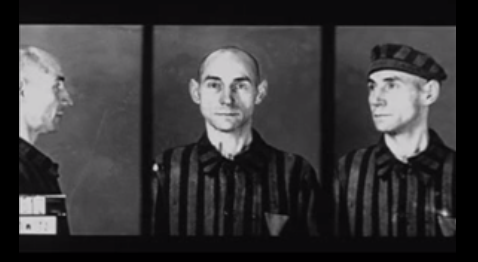
A hundred thousand men and women identified as homosexuals were imprisoned during the Nazi regime. They were detained under a law known as “paragraph 175,” which made sodomy illegal.  Up to 15,000 were sent to concentration camps instead of prisons.  Nearly 2/3rds would die there.  The last surviving victim is believed to have died in 2011.

These men and women were not only victims of Nazi Germany, surviving torture in concentration camps, they were also denied validation as victims of the Third Reich.  They were classified as criminals upon release and included on lists of sex offenders.  Some were re-captured and imprisoned again.

The world went on to mourn the inhumanity of the Holocaust, but not for them.  Because they were designated as non-victims, and also because they were stigmatized sexual minorities, they were largely excluded from the official history of Hitler’s Germany.

Screenshot_1

Seeking to give these men and women a voice, historian Klaus Müller interviewed several gay men and one lesbian around the year 2000.  At the time, there were fewer than 10 left alive.  Not one of the men and women imprisoned for being homosexual — alive or dead — had ever been officially identified as a victim of the Nazi regime.

The documentary, titled Paragraph 175, is one of the most heart-wrenching I’ve ever seen.  For some, it sounds as if this is the first time anyone — even members of their own family — has ever asked them about what happened.  Re-telling the stories of death and torture is obviously incredibly painful, as it would be for any survivor.

On top of this, however, is anger at their extended invisibility and continued oppression.  Many seem opposed to talking about it at all, saying that it’s too painful to re-live, but it is as if they can’t help it; they are at the end of their lives and facing, perhaps, their first and last chance to do so.  In the interviews, the anger, pain, survivor guilt, and relief mix together. It’s excruciating.

I was riveted, even as I desperately wanted to look away so as to avoid the emotions it brought out in me.  I can’t recommend it strongly enough.

Cross-posted at Pacific Standard.

Lisa Wade, PhD is an Associate Professor at Tulane University. She is the author of American Hookup, a book about college sexual culture; a textbook about gender; and a forthcoming introductory text: Terrible Magnificent Sociology. You can follow her on Twitter and Instagram.

Last week Kay Hymowitz (who sometimes works out of a PO Box rented by Brad Wilcox) wrote the following in the LA Times:

As far back as the 1970s, family researchers began noticing that… [b]oys from broken homes were more likely than their peers to get suspended and arrested… And justice experts have long known that juvenile facilities and adult jails overflow with sons from broken families. Liberals often assume that these kinds of social problems result from our stingy support system for single mothers and their children. But the link between criminality and fatherlessness holds even in countries with lavish social welfare systems.

Ah, the link between criminality and fatherlessness again. So ingrained is the assumption that crime rates always go up that conservatives making this argument do not even see the need to account for the incredible, world-historical drop in violence that has accompanied the collapse of the nuclear family. I know Kay Hymowitz knows this, because we’ve argued about it before. But if her editors and readers don’t, why should she make a big deal out of it?

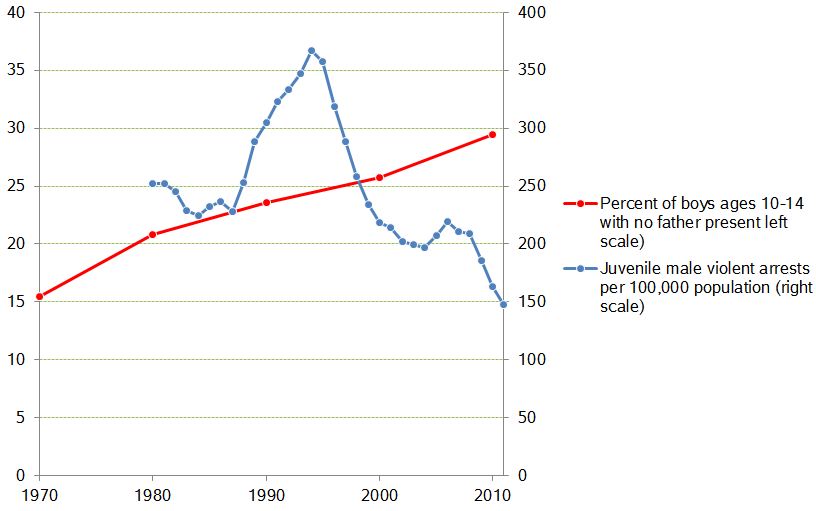
In this graph I show the scales down to zero so you can see the proportional change in each trend: father-not-present boys ages 10-14 and male juvenile violent-crime arrest rates.

1

I’m not arguing about whether boys living without fathers are more likely to commit crimes. I’m just saying that this is very unlikely to be the major cause of male juvenile violent crime if the trends can move so drastically in opposite directions at the same time. These aren’t little fluctuations. Even if you leave out the late-80s-early-90s spike in crime, arrests fell about 40% from 1980 to 2010 while father-absent boys increased almost 50%.

If you are going to argue for a strong association — which Hymowitz does — and use words like “tide,” you should at least acknowledge that the problem you are trumpeting is getting better while the cause you are bemoaning is getting worse.

Cross-posted at Family Inequality.

Philip N. Cohen is a professor of sociology at the University of Maryland, College Park, and writes the blog Family Inequality. You can follow him on Twitter or Facebook.