Search results for The

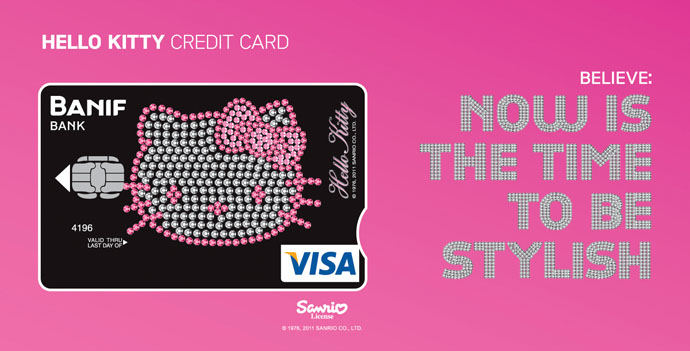
This year marks the 40th anniversary of the Equal Credit Opportunity Act.  This granted women the right to have a credit card in her own name.  This translated into an unprecedented degree of independence for women.  Feminists and their allies fought for this new world and it’s a good thing because we love to buy things with our credit cards sooooooo muuuuuuuuch!

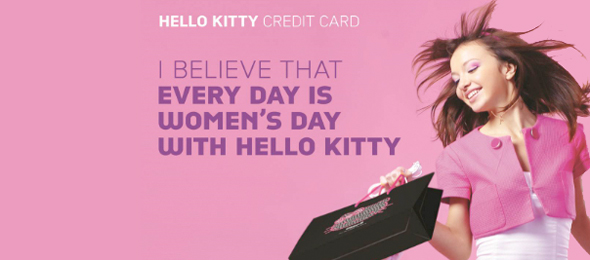
And, thankfully, credit card companies like Banif know just how to make us comfortable, by combining feminism and infantilization and kissing our asses because We. Are. So. Special. “Every day is women’s day!” Wheeeee!
23

The husband in this ad, though, likely thinks he would have been better off if his wife wasn’t allowed to make financial decisions without his approval.  Stupid women and their stupid financial decisions. Ruining everything.

Lisa Wade, PhD is an Associate Professor at Tulane University. She is the author of American Hookup, a book about college sexual culture; a textbook about gender; and a forthcoming introductory text: Terrible Magnificent Sociology. You can follow her on Twitter and Instagram.

In this excellent 6 minute video, CJ Pascoe discusses some of the findings of her widely acclaimed book, Dude, You’re a Fag.  She points out that, while being called “fag” and other terms for people with same sex desires are the most common and most cutting of insults between boys in school, they rarely mean to actually suggest that the target is gay.  Instead, the terms are used to suggest that boys are failing at masculinity.

This, she points out, is not “unique to childhood.”  For this reason, calling it bullying it is probably a distraction from the fact that this doesn’t just happen among kids.  She includes, as an example, a bomb destined for Afghanistan with the phrase “highjack this, fags” written on it by American soldiers.

Kids, then, aren’t in a particularly nasty stage.  They’re “repeating, affirming, investing in all of these norms and expectations that we as adults are handing down.”  If we used more adult language, Pascoe argues, we might do a better job of thinking how we’re teaching boys how to be this way.

A great watch:

Lisa Wade, PhD is an Associate Professor at Tulane University. She is the author of American Hookup, a book about college sexual culture; a textbook about gender; and a forthcoming introductory text: Terrible Magnificent Sociology. You can follow her on Twitter and Instagram.
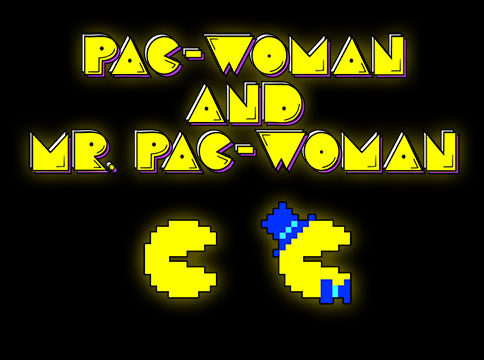
Anita Sarkeesian is back with a new installment in her feminist analysis of video games. This one is a 25 minute discussion of the Ms. Male Character Trope, the phenomenon in which video games spice up their characters by including a female modeled off of the original male character.  It’s a good example of the way in which males are centered, while females, if included at all, are seen as a non-normative kind of human, animal, or thing.

She starts with the classic example of Pac-Man and Mrs. Pac-Man, observing that only Mrs. is marked with symbols of femininity; Pac-Man, who’s not even called Mr. Pac-Man, has no markers at all.  This is typical.  This is how maleness is made simultaneously invisible and front-and-center, while femaleness is othered.  Like this:

Pacman and Mrs Pacman

A fan sent her an example of what a reverse world would look like, where women were the default and men were marked and othered.  Awesome:

2

Here’s the whole video:

Lisa Wade, PhD is an Associate Professor at Tulane University. She is the author of American Hookup, a book about college sexual culture; a textbook about gender; and a forthcoming introductory text: Terrible Magnificent Sociology. You can follow her on Twitter and Instagram.

SureYou absolutely must find three minutes to watch Aamer Rahman defend the idea of reverse racism. Yes, he says, of course reverse racism is possible: “All I would need is a time machine…”  The rest is glorious.

Lisa Wade, PhD is an Associate Professor at Tulane University. She is the author of American Hookup, a book about college sexual culture; a textbook about gender; and a forthcoming introductory text: Terrible Magnificent Sociology. You can follow her on Twitter and Instagram.
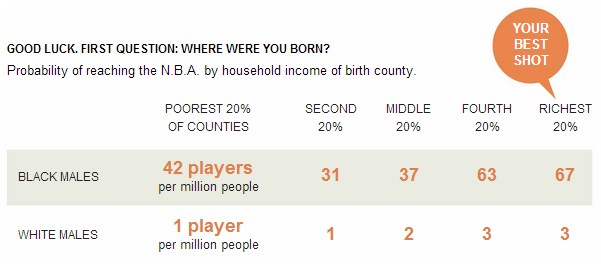
Part of what makes professional basketball appealing, for kids who love to play as well as fans, is the idea that a person can come from humble beginnings and become a star.  The players on the court, the narrative goes, are ones who rose to fame as a result of incredible dedication and extraordinary talent.  Basketball, then, is a way out of poverty, a true equal opportunity sport that affirms what we think America is all about.

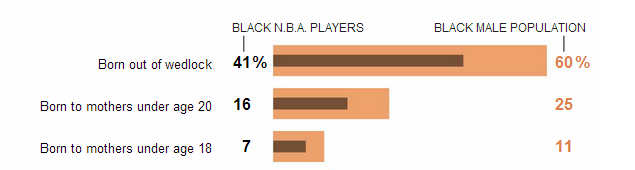
Seth Stephens-Davidowitz crunched the numbers to find out if the equal opportunity story was true.   Analyzing the economic background of NBA players, he found that growing up in a wealthy neighborhood (the top 40% of household incomes) is a “major, positive predictor” for success in professional basketball.  Black players are also less likely than the general black male population to have been born to a young or single mother.  So, class privilege is an advantage for pro ball players, just like it is elsewhere in our economy.

Screenshot_1

.

Screenshot_2

The richest Black men, then, are most likely to end up in the NBA, followed by those in the bottom 20% of neighborhoods by income.  Middle class black men may, like many middle class white men, see college as a more secure route to a successful future.  Research shows that poor black men often see sports as a more realistic route out of poverty than college (and they may not be wrong).  This also helps explain why Jews dominated professional basketball in the first half of the 1900s.

LeBron James was right, then, when he said, “I’m LeBron James. From Akron, Ohio. From the inner city. I am not even supposed to be here.”  The final phrase disrupts our mythology about professional basketball: that being poor isn’t an obstacle if one has talent and drive.  But, as Stephens-Davidowitz reminds us, “[a]nyone from a difficult environment, no matter his athletic prowess, has the odds stacked against him.”

Cross-posted at Pacific Standard.

Lisa Wade, PhD is an Associate Professor at Tulane University. She is the author of American Hookup, a book about college sexual culture; a textbook about gender; and a forthcoming introductory text: Terrible Magnificent Sociology. You can follow her on Twitter and Instagram.
We’re celebrating the end of the year with our most popular posts from 2013, plus a few of our favorites tossed in.  Enjoy!

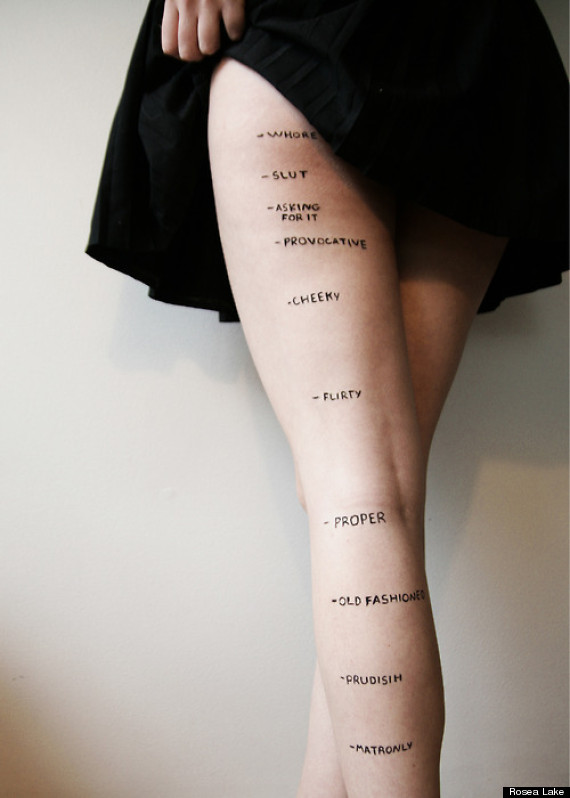
@bfwriter tweeted us a link to a college design student’s photograph that has gone viral.  Rosea Lake posted the image to her tumblr and it struck a chord.

What I like about the image is the way it very clearly illustrates two things.  First, it reveals that doing femininity doesn’t mean obeying a single, simple rule. Instead, it’s about occupying and traveling within a certain space.  In this case, usually between “proper” and “flirty.”  Women have to constantly figure out where in that space they’re supposed to be.  Too flirty at work mean’s you won’t be taken seriously; too proper at the bar and you’re invisible.  Under the right circumstances (e.g., Halloween, a funeral), you can do “cheeky” or “old fashioned.”

The second thing I like about this image is the way it shows that there is a significant price to pay for getting it wrong.  It’s not just a faux pas.  Once you’re “‘asking for it,” you could be a target. And, once you’re reached “prudish,” you’ve become socially irrelevant.  Both violence and social marginalization are serious consequences.

And, of course, all women are going to get it wrong sometimes because the boundaries are moving targets and in the eye of the beholder. What’s cheeky in one setting or to one person is flirty in or to another.  So women constantly risk getting it wrong, or getting it wrong to someone.  So the consequences are always floating out there, worrying us, and sending us to the mall.

Indeed, this is why women have so many clothes!  We need an all-purpose black skirt that does old fashioned, another one to do proper, and a third to do flirty… at the very least… and all in casual, business, and formal.   And we need heels to go with each (stilettos = provocative, high heels = flirty, low heels  = proper, etc, plus we need flats for the picnics and beach weddings etc).  And we need pants that are hemmed to the right length for each of these pairs of shoes.  You can’t wear black shoes with navy pants, so you’ll need to double up on all these things if you want any variety in your wardrobe. I could go on, but you get the picture.

Women’s closets are often mocked as a form of self-indulgence, shop-a-holicism, or narcissism.  But this isn’t fair.  Instead, if a woman is class-privileged enough, they reflect an (often unarticulated) understanding of just how complicated the rules are.  If they’re not class-privileged enough, they can’t follow the rules and are punished for being, for example, “trashy” or “unprofessional.”  It’s a difficult job that we impose on women and we’re all too often damned-if-we-do and damned-if-we-don’t.

Cross-posted at Business Insider and The Huffington Post; view the original.

Lisa Wade, PhD is an Associate Professor at Tulane University. She is the author of American Hookup, a book about college sexual culture; a textbook about gender; and a forthcoming introductory text: Terrible Magnificent Sociology. You can follow her on Twitter and Instagram.
We’re celebrating the end of the year with our most popular posts from 2013, plus a few of our favorites tossed in.  Enjoy!

Last year Lynne Grumet set the internet a-flutter when she appeared on the cover of TIME magazine breastfeeding her toddler. Reactions were largely negative, often reflecting unease at the open display of a sexualized body part being used to feed a child older than the age we generally find acceptable. Others objected to what they saw as the sensationalism of the photo. Grumet later posed on the cover of another magazine in a pose that focused on bonding and intimacy, commonly cited as benefits by breastfeeding advocates. The entire episode tapped into larger cultural anxieties about appropriate mothering.

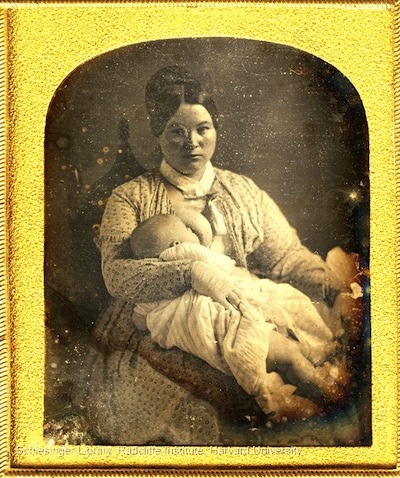
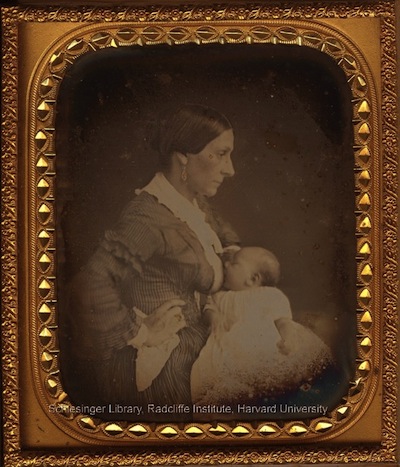
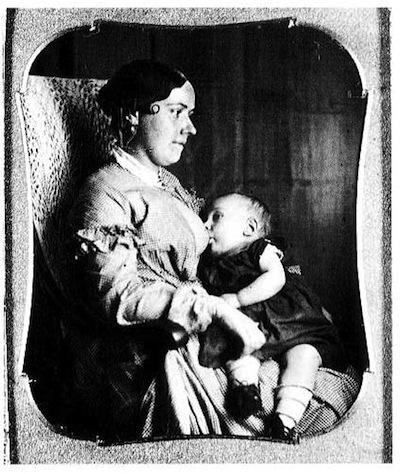
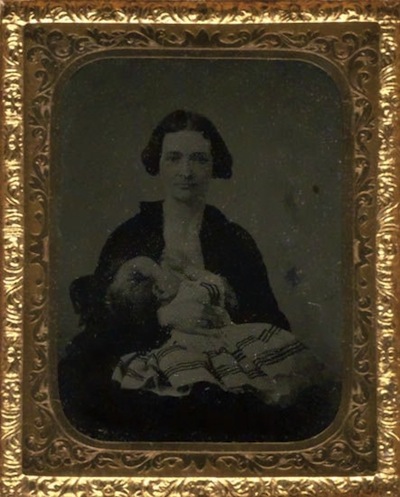
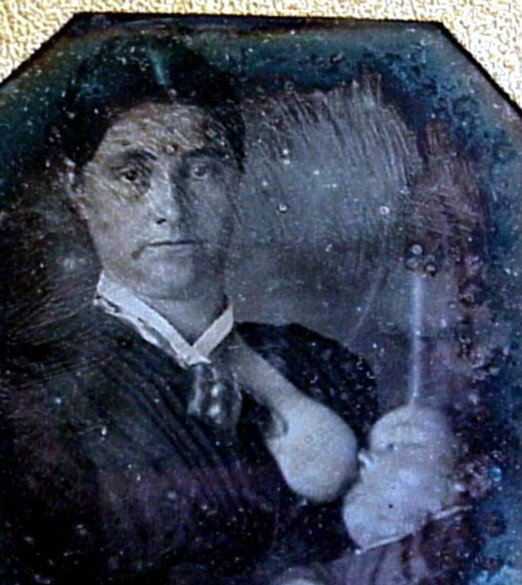
And as Jill Lepore explains in The Mansion of Happiness, it’s just the latest round in the changing discourse about breastfeeding; in the mid-1800s, images of breastfeeding mothers became a fad in the U.S. The use of wet nurses had never been as common in the U.S. as in Europe, and it became even less popular by the early 1800s; breastfeeding your own child became a central measure of your worth as a mother.  Cultural constructions of femininity became highly centered on motherhood and the special bond between a mother and her children in the Victorian era.

As daguerreotypes became available, women began to pose breastfeeding their infants, capturing them in this most essential of maternal roles:

daguerreotype5

daguerreotype6

daguerreotype2

M24278-1 001

2051237_1_l

Cosetra has created a Pinterest board of vintage photos and paintings of breastfeeding that has more examples.

Within decades, American women suddenly seemed to lose the ability to adequately feed their babies, just as infant formula hit the market. Doctors continued to push breastfeeding, but cultural perceptions changed, and with them the social construction of femininity. Rather than being a symbol of maternalism, breastfeeding seemed incompatible with femininity — or, specifically, with white upper-class femininity. Breastfeeding didn’t mesh well with ideas of delicate, refined white women; it was too animal-like, too uncivilized. As Lepore relates, by the early 1900s, a study in Boston found that 9 out of 10 poor mothers breastfed, but only 17% of wealthy mothers did.

By the 1950s, only 20% of mothers nursed their children. Then, ideas about motherhood changed once again; suddenly comparatively privileged, white women were drawn to movements that advocated breastfeeding. Formula came under increased scrutiny. And so continued the ongoing cultural debate over breastfeeding, motherhood, and proper femininity.

Cross-posted at The Huffington Post.  Sources: Schlesinger Library, Radcliffe Institute, Harvard University (direct link to daguerreotypes here); Marvelous Kiddoliveauctioneers.

Gwen Sharp is an associate professor of sociology at Nevada State College. You can follow her on Twitter at @gwensharpnv.

We’re celebrating the end of the year with our most popular posts from 2013, plus a few of our favorites tossed in.  Enjoy!

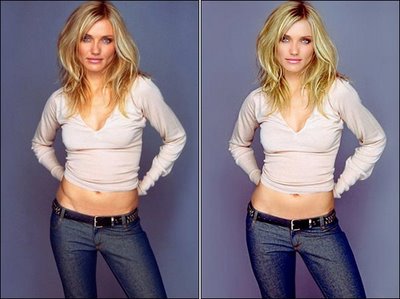
A former editor at Cosmopolitan, Leah Hardy, recently wrote an exposé about the practice of photoshopping models to hide the health and aesthetic costs of extreme thinness. Below is an example featuring Cameron Diaz:


The story about Diaz, in The Telegraph, includes the following description of the image’s manipulation:

  • Face: Cheeks appear filled out
  • Bust: Levelled
  • Thighs: Wider in the picture on the right
  • Hip: The bony definition has been smoothed away
  • Stomach: A fuller, more natural look
  • Arms: A bit more bulk in the arms and shoulders

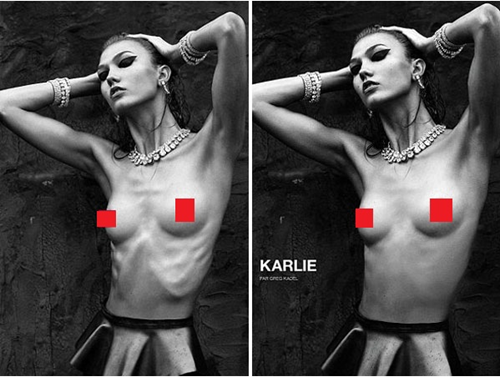
Another example was posted at The Daily What. Notice that her prominent ribcage has been photoshopped out of the photograph on the right, which ran in the October 2012 issue of  Numéro.

Hardy, the editor at Cosmo, explains that she frequently re-touched models who were “frighteningly thin.”  Others have reported similar practices:

Jane Druker, the editor of Healthy magazine — which is sold in health food stores — admitted retouching a cover girl who pitched up at a shoot looking “really thin and unwell”…

The editor of the top-selling health and fitness magazine in the U.S., Self, has admitted: “We retouch to make the models look bigger and healthier”…

And the editor of British Vogue, Alexandra Shulman, has quietly confessed to being appalled by some of the models on shoots for her own magazine, saying: “I have found myself saying to the photographers, ‘Can you not make them look too thin?'”

Robin Derrick, creative director of Vogue, has admitted: “I spent the first ten years of my career making girls look thinner — and the last ten making them look larger.”

Hardy described her position as a “dilemma” between offering healthy images and reproducing the mythology that extreme thinness is healthy:

At the time, when we pored over the raw images, creating the appearance of smooth flesh over protruding ribs, softening the look of collarbones that stuck out like coat hangers, adding curves to flat bottoms and cleavage to pigeon chests, we felt we were doing the right thing… We knew our readers would be repelled by these grotesquely skinny women, and we also felt they were bad role models and it would be irresponsible to show them as they really were.

But now, I wonder. Because for all our retouching, it was still clear to the reader that these women were very, very thin. But, hey, they still looked great!

They had 22-inch waists (those were never made bigger), but they also had breasts and great skin. They had teeny tiny ankles and thin thighs, but they still had luscious hair and full cheeks.

Thanks to retouching, our readers… never saw the horrible, hungry downside of skinny. That these underweight girls didn’t look glamorous in the flesh. Their skeletal bodies, dull, thinning hair, spots and dark circles under their eyes were magicked away by technology, leaving only the allure of coltish limbs and Bambi eyes.

Insightfully, Hardy describes this as a “vision of perfection that simply didn’t exist” and concludes, “[n]o wonder women yearn to be super-thin when they never see how ugly [super-]thin can be.”

UPDATE:  A comment has brought up the point that it’s bad to police people’s bodies, no matter whether they’re thin or fat.  And this is an important point (made well here) and, while I agree that some of the language is harsh, that’s not what’s going on here.  The vast majority of the models who need reverse photoshopping aren’t women who just happen to have that body type.  They are part of an social institution that demands extreme thinness and they’re working hard on their bodies to be able to deliver it.  This isn’t, then, about shaming naturally thin women, it’s about (1) calling out an industry that requires women to be unhealthy and then hides the harmful consequences and (2) acknowledging that even people who are a part of that industry don’t necessarily have the power to change it.

Cross-posted at Business Insider and The Huffington Post in Spanish, French, and German.

Lisa Wade, PhD is an Associate Professor at Tulane University. She is the author of American Hookup, a book about college sexual culture; a textbook about gender; and a forthcoming introductory text: Terrible Magnificent Sociology. You can follow her on Twitter and Instagram.