
Search results for The

Haley Morris-Cafiero is an artist, a photographer, and a scorned body.  Aware that her appearance attracts disgust and mockery from some, she decided to try to document people’s public disdain.  The result is a series of photographs exposing the people who judge and laugh at her.  She chose to publish several at Salon. Go take a look. I’ll wait.

Dmitriy T.C. was the last of many who’ve suggested I write about this.  I’ve decided against it in the past because I anticipated a critique, one that dismissed the project on the argument that we can’t really know what is going through these people’s minds.  Maybe the cop is just a jerk and he does that to everyone?  Maybe the gawkers are looking at someone or something on the other side of her?  Where’s the proof that these are actually instances of cruel, public anti-fat bias?

In some cases, Morris-Cafiero has a story to go along with the photo.  The girl waiting to cross the street with her, she said, was slapping her stomach.  In another instance, she overheard a man say “gorda,” fat woman.  This type of context makes at least some of the photographs seem more “legit.”

But, as I’ve thought more about it, I actually think the project’s strength is in its ambiguity.  The truth is that Morris-Cafiero often does not know what’s going on in the minds of her subjects.  Yet, because she carries a body that she knows is disdained by many, it is perfectly reasonable for her to feel like every grimace, look of disgust, laugh, shared whisper, and instance of teasing is a negative reaction to her body.  In fact, this is how many fat people experience being in public; whether they’re right about the intent 100% of the time is irrelevant to their lived experience.

And this is how people of color, people who speak English as a second language, disabled people and others who are marginalized live, too.  Was that person rude because I speak with an accent?  Did that person say there was no vacancies in the apartment because I’m black?  Was I not chosen for the job because I’m in a wheelchair?  Privilege is being able to assume that the person laughing behind you is laughing at something or someone else, that the scowl on someone’s face is because they’re having a bad day, and that there must have been a better qualified candidate.

For many members of stigmatized groups, it can be hard not to at least consider the possibility that negative reactions and rejections are related to who they are. Morris-Cafiero’s project does a great job of showing what that looks like.

Lisa Wade, PhD is an Associate Professor at Tulane University. She is the author of American Hookup, a book about college sexual culture; a textbook about gender; and a forthcoming introductory text: Terrible Magnificent Sociology. You can follow her on Twitter and Instagram.

What comes to mind when you think of romance, love, and Valentine’s Day?  Probably things like sunsets, flowers, chocolates, candles, poetry, and bubble baths.  You know, girl stuff.

4

Francesca Cancian, who writes on love, calls this the feminization of love.  It makes love seem like its for women and girls only.  This is a problem for at least two reasons.  First, because men are supposed to avoid girly things in our culture, they are pressured to pretend like they’re not into love and love-related things.  That’s why men are offered the alternative Steak and a Blow Job Day.

Second, it makes other ways of expressing love less visible.  Maybe he shows love by always changing the oil in the car or making sure the computer is updated with anti-virus software.  These can be mis-recognized as not about love because they aren’t the proper socially constructed symbols.  So, if he doesn’t also show up with flowers or candy once in a while, maybe she doesn’t feel loved.

The flip side of this is the masculinization of sex.  The rather new idea that what men are really interested in is sex and that this is secondary or, even, obligatory for women.

The feminization of love and masculinization of sex manifests itself in a myriad of ways across our culture, causing all sorts of problems.  In the case of Valentine’s Day, it makes it seem as if the (assumed heterosexual) holiday is for women but, if he does it right, he’ll get sex as a reward.  How romantic.

Cross-posted at Pacific Standard.

Lisa Wade, PhD is an Associate Professor at Tulane University. She is the author of American Hookup, a book about college sexual culture; a textbook about gender; and a forthcoming introductory text: Terrible Magnificent Sociology. You can follow her on Twitter and Instagram.
This animated poem, sent in by Dmitriy T.C., artfully addresses the stigma of being alone. It begins by differentiating between social contexts in which solitude is expected or accepted (libraries) and those in which we are taught it is embarrassing or sad (restaurants). It ends with a defense of the pleasure of being only with oneself.

Video by Andrea Dorfman; poem, music, and performance by Tanya Davis.  Originally posted in 2010.

Lisa Wade, PhD is an Associate Professor at Tulane University. She is the author of American Hookup, a book about college sexual culture; a textbook about gender; and a forthcoming introductory text: Terrible Magnificent Sociology. You can follow her on Twitter and Instagram.

Last year I was tickled to write about a cool study showing that, if a person grows up with a language that writes from left to right, then numerical estimates of things like weight or height will, on average, be smaller when a person is imperceptibly and unknowingly leaning to the left.  Seriously, it’s awesomely fun research and you can read about it here.

Today I have the equally fun pleasure of sharing a research study on weight and importance.  It turns out that, when people are holding something heavy, they will report an issue to be more serious, compared to when they are holding something lighter.

Some examples come from a set of studies by psychologist Nils Jostmann and colleagues.

  • In the first study, European participants were asked to guess the value of various foreign currency in euros.  Some were given a heavy clipboard on which to mark their estimates, and others a light clipboard.  Those who held the light clipboard estimated, on average, lesser values.
  • In a second study, subjects were asked to estimate the importance of college students having a voice in a decision-making process involving grants to study abroad.  Participants with the heavy clipboard felt that it was more important for students to have a voice.
  • In a third, subjects were asked to report whether they liked their city after reading a biography of the mayor and indicating how the felt about him.  If they carried the heavy clipboard, there was a relationship between their estimation of the mayor and that of the city, but not if they carried a light clipboard.  In this case, the importance of their feelings about the mayor weighed heavier on their evaluation of the city if the clipboard was heavy.

What is driving these findings?

In English, and several other languages as well, weight is used as metaphor to signify importance.  The authors hypothesized that this abstraction can be triggered by concrete experiences of weight, like holding something heavy.  They call this “embodied cognition.”  Our thinking is affected by the connection between our bodies, their relationship with objects, and metaphors in our minds.

Another nail in the Descartian mind-body dualism coffin.

Cross-posted at Pacific Standard.

Lisa Wade, PhD is an Associate Professor at Tulane University. She is the author of American Hookup, a book about college sexual culture; a textbook about gender; and a forthcoming introductory text: Terrible Magnificent Sociology. You can follow her on Twitter and Instagram.
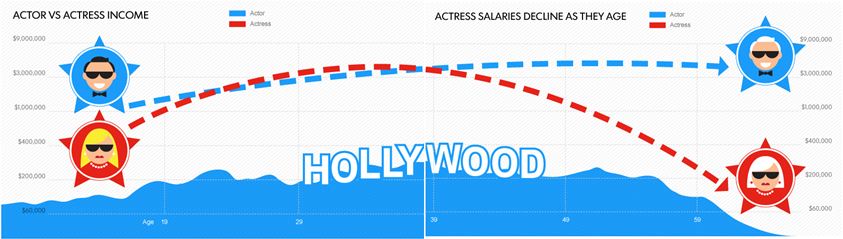
A new study on the differential earning power of male and female movie stars beings with a quote from Jennifer Jason Leigh:

It’s the nature of the business. People equate success with youth (source).

She’s half right.   Irene Pater and her co-authors looked at the pay of 265 actors and actresses who appeared in Hollywood films from 1968 to 2008.  They found that the average earnings of actors rises until the age of 51 and remains stable after that.  The average earnings of actresses, in contrast, peaks at 34 and decreases “rapidly thereafter.”

2
Source: USA Today

Sarah Jessica Parker, then, was more on the mark:

There is still a discrepancy in earning power between men and women in Hollywood. And it becomes doubly unfair when you think of our earning potential in terms of years.  Actresses are like football players. They have a small window of prime earning ability (source).

So, is this sexism or just “market forces”?  That is, is female acting work devalued compared to men’s because people in positions of power don’t value women?  Or is it because casting women over 34 decreases box office returns, whereas casting older men does not?  Pater and her colleagues suggest that it’s sexism.  One study, they explain,

…actually examined the combined effect of gender and age on box office performance [and] revealed that casting a female lead older than 32 years of age does not influence a movie’s box office performance, whereas casting a male lead older than 42 decreases box office revenues by almost 17% (source).

So the presence of male actors in their forties and over decreases box office revenue, but they still get paid more than women of the same age.  In contrast, casting women in their mid-thirties and over doesn’t bring down profits, but she’s still less valuable in the eyes of producers.  Sexism sounds like a plausible explanation to me.

Lisa Wade, PhD is an Associate Professor at Tulane University. She is the author of American Hookup, a book about college sexual culture; a textbook about gender; and a forthcoming introductory text: Terrible Magnificent Sociology. You can follow her on Twitter and Instagram.
In 2010 a scandal that erupted when designer Mark Fast decided to use four plus-size models (US sizes 8-10) in his catwalk show at London Fashion Week.  Protesting his decision, his stylist and creative director quit, leaving him just three days to find replacements.

The incident is a great example of how even relatively powerful figures (e.g., designers with catwalk shows) often have to pay a price for deviating from cultural rules. Designers are often criticized for only hiring waif-like models, but this shows that they don’t get to do whatever they like without consequences.

While it’s easy to condemn Fast’s stylist and creative director for walking out on him, the truth is that even being associated with deviance can bring consequences.  Sociologist Erving Goffman introduced the idea of the “courtesy stigma” to refer to the stigma that attaches to those who are merely associated with a stigmatized person. A recent Grey’s Anatomy episode dealt with exactly this idea in a story about the reaction to an attractive blonde married to an obese man. Her willingness to stay with such a person was a source of curiosity and disbelief.  Similarly, siblings of the mentally ill or mothers of children with  attention deficit/hyperactivity disorder might suffer courtesy stigma when people wonder if the mental illness is genetic or the parenting is bad, respectively.

So, while it’s tempting to say that Fast’s employees hold reprehensible ideological beliefs (a hatred or intolerance for “plus-size” women), it’s also possible that they thought being associated with the show could hurt their chances of success in a very competitive career.  In an industry that stigmatizes fat so powerfully, I can imagine it might be terrifying indeed to be seen as endorsing it.

Cite: Goffman, E. (1963) Stigma: Notes on the Management of Spoiled Identity. Engelwood Cliffs, NJ: Prentice-Hall.

Originally posted in 2010.

Lisa Wade, PhD is an Associate Professor at Tulane University. She is the author of American Hookup, a book about college sexual culture; a textbook about gender; and a forthcoming introductory text: Terrible Magnificent Sociology. You can follow her on Twitter and Instagram.

A survey question is only as good as its choices. Sometimes an important choice has been left off the menu.  I was Gallup polled once, long ago. I’ve always felt that they didn’t get my real opinion.

“What’d they ask?” said my brother when I mentioned it to him.

“You know, they asked whether I approved of the way the President was doing his job.”  Nixon – this was in 1969.
“What’d you say?”

“I said I disapproved of his entire existential being.”

I was exaggerating my opinion, and I didn’t actually say that to the pollster.  But even if I had, my opinion would have been coded as “disapprove.”

For many years the American National Election Study has asked:

How much of the time do you think you can trust the government in Washington to do what is right – just about always, most of the time or only some of the time?

The trouble with these choices at that they exclude the truly disaffected. The worst you can say about the federal government is that it can be trusted “only some of the time.”  A few ornery souls say they don’t trust the federal at all. But because that view is a write-in candidate, it usually gets only one or two percent of the vote.

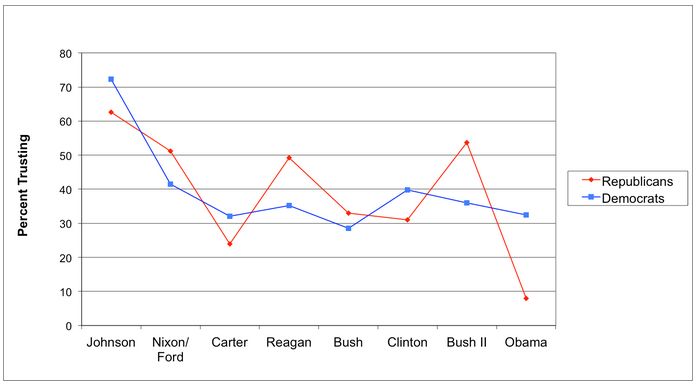
This year the study included “never” in the options read to respondents.  Putting “no-way, no-how” right there on the ballot makes a big difference. And as you’d expect, there were party differences:

1 (2)

Over half of Republicans say that the federal government can NEVER be trusted.

The graph appears in this Monkey Cage post by Marc Hetherington and Thomas Rudolph. Of course, some of those “never” Republicans don’t really mean “never ever.”  If a Republican becomes president, they’ll become more trusting, and the “never-trust” Democrat tide will rise.  Here’s the Hetherington-Rudolph graph tracking changes in the percent of people who do trust Washington during different administrations.

1 (3)

This one seems to show three things:

  1. Trust took a dive in the 1960s and 70s and never really recovered.
  2. Republican trust is much more volatile, with greater fluctuations depending on which party is in the White House.
  3. Republicans really, really hate President Obama.

Cross-posted at Montclair SocioBlog.

Jay Livingston is the chair of the Sociology Department at Montclair State University. You can follow him at Montclair SocioBlog or on Twitter.

One conventional explanation for our economic problems seems to be that our businesses are strapped for funds.  Greater business earnings, it is said, will translate into needed investment, employment, consumption and, finally, sustained economic recovery.  Thus, the preferred policy response: provide business with greater regulatory freedom and relief from high taxes and wages.

It is this view that underpins current business and government support for new corporate tax cuts and trade agreements designed to reduce government regulation of business activity, attacks on unions, and opposition to extending unemployment benefits and increasing the minimum wage.

One problem with this story is that businesses are already swimming in money and they haven’t shown the slightest inclination to use their funds for investment or employment.

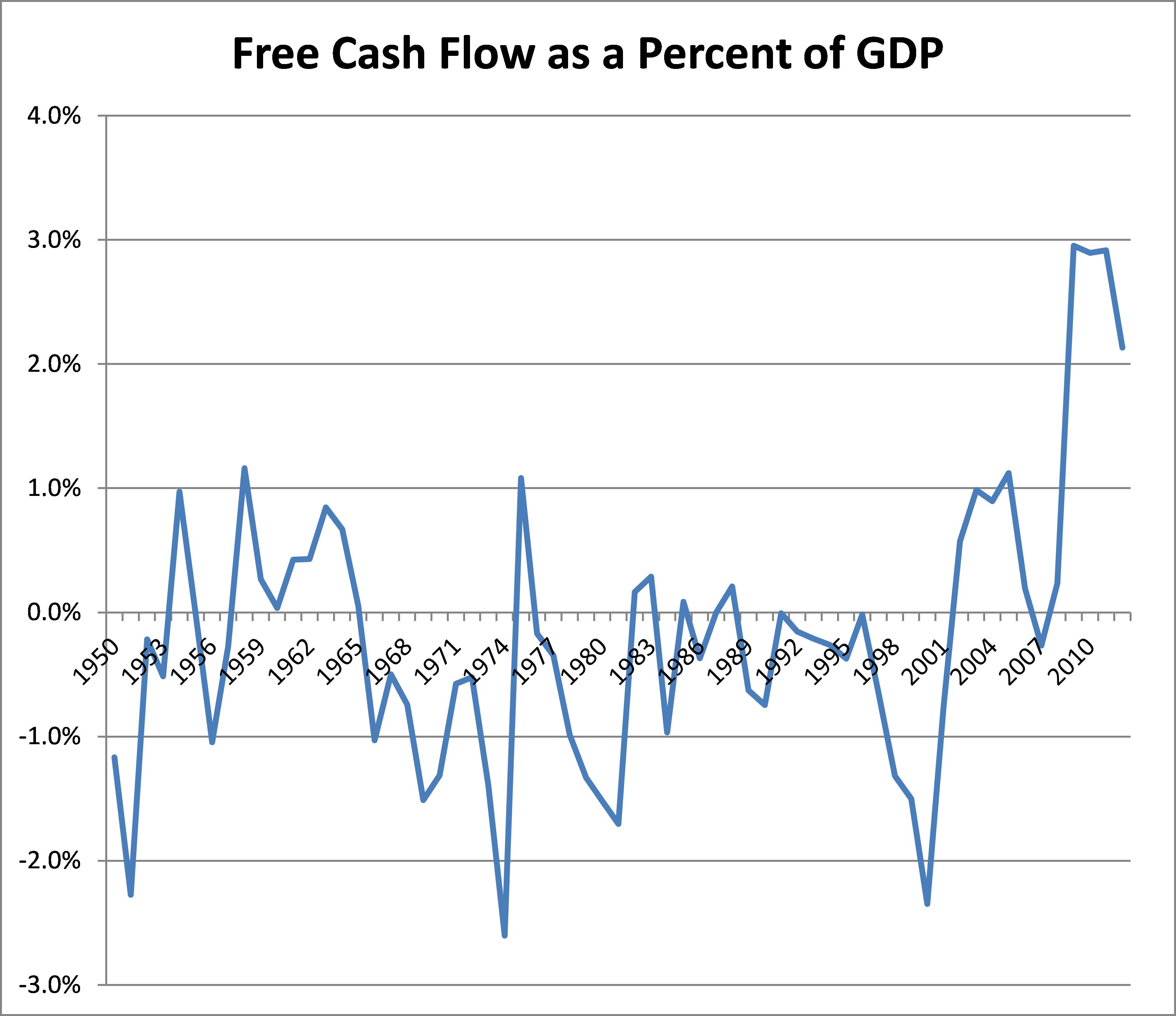
The first chart below highlights the trend in free cash flow as a percentage of GDP.  Free cash flow is one way to represent business profits.  More specifically, it is a pretax measure of the money firms have after spending on wages and salaries, depreciation charges, amortization of past loans, and new investment.  As you can see that ratio remains at historic highs.  In short, business is certainly not short of money.

1 (2)

So what are businesses doing with their funds?  The next chart looks at the ratio of net private nonresidential fixed investment to net domestic product (I use “net” rather than “gross” variables in order to focus on investment that goes beyond simply replacing worn out plant and equipment).  The ratio makes clear that one reason for the large cash flow is that businesses are not committed to new investment.  Indeed quite the opposite is true.

1 (3)

Rather than invest in plant and equipment, businesses are primarily using their funds to repurchase their own stocks in order to boost management earnings and ward off hostile take-overs, pay dividends to stockholders, and accumulate large cash and bond holdings.

Cutting taxes, deregulation, attacking unions and slashing social programs will only intensify these very trends.  Time for a new understanding of our problems and a very new response to them.

Cross-posted at Reports from the Economic Front.

Martin Hart-Landsberg is a professor of economics at Lewis and Clark College. You can follow him at Reports from the Economic Front.