Search results for The

Burk sent in several Miller beer ads, all directed by Errol Morris, which contain some interesting messages about modern masculinity. Specifically, real men drink beer and don’t worry about stupid things like their diet or health:

This one connects drinking Miller to pro-American patriotism and the value of manpower (and it really means MANpower):

Real men know how to back up Suburbans pulling boats:

Clearly, we’ve lost an important element of manhood when men can no longer do this. Of course, driving a Suburban pulling a boat seems to contradict the whole patriotic non-use of gas element of manhood, but let’s not get into details.

And finally, real men have to restrain themselves while they listen to women:

It’s such a pain to have to interact with gals!

You can find even more here.

UPDATE: In a comment, Chuk says,

In these ads, with the exception of the cyclist, none of the men’s faces are ever fully shown. What if this was a series of adds with images of women? How would the regular poster and commentators normally react to this kind of framing? What would it mean in that context? Does that analysis apply to this context?

I think that’s a good question. One criticism people often make of ads is the way women’s faces are often obscured; this is pointed out as a way of objectifying them, turning them into bodies rather than full people with faces, voices, etc. I certainly think it’s possible to objectify men as well, although it’s also possible to show part of a body because the viewer is supposed to take on the viewpoint of the person in the ad, in which case you can’t, obviously, see the face or head, since you’re supposed to be the face/head. I found the bacon and butter burger ads creepy overall, as well as another one of the Morris ads where a (generally faceless) grandma is cooking for a bunch of men whose faces we never see.

Thanks for the comment, chuk!
Click to embiggen.

Found here.

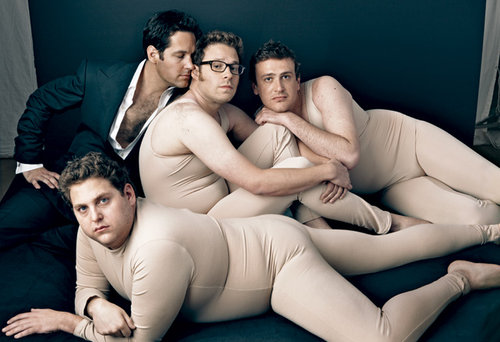
Mercedes DeM. sent in this Vanity Fair cover (for April 2009)…

pu1p3ehapkkz1o5pwwcpbyn5o1_5001

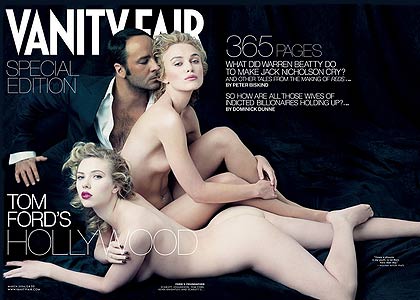
…spoofing this previous cover:

ap_vanity_fair420x300

The women on the original cover are sex symbols.  We should expect gratuitous nudity.  The men in the spoof, in contrast, are comedians and so a direct comparison, arguing that men’s bodies are more off-limits, would be misguided.  (Not that I think an argument couldn’t be made, but I don’t think this set of images supports it.)

Nor do I think that these images support the idea that we’re more accepting of variation in men’s bodies than women’s.  If that were so, I think the men would actually be nude.  Instead they’re covered up.  My sense is that they’re covered up because their bodies are, according to rigid cultural standards, gross. 

 The relevant comparison, I think, would be between the spoof cover and a similar spoof cover featuring non-skinny women in nude body suits.  The fact that the former is funny points to how men are allowed to be many things.  They can be good-looking and fit, OR they can be not-so-good-looking, but rich, nice, or funny.  And we still like them.  There is no disdain for these men.  We may even like them MORE because they’re willing to pose in ways that reveal how imperfect their bodies are.

I think we would be unlikely to see a similar cover featuring women, even women comedians, because women are allowed to be rich, nice, or funny but they must ALSO be good-looking and fit.  A cover featuring chubby women would JUST be gross.  It wouldn’t be gross and funny.

Being good-looking and fit is ONE way for men to be admire in our society.  Being good-looking and fit is a REQUIREMENT for women to be admired, no matter what else she brings to the table.

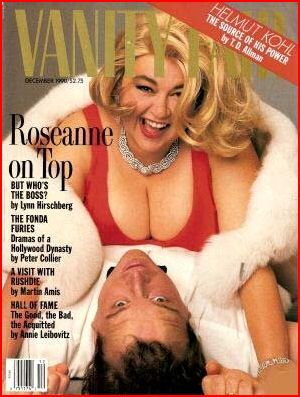
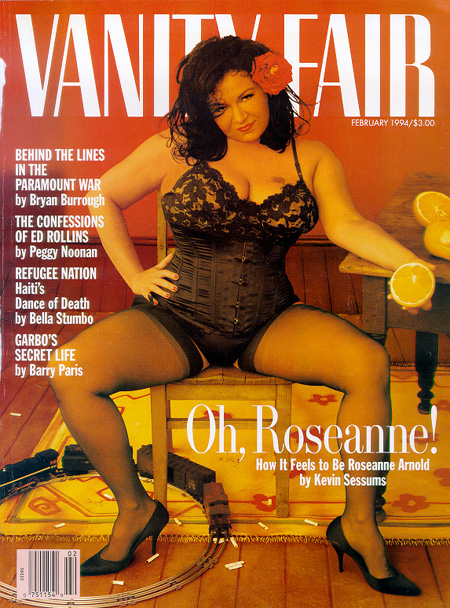
I asked myself: in the entire history of Vanity Fair, would we be able to find three women with a similar body type to those men on the cover?

I found two, both featuring Roseanne Barr (images here and here):

capture1

roseanne20vanity20fair20cover

The covers feature a comedian who is well-known for being successful while bucking social expectations for women.  She’s the exception to the rule that proves the rule.  Or is she?  I certainly think so.  That “Oh, Roseanne!” is about how crazy she is.

In any case, notice that she’s still a sex symbol, while the men in the spoof are decidedly not.  They’re spoofing such symbolism.  Roseanne, despite her wacky resistance, still has to abide by it.

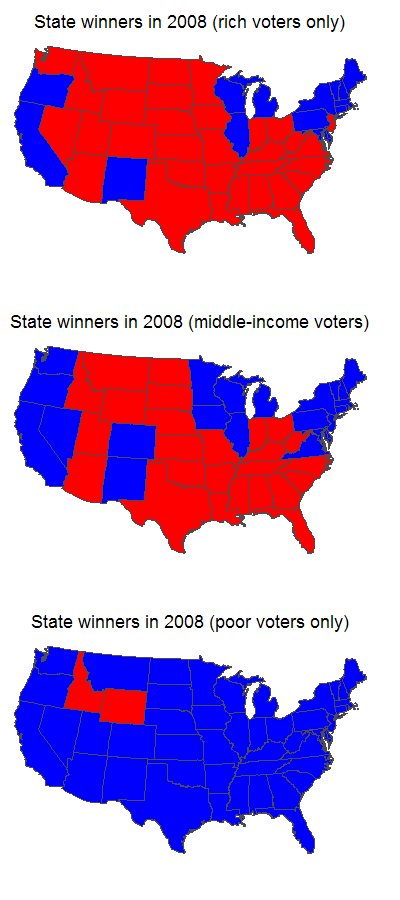
Andrew over at FiveThirtyEight posted three maps that show which candidate would have carried each state if only members of one social class voted (in case it’s not obvious, blue = Obama and red = McCain):

pewmaps

For the purposes of the estimate, “rich” was defined as a household income of $150,000+, “middle-income” was $40,000-75,000, and “poor” was $0-20,000. [Note: for the point of illustration, he just made maps showing the lowest, middle, and upper 20% of households by income, which is why the groups between $20,000-39,000 and $76,000-150,000 don’t show up here–he just made the 3 maps to illustrate the point.]

So what we seem to see here is that poor voters were more consistently partisan than rich voters, at least in the 2008 election. Whether this is a general pattern or something unique to 2008 I don’t know.

Hyperion submitted a great illustration of cultural change. Today, cigarette smoking is illegal in most public places, but there was a time in which cigarette smoking was normative instead of deviant. This radar analysis instrument, in use through the 1950s through 1980s, includes a built-in cigarette lighter and ashtray:

800px-sage_console

More on this and like instruments here.

Thanks Hyperion!

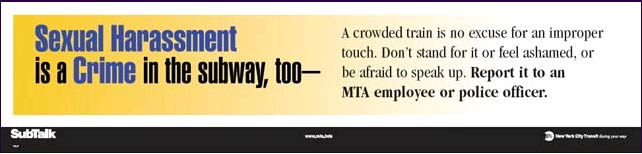
Britt Karp, Occidental College student and all-around great person, saw this public service notice on a subway in Manhattan:

mtasexassaultposter

Britt remarks:

Why is the message not – don’t sexually assault people?! Instead of reprimanding perpetrators of sexual assault (most frequently men), this poster places the responsibility on the person who is being assaulted (usually a woman). By doing this, it completely normalizes sexual harassment. The poster alludes to the argument touted by evolutionary psychologists – that it is in men’s nature to sexually assault women and so trying to control this behavior is futile. In this way, they make it seem that the only way to deal with this issue is for women to be braver.  It’s no wonder women so frequently blame themselves when they are sexually assaulted.

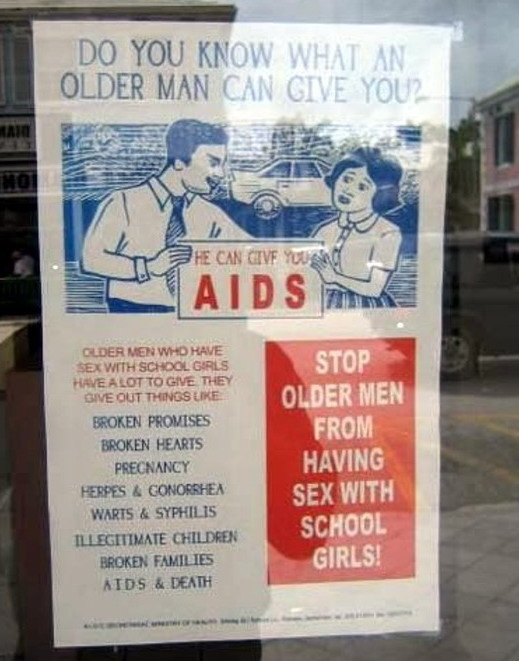
NEW! Rachel McC. J., from Deeply Problematic, sent us another example of a poster asking women to stop men from behaving badly. This one targets young girls, telling them to turn away older men:

do-you-know-what-an-older-man-can-give-you-16149-1245684709-6

Racism is ingrained in the Midwest; we’ve normalized it. Take, for example, my earlier post on Tony Zirkle, the Chinese_stereotype.jpgHoosier Republican congressional candidate who spoke at a dinner honoring Hitler’s birthday. (He also publicly advocated for racial segregation.) Zirkle lost, of course, but the fact that he had no problem publicly stating his racism – without thinking that others would object – shows just how commonplace overt racism can be here.

One of the best examples is the “U-Washee” in Richmond, Indiana. The laundromat is, literally, built on racist stereotypes of Chinese people and no one gives it a passing glance. It’s 1940’s era cartoon stereotype mascot, what Margaret Cho calls “feng shui hong kong fooey font,” and the extra “ee”s at the end of words in the business’s name and posted notices all combine to form one hellish timewarp into a past America most areas have forgotten but we tend to accept as typical – and no one utters a peep.

Losing Sight of the Past

lost_clothes.jpg

While Americans tend to think of the South when the subject of racism comes up, the Midwest is no stranger to our own brand of anti-minority bigotry. The Klu Klux Klan was headquartered in Indiana for many years. The former national Grand Dragon, D.C. Stephenson‘s, home is blocks from mine; he more or less ran our state government in the 1920’s. One July 1923 Klan rally hosted by Stephenson in nearby Kokomo drew an estimated 50,000 people.

Bigotry flourished around the nation thanks to Stephenson’s efforts. He influenced governors, state legislators and congressmen. It wasn’t until he abducted, forcibly intoxicated, assaulted and raped a white neighbor woman who later died that he became a societal pariah. (One witness said her body looked like she’d “been chewed by a cannibal.” He was sentenced to life in prison.) No one knows if there were any African-American victims too; they were never considered.

Racism is part of our heritage too.

Don’t Get Too Worked Up

so_sorry.jpg

The reader who sent in these photos described his encounter at the laundromat. While he was taking the pictures, another customer walked up to him to ask, “You’re not from around here, are you?” It wasn’t meant in a threatening manner, but more of a bemused “Well, this is Indiana…” general excuse.

It’s often said that one thing Hoosiers fear most is change. We use it as a crutch to continue any bad behaviors we want to tacitly condone. Smoking rate too high? Our citizens are stressed over the economy. Rate of overweight people per capita one of the highest in the nation? It’s the diet. No protections whatsoever for gays and lesbians? These type of things take time.

Apparently almost 50 years isn’t quite enough.

Rewarding Bigotry

Chinese_reward.jpg

Another interesting aspect to this story is the financial angle. The unemployment rate in Richmond is 9.8%. Very few small businesses are succeeding. The “U-Washee” is entirely built around this racist theme and to remove the associations would cost a small fortune – new signage inside and out, a new name, changed business records with resultant legal fees, etc.

The owner is an elderly white man who’s barely making ends meet as energy costs and business expenses have skyrocketed while income has stayed the same. He’ll wash, dry and fold your clothes for you for $1 per pound. He provides a service the community needs. How do you wash your clothes if you don’t have a car to drive miles to another laundromat? There are three* other laundromats in the city of 40,000 people.

How does the community deal with the issue without cutting off their nose to spite their face in these desperate economic times?

Large Issues to Deal With

big_bundles.jpg

Confronting racism is never an easy task. Adding in poverty, employment and basic living issues only compounds the problem. If no one is complaining, why stir up trouble?

0.8% of Richmond’s population is Asian according to the US Census Bureau. They’re not complaining. The citizens obviously aren’t either. A quick Google search for “U Washee Richmond” shows exactly one relevant link – a listing for the pay phone. No other blog posts. No outrage in the newspaper. No protests outside the business.

What right do I have to interject myself in their affairs?

The Stain That Will Not Wash Away

rain_soft.jpg

I’ve not reached out to the “U-Washee” before posting these pictures and commentary. I plan to do it though, because someone has to speak up. I won’t demand or threaten. My goal is to help the owner move his business past the anti-Chinese racist stereotypes and not to shut the place down.

Someone has to speak up. Someone has to be first and break the cycle of complacency – the “I’m better than those poor deluded people” theory that too often excuses the continuation of prejudices and vices. Someone has to speak up.

Otherwise this stain will never wash away.

*Commenter AWB has pointed out that two laundries I thought were closed are open. I corrected the number of laundries in the town.

—————————-

Bil Browning is a long-time LGBT activist and writer.  He is the co-owner and Editor-In-Chief of The Bilerico Project – an LGBT political blog recently named one of four “must reads” by the Washington Post.  He and his partner, Jerame Davis, live with their teenage daughter in Indianapolis, Indiana.  We asked Bil if we could reproduce this post from his blog and he said “yes.”

If you would like to write a post for Sociological Images, please see our Guidelines for Guest Bloggers.

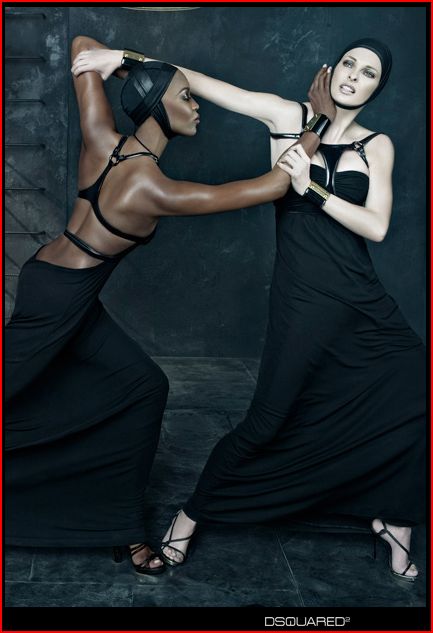
Bri a sent in this ad, found in Interview Magazine, and we’d like to know what you think of it:

capture

It reminds me, somewhat, of this post featuring a billboard for Playstation with a black and white woman fighting.