Search results for The

Flashback Friday.

The word commodification refers to the process by which something that is not bought and sold becomes something that is.  As capitalism has progressed, more and more parts of our lives have become commodified.  Restaurants are the commodification of preparing and cleaning up meals; day care and nannying is the commodification of child raising; nursing homes is the commodification of caring for elders.

We sometimes post instances of commodification that tickle us.  Previously I posted about a company that will now put together and deliver a care package to your child at camp.  A parent just goes to the site, chooses the items they want included, and charge their credit card.  As I wrote in that post: “The ‘care’ in ‘care package’ has been, well, outsourced.”

I was equally tickled by a photograph, taken by sociologist Tristan Bridges, of pre-dyed Easter eggs:

This is a delicious example of commodification.  If you don’t have the time or inclination to dye eggs as part of your Easter celebration, the market will do it for you.  No matter that this is one of those things (e.g., a supposedly enjoyable holiday activity that promotes family togetherness) that is supposed to be immune to capitalist imperatives.

While we might raise our eyebrows at this example, newly commodified goods and services often elicit this reaction.  We usually get used to the idea and, later, have a hard time imagining life any other way.

For more on commodification, peruse our tag by that name. This post originally appeared in 2012.

Lisa Wade, PhD is an Associate Professor at Tulane University. She is the author of American Hookup, a book about college sexual culture; a textbook about gender; and a forthcoming introductory text: Terrible Magnificent Sociology. You can follow her on Twitter and Instagram.

1

Writer and director Elena Rossini has released the first four minutes of The Illusionists.  I’m really excited to see the rest.  The documentary is a critique of a high standard of beauty but, unlike some that focus exclusively on the impacts of Western women, Rossini’s film looks as though it will do a great job of illustrating how Western capitalist impulses are increasingly bringing men, children, and the entire world into their destructive fold.

The first few minutes address globalization and Western white supremacy, specifically.  As one interviewee says, the message that many members of non-Western societies receive is that you “join Western culture… by taking a Western body.”  The body becomes a gendered, raced, national project — something that separates modern individuals from traditional ones — and corporations are all too ready to exploit these ideas.

Watch for yourself (subtitles available here):

Lisa Wade, PhD is an Associate Professor at Tulane University. She is the author of American Hookup, a book about college sexual culture; a textbook about gender; and a forthcoming introductory text: Terrible Magnificent Sociology. You can follow her on Twitter and Instagram.
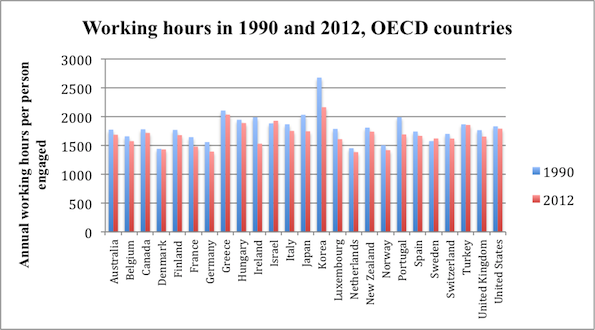
On average, U.S. workers with jobs put in more hours per year  than workers in most OECD countries. In 2012, only Greece, Hungary, Israel, Korea, and Turkey recorded a longer work year per employed person.

2

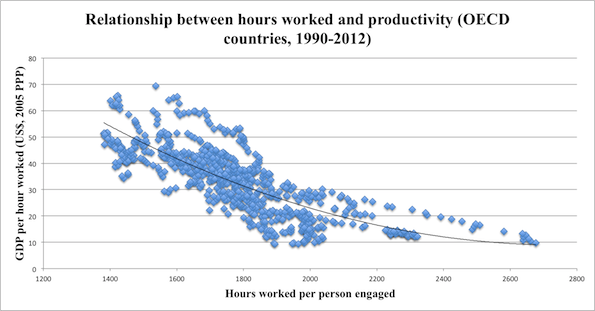
A long work year is nothing to celebrate. The following chart, from the same Economist article, shows there is a strong negative correlation between yearly hours worked and hourly productivity.

3.5

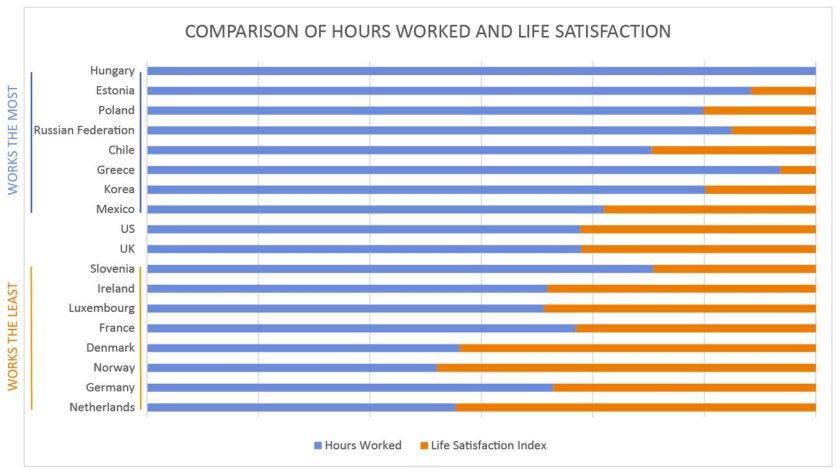
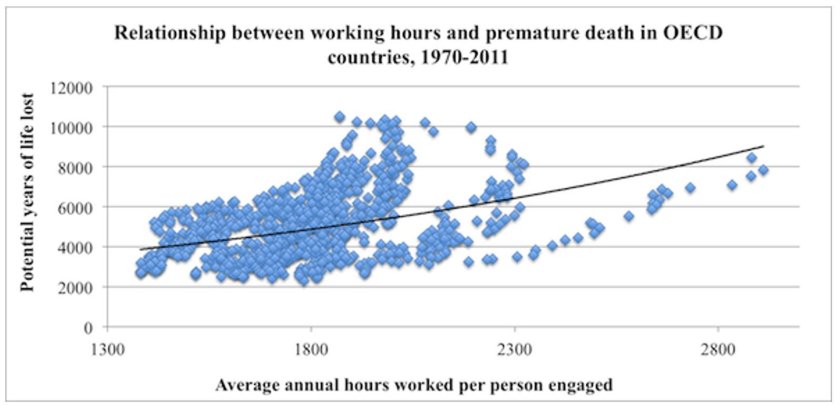
More importantly, the greater the number of hours worked per year, the greater the likelihood of premature death and poor quality of life.  This reality is highlighted in the following two charts taken from an article by Angus Chen titled “8 Charts to Show Your Boss to Prove That You Can Do More By Working Less.”

1 (2) - Copy

1 (2)

In sum, we need to pay far more attention to the organization and distribution of work, not to mention its remuneration and purpose, than we currently do.

Martin Hart-Landsberg is a professor of economics at Lewis and Clark College. You can follow him at Reports from the Economic Front.

Advertisements echo with many reverberations and overtones. Different people hear different things, and with all the multiple meanings, it’s not always clear which is most important.

This week Lisa Wade posted this Snickers ad from Australia. Its intended message of course is “Buy Snickers.” But its other message is more controversial, and Lisa and many of the commenters (more than 100 at last count) were understandably upset.

[youtube]https://www.youtube.com/watch?v=MqgjTZQiySw[/youtube]

The construction workers (played by actors) shout at the women in the street (not actors). “Hey,” yells a builder, and the woman looks up defensively. But then instead of the usual sexist catcalls, the men shout things like,

I appreciate your appearance is just one aspect of who you are.

And

You know what I’d like to see? A society in which the objectification of women makes way for gender neutral interaction free from assumptions and expectations.

The women’s defensiveness softens.  They look back at the men. One woman, the surprise and delight evident in her smile, mouths, “Thank you.”

But, as the ad warned us at the very beginning, these men are “not themselves.”

1 (2) - Copy

Hunger has transformed them. The ad repeats the same idea at the end.

1 (2) - Copy

Here’s Lisa’s conclusion:

The twist ending is a genuine “fuck you” to the actual women who happened to walk by and become a part of the commercial… I bet seeing the commercial would feel like a betrayal. These women were (likely) given the impression that it was about respecting women, but instead it was about making fun of the idea that women deserve respect.

I suspect that Lisa too feels betrayed.  She has bought her last Snickers bar.

My take is more optimistic.

In an earlier generation, this ad would have been impossible. The catcalls of construction workers were something taken for granted and not questioned, almost as though they were an unchangeable part of nature.* They might be unpleasant, but so is what a bear does in the woods.

This ad recognizes that those attitudes and behaviors are a conscious choice and that all men, including builders, can choose a more evolved way of thinking and acting.  The ad further shows, that when they do make that choice, women are genuinely appreciative. “C’mon mates,” the ad is saying, “do you want a woman to turn away and quickly walk on, telling you in effect to fuck off? Or would you rather say something that makes her smile back at you?”  The choice is yours.

The surface meaning of the ad’s ending is , “April Fools. We’re just kidding about not being sexists.” But that’s a small matter. Not so far beneath that surface progressive ideas are having the last laugh, for more important than what the end of the ad says is what the rest of the ad shows — that ignorant and offensive sexism is a choice, and that real women respond positively to men who choose its opposite.

* Several of the comments at Sociological Images complained that the ad was “classist” for its reliance on this old working-class stereotype.

Cross-posted at Montclair SocioBlog.

Jay Livingston is the chair of the Sociology Department at Montclair State University. You can follow him at Montclair SocioBlog or on Twitter.

Last week NPR reported that scientists now trace some of the rise of American obesity to the fear of fat.  Beginning in the 1970s, nutritionists began warning Americans to consume less fat.  This initiated the “low fat” and “fat free” crazes that still linger.

Yet, it now seems that people who followed the advice of nutritionists at the time — to eat less cheese, milk, and meat and more pasta, potatoes, and rice — were likely to get fatter, not skinnier.  The closer a person stuck to the dietary guidelines, the more weight they would gain and, the more weight they gained, the more others would pressure them to stick to the dietary guidelines.  The phrase “cruel irony” only begins to capture it.

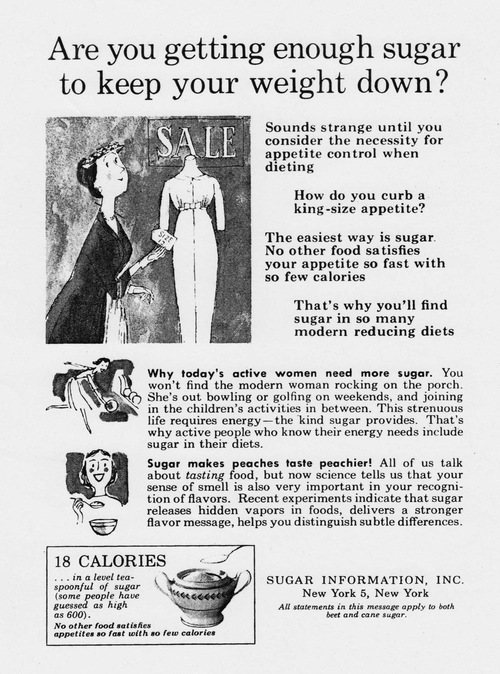
The ad below, from 1959, is a peek into another era.  Just a few years before the fear of fat began, the sugar industry was plausibly suggesting that eating more sugar was the best way to stay slim.  This was industry association propaganda, but no doubt the potato and pasta industries contributed to the story in the ’70s just as the meat and dairy industries are in on it today.

1

The revision of our nutritional guidelines reminds us to be skeptical of the conventional wisdom.  Moreover, it should inspire us all to check our tendency to judge others.  We don’t have perfect knowledge that allows us perfect control over our bodies.  Scientists are doing the best they can — and hopefully not taking too much funding from for-profit food industries — and individuals are restricted by whatever knowledge and resources they have.

Lisa Wade, PhD is an Associate Professor at Tulane University. She is the author of American Hookup, a book about college sexual culture; a textbook about gender; and a forthcoming introductory text: Terrible Magnificent Sociology. You can follow her on Twitter and Instagram.
We’re previously featured great examples of resistance to sexist advertising, but this example takes it up a level.  Clownify describes itself as a “street art project to turn everyday ads into ads for clowns.” I’m not sure what political message they intend to send, but what I see is a super easy, I would even say graceful, way of knocking us into consciousness. If advertisements typically occupy our lives as a taken-for-granted source of psychological coercion, this campaign reminds us to (1) actually look at what we’re seeing and (2) remember not to take ads, their messages, or their products too seriously.

Here are four examples, but there are lots more at the site:

17

H/t copyranter.

Lisa Wade, PhD is an Associate Professor at Tulane University. She is the author of American Hookup, a book about college sexual culture; a textbook about gender; and a forthcoming introductory text: Terrible Magnificent Sociology. You can follow her on Twitter and Instagram.
Economic policies often rest on assumptions about human motivation.  Here’s Rep. Ryan (Republican of Wisconsin):

The left is making a big mistake here. What they’re offering people is a full stomach and an empty soul. People don’t just want a life of comfort. They want a life of dignity — of self-determination.

Fox News has been hitting the theme of “Entitlement Nation” lately. This Conservative case against things like Food Stamps, Medicare, welfare, unemployment benefits, etc rests on some easily understood principles of motivation and economics.

1.    Giving money or things to a person creates dependency and saps the desire to work. That’s bad for the person and bad for the country.
2.    A person working for money is good for the person and the country.
3.    We want to encourage work.
4.    We do not want to encourage dependency.
5.    Taxing something discourages it.

Now that you’ve mastered these, here’s the test question:

1. According to Conservatives, which should be taxed more heavily:

a.    money a person earns by working.
b.    money a person receives without working, for example because someone else died and left it in their will.

If you said “b,” you’d better go back to Conservative class. A good Conservative believes that the money a person gets without working for it should not be taxed at all.

Not all such money, of course.  Lottery tickets are bought disproportionately by lower-income people.  If a person gets income by winning the PowerBall or some other lottery, the Federal government taxes the money as income. Conservatives do not object.  But if a person gets income by winning the rich-parent lottery, Conservatives think he or she should not pay any taxes.

What Conservatives are saying to you is this: working for your money is not as good as instead of inheriting it. This message seems to contradict the principles listed above. But, as Jon Stewart recently pointed out, Conservatives apply those principles of economics and motivational psychology only to the poor, not to wealthy individuals or corporations.

Cross-posted at Montclair SocioBlog and the Huffington Post.

Jay Livingston is the chair of the Sociology Department at Montclair State University. You can follow him at Montclair SocioBlog or on Twitter.

Do Millennials really carry more debt than their parents and grandparents did at their age? Yes, according to a new study by sociologist Jason Houle.  “In order to participate in society and gain economic independence,” he writes, “many young adults today must take a massive financial risk.”  Or, as he puts it, “out of the nest and into the red.”

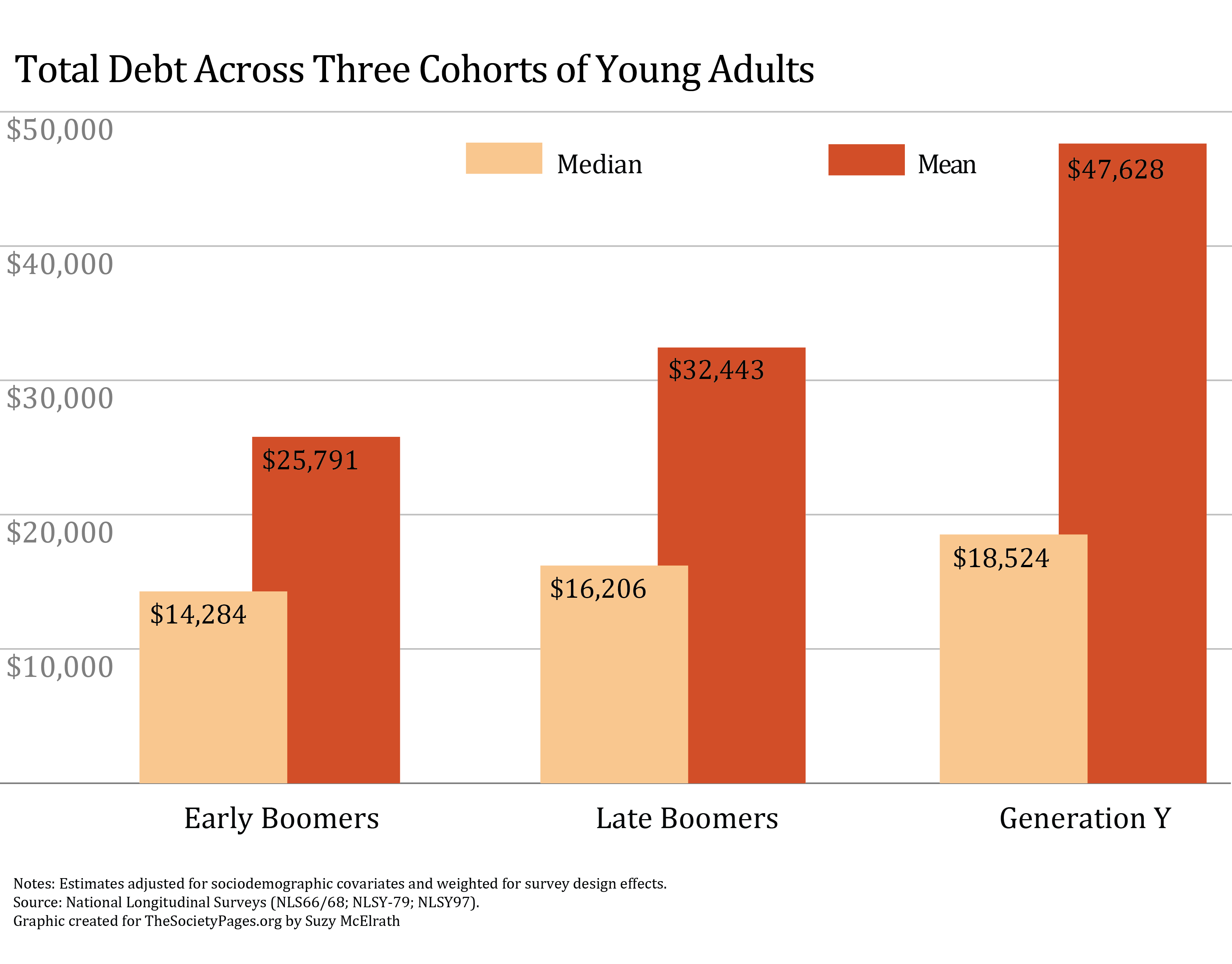
The graph below compares the amount of debt held by three generations in young adulthood (adjusted for inflation and controlled for other variables). Notice that the median debt load has grown, but the average debt load has grown much faster. This means that, while debt has grown over all, averages are also pulled up by a small number of young people that have really high levels.

1 (2) - Copy

Some evidence suggests that high debt individuals may be coming from lower income families. They take on debt as young people because the adults in their lives have already maxed out. They can’t count on their parents, for example, to take out a second mortgage on the house in order to pay for their college education. So, if they want to go to college, they have to take on the debt themselves.

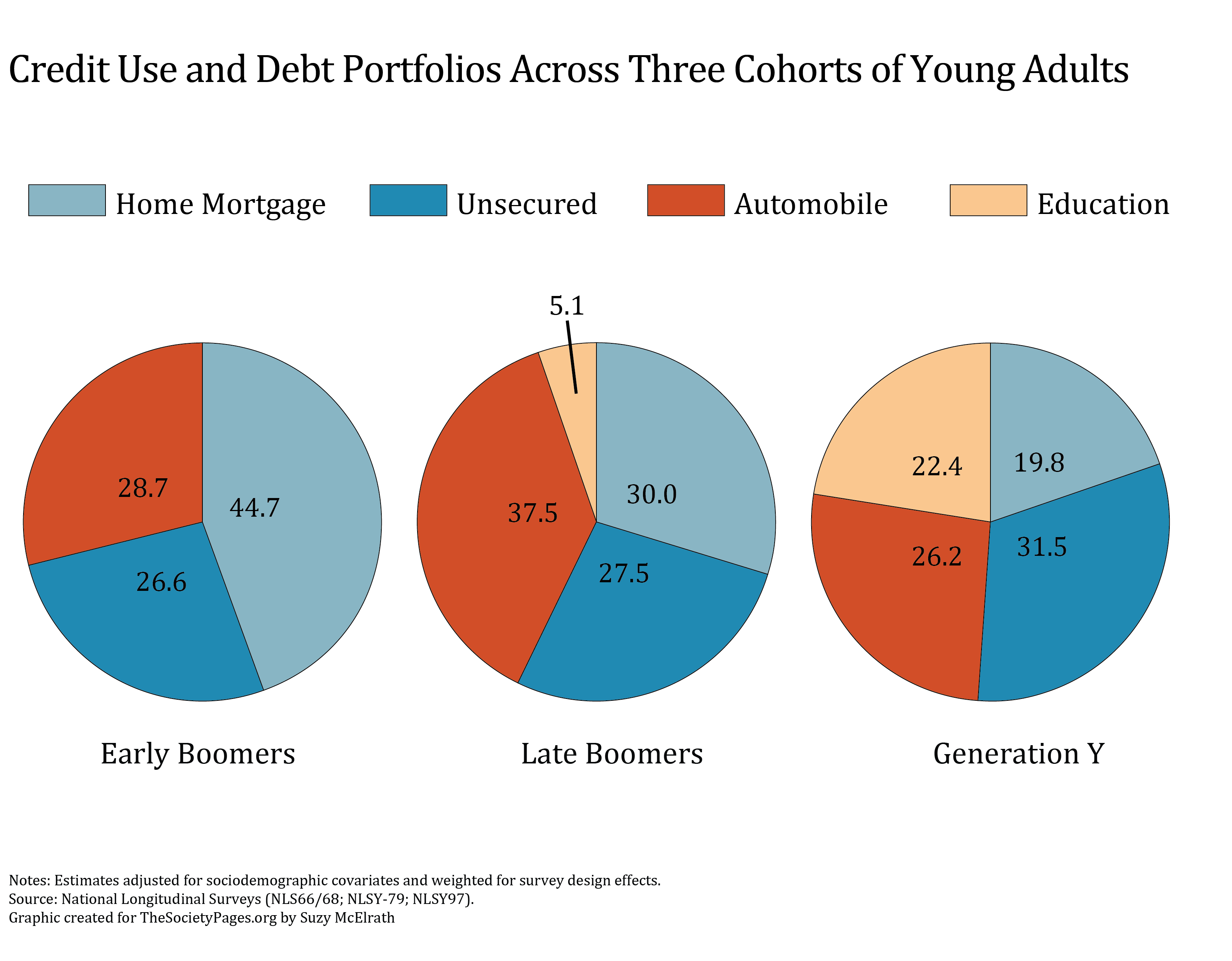
Houle’s analysis, however, also shows that the kind of debt has changed across the three generations. The pie charts below reveal that the proportion of debt accounted for by home or car loans has shrunk, while the proportion accounted for by education loans and unsecured debt, like credit cards, has risen.

1 (2)

Moreover, Houle argues that this profile of generation Y’s debt is class specific:

The more advantaged are able to take on debt that helps them pursue a middle class lifestyle and build their wealth, while the less advantaged must take on debt to pay their bills and keep their heads above water.

So, is massive financial risk the new recipe for success?

For some, the answer may be yes. But for many, the gamble does not pay off. Students that take out college loans, for example, are more likely to drop out of college than those who have a parent that can pay. The combination of school loans and minimum-wage jobs can add up to a lifetime of economic insecurity. But, without other resources, not risking at all almost guarantees failure in this economy.  For this reason, Houle argues, the availability of credit and acquisition of debt may be just another driver of income and wealth inequality.  It’s a disturbing story that you can read in more depth here.

Lisa Wade, PhD is an Associate Professor at Tulane University. She is the author of American Hookup, a book about college sexual culture; a textbook about gender; and a forthcoming introductory text: Terrible Magnificent Sociology. You can follow her on Twitter and Instagram.