Search results for The

A touching BBC story describes a new documentary, Menstrual Man, that chronicles the trials and tribulations of a humble man in India who sought to offer his wife a sanitary napkin.  After marrying, he discovered that his wife kept from him a secret: the rags she used and re-used to collect menstrual blood.

Only 12% of women in India used pads; they were simply too expensive for most to buy. Nearly three-quarters of all reproductive diseases were caused by poor menstrual hygiene.  A combination of high cost and embarrassment kept women from developing a safe method of managing menstruation.  Nearly a quarter of girls dropped out of school when they started their periods.

Arunachalam Muruganantham was driven to offer women a solution.  He was going to design a machine that would produce low cost menstrual pads.  He asked his wife to serve as an experimental subject, but one woman menstruating once a month wasn’t enough of a sample.  He asked medical students to participate, but the responses were slim.  He fashioned a fake uterus and collected goat blood, trying to experiment himself.

“Everyone thought he’d gone mad.”

His wife left, his mother left, his friends avoided him; it was suspected he was some kind of diseased or possessed sexual pervert, collecting menstrual blood to do god-knows-what.

Figuring out how to make highly absorptive cotton was a significant challenge.  He finally tricked a  multinational company into sending him samples of the raw material: cellulose from the bark of the tree.  Now he just had to design a cheap machine that would turn the raw material into pads.

Four-and-a-half years later, he was producing affordable menstrual pads for Indian women on a cheaply made machine.  He won an award.  His wife came back.

He built 250 machines, which he then took to the poorest areas of Northern India.  He gave them to women, at no profit, who could then produce the pads and sell them to local women.  Each woman now runs her own business.  “Over time the machines spread to 1,300 villages in 23 states.” He is now looking to expand to 106 more countries.

About his success, Muruganantham said:

Anyone with an MBA would immediately accumulate the maximum money. But I did not want to. Why? Because from childhood I know no human being died because of poverty — everything happens because of ignorance…. I have accumulated no money but I accumulate a lot of happiness.

Watch the trailer here.

Cross-posted at Pacific Standard.

Lisa Wade, PhD is an Associate Professor at Tulane University. She is the author of American Hookup, a book about college sexual culture; a textbook about gender; and a forthcoming introductory text: Terrible Magnificent Sociology. You can follow her on Twitter and Instagram.

Apparently universities are issuing guidelines to help professors consider adding “trigger warnings” to syllabi for “racism, classism, sexism, heterosexism, cissexism, ableism, and other issues of privilege and oppression,” and to remove triggering material when it doesn’t “directly contribute to learning goals.” One example given is Chinua Achebe’s “Things Fall Apart” for its colonialism trigger. This from New Republic this week.

I have no desire to enter the fray of online discussions on trigger warnings and sensitivity. I have used trigger warnings. Most recently, I made a personal decision to not retweet Dylan Farrow’s piece in the New York Times detailing Woody Allen’s sexual abuse. I was uncomfortable shoving a very powerful description at people without some kind of warning. I couldn’t read past the first three sentences. I couldn’t imagine how it read for others. So, I referenced the article with a trigger warning and kept it moving.

But, I’m not sure that’s at all the kind of deliberation universities are doing with their trigger warning policies. Call me cynical, but the “student-customer” movement is the soft power arm of the neo-liberal corporatization of higher education. The message is that no one should ever be uncomfortable because students do not pay to feel things like confusion or anger. That sounds very rational until we consider how the student-customer model doesn’t silence power so much as it stifles any discourse about how power acts on people.

I’ve talked before about how the student-customer model becomes a tool to rationalize away the critical canon of race, sex, gender, sexuality, colonialism, and capitalism.

The trigger warned syllabus feels like it is in this tradition. And I will tell you why.

In the last three weeks alone: a college student has had structural violence of normative harassment foisted on her for daring to have sex (for money), black college students at Harvard have taken to social media to catalog the casual racism of their colleagues, and black male students at UCLA made a video documenting their erasure.

It would seem that the most significant “issue” for a trigger warning is actual racism, sexism, ableism, and systems of oppression. Cause I’ve got to tell you, I’ve had my crystal stair dead end at the floor of racism and sexism and I’ve read “Things Fall Apart.” The trigger warning scale of each in no way compares.

Yet, no one is arguing for trigger warnings in the routine spaces where symbolic and structural violence are acted on students at the margins. No one, to my knowledge, is affixing trigger warnings to department meetings that WASP-y normative expectations may require you to code switch yourself into oblivion to participate as a full member of the group. Instead, trigger warnings are being encouraged for sites of resistance, not mechanisms of oppression.

At for-profit colleges, strict curriculum control and enrollment contracts effectively restrict all critical literature and pedagogy. We elites balk at such barbarism. What’s a trigger warning but the prestige university version? A normative exclusion as opposed to a regulatory one?

Trigger warnings make sense on platforms where troubling information can be foisted upon you without prior knowledge, as in the case of retweets. Those platforms are in the business of messaging and amplification.

That is an odd business for higher education to be in… unless the business of higher education is now officially business.

In which case, we may as well give up on the tenuous appeal we have to public good and citizenry-building because we don’t have a kickstand to lean on.

If universities are not in the business of being uncomfortable places for silent acts of power and privilege then the trigger warning we need is: higher education is dead but credential production lives on; enter at your own risk.

Tressie McMillan Cottom is a PhD candidate in the Sociology Department at Emory University in Atlanta, GA.  Her doctoral research is a comparative study of the expansion of for-profit colleges.  You can follow her on twitter and at her blog, where this post originally appeared.

13A few times on SocImages we’ve been tickled to highlight instances of very young children performing adult behavior.  In each (adorable) case, they were great examples of how children learn how to a culturally intelligible adult and particular kinds of ones at that.

Our favorites include the baby worshipper, baby preacher, baby Beyonce, baby rapper, and babies learn how to have a conversation. Seriously. Click on every single one of those links. You won’t be disappointed.

This one is of a little girl in a Baptist church in Bishkek, Kyrgyzstan mimicking a choir conductor.  It’s fantastic.

I’m sure you’ll have your own favorite thing about it, but mine is her intensity. Maybe it’s an indication of just how seriously she takes learning.  At one time, and in a different way in the modern world, learning to copy adults was a matter of life or death. This must be part of what it means to be a human child even today.

But it may also be part of the mimicry.  Conducting tends to be a pretty serious business. Maybe she’s just performing seriousness as part of the game, like her heartfelt facial expressions.

Either way, it’s a pretty impressive performance and a wonderful example of children’s active involvement in their own socialization.

Lisa Wade, PhD is an Associate Professor at Tulane University. She is the author of American Hookup, a book about college sexual culture; a textbook about gender; and a forthcoming introductory text: Terrible Magnificent Sociology. You can follow her on Twitter and Instagram.
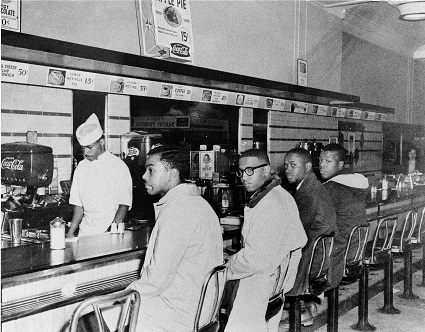
Ed, at Gin & Tacos, made a fantastic observation about this photo of a 1960 lunch counter sit-in at a Woolworth’s in Greensboro, NC, protesting the exclusion of black customers.

1

“The most interesting thing about it,” he writes:

…is that the employee behind the Whites Only lunch counter is also black. That’s curious, since on the scale of intimate social contact one would think that having someone handle your food ranks above sitting next to a fully clothed stranger on adjacent stools.

This, he observes, tells us something important about prejudice.

When I first saw this picture and learned about this period in our history… I thought that racism was about believing that another race is inferior. Like most people I got (slightly) wiser with age and eventually figured out that racism is about keeping someone else beneath you on the social ladder… If you actually thought black people were dirty savages you wouldn’t eat anything they handed you. But of course it has nothing to do with that. You’re fine being served food because servility implies social inferiority. And you don’t want to sit next to them simply because it implies equality.

When we observe efforts to uphold unequal social conditions, it’s smart to think past notions of hatred and fear (like the term homophobia unfortunately implies) and instead about how the privileged are benefiting and what they would lose along with their superordinate status.  Hate may be useful for justifying inequality, but at its root it’s about power and resources, not emotions.

Lisa Wade, PhD is an Associate Professor at Tulane University. She is the author of American Hookup, a book about college sexual culture; a textbook about gender; and a forthcoming introductory text: Terrible Magnificent Sociology. You can follow her on Twitter and Instagram.
The narrative of the American Dream is one of upward mobility, but there are some stories of mobility we prize above others.  Who is more successful: a Mexican-American whose parents immigrated to the U.S. with less than an elementary school education, and who now works as a dental hygienist? Or a Chinese-American whose parents immigrated to the U.S. and earned Ph.D. degrees, and who now works as a doctor?

Amy Chua (AKA “Tiger Mom”) and her husband Jed Rubenfeld, author of the new book The Triple Package, claim it’s the latter. They argue that certain American groups (including Chinese, Jews, Cubans, and Nigerians) are more successful and have risen further than others because they share certain cultural traits. Chua and Rubenfeld bolster their argument by comparing these groups’ median household income, test scores, educational attainment, and occupational status to those of the rest of the country.

But what happens if you measure success not just by where people end up — the cars in their garages, the degrees on their walls — but by taking into account where they started? In a study of Chinese-, Vietnamese-, and Mexican-Americans in Los Angeles whose parents immigrated here, sociologist Min Zhou and I came to a conclusion that flies in the face of Chua and Rubenfeld, and might even surprise the rest of us: Mexicans are L.A.’s most successful immigrant group.

Like Chua and Rubenfeld, we found that the children of Chinese immigrants exhibit exceptional educational outcomes that exceed those of other groups, including native-born Anglos. In Los Angeles, 64 percent of Chinese immigrants’ children graduated from college, and of this group 22 percent also attained a graduate degree. By contrast, 46 percent of native-born Anglos in L.A. graduated from college, and of this group, just 14 percent attained graduate degrees. Moreover, none of the Chinese-Americans in the study dropped out of high school.

These figures are impressive but not surprising. Chinese immigrant parents are the most highly educated in our study. In Los Angeles, over 60 percent of Chinese immigrant fathers and over 40 percent of Chinese immigrant mothers have a bachelor’s degree or higher.

At what seems to be the other end of the spectrum, the children of Mexican immigrants had the lowest levels of educational attainment of any of the groups in our study. Only 86 percent graduated from high school — compared to 100 percent of Chinese-Americans and 96 percent of native-born Anglos — and only 17 percent of graduated from college. But their high school graduation rate was more than double that of their parents, only 40 percent of whom earned diplomas. And, the college graduation rate of Mexican immigrants’ children more than doubles that of their fathers (7 percent) and triples that of their mothers (5 percent).

There is no question that, when we measure success as progress from generation to generation, Mexican-Americans come out ahead.

A colleague of mine illustrated this point with a baseball analogy: Most Americans would be more impressed by someone who made it to second base starting from home plate than someone who ended up on third base, when their parents started on third base. But because we tend to focus strictly on outcomes when we talk about success and mobility, we fail to acknowledge that the third base runner didn’t have to run far at all.

This narrow view fuels existing stereotypes that Chua and Rubenfeld play into — that some groups strive harder, have higher expectations of success, and possess a unique set of cultural traits that propels them forward.

For at least a generation, Americans have been measuring the American Dream by the make of your car, the cost of your home, and the prestige of the college degree on your wall. But there’s a more elemental calculation: Whether you achieved more than the generation that came before you. Anyone who thinks the American Dream is about the end rewards is missing the point. It’s always been about the striving.

Jennifer Lee, PhD, is a sociologist at the University of California, Irvine. Her book, The Diversity Paradox, examines patterns of intermarriage and multiracial identification among Asians, Latinos, and African Americans.  

Cross-posted at Time and Zocalo Public Square.

Let’s imagine that a woman — we’ll call her “you,” like they do in relationship advice land — is trying to calculate the odds that a man will call back after sex. Everyone tells you that if you sleep with a guy on the first date he is less likely to call back. The theory is that giving sex away at a such a low “price” lowers the man’s opinion of you, because everyone thinks sluts are disgusting.* Also, shame on you.

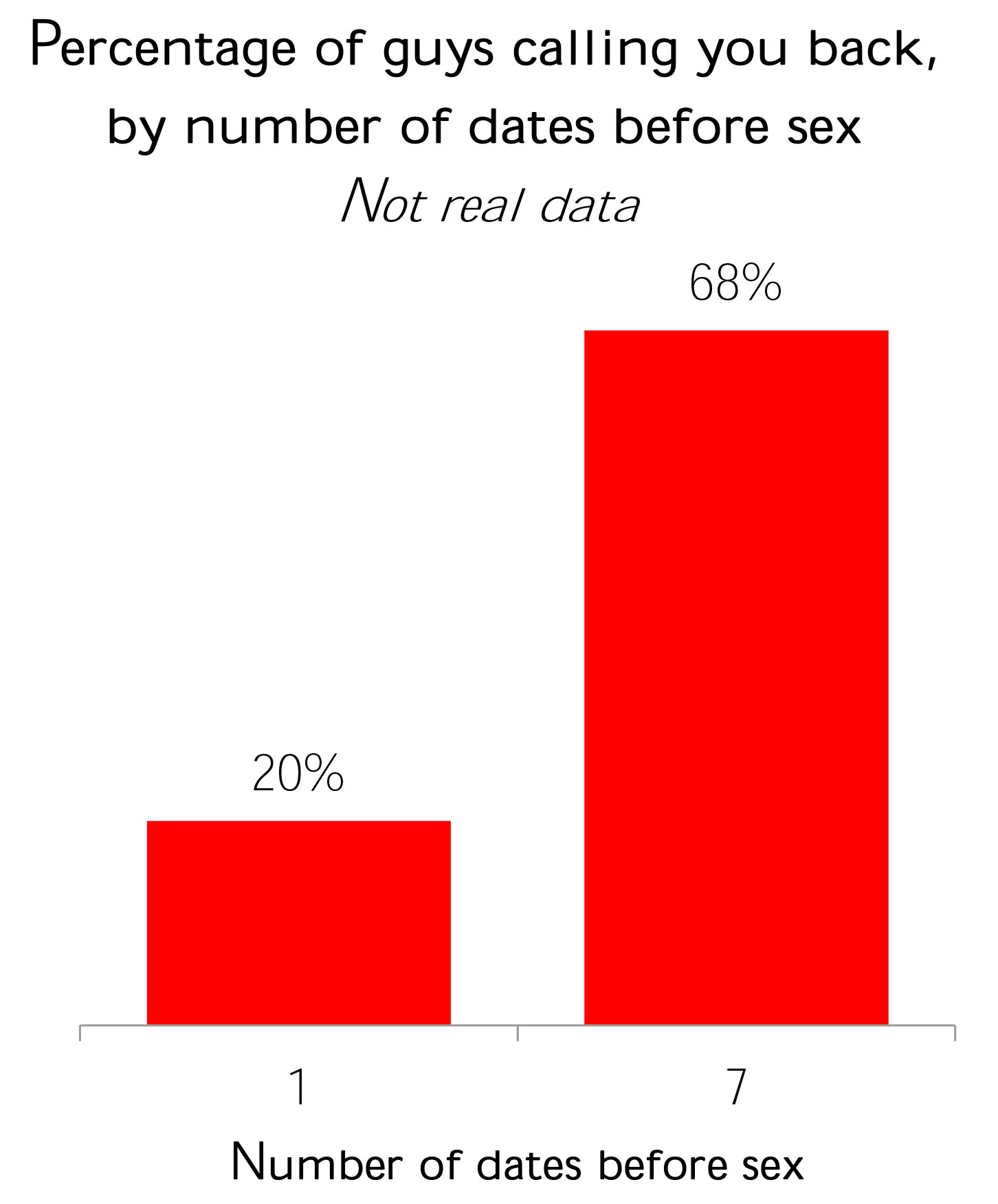
So, you ask, does the chance he will call back improve if you wait till more dates before having sex with him? You ask around and find that this is actually true: The times you or your friends waited till the seventh date, two-thirds of the guys called back, but when you slept with him on the first date, only one-in-five called back. From the data, it sure looks like sleeping with a guy on the first date reduces the odds he’ll call back.

1 (2)

So, does this mean that women make men disrespect them by having sex right away? If that’s true, then the historical trend toward sex earlier in relationships could be really bad for women, and maybe feminism really is ruining society.

Like all theories, this one assumes a lot. It assumes you (women) decide when couples will have sex, because it assumes men always want to, and it assumes men’s opinion of you is based on your sexual behavior. With these assumptions in place, the data appear to confirm the theory.

But what if that those assumptions aren’t true? What if couples just have more dates when they enjoy each other’s company, and men actually just call back when they like you? If this is the case, then what really determines whether the guy calls back is how well-matched the couple is, and how the relationship is going, which also determines how many dates you have.

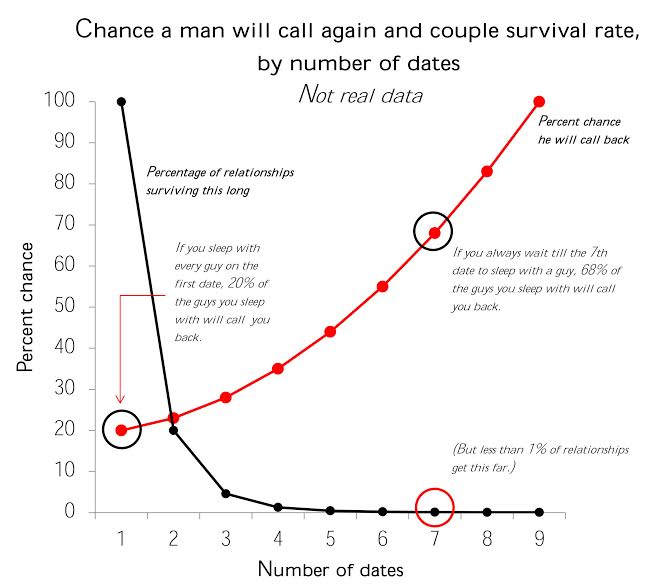
What was missing in the study design was relationship survival odds. Here is a closer look at the same data (not real data), with couple survival added:

5
(Graph corrected from an earlier version.)

.

By this interpretation, the decision about when to have sex is arbitrary and doesn’t affect anything. All that matters is how much the couple like and are attracted to each other, which determines how many dates they have, and whether the guy calls back. Every couple has a first date, but only a few make it to the seventh date. It appears that the first-date-sex couples usually don’t last because people don’t know each other very well on first dates and they have a high rate of failure regardless of sex. The seventh-date-sex couples, on the other hand, usually like each other more and they’re very likely to have more dates. And: there are many more first-date couples than seventh-date couples.

So the original study design was wrong. It should have compared call-back rates after first dates, not after first sex. But when you assume sex runs everything, you don’t design the study that way. And by “design the study” I mean “decide how to judge people.”

I have no idea why men call women back after dates. It is possible that when you have sex affects the curves in the figure, of course. (And I know even talking about relationships this way isn’t helping.) But even if sex doesn’t affect the curves, I would expect higher callback rates after more dates.

Anyway, if you want to go on blaming everything bad on women’s sexual behavior, you have a lot of company. I just thought I’d mention the possibility of a more benign explanation for the observed pattern that men are less likely to call back after sex if the sex takes place on the first date.

* This is not my theory.

Cross-posted at Family Inequality and Pacific Standard.

Philip N. Cohen is a professor of sociology at the University of Maryland, College Park, and writes the blog Family Inequality. You can follow him on Twitter or Facebook.

Prostitutes have often been at the forefront of challenges to gender conventions. Already at the fringes of “respectable society,” by choice or circumstance, these women often have less to lose than others.

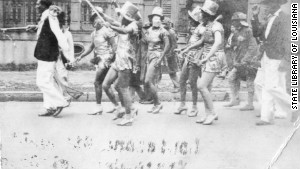
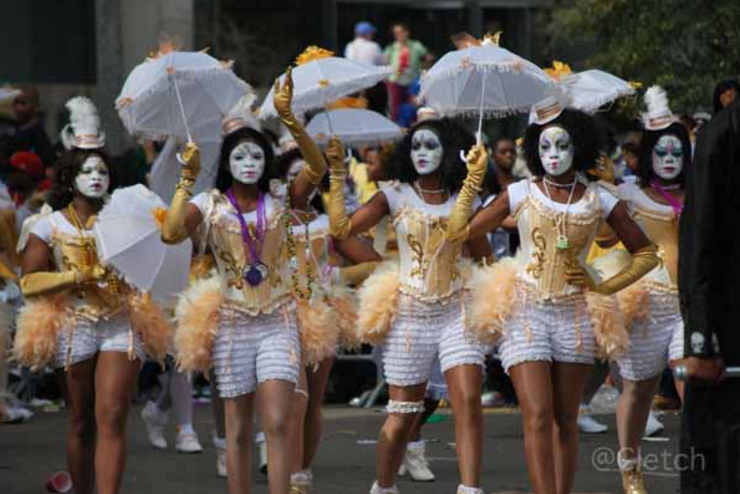
The Mardi Gras Baby Dolls are an excellent example.  NPR’s Tina Antolini writes that the baby doll tradition began in 1912.  That year a group of African American sex workers dressed up like baby dolls and took to the streets to celebrate Mardi Gras.

Baby dolls, 1930s (CNN):

5

Baby dolls, 1942:
babydolls1

Calling your lover “baby” had just become part of the English language.  Meanwhile, actual baby dolls, the toy, were rare.  By dressing up this way, they flouted both gender and race rules.  Women were largely excluded from masking for Mardi Gras and African Americans were still living under Jim Crow.  Black women, by virtue of being both Black and female, were particularly devalued, sex workers ever more so.  Asserting themselves as baby dolls, then, was a way of arguing that they were worth something.

“[I]t had all that double meaning in it,” explains historian Kim Vaz, “because African-American women weren’t considered precious and doll-like.”

It was a bold thing to do and the Baby Dolls carried walking sticks with them to beat off those who accosted them.

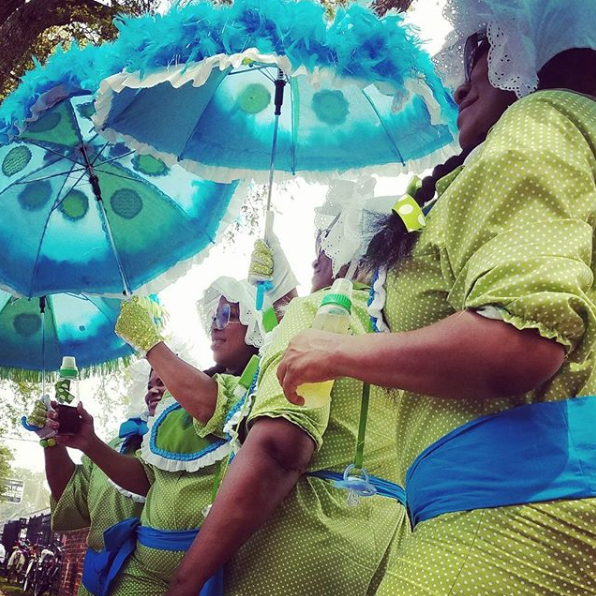
Today, honoring those brave women that came before, the tradition lives on in a city with the richest and most creative and unique traditions I have ever encountered.  Happy Mardi Gras, Baby Dolls!  Have a wonderful day tomorrow!

Flickr creative commons by Pat (Cletch) Williams.
Flickr creative commons dipfoto.
Instagram, by Lisa Wade.

For more, visit They Call Me Baby Doll.  Cross-posted at Pacific Standard.

Lisa Wade, PhD is an Associate Professor at Tulane University. She is the author of American Hookup, a book about college sexual culture; a textbook about gender; and a forthcoming introductory text: Terrible Magnificent Sociology. You can follow her on Twitter and Instagram.
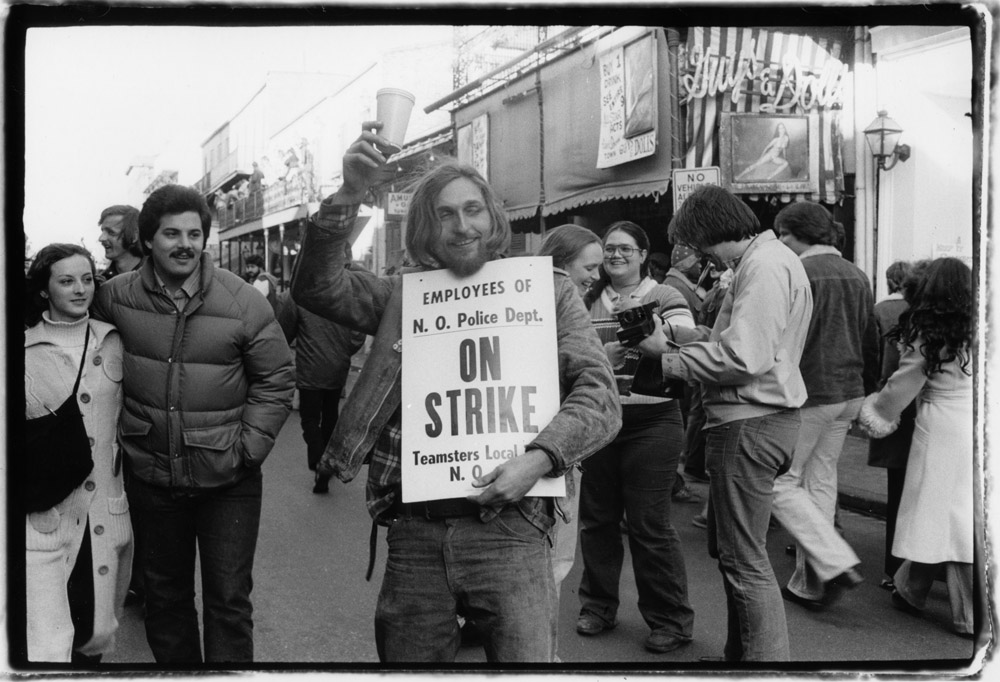
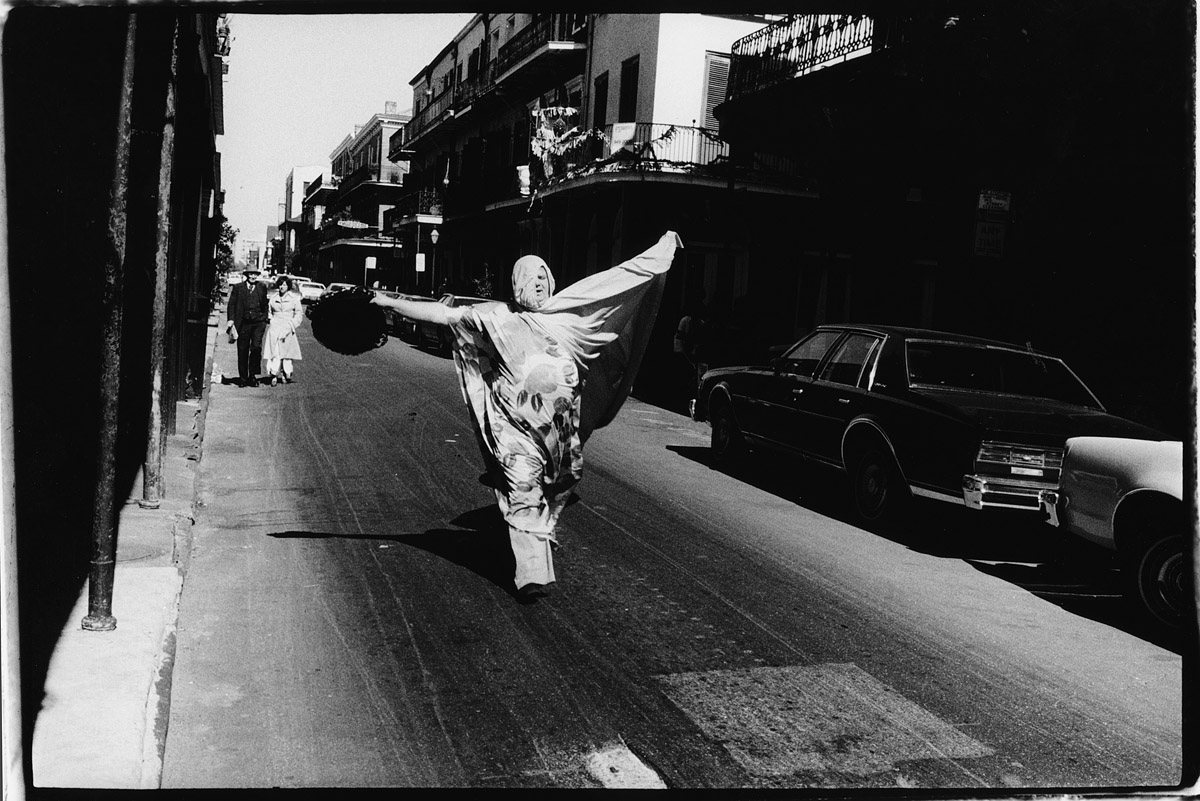
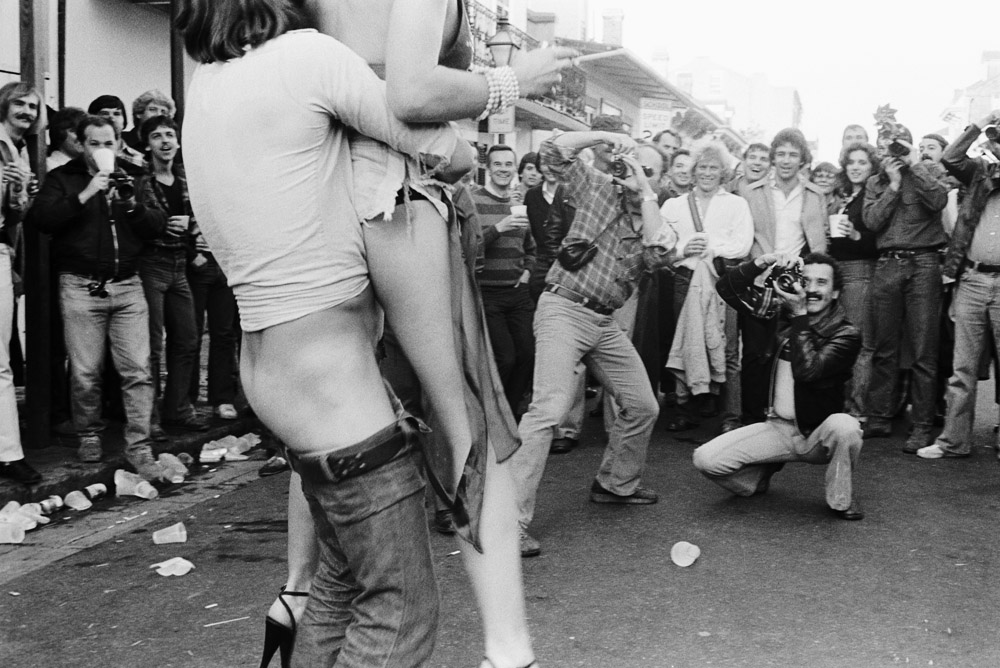
In 1979 the New Orleans police department went on strike, using the powerful leverage of Mardi Gras to push for an improvement in their working conditions.  The city held fast and the celebration was cancelled.  Ish.  Some parades moved just out of town.  Most tourists stayed away, fearful of unregulated reveling.  But lots of locals went forward with the holiday, partying in the streets without the influx of tourists that accompany a typical Fat Tuesday.

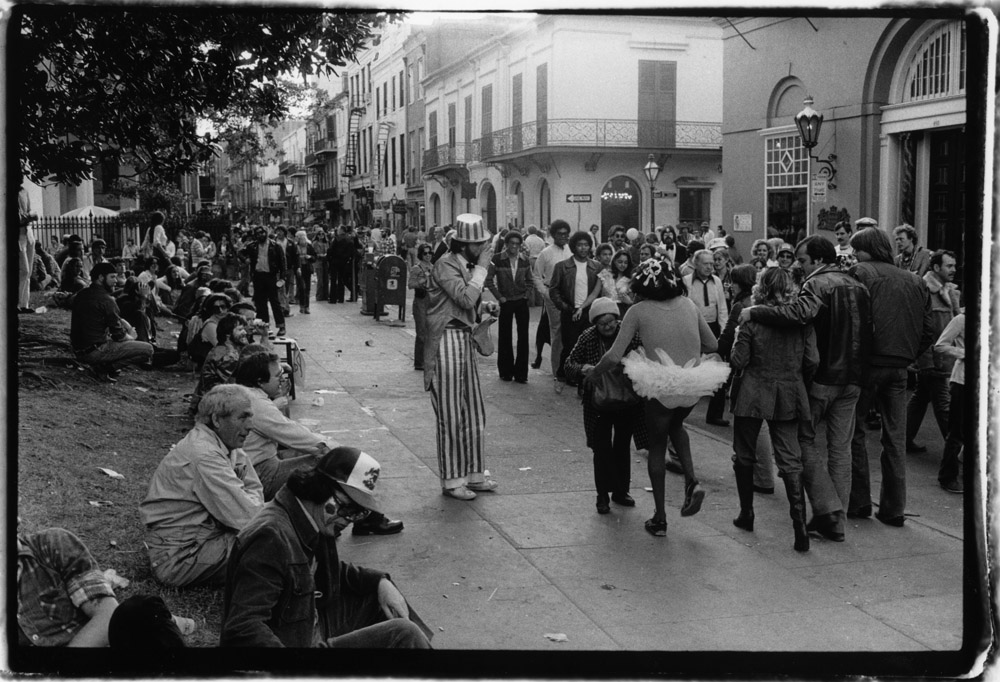
The National Guard was called in to ensure a semblance of order, but they ignored vice, intervening only against violence.  According to Wikipedia, many French Quarter locals decided it was the best Mardi Gras ever.  Photographer Robbie McClaran was there.  Here are some of his photographs of the day:

Untitled - New Orleans 1979Vintage photography from the late 1970s Untitled - New Orleans 1979

Of the last photo, McClaran writes: “I remember this scene like it was yesterday, it was the moment when I thought to myself Mardis Gras had reached a level of surreality I had never experienced before. Homeless woman dancing with a man in a tutu while Uncle Sam looks on and salutes.”

Untitled15

Le bon temps roule, everybody.

Lisa Wade, PhD is an Associate Professor at Tulane University. She is the author of American Hookup, a book about college sexual culture; a textbook about gender; and a forthcoming introductory text: Terrible Magnificent Sociology. You can follow her on Twitter and Instagram.