Search results for The

Dimitriy T.M. let us know about the Bureau of Labor Statistics American Time Use Survey website, which has lots of fascinating information. The ATUS data for 2009 was just released but they don’t have charts available yet, so I’m presenting data from 2008 here.

This shows daily time spent in various activities for women who are married and have children under 6 living in the home, by their employment status:
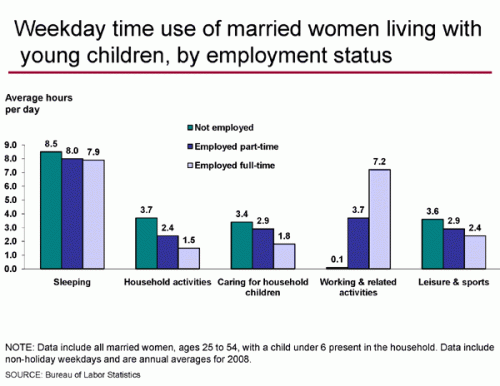
They didn’t provide a similar breakdown for married men, oddly.

Hours spent daily on household chores, by sex (but not broken down by employment status):
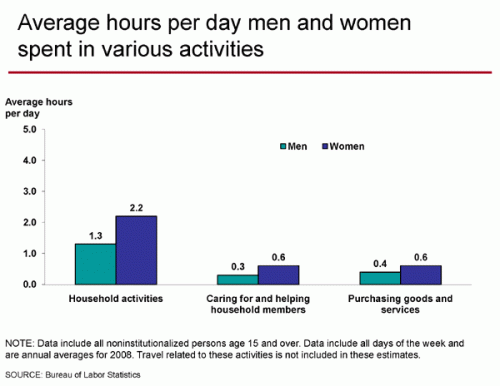
The difference in hours spent on household activities is interesting, but since it’s not broken down by employment, and women are less likely to be employed full-time than men, it doesn’t really tell us to what degree this is women doing a “second shift” vs. household management as their primary activity, so that’s sort of annoying.

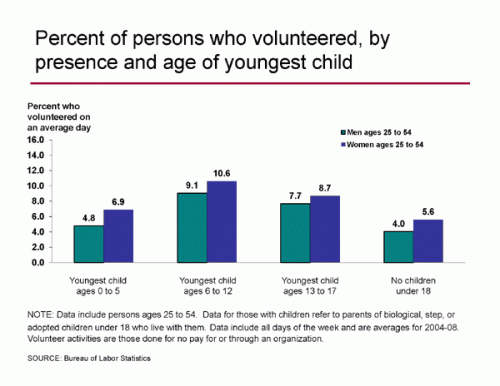
Volunteer activity by sex and age (notice that the columns represent the average daily % of the population who volunteered, not the number of hours they spent volunteering, and the data is an average for 2004-2008):

This isn’t surprising, given that social scientists have generally found that women do more volunteer work, more regularly, than men (again, I’d like to see this broken down by employment status).

It’s also interesting that men and women who volunteer tend to do different types of activities. As this graph shows, it mimics the indoor/outdoor household chores pattern we see in family life. Women are more likely to do food preparation, while men are more likely to do maintenance. Also, men seem somewhat more likely to have leadership positions or to attend skills-building activities, while women do organizational stuff:

For both men and women, volunteering is most common for those with school-aged children in the household, indicating that a lot of volunteering is probably for child-centered organizations such as sports teams and PTA meetings:
I was somewhat surprised by the relationship between volunteering and educational level. The percent of people who volunteer goes up with more education, but the hours spent volunteering per day goes down:
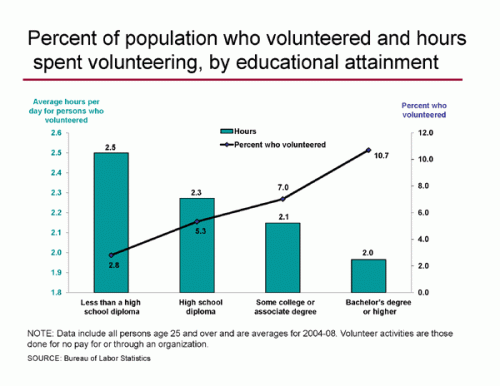
Though the daily difference isn’t huge (just a half hour less for those with a 4-year college degree and those with less than a high school degree), over the course of a month or year it would certainly add up.

If you go through the raw data files, I’m sure there are all types of interesting relationships that give more detailed information about sex, employment status, and time usage. A fun way to waste time if you ever need a procrastination tool.
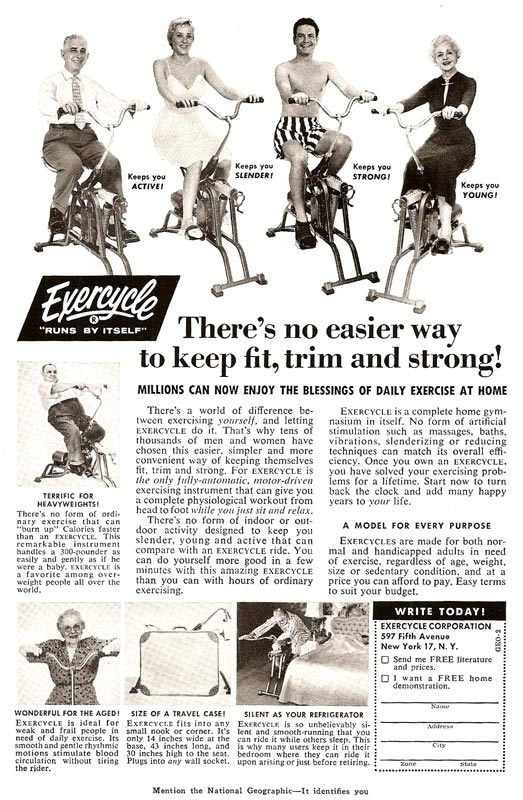

This 1957 ad for an Exercycle tells young and old women and men exactly what they should be concerned about:

So old women are supposed want to be young, young women want to be slender, young men want to be strong, and old men want to be active.  I think it’s pretty much the same today.

Vintage Ads.

Lisa Wade, PhD is an Associate Professor at Tulane University. She is the author of American Hookup, a book about college sexual culture; a textbook about gender; and a forthcoming introductory text: Terrible Magnificent Sociology. You can follow her on Twitter and Instagram.

Talking Points Memo has an article about a new advertising campaign from Spirit Airlines (as of this morning the images are still available on their homepage, though I presume — hope — they’ll be taken down soon). In order to highlight their fares to coastal locations no affected by the oil spill, they created an ad campaign titled “Best Protection”:

Get it? BP? Oh, funny.

The ads show bikini-clad women sunning themselves on the beach and carry the tagline “check out the oil on our beaches.” Two examples:

Honestly, I’m just stunned. Seriously, how do these things get made? Who comes up with this, and how is it that nowhere along the line from the idea to actually putting the images up on the website does someone in authority say, “Um, I think this is a really bad idea.”

Classy, Spirit Air. Classy.

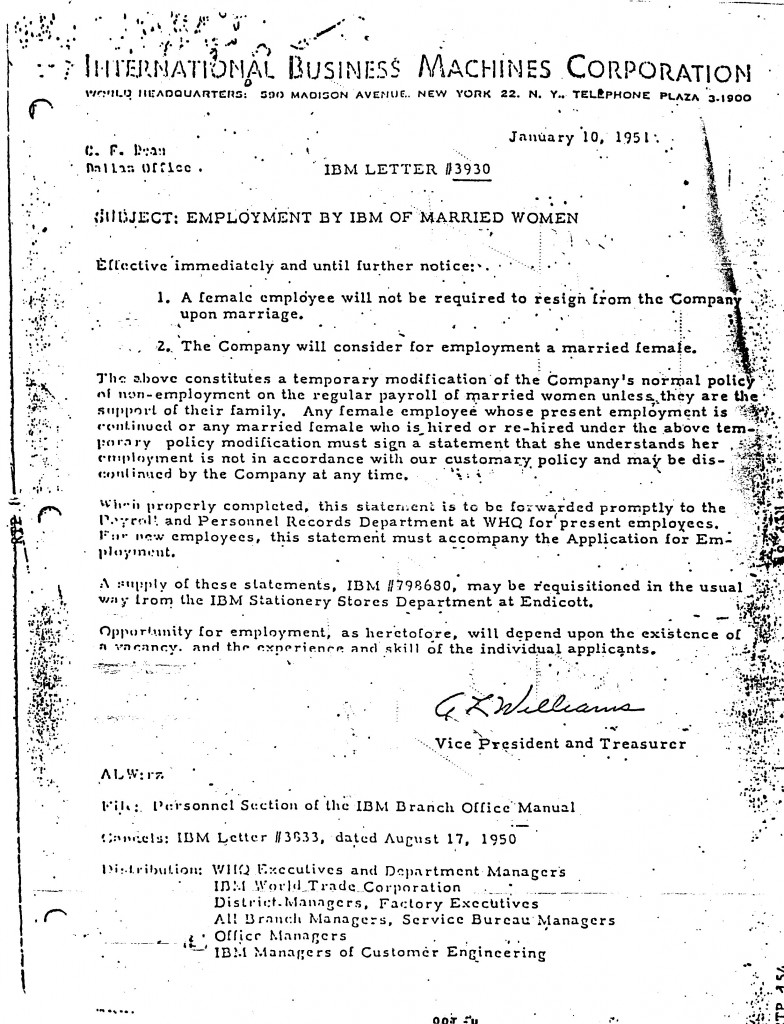
Marc Sobel sent in this IBM memo from 1951 that announces a “temporary modification” of corporate policy to allow married women to work at the company:

This is the type of thing that often turns out to be a hoax so I spent some time searching, but I can’t find any evidence that it isn’t authentic.

Also see: reasons not to hire women and if you don’t fire women, men have to be bums.


Neha M. sent us this fun little video that looks at women in beer commercials. Enjoy!

The Equal Justice Initiative just released a report about racial bias in jury selection, particularly in the South. I first heard about it on NPR. Racial discrimination in jury selection is illegal, but evidence suggests it’s still quite common, particularly through the use of peremptory challenges (the ability of attorneys to exclude a certain number of potential jurors without having to say why or justify it).

The results are striking; for instance, “…in Houston County, Alabama, 80% of African Americans qualified for jury service have been struck by prosecutors in death penalty cases” (p. 4 of the report).

Here’s a short video about one case:

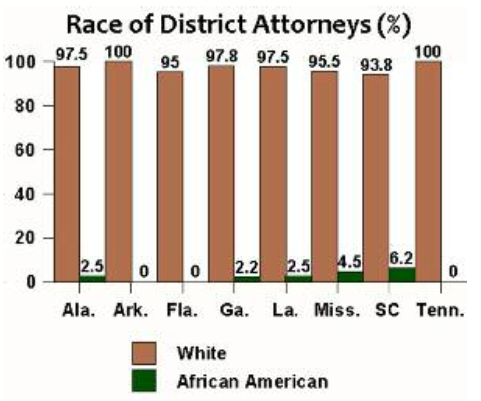
The report doesn’t have as many informational images as I’d like, but here’s one showing the race of District Attorneys in several Southern states:

This video gives a historical overview, though it’s maybe not the most captivating description you’ll ever encounter:

And with that, dear readers, I’m off to court, as I got a jury summons and now must find out if I’ll end up on an actual jury. I’m taking lots of reading material.


Today we’ve got two examples of the sexual objectification of Black men.

Margaret M. sent us this commercial she recently saw on TV in Budapest. It’s for an ice cream bar called Maxi King, and I think it’s not stretching to say that the ice cream bar is a stand-in for the guy’s penis:

The placement of the container she takes it out of, her sexy look, the shot of the ice cream with the white center and the caramel goo…yeah, that’s a penis. And the commercial is playing on the stereotype that Black men are particularly well-endowed. Massive satisfaction!

In both cases, Black men’s sexuality is fetishized for White audiences. They represent a fantasy of exotic, hypersexual, and sexually-gifted Black men. While the stereotype could appear positive — after all, they’re presented as desirable sexual partners — the flip side is that Black men are thus also often presented as more animalistic and sexually aggressive than White men, a stereotype that has been used against them time and time again.

And as we see in the second commercial, representing a fantasy means you are interesting because of that fantasy, not because of who you are. When the man failed to live up to the woman’s fantasy, not only did she no longer find him attractive, she and her friend found the situation laughable…because you certainly wouldn’t want to sleep with, or even date, a Black man from Shropshire. If he’s not an exotic sexual fantasy, what’s the point?

UPDATE: Reader Carlo says,

I took the joke in the second commercial to be on the woman. She allowed her race based assessment of the man as an exotic other to make a fool of her when the man proved to be just like her (from somewhere local). Even though this commercial is obviously playing on recognized stereotypes (women find exotic men attractive), it sort of points out the ridiculousness of those assumptions. In the end, her friend is laughing at her for being, essentially, that daft white audience that equates blackness with the exotic.

For another take on fetishizing Black men, see our post on male sex workers in the Caribbean.

Gwen Sharp is an associate professor of sociology at Nevada State College. You can follow her on Twitter at @gwensharpnv.

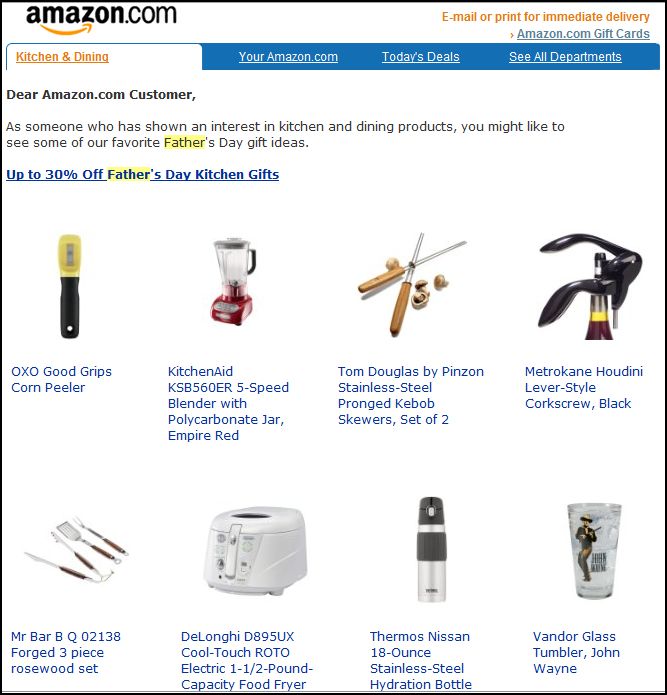
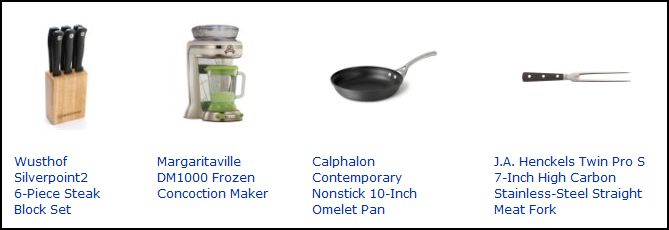
Lisabee received an Amazon ad in her inbox for “Father’s Day Kitchen Gifts” that, at first glance, appeared to challenge the stereotype that men don’t cook.  Upon opening it, however, it turns out that it masculinizes cooking activities.  It’s a nice example of the trend of de-feminizing items in order to make them safe for dudes who generally have to stay far away from the stigma of femininity.  What do we have?

Corn peelers with “good grips” for those aggressive peeling sessions;

A blender with a “polycarbonate jar” (how science-y!);

A corkscrew named after a famous magician and a John Wayne-themed tumbler;

Stuff for “Mr Bar B Q”;

A fryer (and what’s more masculine than fried food);

Stuff for meat.

And there’s other stuff, too, but I would bet that cooking items marketed for Mother’s Day would look significantly different.

Lisa Wade, PhD is an Associate Professor at Tulane University. She is the author of American Hookup, a book about college sexual culture; a textbook about gender; and a forthcoming introductory text: Terrible Magnificent Sociology. You can follow her on Twitter and Instagram.