Search results for The

Ryan was browsing the Walmart website for a toy for his soon-to-be one-year-old child and happened upon this play cop car:

Both boys and girls can aspire to be cops, of course, but the specifications on the product insist that it is for boys:

See also our post in which the exact same toy is marketed to boys as a doctor’s kit and to girls as a nurse’s kit.

—————————

Lisa Wade is a professor of sociology at Occidental College. You can follow her on Twitter and Facebook.
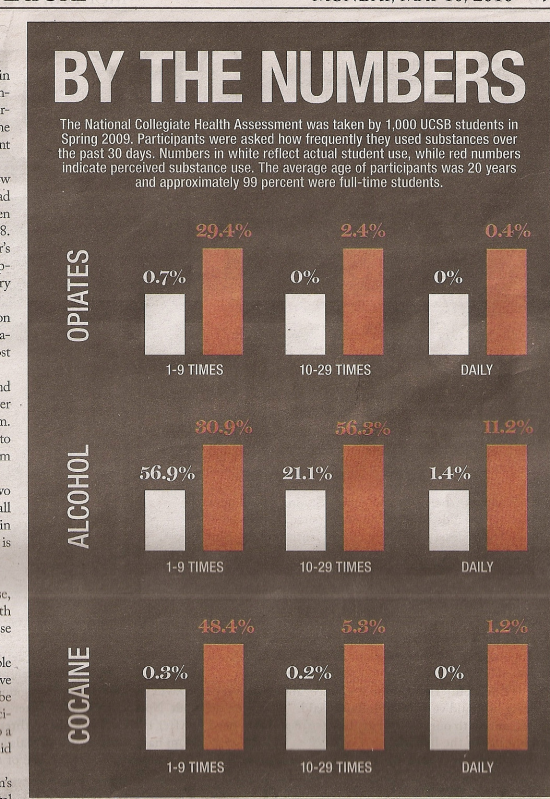
The phrase “pluralistic ignorance” refers to a situation where a large proportion of a population misunderstands reality.  They may all agree, but they are, nonetheless, mistaken.  This data on University of California-Santa Barbara students from the National Collegiate Health Assessment is a great illustration of this idea; it’s also a great illustration, however, of a terrible, terrible illustration.

Let’s get past the bad graphic first.  The white bars (which represent the percent of people reporting that they themselves used opiates, alcohol, or cocaine) are all the same height, despite the fact, for example, that 56.9% of students reported using alcohol 1-9 times in the last month, but only 0.3% reported using cocaine.  So the bars do not actually represent the percentages they are supposed to.  The red bars (which represent the percent of people that respondents think are using drugs and alcohol) suffer from the same problem.  In one case, the white bar should be even higher than the red bar.

But, if we can get past the poor graphic, then the information is really interesting.  In all but one case, the number of people reporting drug and alcohol use is smaller than the perceptions of how many people are using these substances.  For example, looking at the middle column, (almost) no one reports using opiates or cocaine 10-29 times last month, but students perceive  that 2.4% and 5.3% of the population (respectively) are; similarly, 21.1% of students report drinking alcohol 10-29 times last month, but they perceive that over half the population is drinking that frequently.

This pattern is consistently true in all cases except for the percentage of people who drank alcohol 1-9 times in the last month.  The majority of respondents who drink reported that they did so at that rate, but they perceive that others are drinking far more than they are.  The overall impact of the illustration, then, is correct.  On the whole, students perceive more drug and alcohol use than they report.

It’s possible that people are underreporting and their perceptions are more true than the self-reports.  If their self-reports are more true, however, than we have a case of pluralistic ignorance.  In this case, students agree that the rate of drug and alcohol use is higher than it actually is.  They may, then, feel pressure to drink and do drugs more frequently to fit in, even as doing so results in just the opposite.

Eager Eyes, via Flowing Data.

—————————

Lisa Wade is a professor of sociology at Occidental College. You can follow her on Twitter and Facebook.

Many of you have probably by now seen this video of a group of young girls dancing to Beyonce’s Single Ladies on the World of Dance tour.  Huong L., Jeff S., and Dmitriy T.M. sent it in and asked us to comment on it.  First, the video… which is stunning:

I think I’ve watched this a half dozen times and I’m mesmerized.

But to the analysis…

After the Single Ladies video came out there was a rash of parents uploading videos of their kids dancing along to the video.  We featured a particularly impressive example of a preschool-aged girl dancing to the video and offered it as an example of how kids are active agents in their own socialization.  You might also apply this idea to this video, sent in by Heather B. (which I am not going to comment on because I can’t figure out the context).

Certainly children do make choices about what to mimick.  In a culture that highly sexualizes young girls, we shouldn’t be that surprised when they make choices that we find incongruent with (our beliefs about) childhood.  The World of Dance routine, however, is not simply an example of children being active in their own socialization and responding to the powerful messages of self-objectification aimed at girls of all ages.  In this case, many, many adults were instrumental in producing the product: their dance teacher(s), the choreographer, their parents, and the producers of the tour, to name the obvious.  These girls are performing a highly sexualized routine because many adults chose to sexualize them.

For more examples of the sexualization of young girls, see our posts on sexually suggestive teen brands, adultifying children of color, “trucker girl” baby booties, “future trophy wife” kids’ tee, House of Dereón’s girls’ collection, “is modesty making a comeback?“, more sexualized clothes and toys, sexist kids’ tees, a trifecta of sexualizing girls, a zebra-striped string bikini for infants, a nipple tassle t-shirt, even more icky kids’ t-shirts, “are you tighter than a 5th grader?” t-shirt, the totally gross “I’m tight like spandex” girls’ t-shirt, and a Halloween costume post.

—————————

Lisa Wade is a professor of sociology at Occidental College. You can follow her on Twitter and Facebook.

Lisa Wade, PhD is an Associate Professor at Tulane University. She is the author of American Hookup, a book about college sexual culture; a textbook about gender; and a forthcoming introductory text: Terrible Magnificent Sociology. You can follow her on Twitter and Instagram.

Dmitriy T.M. and Andrew L. sent a link to a collection of post-World War I men’s magazine covers. They are a window into a time when being a man was clearly a very distinct achievement, but much less related to consumption than it is today.

Today’s men’s magazines emphasize control over oneself and the conquest of women, as do these vintage magazines, but instead of tests of strength, cunning, and fighting ability, they emphasize conquest through consumption. The message is to consume the right exercise, the right products (usually hygiene or tech-related), the right advice on picking up women and, well, the right women. In contrast, these old magazines pit man against nature or other men; consumption has not yet colonized the idea of masculinity.

View a selection of the covers at The Art of Manliness.

Lisa Wade, PhD is an Associate Professor at Tulane University. She is the author of American Hookup, a book about college sexual culture; a textbook about gender; and a forthcoming introductory text: Terrible Magnificent Sociology. You can follow her on Twitter and Instagram.

Sorry for the sporadic posting. I’m visiting family in Oklahoma and that means very, very limited internet access.

Zac from Georgia sent in a link to some interesting images that illustrate the mismatch between what the federal government spends money on and what the media cover. This image shows spending only via federal contracts (not all spending) compared to all articles in the New York Times in 2009 (granted, a very small sample of all media coverage, so keep that in mind):

Contract spending data is available here.

This time we have all spending, not just spending through contracts; the Department of Defense has dropped down to 4th place:


Gwen Sharp is an associate professor of sociology at Nevada State College. You can follow her on Twitter at @gwensharpnv.

What happens when huge numbers of people lose their homes?   Hundreds of thousands of Haitians lost their homes in the giant earthquake that struck Port-au-Prince in January.  Six months later, resource-poor and with little help from their government, they remain homeless.  When there are that many displaced people, where do they live?  Apparently, everywhere.  This week NPR reported that about 1,000 people are living in 326 make-shift structures on an 8-foot-wide median dividing one of Haiti’s busiest roads.

If private property is off-limits, public space fills up, and temporary housing isn’t provided, where are people to go?

—————————

Lisa Wade is a professor of sociology at Occidental College. You can follow her on Twitter and Facebook.

Lisa Wade, PhD is an Associate Professor at Tulane University. She is the author of American Hookup, a book about college sexual culture; a textbook about gender; and a forthcoming introductory text: Terrible Magnificent Sociology. You can follow her on Twitter and Instagram.

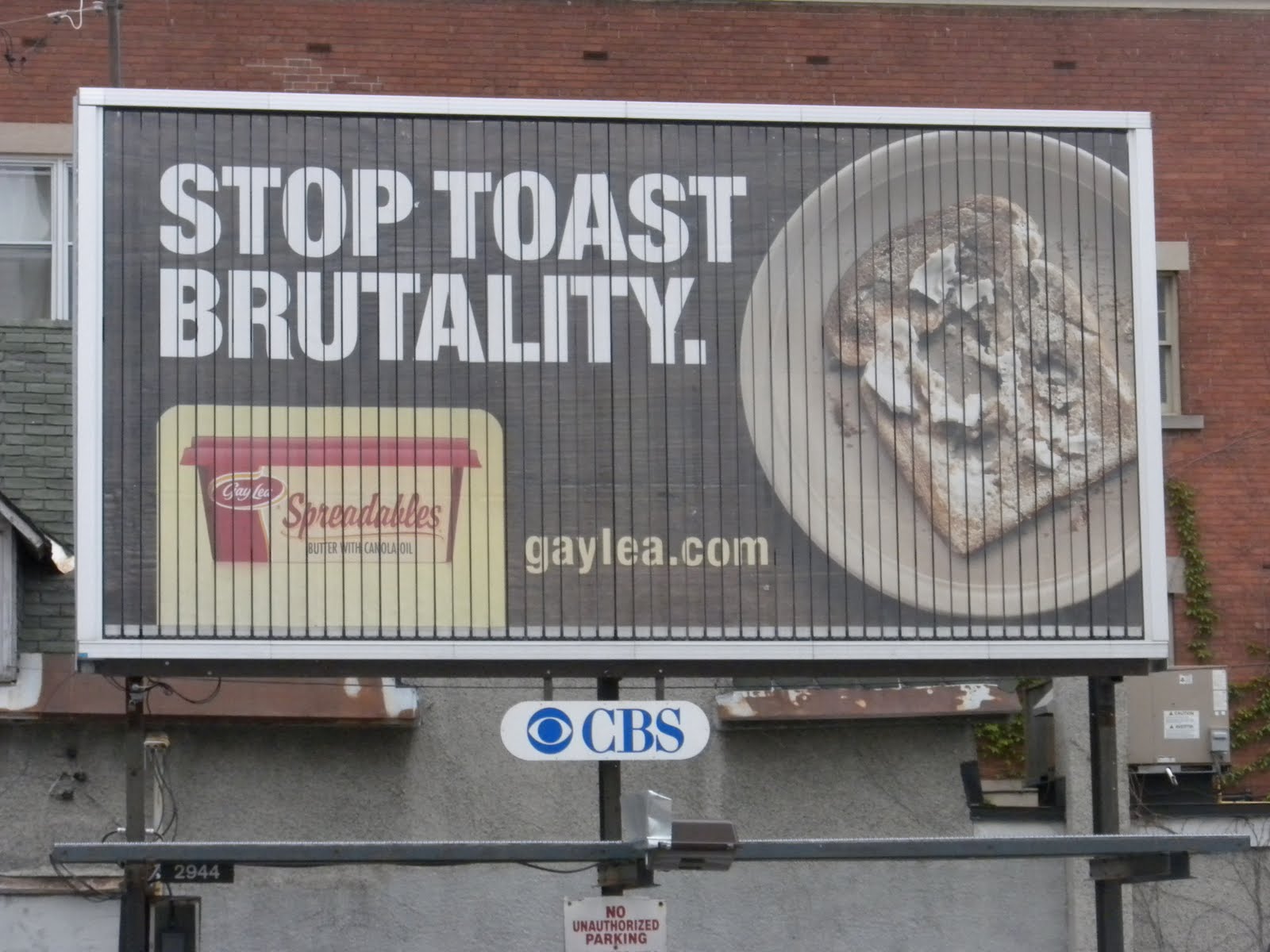
Tom Megginson blogged about a billboard advertising Gaylea spreadable butter that made fun of brutality… affixed to the back of a women’s shelter in Ottawa:

See also our post featuring dueling advertising and public service announcements.

—————————

Lisa Wade is a professor of sociology at Occidental College. You can follow her on Twitter and Facebook.
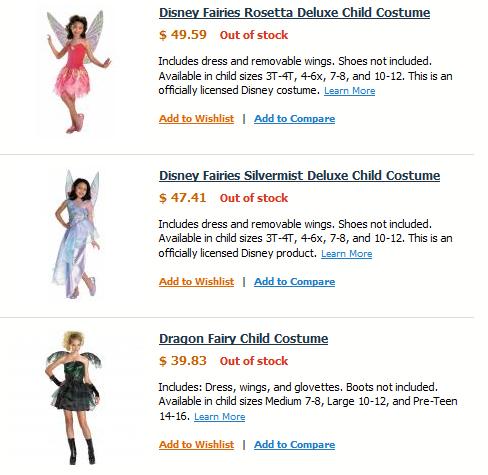
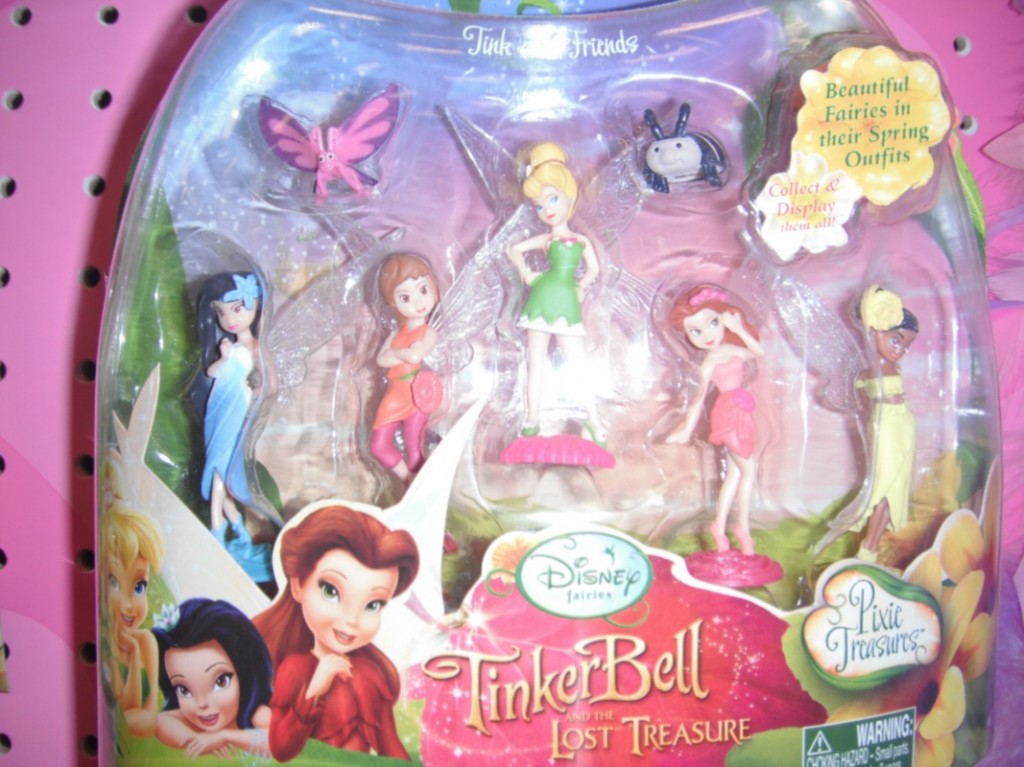
There are masculine and feminine versions of standing, ones that many adults reproduce rather consistently, and boys and girls must learn which stances are which.  To illustrate this, Miriam H. sent us a photograph of a package of Tinkerbell figurines and a screen shot of a web page selling fairy costumes.  These images — two among many possible examples — nicely show how girls are taught, from a very young age, how to stand.

See also a related post: Male Models Display Clothes; Female Model Display Themselves.

—————————

Lisa Wade is a professor of sociology at Occidental College. You can follow her on Twitter and Facebook.
Lisa Wade, PhD is an Associate Professor at Tulane University. She is the author of American Hookup, a book about college sexual culture; a textbook about gender; and a forthcoming introductory text: Terrible Magnificent Sociology. You can follow her on Twitter and Instagram.