Search results for The

Kasia G. and Tom M. sent in this remarkable product designed to smooth out…     wait for it…     camel toe.

That’s right, women.  Listen up.  We want you to wear clothes so tight that we can see every bump and crevice on your body, but see… we don’t want you to actually have bodies.  Can you work on that for us, please?

(source)

(source)

Lisa Wade, PhD is an Associate Professor at Tulane University. She is the author of American Hookup, a book about college sexual culture; a textbook about gender; and a forthcoming introductory text: Terrible Magnificent Sociology. You can follow her on Twitter and Instagram.

Diego Costa recently pointed out to us the sexualization of Jaden Smith. In that post, I wondered if race played much of a part in this process; while non-White boys are often adultified, it wasn’t clear to me that it was a major factor in this case. Diego followed up by sending along some photos of White teen heartthrob/pop star Justin Bieber, who you may know better as that kid on the cover of magazines whose hair you desperately want to brush out of his eyes. He’s a bit older than Jaden, so the idea of him dating or talking about girls isn’t surprising, but the specific example Diego sent in is.

Apparently Justin Bieber, who is 16, met Kim Kardashian, the 29-year-old reality-TV personality and model, earlier this year at the White House Correspondents’ Dinner (and no, I didn’t know teen pop stars go to the Correspondents’ Dinner, either). Apparently after she Tweeted that she had “Bieber fever” and he joked about her being his “girlfriend,” Bieber fans flipped out and sent her death threats and such.

Following this, the two recently posed together for a fashion shoot for Elle, presumably making fun of and capitalizing on the earlier frenzy and publicity regarding their friendship. The photo shoot had them walking on the beach, in the water, holding hands, and in other ways hinting at romance; in some cases, Bieber’s light-colored shirt is wet and you can see his entire chest through it:

Diego asks how this would go over if the roles were reversed: if Elle had images of a 16-year-old female teen star in a see-through shirt walking on the beach with, or getting a flower from, a 29-year-old male celebrity “mostly known for…posing nude several times and making money off of his condom-free sex tape…” (after a sex tape of Kardashian with her ex-boyfriend appeared, she sued and settled with the company distributing it for $5 million).

I’m not trying to stigmatize Kardashian; I’m not interested in her, or why she’s famous, here. But I think Diego has a very good point: it’s unlikely many people will think this is an inappropriate sexualization of Bieber (though perhaps Kardashian will need some extra security guards when Bieber’s fans see these). As the reaction to Jayden Smith indicates, we accept the idea of boys being sexual, or sexually interested, at younger ages than girls, and any interest they show in older girls or women is a sign of their sexual precocity — and, of course, heterosexuality — not a sign that they are either in danger of being preyed upon or that they are tempting Lolitas (and thus dangerous to men). We simply don’t worry as much about a 16-year-old teen boy shown in a photo like this because we don’t think of sexuality being dangerous for them in the way we think it is for girls.

UPDATE: Sorry comments were previously turned off — some type of glitch.

Stephanie DeH., Cara McC., and our intern, Lauren McGuire, sent in this CPR certification campaign that embraces the idea that sex sells.  I initially added it to our post on using sex to sell unlikely things (e.g., organ donation and sea monkeys), but I changed my mind and decided it deserved its own discussion.

What was interesting to me about this example is the sexualization of the possibility of dying. The fact that a person might die is apparently not serious enough to make it unsexy.  It actually took me a minute to even notice the weirdness of sexualizing the risk of death.  After I noticed I thought “How crazy!”  But then I thought again: in a society that regularly sexualizes violence and murder, the sexualization of near-death is par for the course (which, of course, is why it didn’t strike me as particularly weird in the first place.

NSFW and possibly triggering, so images are after the jump:

more...

Tom Megginson alerted us to an interesting example of “astroturf” activism.  After complaints from religious groups, the New York City transit authority took down the following ads from buses running through largely Hasidic Jewish communities:

Georgi Vodka saw the move as a marketing opportunity and hired models to wear the bikini pictured in the ad and pretend to protest the censorship.  Playing on their nudity, their signs had slogans such as “MTA should butt out of bikini ads.”

To contrast this with genuine grassroots campaigns in which “regular” people come together to try to change something about their society, sociologists call this type of marketing “astroturf” activism, fake protests arranged and paid for by companies.

So first we have a religious community expressing its displeasure to the city regarding an advertising campaign they find offensive.  They organize, in true grassroots fashion, to have the ads removed from the buses that travel through their neighborhoods.  Then a company hires people to put on a counter-protest, in true astroturf fashion, turning what was a simple case of collective action into (an apparent) social conflict.  But, as is characteristic of astroturf movements, Georgi isn’t doing it in an effort to shape society into a form that it finds good and beneficial (as the Jews are, whether you agree with their opinion or not), they’re simply trying to make money.  And they’re willing to deride the Hasidic community if they need to.  In fact, Georgi spokesperson Todd Shapiro told Fox News that they have:

…no intention of resting until their controversial campaign is blasted across the backside of all buses that travel through Hasidic Jewish neighborhoods in Brooklyn… Georgi Vodka now plans to drive the billboard through these forbidden areas…

This is a good example of how even protest has been co-opted by marketers.  Our rights as citizens to mobilize can seem ineffectual and trivial when solid efforts, like that of the Hasidic community, are mocked by more powerful organizations.  Further, “non-profit” organizations funded by companies or industries make it difficult to know if any given protest is grassroots or astroturf, such that all activism is suspect.

Lisa Wade, PhD is an Associate Professor at Tulane University. She is the author of American Hookup, a book about college sexual culture; a textbook about gender; and a forthcoming introductory text: Terrible Magnificent Sociology. You can follow her on Twitter and Instagram.

Dmitriy T.M. sent us a link to a story at Slate about (mostly European) “national personifications” — that is, human figures used to represent particular countries, their citizens, or ideas of the national character.  Personification is contentious in that it aims to represent a diverse society with a single person, often representing a simple idea.  Accordingly, we sometimes see divergent, or even conflicting, personifications.

Many personifications in Europe and areas once colonized by them connect the nation to noble ideas and values through the use of Latin-derived names and the use of robes, poses, and other elements of classic statues and paintings to adorn a female figure. For instance, the United Kingdom’s Britannia (an emblem that first emerged when Britain was still ruled by Rome) is a goddess-like figure wearing a Roman-style helmet who has, over time, come to represent the nation and the idea of liberty:

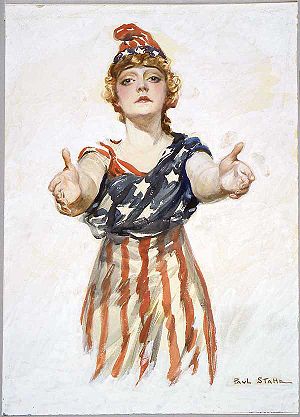
The U.S. has a similar figure, Columbia:

More popular characterizations also emerge, often representing the national character not through goddess-like imagery but as an Average Citizen.  For instance, much more familiar in the U.S. than Columbia is Uncle Sam. He differs from many other national personifications in that he doesn’t represent the U.S. citizenry or the idea of the nation in general; he specifically represents the U.S. government and is best known for wanting “you” to join the military, buy war bonds, and such:

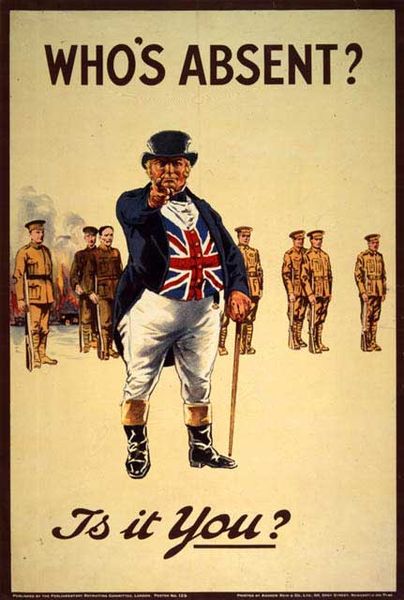
And in addition to Brittania, the U.K. is also personified by John Bull:

According to the Slate article, John Bull presents the British people as middle-class, smart in a common-sense way, and also somewhat suspicious of authority — that is, John Bull is a personification that separates the citizenry from government (the source of authority) to some extent, and thus has been used in many political cartoons to question government policies (whereas Uncle Sam has often been used to advocate them, since he represents the government itself).

Going a step further, Portugal’s Zé Povinho, a working-class personification, actively mocks the powerful, including political elites:

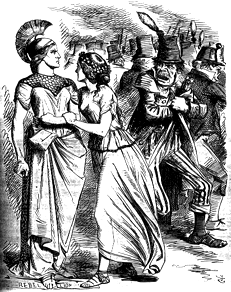
Competing personifications may be used by different political factions. For instance, those in favor of and opposed to Irish independence used female emblems of Ireland. Opponents of Irish nationalism used the figure of Hibernia, represented as the younger sister of Brittania and in need of her sister’s protection from the brutish (male) nationalist forces:

Nationalists responded with Kathleen Ni Houlihan, “generally depicted as an old woman who needs the help of young Irish men willing to fight and die to free Ireland from colonial rule, usually resulting in the young men becoming martyrs for this cause”:

The gender element in these competing personifications is interesting: in both cases Ireland is a woman in need of protection, but who see needs protected by (a stronger sister or men) and from (men in both cases) differs.

So here we have just a small handful of national personifications that may coexist fairly harmoniously while serving different purposes (say, Brittania and John Bull) or actively conflict (representations of Ireland). Various groups in a nation (political elites, different social classes, rebels, etc.) are unlikely to identify equally with a single personification; thus, the figures used to represent a country or its citizens can become sites of political or cultural contention, defining who has the most legitimate claim to being the backbone of the nation (the middle-class John Bull, the working-class Zé Povinho) or framing independence or other political movements.

Kristi P. sent us a link to a story at OMG! from Yahoo! about Christina Hendricks, who is famous for playing the curvaceous Joan on Mad Men. The article title includes “‘I Felt Beautiful’ Gaining ’15 Pounds’,” and the article discusses how Hendricks feels about her body.

Notice the contradiction in this screencap?

That’s right: throughout the article on how Christina Hendricks loves her non-waifish body there are links to stories about “incredible star slim-downs,” getting a “celebrity six-pack,” and how to get a “last-minute bikini bod.” So even in a story about a person reveling in her body, the message is clearly conveyed that your own body is not good enough, and to make it better, you probably need to make it thinner.

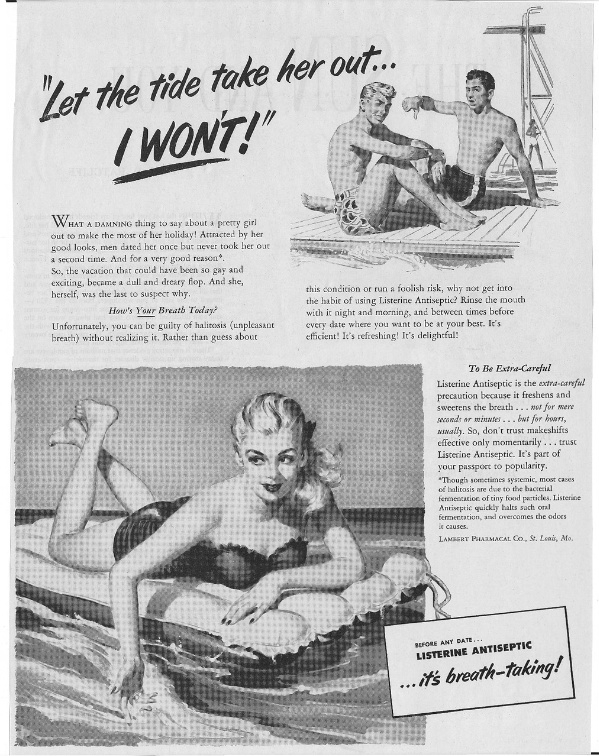
This headline for this Listerine ad from 1951 reads, “Let the tide take her out… I WON’T!”

Translation:  “I’d let a woman with bad breath die before I would go on a date with her.”

If that wouldn’t scare you into buying Listerine, I don’t know what would!

Source: Vintage Ads.

Lisa Wade, PhD is an Associate Professor at Tulane University. She is the author of American Hookup, a book about college sexual culture; a textbook about gender; and a forthcoming introductory text: Terrible Magnificent Sociology. You can follow her on Twitter and Instagram.

Bundle presents the following infographic detailing how much people in various U.S. cities spend restaurants and groceries (some highlights below): The average household in the U.S. spends 37% of its food and drink budget in restaurants. In Hialeah, Florida, 69% of food and drink spending is spent on groceries instead of dining out; the largest proportion of spending in eating in. Atlanta is on the other side of the spectrum, with 57% of the food budget spent at restaurants. Households in Austin spend the most on food ($12,447) with more than half of that spent dining out. In contrast, people in Detroit spend the least ($2,246), As the graphic notes, “five average Detroit households can eat on one Austinite’s food budget.” On average, in U.S. households 17% of spending goes towards food and drink. The largest proportion of spending allocated towards food and drink is found in Denver (22%), but my city, Los Angeles, is not far behind (21%). Hat tip to Flowing Data.

Lisa Wade, PhD is an Associate Professor at Tulane University. She is the author of American Hookup, a book about college sexual culture; a textbook about gender; and a forthcoming introductory text: Terrible Magnificent Sociology. You can follow her on Twitter and Instagram.