Search results for The

Cross-posted at Love Isn’t Enough.

Diego Costa sent in an image of Jaden Smith, star of the remake of The Karate Kid, at a recent promotional event in China. In it, 11-year-old Jaden has lifted his shirt to show off his abs, while co-star Jackie Chan and a man I presume is the event host marvel at them:

What struck Diego is how this image was received differently than a similar image of an 11-year-old girl pulling up her shirt to show off her abs might be seen. For instance, The Huffington Post showed the image without any comment about its content. We might compare that to the public outcry over the images of Miley Cyrus wrapped in a sheet that came out two years ago. I also suspect The Huffington Post article might say something about the adult men in the above photo if it were a girl rather than a boy they were touching/ogling.

Apparently when he went on The View, Jaden said he’s “already a great kisser” and the audience cheered, though I can’t find a video of it.

Diego says,

Why is the exposure of boy bodies deemed appropriate whilst the revealing of girls’ bodies must always accompany relentless probing, judging and outrage? If we agree that we shouldn’t sexualize children, then let’s not do it to any child. And, while we are at it, let’s also not assume infantile heterosexuality by asking if boys already have “a girlfriend.”

Excellent points. I suspect if an 11-year-old girl went on The View and said she was a good kisser already, she and her parents would be attacked in the press, people would express horror, and rumors would circulate about whether she’s been sexually abused, is already sexually active, etc. etc. But when an 11-year-old boy does it? That’s cute! He’s on his way to being a smooth-talking ladies’ man!

I can’t decide if, or to what degree, race might be at play here. There is certainly a tendency to adultify non-White children — that is, to treat them as mini-adults rather than children at much earlier ages than White kids are. This includes sexuality (for instance, teachers often assume Black girls are sexually active at younger ages than White girls). My recent post on the hypersexualization of a 13-year-old Latino boy discussed this topic.

But I’m not sure if that’s playing a major role here, or if gender assumptions and him being the son of a much-beloved celebrity couple are the more important factors. Thoughts?

For another example, see our post on the Rolling Stone cover with Taylor Lautner.
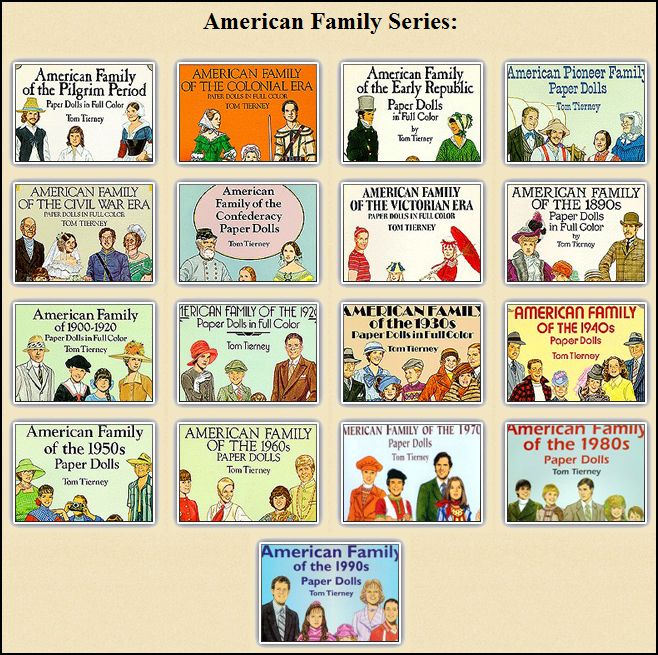
Tom Tierney is a famous paper doll artist.  Katrin sent along a link to his American Family series.  The covers erase all non-white families; apparently American Indian families weren’t “American” enough, nor were the indigenous population of what-would-one-day-be-California, African families during the Civil War era, or the many other non-white people that lived here before and after white people arrived.

Elsewhere on his site, Tierney has paper dolls with non-white characters, but they are always specified (e.g., Famous African Americans Paper Dolls or the new Obama Family).  Non-modified, though, “American”= white.

See also our post on how people tried to claim American-ness by claiming whiteness and suing for whiteness.

Lisa Wade, PhD is an Associate Professor at Tulane University. She is the author of American Hookup, a book about college sexual culture; a textbook about gender; and a forthcoming introductory text: Terrible Magnificent Sociology. You can follow her on Twitter and Instagram.


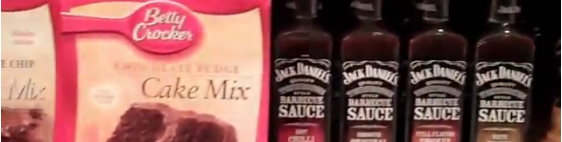
Mitchel Stein sent in a video a woman took of the “USA” section of the ethnic food aisle in a German grocery store. It’s an interesting look at what types of foods/brands are associated (at least in this store) with the U.S.:

I suspect that a lot of citizens of the U.S. wouldn’t necessarily think of those items if they tried to think of quintessentially American foods, much like foods defined as Chinese often aren’t found in China (e.g., the fortune cookie). It’s a good example of the social construction of national foods — that is, a set of food items become associated with a particular culture or nation, which may or may not align with the foods members of that culture most prefer or eat most frequently.

Also, apparently we in the U.S. are most associated with processed sweet/dessert items, and BBQ sauce.

Though I was super excited to see Head Country BBQ sauce, since it’s made in northern Oklahoma!

Tom Megginson of Change Marketing and Kandirra sent us a stunning example of the objectification of women in advertising. It’s a commercial for Rosgosstrakh, the largest insurance company in Russia, advertising their car insurance. How do they do so? By painting pictures of vehicles on (headless) women’s breasts and showing various hands fondling/smushing/jiggling them.

Reader lizardbreath pointed out that showing breasts on TV wouldn’t be as shocking in a lot of cultures as it would be in the U.S., which I think is a valid point. What makes it seem objectifying to both of us isn’t just the breasts themselves, but the headless women (so you have disembodied breasts). I also noticed that at one point a woman pushes the (also disembodied) male hands away, which implies she’s being groped when she doesn’t want to be.
more...

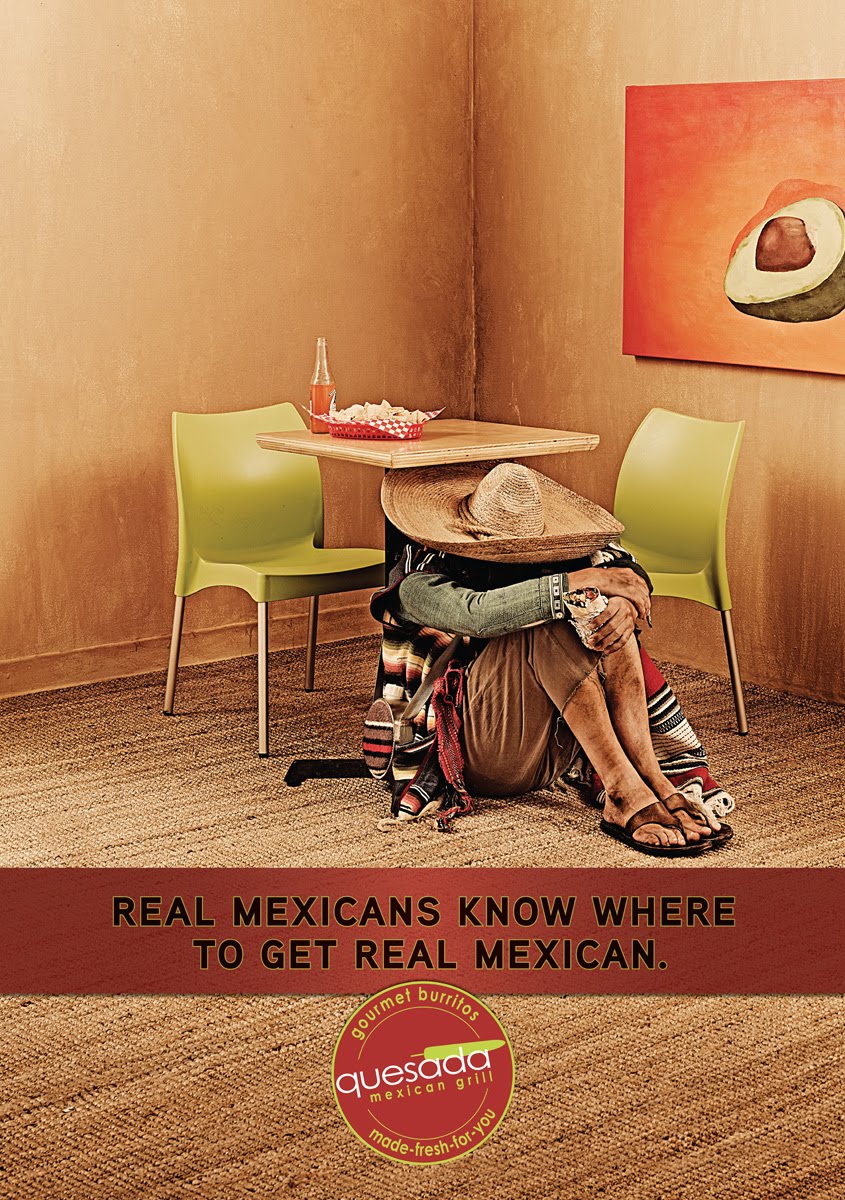
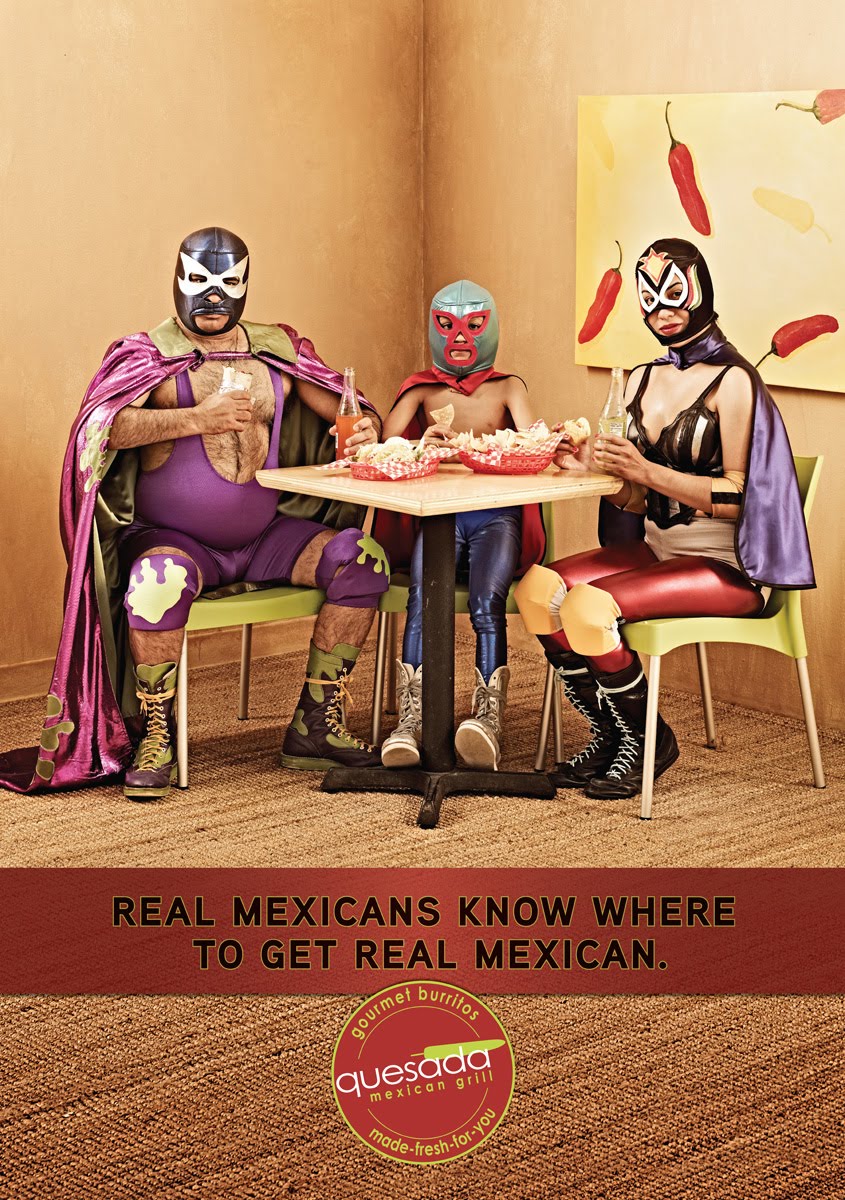
The Quesada Mexican Grill in Canada tries to claim authenticity (“real Mexican”) by, ironically, invoking Western stereotypes of Mexicans:

Hat tip to Copyranter.

Lisa Wade, PhD is an Associate Professor at Tulane University. She is the author of American Hookup, a book about college sexual culture; a textbook about gender; and a forthcoming introductory text: Terrible Magnificent Sociology. You can follow her on Twitter and Instagram.

Katrin discovered a particularly ironic bit of photoshopping.  The first picture is of Rosie Huntington-Whiteley on a photo shoot, the second is her ad for the Victoria’s Secret “I Love My Body” ad campaign.  Notice that the body she is supposedly loving has significantly more cleavage than the body we see in the first photo.  Apparently even models’ bodies are unlovable without re-touching (or surgery?).

Lisa Wade, PhD is an Associate Professor at Tulane University. She is the author of American Hookup, a book about college sexual culture; a textbook about gender; and a forthcoming introductory text: Terrible Magnificent Sociology. You can follow her on Twitter and Instagram.

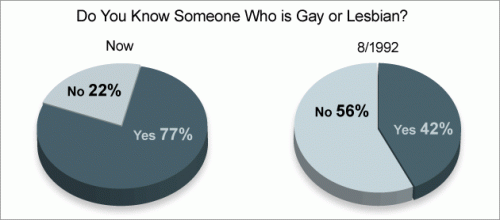
Dimitriy T.M. sent in a link to an article at CBS news about changing attitudes toward gays and lesbians. The poll found that the proportion of people who say they know someone who is gay or lesbian has increased dramatically since 1992:

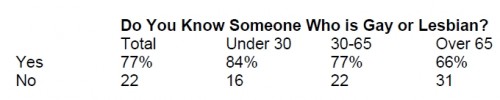
This differs quite a lot by age, however:

It seems likely that the difference is a reflection of increased visibility of gays and lesbians in our culture, such that younger people know more people who openly describe themselves as gay. In general, knowing someone who is gay is correlated with more positive attitudes toward gays and lesbians.

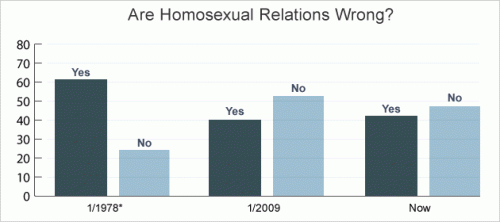
Over time people have also become more accepting of gays and lesbians, though the number saying homosexual relations are wrong has increased slightly between 2009 and 2010 (from 41 to 43 percent).

Over half of Americans believe there should be legal protections to prevent discrimination against gays and lesbians.

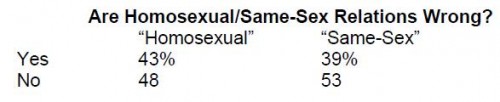
The wording of questions seems to affect people’s reported attitudes, with people being slightly less tolerant when relationships are described as “homosexual” than when the term “same-sex” is used:

If younger people are more accepting of gays and lesbians than older generations, it seems that we can expect more increasingly positive attitudes over time, unless it turns out that people become less tolerant of gays and lesbians as they get older. Overall, the responses here seem to justify some optimism about increasing gay rights and decreasing discrimination.

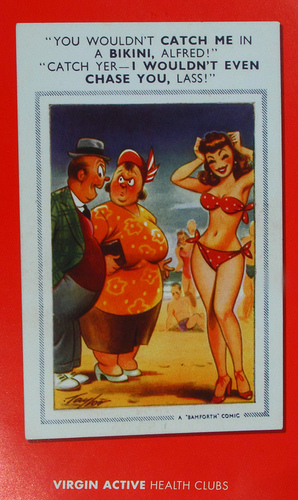
Vintage ad?

Nope. This ad for Virgin Active Health Clubs arrived in D’s mailbox this very month.

Credit: “D & T” of “Wish I Were Baking” at Flickr.

Lisa Wade, PhD is an Associate Professor at Tulane University. She is the author of American Hookup, a book about college sexual culture; a textbook about gender; and a forthcoming introductory text: Terrible Magnificent Sociology. You can follow her on Twitter and Instagram.