Search results for The

Kelly sent in a photo she took of a flyer she found on her car windshield recently. The flyer advertised an event at a local bar:

Notice that women ladies paid no cover all night, but men paid $5. In addition, men had to be 21 to get in, but women only had to be 18. And from 8-10 p.m. Sex on the Beach drinks, stereotyped as girly, were free.

It’s a particularly striking example of how bars use women as lures to get men in to buy lots of drinks. Ladies’ nights technically discriminate against men, who have to pay a cover while women don’t. But at the same time, women are being used by the bars letting them in for free.

Why let in women who can’t legally drink but not men of the same age? Because these establishments don’t see women as the real money-making customers. Letting some women in who might take up tables without buying expensive drinks is worth it if it gives the bar a reputation for having hot female patrons and, as a result, draws in men who will buy drinks, both for themselves and for women.

This works because of gendered norms in which men actively pursue and buy things for women they’re interested in, but not vice versa, and that men date younger women more than women date younger men. Given these assumptions, there’s no point in (intentionally) allowing underage men in or to let men in for free while charging women. The norms of dating make it unlikely that groups of women would show up and buy enough drinks for themselves and the men in the bar to make up for the free drinks the guys drank or the waived cover charges.

We see ladies’ nights much more frequently than guys’ nights or whatever the equivalent would be because patterns of dating and sexual interest make women passive players whose job is to attract male attention, largely by paying attention to how they look and dress. Men’s job is to see a woman they find attractive and then pursue her, partially by paying for drinks, dinner, movies, etc.

And bars such as this one capitalize on this by sacrificing some profits (through free drinks and no cover) to get more women to come in and as a result attract the male customers they count on to spend the majority of the money. Gendered norms of dating thus provide a pretty good marketing strategy for bars.

NEWS:

Happy July everyone!

Gwen and I were traveling in June so there are only a few enriched posts to peruse (below) and little SocImages news to impart.  There is exciting me news, however.

I took a tumble and broke my leg this week.  This has the excellent upside of earning me a two week visit from Gwen!  So if any of you Los Angelenos would like to meet for cocktails, we’ve got lots of time and good reason to drink!  Send us an email at socimages@thesocietypages.org.

And take pity on me and sign up to follow us on Twitter or friend us on Facebook (where we update with a featured post everyday).

NEWLY ENRICHED POSTS (Look for what’s NEW! June ’10):

Two more boobs for our two boobs posts!  Dmitriy T.M. sent along a boob scarf; yeah so we added that to our booooooooooooooobs post.  And Jay Livingston found another ad in which a product that is not a boob is made to look like a boob.  Maybe NSFW.

We added seaweed-flavored Pringles to our post on culturally-specific flavors.

Lauren McGuire spotted another vintage ad for weight gain, we added it to our collection.

Thanks to Stephanie DeH. and Lindsey Dale, we have a handful of new ads to add to our post on truly unlikely things sold with sex… including archery.  We also included an ad from Lindsey’s site that we added to our post on ads selling homes with women’s bodies.

We added a snapshot of pink handguns for sale in Oklahoma to our ad featuring, well, pink guns marketed to women.

Lisa Wade, PhD is an Associate Professor at Tulane University. She is the author of American Hookup, a book about college sexual culture; a textbook about gender; and a forthcoming introductory text: Terrible Magnificent Sociology. You can follow her on Twitter and Instagram.

Reflecting the expectation that it is women who will do the majority of the child care, men’s bathrooms frequently do not have baby changing tables.   This particular bathroom at the Baltimore airport, however, is an exception.  Notice anything odd?

Thanks to Corey O., Monique P., and eaglevision for the submission!

See also our post on stick figures and stick figures who parent.

Lisa Wade, PhD is an Associate Professor at Tulane University. She is the author of American Hookup, a book about college sexual culture; a textbook about gender; and a forthcoming introductory text: Terrible Magnificent Sociology. You can follow her on Twitter and Instagram.

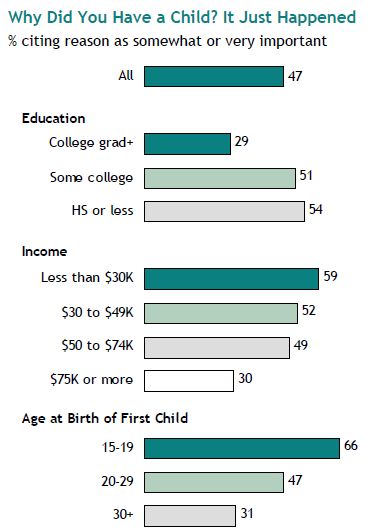
The Pew Research Center, in a report on American motherhood released this month, reported that 35% of people say that their first child “just happened.”

I think this is fascinating in light of the fact that many Americans are generally committed to the idea that we control our fertility.  Safe(r) sex and family planning campaigns tell us that, if we make the proper choices, then we will (very probably) not have an unplanned pregnancy.  They tend to downplay the fact that even the most effective methods of pregnancy prevention are not foolproof.  Let’s call this the ideology of near-perfect control of reproduction.

In fact, about half of all births occur as a result of an unplanned pregnancy.  So the fact that 1/3rd of parents say their first child “just happened” may actually be an under count.  An ideology of near-perfect control of reproduction, however, makes it seem really surprising that so many parents would choose that response.

Then again… maybe the ideology of near-perfect control of reproduction is a luxury afforded mostly to privileged classes.  The Pew report also offered data on who said that their first child “just happened”:

Notice that people with less education and lower incomes were more likely to have their first child by “accident” than people with more education and higher incomes.  They were also more likely to have their first child as a teenager.  These are the groups that we might expect, on average, to have less knowledge about birth control and less access to (especially more effective forms of) birth control.  Given that our society is class segregated, members of these groups may also be surrounded by other people who “just happened” to have kids.  The ideology of near-perfect control of reproduction, then, may not be as strong.  This may also contribute to a willingness to admit that it “just happened,” instead of re-fashioning the introduction of parenting as a fully conscious choice.

Hat tip to Philip Cohen at Family Inequality.

Lisa Wade, PhD is an Associate Professor at Tulane University. She is the author of American Hookup, a book about college sexual culture; a textbook about gender; and a forthcoming introductory text: Terrible Magnificent Sociology. You can follow her on Twitter and Instagram.

This 1937 ad for United Airlines boasts a “miracle” improvement in air travel in just 10 years. In 1927, when commercial flight was initiated, it took 33 hours and 14 stops to fly from coast to coast. By 1937, one could fly the same distance in just 15 and 1/3 hours! With only three stops!

The ad certainly puts into perspective my own frustration at what a time-suck air travel can be.

Source: Vintage Ads.

Lisa Wade, PhD is an Associate Professor at Tulane University. She is the author of American Hookup, a book about college sexual culture; a textbook about gender; and a forthcoming introductory text: Terrible Magnificent Sociology. You can follow her on Twitter and Instagram.

Crossposted at Jezebel.

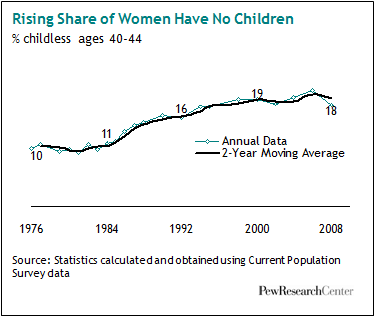
Lisa recently discussed the trend of women having children at older ages. The Pew Research Center also just released data on women who do not have children lessfree (a commenter pointed out that “childless” implies a lack, whereas “childfree” doesn’t; others say “child-free” is also value-laden; “childless” is the word used in the report). They defined “childless” as women aged 40-44 who have no children; importantly, women who have adopted but never given birth themselves are also categorized as without children, which I find rather problematic. I can see why you might want info on both situations, but to define adoptive mothers as not having children? That’s weird. Also, they don’t report info for men.

From the report:

One in five women aged 40 to 44 reported that they’ve never had children. Meanwhile, just 41 percent of Americans say having children is necessary to a good marriage, compared to 65 percent in 1990.

The number has been increasing over time, with slightly short-term dips here and there:

Not having children is more common as education increases, though interestingly, the number of women without kids who have a Master’s or higher degrees is actually lower than in the early ’90s:

Of course, you could interpret the educational pattern a couple of ways. Perhaps achieving advanced degrees requires women who would have liked to have children to choose between career advancement and family life. Or maybe having an advanced degree makes them less attractive to potential partners, or unwilling to accept the partners available to them, so they have to decide whether to be single parents. But of course, it could also be that women who pursue advanced degrees are women who were less interested in having children to begin with. I’m sure there are other explanations and that it’s likely to be a combination of all these factors, and I’m sure somewhere there is data available. Let me know if you’ve got a good link.

But I’m stumped about the decrease in the number of highly-educated women without children between the early ’90s and now. Any thoughts on what might have caused that?

Anyway, moving on…

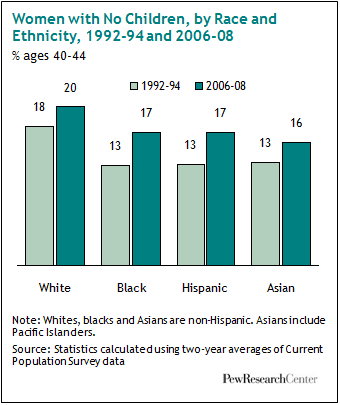
The increase in women without children holds for all racial/ethnic groups (and, as usual, data on Native Americans wasn’t included; sorry):

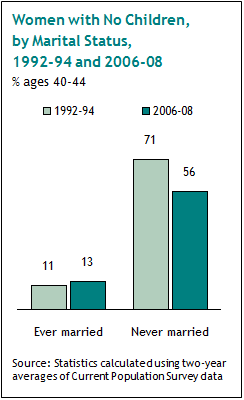
Probably not surprisingly, women aged 40-44 who never married are much more likely to be without children than are married women, though as we see, the percentage has gone down, indicating more never-married single mothers:

From that perspective, it appears that marriage and childbearing are tightly linked–only a small proportion of women who have been married at some point have no children.

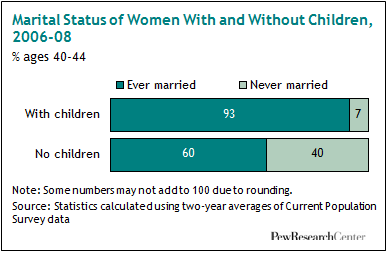
But if we break down the data a bit, we see that of women aged 40-44 without children, 60% were married at least once:

So while for the U.S. population as a whole, getting married generally indicates children will appear at some point, most women who forgo childbearing do marry at least once, showing that this isn’t just a phenomenon of single women.

Where did I learn about this report? From the website Shit My Kids Ruined, which I read with morbid fascination.

Rose saw the ad below in a free UK parenting magazine.  She thought it was a great example of how an ad sometimes pays “lip service to being inclusive and PC, while [including] numerous elements [that] make it obvious that it isn’t what they really intend.”

So, yes, the ad specifies that the event is for “mums, dads and carers” and it’s nice that they went that far to include them.  But the event is clearly for mothers or women carers and their girl children (and, more specifically, the transfer of feminine training from mother to daughter).  The color of the ad, the feminine shoes with bows, the title (“Mummy Mornings”), and the feminized activities (including “beauty sessions” and the chance to be “spoilt”) are all elements that mark this as for-girls-only.

Is it better to include dads as an afterthought?  Or should we just acknowledge that we’re organizing parent/child activities around mothers (and in this case, daughters)?

Lisa Wade, PhD is an Associate Professor at Tulane University. She is the author of American Hookup, a book about college sexual culture; a textbook about gender; and a forthcoming introductory text: Terrible Magnificent Sociology. You can follow her on Twitter and Instagram.

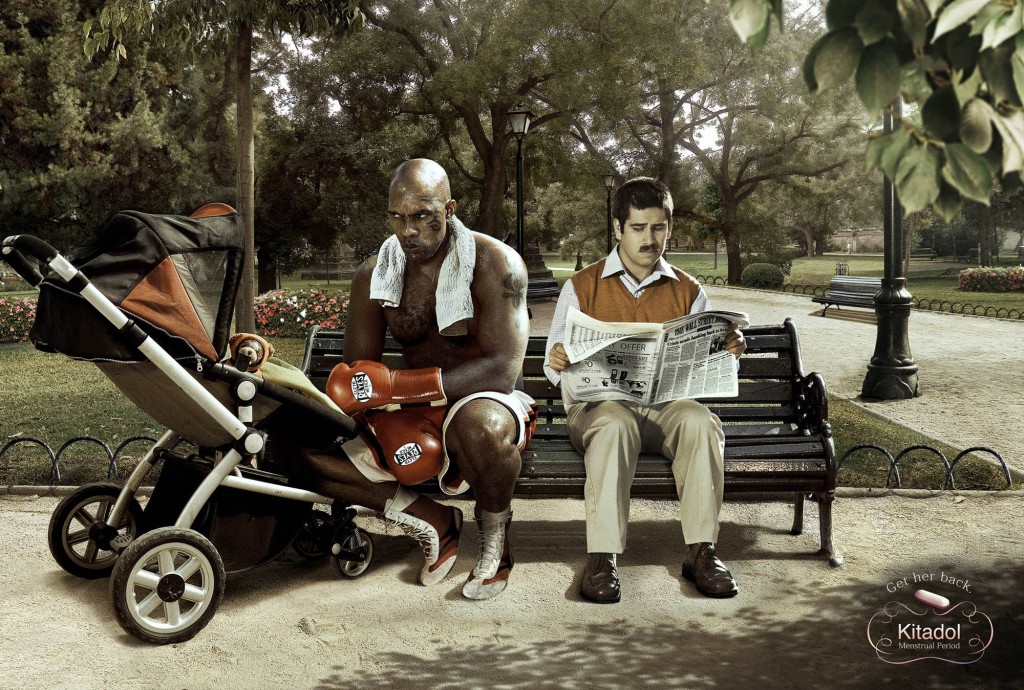
These Chilean ads for menstrual pain medication, sent in by Mia A., turn women into symbols of violent aggression: fighters, literally, but also men of color.  They simultaneously affirm, then, the association of violence with both masculinity and non-white skin and the de-association of women with those characteristics.  The message is that men of color are appropriately violent, while women are not.

(source)

Lisa Wade, PhD is an Associate Professor at Tulane University. She is the author of American Hookup, a book about college sexual culture; a textbook about gender; and a forthcoming introductory text: Terrible Magnificent Sociology. You can follow her on Twitter and Instagram.