Search results for The

Muriel Minnie Mae and an anonymous contributor sent in contrasting examples of cell phone marketing that draws on the idea of nature. The two ad campaigns, side by side, are a great illustration of how we can imagine nature to be either our enemy or our friend.

The campaign for the Motorola Brute portrays nature as aggressive and destructive.  The Brute is designed to beat nature in this battle (anthropomorphized as “mother”) by being able to withstand “extreme temperatures, blowing rain, dust, shock, vibration, pressure and humidity…”  Mother nature is a bitch, indeed!  She does deserve a slap in the face!

In dramatic contrast, this ad for AT&T cellular service portrays nature as the source of grace and beauty.  Cell phones bloom out of flowers and are carried on the wind by dandelion fluff:

The two examples together show us that the nature of nature is socially constructed; humans portray it in multiple ways, using it as a resource to tell stories about ourselves… and cell phones.

Lisa Wade, PhD is an Associate Professor at Tulane University. She is the author of American Hookup, a book about college sexual culture; a textbook about gender; and a forthcoming introductory text: Terrible Magnificent Sociology. You can follow her on Twitter and Instagram.

Ellen B. found this birthday card for sale in Dublin.  The front cover reads “I wish for… intelligence, logic, and driving skills…”

Wait for it… … …

Gwen and my thought process as we moved from the first to the second image:  “…’POOF’… oh it’s not… it better not… oh no it did!”

Lisa Wade, PhD is an Associate Professor at Tulane University. She is the author of American Hookup, a book about college sexual culture; a textbook about gender; and a forthcoming introductory text: Terrible Magnificent Sociology. You can follow her on Twitter and Instagram.

Katie sent in an image from Digital SLR Cameras and Photography For Dummies by David D. Busch. The image followed this text (p. 181):

To minimize wrinkles or facial defects, such as scars or bad complexions, use softer, more diffuse lighting, as shown in Figure 10-3.

And here is Figure 10-3 with the accompanying caption (p. 182):

So after learning that diffuse lighting is good for minimizing defects, we are then told that women in general need such lighting. Katie says she tried to imagine the reason for this instruction, but “can’t think of a possibility that isn’t about reinforcing traditionally-gendered imagery.” The assumption in the book seems to be that women always want, and need, to be photographed in ways that emphasize a blemish-free beauty ideal. Not all subjects are “often best pictured” in this way; this instruction is specifically about how to present women. Presumably we might want to picture men in ways that emphasize strength, or show them as wizened or wrinkled or otherwise presented without the softening effect of diffuse lighting.

It’s a small example of how gendered norms are taken for granted and reproduced in various fields. If you’ve seen similar examples (or, for that matter, contrary ones) about  photography, painting, etc., we’d love to have them.


Amanda M. and Lisa C. both submitted a recent Toy Story 3-themed commercial for Visa, pointing out how nice it is to see the Buzz Lightyear character advertised to girls.

I won’t disagree that it’s nice that girls are being included in the marketing for Toy Story 3 (especially as the movie appears to be as boy-centric as most), but I don’t see it as revolutionary. In fact, because we largely value masculine characteristics and pursuits, the idea that girls would be interested in boy things (like space travel) is generally regarded as cute, neat, or even awesome (this is why I like to order bourbon neat on a first date — impresses the men every time). The problem is that the reverse is not true. Because we devalue feminine characteristics and pursuits, we rarely respond to boys’ experimentation with girly things in the same way. In that case, it’s worrisome, strange, or even grotesque. We call the valuing of masculinity over femininity “androcentrism.”

So I would argue that this particular advertisement actually fits nicely with the source of gender inequality today: a devaluation of feminine things at the same time that women are required to perform some degree of femininity (the girl in the commercial is still girly, wearing baby blue, a skirt, and hugging Buzz delightedly before she blasts him off). Of course, this means that men’s life options are narrower than women’s because they have to avoid the stigma of femininity (and that must suck, truly), but at least the things men are restricted to doing and being are valued (both abstractly and with money).

More posts on androcentrism: “woman” as an insult, good god don’t let men wear make up or long hair, don’t forget to hug like a dude, saving men from their (feminine) selves, men must eschew femininity, dinosaurs can’t be for girls, and sissy men are so uncool.

Lisa Wade, PhD is an Associate Professor at Tulane University. She is the author of American Hookup, a book about college sexual culture; a textbook about gender; and a forthcoming introductory text: Terrible Magnificent Sociology. You can follow her on Twitter and Instagram.

[Note: A couple of readers have sent in info that calls into question the graphic below — not the relative sizes and such, but the specific numbers cited for the size of various spills (making them look larger than other reports). This may be a reflection of how the organization defines “spilled” oil (they say “lost to the environment”), and I provide their definition below. Thanks to T for providing a list of generally accepted estimates of major spills. Given that the organization providing the data is an association of oil tanker owners, it seems unlikely that they would be intentionally exaggerating the sizes of spills for political purposes or something. So while the graphic’s illustration of the relative size of these spills is still accurate in a general sense, unless I can track down a clear explanation for the cited numbers, I wouldn’t rely on them. Sorry for the confusion, and I’ll continue updating if I can figure out what’s going on.]

———-

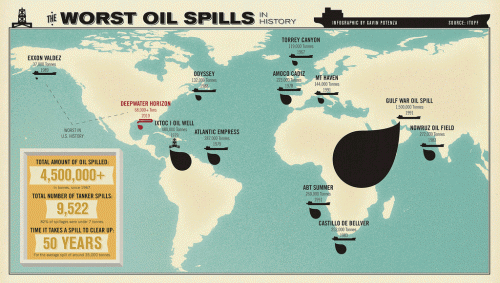
Allie B. sent in a graphic comparing the BP leak to major tanker oil spills (and I forgot to add the numbers reported are in tonnes, which is about 2,240 pounds each):

The info is based on data from The International Tanker Owners Pollution Federation Limited, an industry group that provides a lot of data on spills from oil tankers (so that doesn’t include leaks or spills from pipelines, wells, and so on). From the website:

It should be noted that the figures for the amount of oil spilt in an incident include all oil lost to the environment, including that which burnt or remained in a sunken vessel. There is considerable annual variation in both the incidence of oil spills and the amounts of oil lost. Consequently, the figures in the following tables, and any averages derived from them should be viewed with caution.

UPDATE: Commenter T points out that some of the numbers here (especially the Gulf War spill) don’t match up with more widely-reported data and seem to exaggerate the size of some of the spills. The relative sizes still hold up in general, but be cautious with the actual reported sizes of the spills. It may be that their way of defining spills (all oil “lost to the environment”) includes significantly more oil than what is traditionally counted as being part of a spill. I’m trying to track down exactly what’s going on here.

Given how much media coverage BP leak is getting, it’s a bit shocking to see it in comparison to the tanker spills represented here. That isn’t to say that somehow by comparison the BP leak isn’t that bad; rather, it made me aware of how little I usually hear about the environmental impacts of the global petroleum industry as long as they don’t happen along the U.S. coastline.

For instance, a recent NYT article discusses the impacts of oil leaks and spills in Nigeria:

The Niger Delta…has endured the equivalent of the Exxon Valdez spill every year for 50 years by some estimates. The oil pours out nearly every week, and some swamps are long since lifeless…leaving residents here astonished at the nonstop attention paid to the gusher half a world away in the Gulf of Mexico. It was only a few weeks ago, they say, that a burst pipe belonging to Royal Dutch Shell in the mangroves was finally shut after flowing for two months…

I think the illustration brings into perspective how our perceptions of environmental disasters are shaped (not surprisingly, I know) by the amount of media coverage it gets and whether it occurs in a place we’re familiar with. Some pollution gets national and international media attention (at least for a while), and some is largely ignored outside the local area directly affected. The BP leak is by no means the largest oil-related ecological disaster in history — not even close yet, and hopefully it won’t get there — but media coverage and clean-up efforts aren’t distributed equally. And, again, I’m not saying that somehow this means we shouldn’t be too concerned about the Gulf leak. But it does make clear that we’re not equally concerned about, say, all people whose livelihoods are devastated by petroleum leaks/spills in waterways.

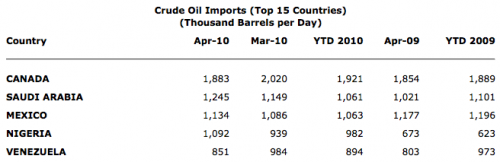
And just out of curiosity about the link between U.S. oil consumption and Nigerian oil production, I went to the webpage of the U.S. Energy Information Administration to see how much oil the U.S. imports from Nigeria. It’s currently our 4th-largest source of crude imports, and our daily Nigerian imports are up quite a bit over a year ago (about 1.1 million barrels in April ’10 compared to 673,000 a day in April ’09):

And I’m a bit embarrassed to admit that I had no idea Canada is currently our biggest source of imported crude oil (and total petroleum imports as well).

Gwen Sharp is an associate professor of sociology at Nevada State College. You can follow her on Twitter at @gwensharpnv.


The ad below is the first-ever British TV commercial advertising abortion services family planning options, including abortion.  It is being shown late at night and says:

If you’re late for your period, you could be pregnant. If you’re pregnant and not sure what to do, Marie Stopes International can help.

I don’t remember ever seeing such a commercial. Condoms, birth control pills, pregnancy tests, herpes medication, HPV vaccines, tampons, Viagra, and sex, sex, sex, YES. Abortion, NEVER. Salon seems to claim that it’s the first of its kind anywhere.

Have you ever seen such a thing where you live? What do you imagine are the politics around the airing of a commercial advertising abortion services?

Via Feministing.

Lisa Wade, PhD is an Associate Professor at Tulane University. She is the author of American Hookup, a book about college sexual culture; a textbook about gender; and a forthcoming introductory text: Terrible Magnificent Sociology. You can follow her on Twitter and Instagram.

We recently posted about an ad for internet service that used the metaphor of a prostitute.  It/she was “fast” and “cheap” with “satisfaction guaranteed.”  We also recently posted about national personifications, fictional or semi-fictional people used to represent countries.  This ad campaign, submitted by Mary S., has both.

Victoria, a city in British Columbia, is personified as “Victoria,” the sex worker.  “Victoria’s cheap,” the ad reads, “but she’ll show you a great time.”  The larger message, of course, is that places are like women and women are like places.  They are experiences to purchase and consume, preferably cheaply.

UPDATE: Some in the comments have suggested that I cropped the ad to make my point.  So here is the whole front page of the website, victoriascheap.com:

Lisa Wade, PhD is an Associate Professor at Tulane University. She is the author of American Hookup, a book about college sexual culture; a textbook about gender; and a forthcoming introductory text: Terrible Magnificent Sociology. You can follow her on Twitter and Instagram.
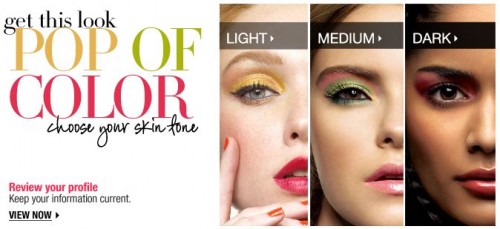
Fox sent us this image from a Sephora email; clicking on the various skin tones would take you to a section on makeup for your complexion:

What struck Fox is how light all three skin tones are. I’m pretty pale — I often match shades with names like “ivory” — and I think I’d still be “medium” toned according to this graphic. Also, all three women have pretty similar, stereotypically Caucasian, facial features.

And while any skin tone categorization is going to throw together a wide array of shades, in this case, it seems like a lot more skin tones are going to be subsumed under the “dark” category than the others, since it starts out at a pretty light shade and contains every shade darker than that. The options here separate out lighter skin tones from one another pretty finely while throwing an enormous range of skin types together under “dark.” Presumably Sephora conducted intensive research and discovered that while lighter-skinned women required carefully customized makeup color schemes, women with even slightly darker skin can all make do with the same one.