Search results for The

Cross-posted at OWNI.

Something has been nagging me about the Representative Weiner (D-NY) sexting scandal: how would this story would play out differently had the sexting-congressperson been female? I wrote earlier about how differently “sexy” pictures of male and female political candidates are handled.

When Krystal Ball ran for congress, images of a past Halloween party became some of the most Google’d images in the world, unlike male politicians running for office at the same time who were also involved in scandals about images of their past behaviors. The images of women in general, and, in this case, female politicians, become poured over, detailed, dissected, analyzed and obsessed upon to a far greater extent than what is occurring with Rep. Weiner. Yes, the images he sent are being shared on and offline, but had Weiner been female the images might be shown akin to the Janet Jackson “wardrobe malfunction”: the media would scowl at the perversion while simultaneously showing them on a constant loop, dissecting every pixel in detail.

So let’s do quick Google Image searches for Krystal Ball and Anthony Weiner. (In these screenshots I am logged out of Google and “SafeSearch” is off, however, neither of those factors influenced the results much).

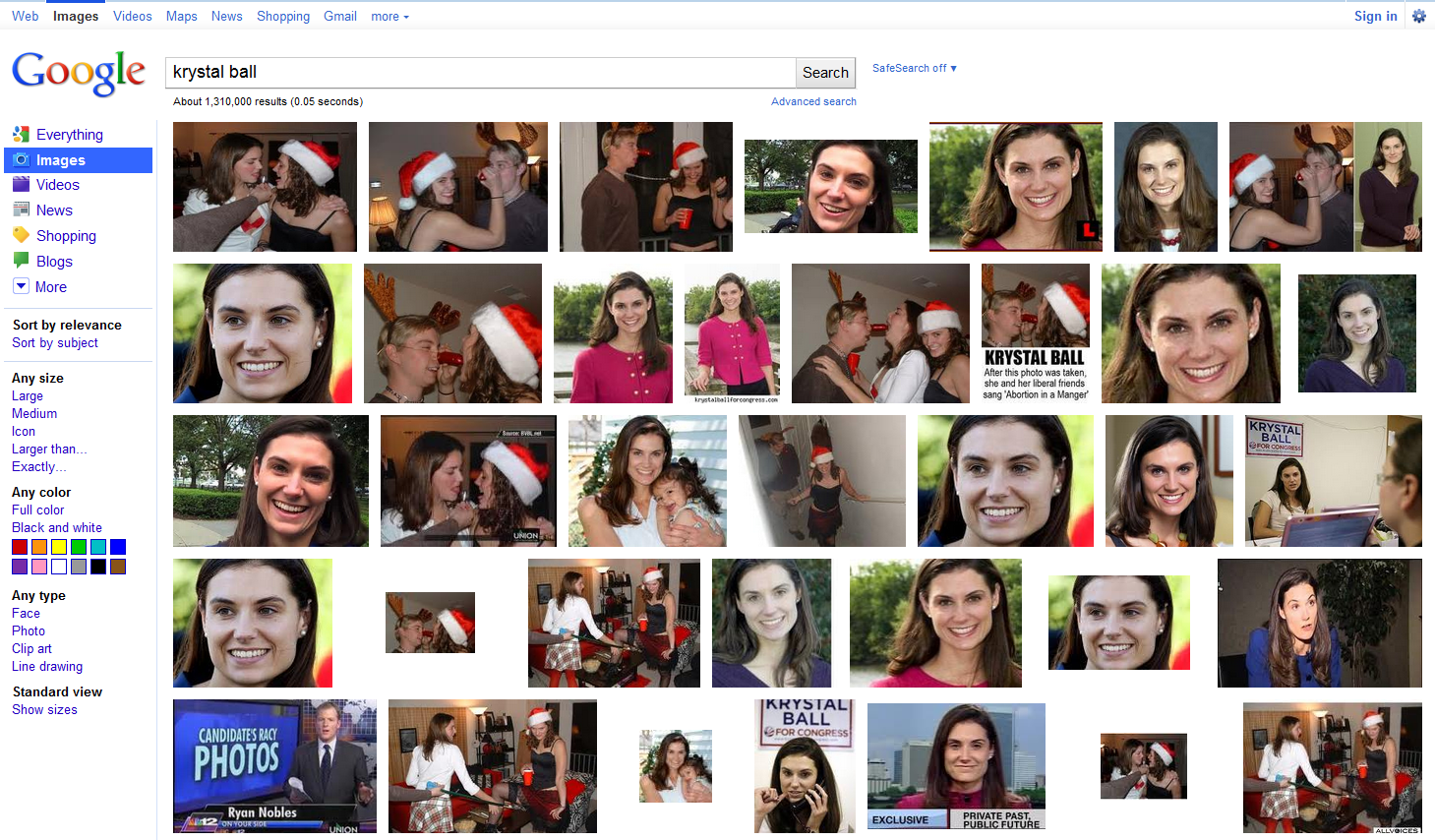

Krystal Ball’s results are dominated by the images that caused scandal. You have to scroll through pages of images in Weiner’s results to find the “offending” images. Given that Google’s resultsare based in part on popularity and website inter-linking, we have to wonder how Weiner’s post-scandal online presence would be different had he been female. [We should note that Weiner had a larger online presence before the scandal than did Ball. However, many of the top images in the search are post-scandal, so that is not a complete explanation for the discrepancy]. In fact, it is easier to find women showing skin in Weiner’s results than the so-called “lewd” images themselves.

Even Sarah Palin, who has never tweeted “lewd” photos of herself to all of the Internet, has search results more focused on her body than does Weiner.

Michel Foucault noted that sexual repression is closely related with sexual obsession; and the obsessively prying “gaze” is really the regulation and controlling of ourselves and our sex. The relative lack of obsession of the images in this scandal strikes me as evidence of the weaker regulation of the male body and men’s sex.

How else would this scandal play out differently had Rep. Weiner been female?

—————————

Please welcome guest blogger Nathan Jurgenson.  Jurgenson is a graduate student in sociology at the University of Maryland and co-edits the Cyborgology blog.

Cross-posted at Family Inequality.

Sociologist, segregate thyself? A little inside-sociology post.

A report from the research folks at the American Sociological Association (ASA) got me thinking about gender-segregated sociology. I added a few numbers from other sources to provide a quick look at three moments of gender segregation within the discipline.

People may (or may not) want to be sociologists, they may or may not be accepted to graduate schools, thrive there (with good mentoring or bad), freely choose specializations, complete PhDs, publish, get jobs, and so on.  As in most workplaces, gender segregation represents the cumulative intentions and actions of people in different institutional settings and social locations.

#1: Phds

Since the mid-1990s, according to data from the National Science Foundation, women have outnumbered men as new sociology PhDs, and a few years ago we approached two-thirds female. In the three years to 2009, however, the number of PhDs has dropped by a third, and women have accounted for two-thirds of that drop. I have no idea what’s going on with that.

For the time being, then, we’re close to 50/50 in gender balance for producing PhDs. But academic careers can be long, so all those years in the 1970s and 1980s when men outnumbered women by so much still affect  today’s discipline. Among members of the ASA today, women are 7 years younger than men, on average. Which means the men are in higher positions, on average, as well.

#2: Specialization

Choosing what area of sociology to study is a combination of personal interest and ambition, institutional setting and mentoring, and happenstance of various kinds. (This is separate from the question of how narrowly to specialize in one’s specialization, which has a big impact on the quantity of publication, since switching topics is risky and costs valuable time.) So it wouldn’t be accurate to describe this as simply a free choice. But, once someone is a member of the ASA, which is open to anyone, then the choice of identifying with a certain area of research is free (or, actually, costs a few dollars a year), through joining sections of the association.

The pattern of section belonging shows a striking level of gender segregation. On a scale of 1 to 100, I calculate the sections are segregated at a level of .28. (That is the same level of segregation I calculated in the gender distribution between major fields for PhDs, such as engineering and social sciences.) Put another way, the correlation between the percentage of women and percentage of men across the sections is a strong -.64. And by both measures the segregation has increased since 2005.

Joining a section means voting to increase the number of presentations in that area at the national conference, getting a newsletter, maybe an email list, being invited to a reception, and having the chance to serve on committees and run for office arranging all those things. At its best it’s a community of scholars interested in similar subjects. Anyway, the point is it’s not a restrictive club or job competition.

#3: Editorial boards

Finally, prestigious academic journals have one or more editors, often some associate editors, and then an editorial board. In sociology, this is mostly the people who are called upon to review articles more often. Because journal publication is a key hurdle for jobs and promotions, these sociologists serve as gatekeepers for the discipline. In return they get some prestige, the occasional reception, and they might be on the way to being an editor themselves someday. I didn’t do a systematic review here, but I looked at the two leading research journals — American Sociological Review and American Journal of Sociology, as well as two prestigious specialized journals — Sociological Methods and Research, and Gender and Society (which is run by its own association, Sociologists for Women in Society, whose membership includes both women and men).

(I included the editors, book review editor, consulting or associate editors, and editorial board members, but not managing editors. The number included ranged from 33 to 73.)

I’m not attributing motives, describing gender discrimination, or even making a judgment on all this. There are complicated reasons for each of these outcomes, and without more research I couldn’t say nature/nurture, structure/agency, system/lifeworld, etc.

But gender segregation never happens for no reason.

Update: Kim Weeden pointed me toward the complete list of section memberships by gender for 2010. So here is a a graph of the gender compositions expanded to include all 49 sections. Also, with that expanded data, I recalculated the segregation level, and it’s .25.

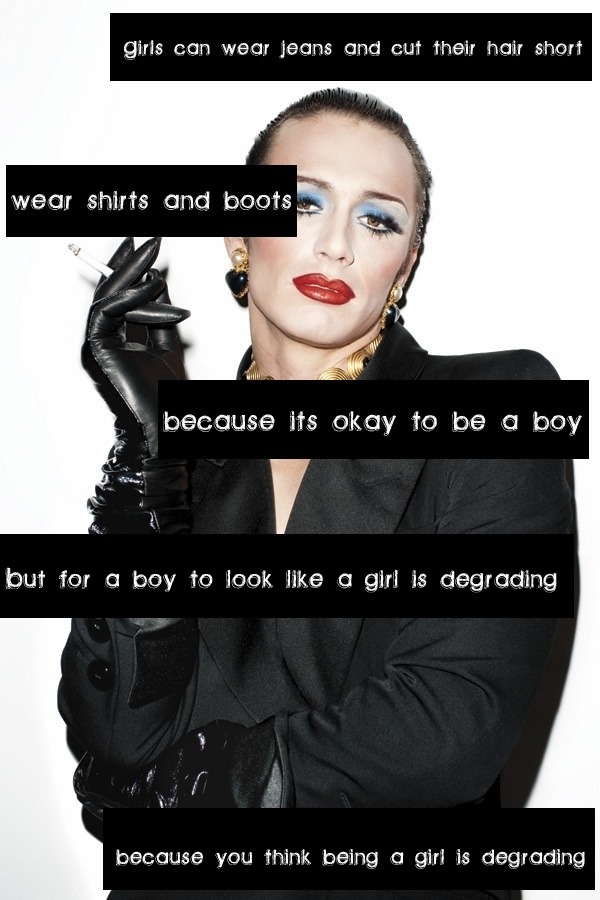
Sociologists use the term “androcentrism” to refer to a new kind of sexism, one that replaces the favoring of men over women with the favoring of masculinity over femininity. According to the rules of androcentrism, men and women alike are rewarded, but only insofar as they are masculine (e.g., they play sports, drink whiskey, and are lawyers or surgeons w00t!). Meanwhile, men are punished for doing femininity and women… well, women are required to do femininity and simultaneously punished for it.

Illustrating this concept, much more concisely, is this altered photograph of James Franco in drag. Sent along by Stephanie V., the photo was originally for the cover of Candy, a “transversal style” fashion magazine.  I’m not sure who added the copy,* but I like it:

* So Caro Visi, where I found the image, credits Virus, but I can’t find it there.  I’m happy to properly credit if someone can point me in the right direction.

UPDATE: Sarah and John, in the comments thread, pointed out that the language is borrowed from a movie titled The Cement Garden.  Jennifer points out that Madonna used it, as well, in her song What it Feels Like For A Girl.

Clip from The Cement Garden:

More posts on androcentrism: “woman” as an insult, making it manly: how to sell a car, good god don’t let men wear make up or long hairdon’t forget to hug like a dude, saving men from their (feminine) selvesmen must eschew femininity, not impressed with Buzz Lightyear commercialdinosaurs can’t be for girls, and sissy men are so uncool.

Lisa Wade, PhD is an Associate Professor at Tulane University. She is the author of American Hookup, a book about college sexual culture; a textbook about gender; and a forthcoming introductory text: Terrible Magnificent Sociology. You can follow her on Twitter and Instagram.

We have posted in the past about non-Whites being used as props in tourism and travel ads, there for the enjoyment and convenience of tourists, like other tourist attractions. Rhiannon J. sent in another excellent example of the residents of vacation areas being treated like just another amenity. In this ad for Travelocity, a White family enthuses about the many pleasures of their vacation spot — including the sun, the sand…and “the Rodrigo”:

As Rhiannon pointed out, the family discusses Rodrigo, who apparently loves carrying fruits for White tourists, the way you might discuss a stray dog.

UPDATE: Reader Chorda correctly points out that, while my use of race as the dividing point made sense when viewing these ads as a group, in this particular case “ethnicity” would probably be a more appropriate term to use.

Yesterday I posted some videos from a story Anderson Cooper did about so-called “sissy boy” therapy, meant to train boys not to act in gender non-conformist ways and, thus, to keep them from being gay (I have now updated the original post with the final segment from the series). The videos provide a horrifying look into the damage that can be done when children are brutally punished and criticized for any signs that adults interpret as evidence of homosexuality.

This type of therapy is still available, and some of the researchers Cooper discusses continue to have lucrative careers assuring parents they have the key to preventing, or eliminating, gayness in their kids. But that said, it’s also clear the cultural attitudes about gays and lesbians have shifted greatly, both within the psychiatric community (the APA no longer defines homosexuality as a mental disorder and does not advocate therapies meant to “cure” gays and lesbians) and among the general public.

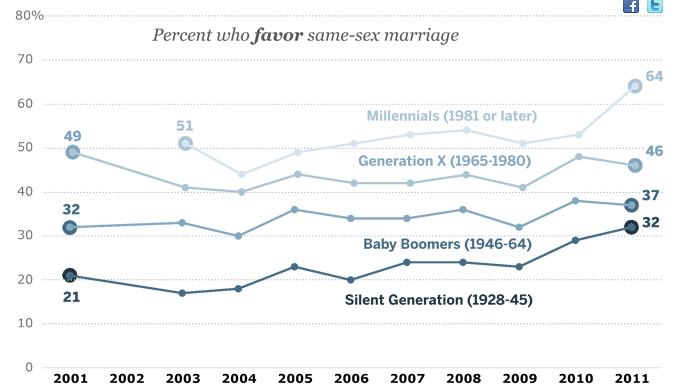
For instance, Peter N. sent in a link to a set of graphs by the Pew Forum on Religion & Public Life illustrating the major changes in attitudes toward gay marriage. Overall support for same-sex marriage has gone up significantly over the last few decades (with polls increasingly showing more people favoring it than opposing it and a few even showing a slim majority of respondents supporting same-sex marriage rights). Attitudes toward same-sex marriage vary widely by age; among those born since 1981, support is quite high:

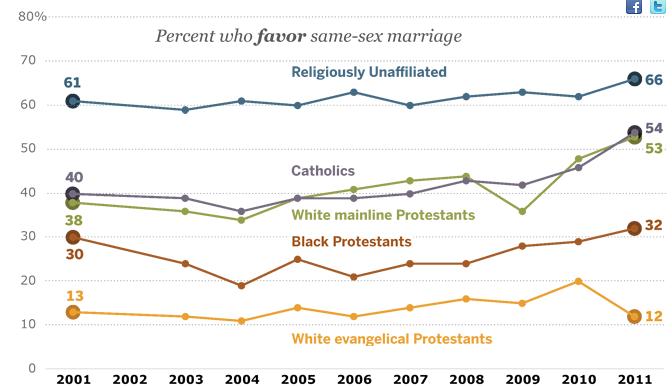
Not surprisingly, support also varies by religious affiliation:

The Pew Forum also has graphs of differences by political affiliation, etc.

We can also see this change in some instances of corporate marketing that include gays and lesbians or discuss gay rights — something that would have been unthinkable for mainstream corporations to do openly until fairly recently for fear of public backlash. David F. sent in Google Chrome’s contribution to the “It Gets Better” series of videos:

Similarly, Megan B. was struck by this Sealy mattress ad, which, though not unambiguous, she thought would be interpreted by many viewers as implying support for same-sex couples:

Finally, Jacob G.sent in a segment from the ABC News “What Would You Do?” series, in which a waitress openly harasses a lesbian couple to see how other customers will react, and found that about half of onlookers actively intervened:

Katrin and Danny sent in a heart-breaking video that highlights the damage that has sometimes been inflicted on children, with the guidance of researchers, because of adult concerns about behavior that deviates from socially-accepted gender norms. In this segment with Anderson Cooper, two siblings and their mother discuss the treatment their brother suffered, with the approval and encouragement of UCLA researchers, as a form of “anti-sissy” therapy:

It would be nice to be able to write this off as completely debunked practices of an earlier time, based on premises that would never recur today. But as the video makes clear, the publications that resulted from this study continued to be cited by those who argue that through therapy, gays and lesbians can be “cured.”

Here’s the second part of the story:

There will be a third installment tonight; I’ll update the post once the final segment is available online.

UPDATE: Here’s the third segment, about a boy who underwent anti-gay therapy in the ’90s:

UPDATE 2: Also, Danny was wonderful enough to type up transcripts of the first two videos! They’re after the jump.

more...

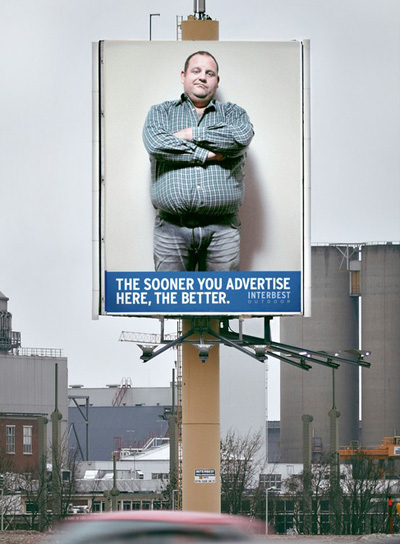
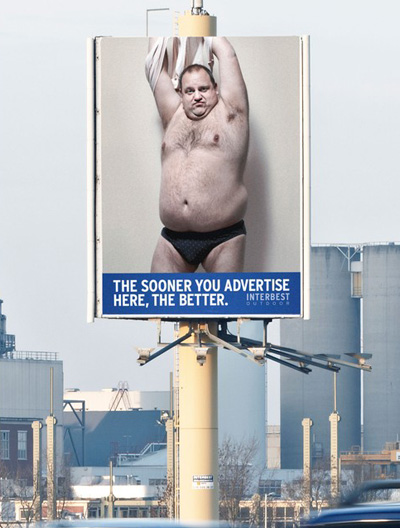
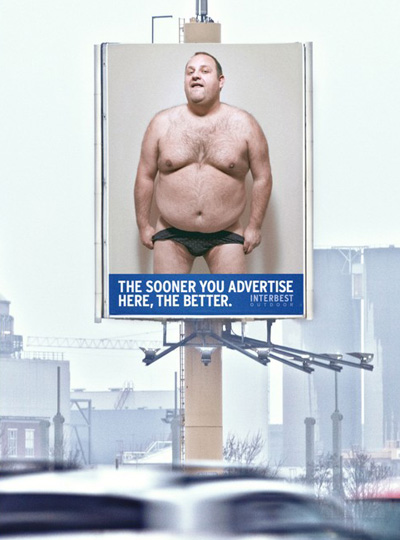
While some bodies are socially-defined as For Display, others are defined as embarrassing or disgusting.  Indigo and Artemis sent in a great example of these distinctions being reinforced. This series of billboards appeared in The Netherlands with the tagline “The Sooner You Advertise Here, the Better”:


The billboard humorously advertises the billboards availability for advertising, a clever version of “Your Ad Here.”  It does so, of course, by suggesting that the model’s body is so repulsive that the threat of simply seeing it should be enough to make us reach for our wallets.  While cultural beliefs about who is and isn’t attractive are often framed as biological or evolutionary, it can’t be denied that, at least in this case, we are receiving a strong social message as well.

Via Copyranter and The Daily Dish.

Lisa Wade, PhD is an Associate Professor at Tulane University. She is the author of American Hookup, a book about college sexual culture; a textbook about gender; and a forthcoming introductory text: Terrible Magnificent Sociology. You can follow her on Twitter and Instagram.

Cross-posted at Montclair SocioBlog.

Sometimes public relations efforts are in such extraordinarily poor taste that it’s difficult to tell whether they’re real or a spoof.

In the 1950s, as the evidence on smoking was becoming undeniable, someone suggested that the cigarette companies were about to launch a new ad campaign: “Cancer is good for you.”

It was a joke, of course. But how about “A really bad recession is good for your marriage”? No joke. The National Marriage Project has released a report with a section claiming that the current economic crises has produced “two silver linings” for marriages. (Philip Cohen at Family Inequality eviscerates this report with the level of snark that it deserves.)  A bad recession is good for crime too, or so says the title of James Q. Wilson’s article in last Sunday’s Wall Street Journal, “Hard Times, Fewer Crimes.”*

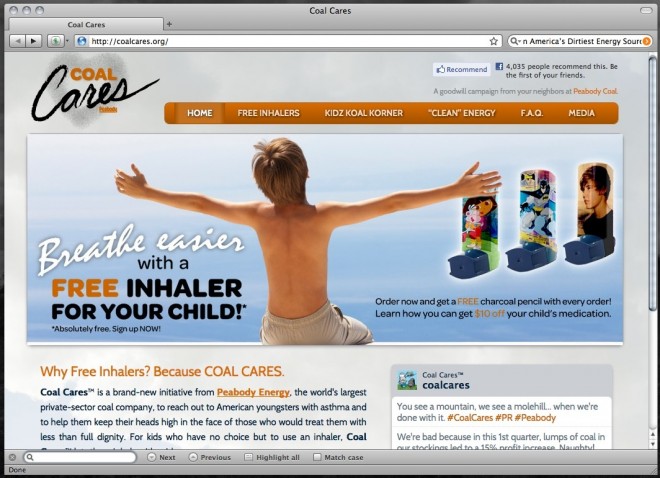
And now welcome Peabody Energy, the world’s largest private coal company, which spends millions each year lobbying against clean-air legislation.  Last month, Peabody was the object of Coal Cares, a clever spoof Website.

(click to enlarge; source: Wired)

It was Peabody’s press release in response that makes them the clear winner of the Cancer-Is-Good-For-You competition.

The United Nations has linked life expectancy, educational attainment and income with per-capita electricity use, and the World Resources Institute found that for every tenfold increase in per-capita energy use, individuals live 10 years longer.

The spurious logic — the implied fallacy of composition and the attempt to fob off correlation as cause — is so obvious that it could easily be part of the Coal Cares spoof.  But no, it was for real, at least while it lasted.  Unfortunately, Peabody removed the document before we could award them the CIGFY trophy .

What the UN data actually show is not surprising: Richer countries produce more electricity. They also have better health, education, and income. The message Peabody wants us to get takes the global and misapplies it locally, and it reverses cause and effect: If you want to be long-lived, educated, and rich, live near a coal-driven power plant.  Cancer, asthma, and heart disease are all good for you.

——————————

*I don’t know if Wilson also wrote that title. Unlike the post-hoc logic suggested by the title, Wilson does not argue that the recession caused the decrease. But he does imply that the recession did not exert any upward force on crime.