Search results for The

HAPPY JULY!

If you’ve been paying close attention, you’ll have noticed three new members of the Sociological Images team.  We’re so pleased to announce that Philip N. Cohen, Caroline Heldman, and Jay Livingston have joined on as regular Contributors.  Each has a bustling public intellectual presence of their own and we’re thrilled that they’re blogging for SocImages!

Philip N. Cohen, PhD is a Sociology professor at University of North Carolina, Chapel Hill.  He writes about family, work, and inequality professionally, and at his fabulous blog, Family Inequality.

Jay Livingston, PhD is the chair of the Sociology Department at Montclair State University.  His expertise is in social psychology, culture, and crime.  He blogs at the equally fabulous Montclair SocioBlog, where he also does great work teaching science literacy with his posts about statistics.

Caroline Heldman, PhD teaches Politics at Occidental College.  She is an expert on the presidency and gender in politics, featured in the new documentary Miss Representation.  She’s also an intrepid investigative journalist and represents the liberal point of view on Fox programs weekly.

Please welcome them with your always incisive commentary!

AROUND THE INTERNET:

After Gwen posted my talk on hook up culture here at SocImages, it was picked up by BoingBoing (to my excitement!).  After seeing the talk, Ben Privot at The Consensual Project asked me to do a quick interview on deconstructing cultural narratives about sexuality.

Caroline, our new Contributor, published two essays exposing the culturally and politically corrupt response to a rape in Silsbee Texas.  You can read abridged versions at the Ms. blog (here and here) or her unedited version at her blog.

Gwen was all over the internet this month: on About for a story about Arnold Schwartzenegger’s Love Child Scandal, on the Huffington Post about a racially-charged Dove Ad, and on a local Las Vegas NPR station offering some perspective on home buying and the recession.

Finally, I was also tickled to see my post about the “obscene” Dossier cover featuring a feminine male model used in a Newsy video report about the controversy.

WHERE ELSE WE ARE…

This is your monthly reminder that SocImages is on Twitter and Facebook.  You can learn more about your editors at my website and Gwen’s.

Oh and, um, I totally joined twitter this week!  And you can follow Philip Cohen and Caroline Heldman too.  :)

I argued earlier that Avatar was not a story about a heroic people, the Na’vi, but a white savior.  I summarized:

Sully is not only a superior human being, he is also a superior Na’vi. After being briefly ostracized for his participation in the land grab, he tames the most violent creature in the sky, thereby proving himself to be the highest quality warrior imaginable per the Na’vi mythology.  He gives them hope, works out their strategy, and is their most-valuable-weapon in the war. In the end, with all Na’vi contenders for leadership conveniently dead, he assumes the role of chief… and gets the-most-valuable-girl for good measure. Throngs of Na’vi bow to him.

Avatar was heralded as a break-through movie for its technological achievements, but its theme is tired.  With the aim of pointing to how Avatar simply regurgitated a strong history of white, Western self-congratulation, Craig Saddlemire and Ryan Conrad re-mixed the movie with other similar movies, including Blind Side, Dancing with Wolves, Blood Diamond, The Last Samurai, Out of Africa, Stargate, and Indiana Jones and the Temple of Doom.

They go through several features of these narratives: awe at the “native” landanimalspeople, the decision that they are helpless and doomed without White, Western intervention, the designation of a White savior who devotes him or herself to their rescue, native self-subordination, and more.  It’s pretty powerful. Thanks to Lizzy Furth for sending the video along!

See also: Formula for a successful American movie.

Lisa Wade, PhD is an Associate Professor at Tulane University. She is the author of American Hookup, a book about college sexual culture; a textbook about gender; and a forthcoming introductory text: Terrible Magnificent Sociology. You can follow her on Twitter and Instagram.

I recently argued that the blog, Born This Way, falsely suggested may give the impression that dressing or acting in ways consistent with the other sex when you are a child is a True Sign that you are gay.  This is obviously not the case, as almost all of us can find a photo from our childhood in which we’re breaking gender norms; it also conflates gender performance and sexual orientation (leaving out “lipstick lesbians” and “butch” gay men) and it locks the GLBTQ movement into a biological argument for acceptance, an argument I believe is short-sighted.

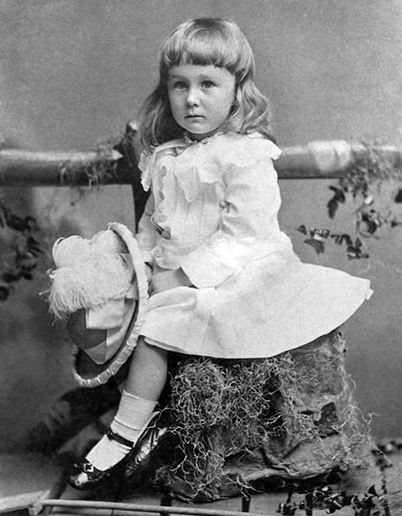
The idea that wearing a dress or seeming girly is a sign that one is gay is also completely ahistorical. If wearing a dress as a child means boys are gay, then there should have been essentially no straight men for much of American history.  Until the 1920s, infants and small children, whether male or female, were dressed and looked alike, often in long hair and dresses (source: Jo Paoletti).  Behold, American President Franklin D. Roosevelt (1882–1945):

Roosevelt may or may not have been gay then, but this outfit and hairdo certainly cannot be read to suggest that he was, at least not anymore than it can for young people and adults today.

Idea and photo borrowed from Family Inequality.

Lisa Wade, PhD is an Associate Professor at Tulane University. She is the author of American Hookup, a book about college sexual culture; a textbook about gender; and a forthcoming introductory text: Terrible Magnificent Sociology. You can follow her on Twitter and Instagram.

Cross-posted at Family Inequality.

It’s been a big week for stories of families denied and disrupted by the state.  Family denial came up in the form of bodily intervention (as in North Carolina’s eugenics program), border control (as when Jose Antonio Vargas‘s mother put him on a one-way plane for the U.S.), parents’ incarceration, or legal denial of family rights (the refusal to recognize gay marriage, or what I suggest we call homogamous marriage).

(1)  North Carolina’s eugenics program was the subject of hearings this week, dragging on with no compensation for the 7,600 people who were involuntarily sterilized between 1929 and 1977. A collection of literature at the State Library of North Carolina includes this 1950 propaganda pamphlet:

(2) Jose Antonio Vargas, a Pulitzer Prize-winning journalist, recounted his life as an undocumented immigrant. His mother put him on a plane for the U.S. with false papers, maybe never to see him again.

(3) While a judge declared the federal law against recognizing gay marriage unconstitutional, the New York legislature maybe moved toward legal recognition, and President Obama’s support of gay marriage apparently stalled.

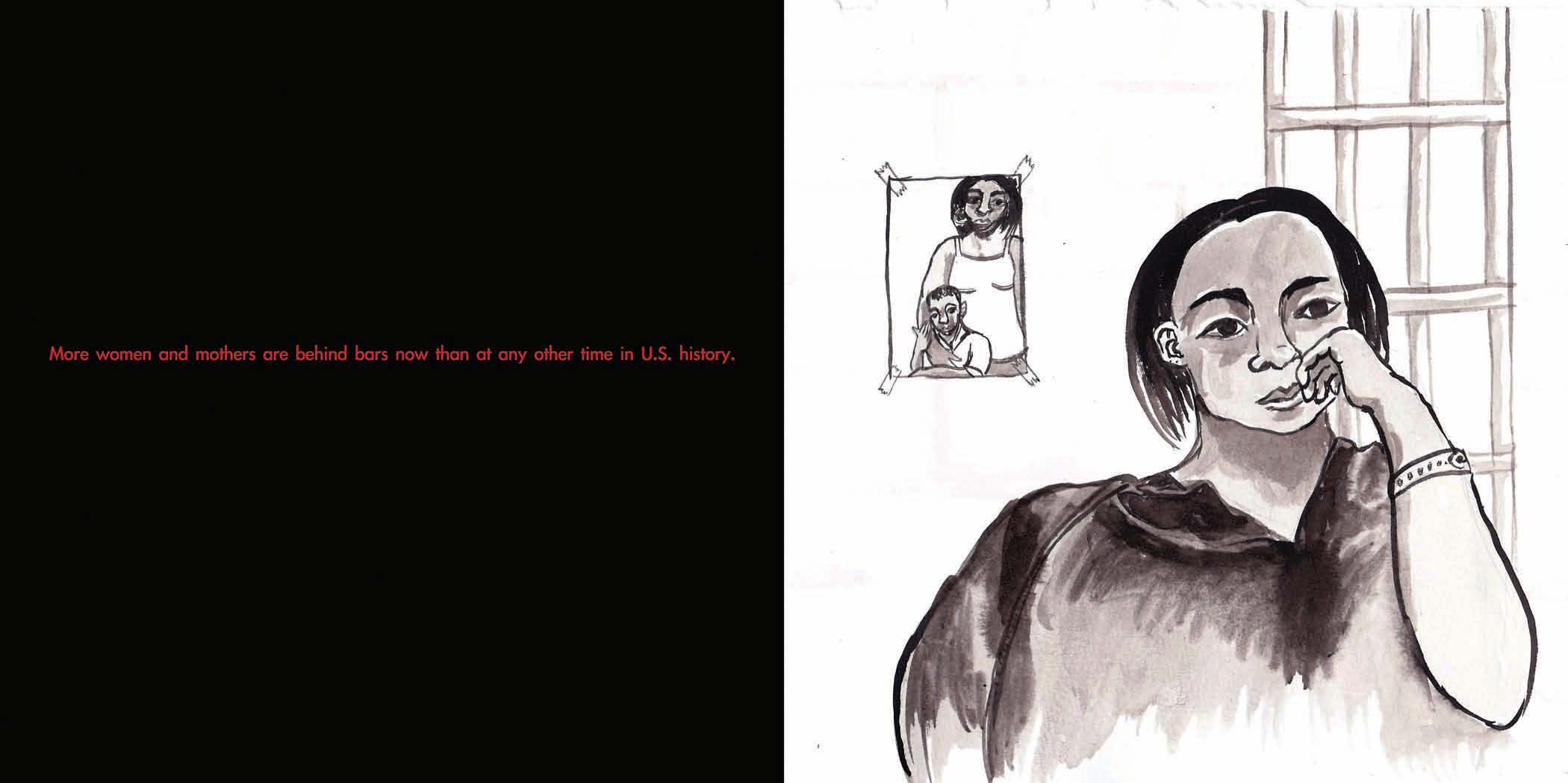
(4) The 40th anniversary of the drug war was a bleak reminder of the millions of U.S. families separated by incarceration during that time.

The text says, “more women and mothers are behind bars than at any time in U.S. history,” from (www.usprisonculture.com).

(My graph from data in an article by Wildeman and Western in The Future of Children)

Philip N. Cohen is a professor of sociology at the University of Maryland, College Park, and writes the blog Family Inequality. You can follow him on Twitter or Facebook.

Recently while reading the feminist magazine Bitch, I came across an interview with Leila Cohan-Miccio and Caitlin Tegart, creators of the web series Vag Magazine. The series focuses on three women who buy a fashion magazine and recreate it as a feminist magazine, a la Bitch or Bust. The young women, Bethany, Fennel, and Sylvie, are stereotypical third-wave feminists. The series pokes fun at them specifically and third-wave feminism in general, highlighting the differences between a vision of feminism as empowering women as a group (Meghan, the “normal” character used to ground the viewer, defines feminism as the idea that men and women should be equal) and the idea that empowerment means individual women are free to do “whatever they want” and “have fun”:

The series reveals some of the limitations of “catch-phrase feminism” (to use a term from Brittany Shoot’s Bitch article). These catchphrases echo throughout American culture: “You go girl!” “It’s about choice!” Vag Magazine’s theme song informs the audience, “A girl is a girl, because she is power. Power is power because it’s a girl.” Another prominent pop culture feminist, Lisa Simpson, sums up this vision of feminism: “Well, as a feminist, virtually anything a woman does is empowering” (“The Blue and the Gray,” originally aired February 13, 2011). A viewpoint like this is inclusive, but can also shut down meaningful conversation. For example, the young women have trouble getting anything done (Fennel hires an intern because “We don’t believe in hierarchies, but we also don’t have time to get our own coffee.”) In another instance, Bethany, Fennel, and Sylvie tell Meghan that the skirts she wants to write about aren’t feminist enough, but are unable to clearly articulate what a feminist skirt would be.

Third-wave feminism is sometimes viewed with disdain because it can seem empty: if any choice a woman makes can be construed as feminist, then perhaps no act can be truly called feminist. At the same time, third-wave feminists can be more inclusive than previous generations: stay-at-home moms, working mothers, sex workers, and scientists are all embraced. However, there can be less of an emphasis on organizing and fighting for equality (though recent efforts to support Planned Parenthood and organize Slut Walks shows that third-wave feminists are interested in more than mere slogans).

Various episodes also address the available media options for those looking for a feminist perspective. The main rival to Vag Magazine is Cunt, a magazine staffed by more stereotypically aggressive feminists. The series shows how often women can feel like they are stuck with only two images of feminism: New Age-y “I honor you as a woman” feminists who seem spacey and ineffectual, or the stereotype of the radical man-hater. Episode 4, “Feminist Sweepstakes,” delves into this dichotomy . The episode starts with Fennel wanting to read her poem; she is asked to wait until the designated poetry hour; these women feel so much that they must have an entire poetry hour. Later, the audience is introduced to Jaybird, the editor of Cunt. Jaybird and her followers wear leather vests and jeans, which contrasts with the dresses, pastel colors, and feathers favored by the Vag staff. Only Meghan, the audience stand-in, gets to be “normal” – that is, reasonable.  During the two magazines’ confrontation, Jaybird yells and talks about the patriarchy; Bethany and Fennel use poetry and talk about honoring Cunt’s place. Meghan is the only one who can speak clearly and without rhetoric, transcending common feminist stereotypes, doing so by being clever and critical.

But Vag Magazine is not about putting women down or just laughing at them or feminism. Indeed, there is a lot of love in this series, and a lot to celebrate. The cast is all-female, and all funny. The women are able to buy the magazine thanks to their efforts at selling crafts on Etsy.  They do publish an issue of their magazine: they are, ultimately, successful. Indeed, the women of Vag Magazine act out the inner turmoil about how to present themselves as feminists to the world. The series humorously highlights the bind modern feminists often find themselves in: how to be inclusive without embracing everything, how to be forthright and challenging of inequality but not bullying.

The rest of the series is after the jump. more...

In the 1940s and ’50s dichlorodiphenyltrichloroethane, a synthetic pesticide better known as DDT, was used to kill bugs that spread malaria and typhus in several parts of the world.  DDT was argued to be toxic to humans and the environment in the famous environmental opus, Silent Spring.  It was banned by the U.S. government in 1972.

Before all that, though, it was sprayed in American neighborhoods to suppress insect populations. The new movie Tree of Life has a great scene re-enacting the way that children would frolick in the spray as the DDT trucks went by. Here are two screen shots from the trailer:

Searching around, I also found some vintage footage (the person who uploaded the clip doesn’t specify the documentary):

The scene reminded me of an old post we’d written, below, featuring advertisements for the pesticide, one with the ironic slogan “DDT is good for Me-e-e!”

—————————

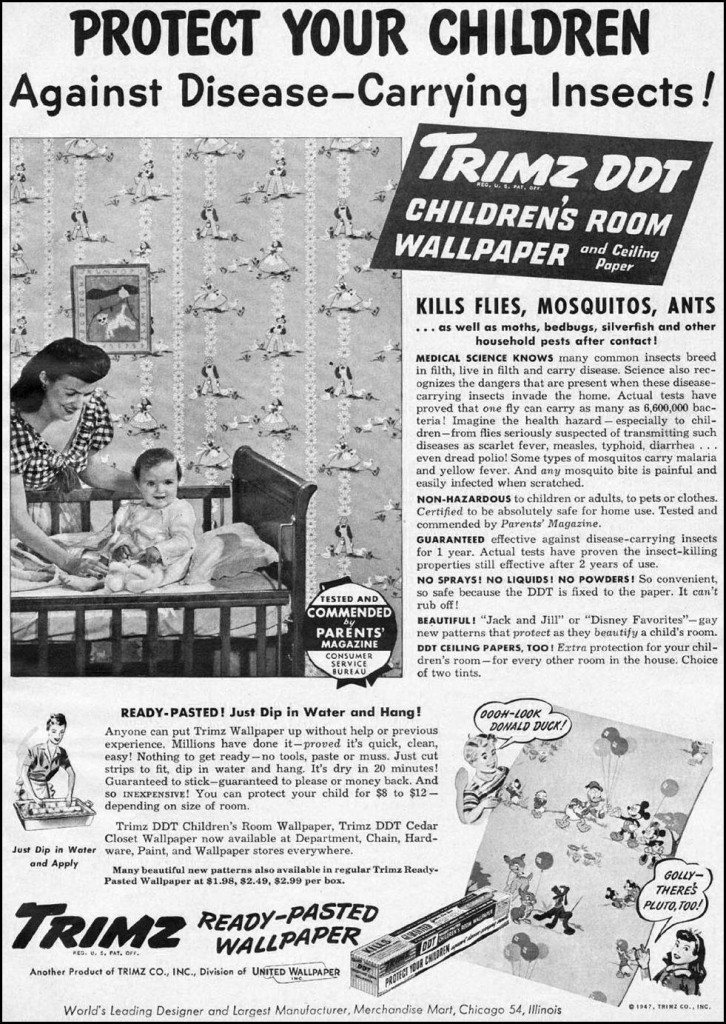
DDT was a pesticide marketed to housewives (and many others). We later discovered it to be an environmental toxin. Below are three of the advertisements (via Mindfully and KnowDrama and noticed thanks to John L.):

DDT-laced wallpaper, from Copyranter:

(text for this final ad after the jump)

more...

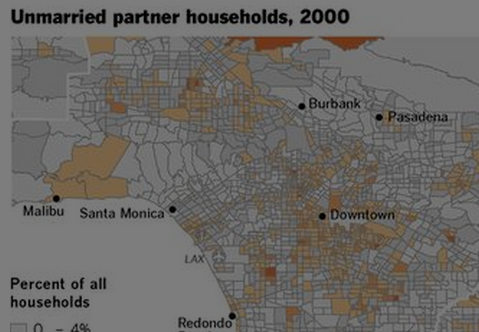
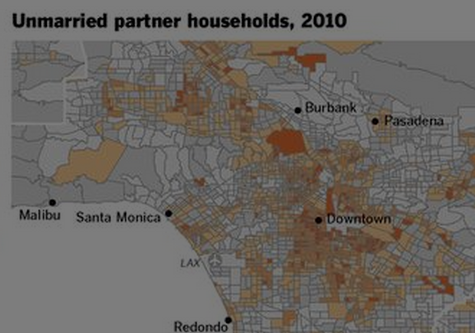
Katrin sent along a link to a Los Angeles Times article reporting on how family composition in the LA area has changed in the past decade.  The short story is that families are less “traditional” than they were ten years ago.  Only 23% of households are now made up of a married couple with kids (down 10% since 2000). Meanwhile, single-parent families, non-married partners (with and without kids), and same-sex couples (with and without kids) have all increased by 20-25%.  Married couples without kids are up too (by 4%), they’re now 26% of all households.

The maps below show the percent of households in each census tract that include an unmarried couple living together.  Darker orange means a greater percentage.  You can see that this convention-breaking isn’t evenly distributed.  I think the big orange blob underneath Burbank is Silver Lake/Echo Park, a notoriously hip part of the city where you find lots of “hipsters,” and Hollywood, where the population of same-sex couples is likely higher.

Los Angelenos, do you see anything else interesting?

See also the amusing: What Does a Traditional Family Look Like?

Lisa Wade, PhD is an Associate Professor at Tulane University. She is the author of American Hookup, a book about college sexual culture; a textbook about gender; and a forthcoming introductory text: Terrible Magnificent Sociology. You can follow her on Twitter and Instagram.

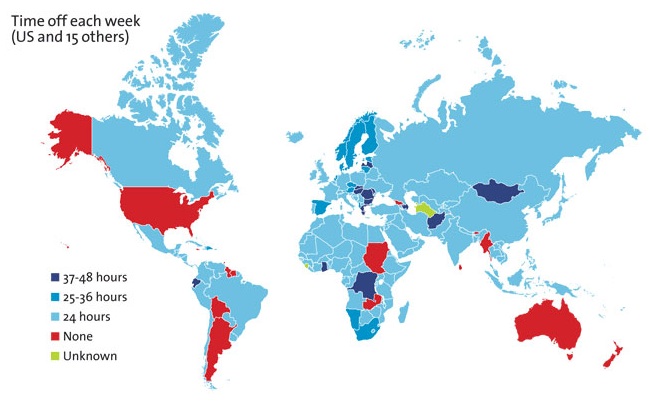
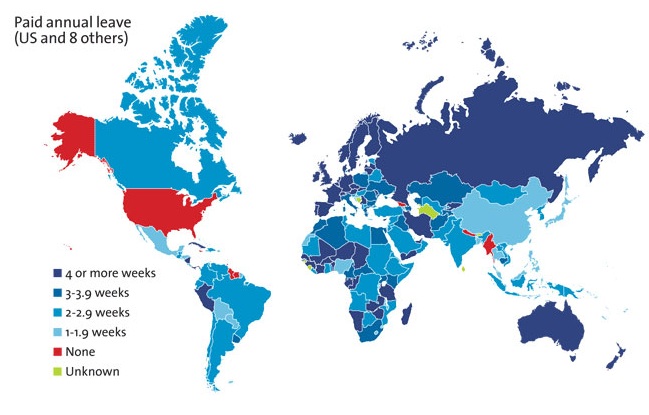
Dolores R. sent us a link to some graphics at Mother Jones about work and income. There are a lot of different topics covered, but I thought I’d highlight their inclusion of some maps generated by the McGill Institute for Health and Social Policy, which gathers international data on government policies about work and family, such as requirements for paid parental leave.

This map shows how much weekly time off from work national governments have guaranteed workers (16 nations require none):

Of course, some nations, like the U.S., don’t regulate whether hourly-wage workers must have a day off each week but require they be paid at a higher rate if they work more than a certain number of hours (40 is usually the magic number in the U.S.), though this often doesn’t really apply to salaried workers, who aren’t paid by the hour.

Here’s paid annual leave (9 nations have none):

Paid maternity leave (6 nations have none):

The McGill Institute has interactive maps that let you compare global policies on a number of family-work balance issues. You can get global maps, such as these, or compare specific countries.