Search results for The


Michael M. sent in a news segment from WBTV, a CBS affiliate, about the video game Portal 2. The segment focuses on a scene in which a character is ridiculed for being adopted, with another character saying kids who were adopted suffer from a “lack of parents.” In addition, the game includes the line, “Alright, fatty. Adopted fatty. Fatty, fatty no parents” (at 55 seconds in). The news crew expresses dismay as they introduce the segment (and again at the end), which features a father who was upset when his family, including his adopted daughter, encountered the scene:

What struck Michael was the framing of this story by the news outlet, and the focus on ridiculing adopted children while entirely ignoring the use of “fatty” as a put-down, implying that insults based on body size aren’t problematic or hurtful. As Michael puts it,

In a story entirely about insensitivity, this statement, which is even subtitled on screen, seems to be parsed to only be an insult to the adopted. For some reason the weight-based [insult] is completely ignored…What makes one outrageous and another not even cause us to blink?


As a consequence of the “drug war” that began in the 1980s, the U.S. prison population has skyrocketed and, despite dramatic increases in corrections spending, many prisons are now grossly overcrowded.  This issue rose to the attention of the U.S. Supreme Court which has ruled that California must release or relocate more than 33,000 prisoners because prisons are so crowded as to amount to cruel and unusual punishment (source).

A recent issue of Mother Jones included a frightening exposé of the overcrowding in these prisons.  


Lisa Wade, PhD is an Associate Professor at Tulane University. She is the author of American Hookup, a book about college sexual culture; a textbook about gender; and a forthcoming introductory text: Terrible Magnificent Sociology. You can follow her on Twitter and Instagram.

On the heels of our post about race, ideas of beauty, and the controversy about Satoshi Kanazawa’s blog post at Psychology Today claiming Black women are “objectively” less attractive than women from other races, Lisa C. sent in the 9-minute trailer for the documentary Dark Girls. In it, African American women discuss their own experiences of bias toward dark-skinned women, both in pop culture broadly and from people in their own lives. It’s a stunning and heart-breaking illustration of the personal costs of beauty standards that define dark skin as inherently and automatically problematic:

Dark Girls: Preview from Bradinn French on Vimeo.

Sorry for the late post today! We’re both busy with travel plans. Lisa is on her way to New Orleans as I type. I will be in Oklahoma from June 2-8 and won’t be able to check comments or update posts while I’m there, so be patient with slower than usual responses from me.

NEWS:

We have a new Sociological Images essay, “Secrets of a Feminist Icon,” now available in the Spring 2011 issue of Contexts magazine. The essay, based on a post on the same topic, discusses the famous “You Can Do It!” poster associated with Rosie the Riveter, including several myths about its creation and use. You can download the essay here.

We’re always excited when we get linked to BoingBoing. This month they reposted a video we posted by Jay Smooth about media, agenda setting, and the Donald Trump “presidential candidacy” fiasco/joke.

Gwen was quoted in a Globe and Mail story about a used car dealership that compared sexually experienced people to used cars. She was also quoted in a Huffington Post article about racial representation and a recent Dove ad.

If you’re interested in writing a post for Soc Images, check out our Guest Post guidelines.

This is your monthly reminder that we’re on Twitter and Facebook.

Finally, if you’d like to learn more about us, you can visit our personal websites here (Lisa) and here (Gwen).

Eduardo Bonilla-Silva and Tyrone Forman wrote a wonderful article* examining the discursive strategies white college students use to distance themselves from racism, while still blaming people of color for their own disadvantage or being, straightforwardly, racist.  Among other strategies, they noted that these students would often preface their comments with the phrase “I am not a racist but…”

We’ve documented this strategy before with a series of PostSecret confessions and we certainly saw it used by UCLA’s Alexandra Wallace in her famous anti-Asian rant.  Now Karen alerted me to a new blog collecting instances of this type of language on Facebook, titled simply I’m Not Racist But… It’s pretty stunning what often follows.  Here are some examples (trigger warning for, um, some seriously racist talk):


That was just a selection from the first two pages.  They are lots more.  In a similar vein, you might visit our post about racist tweets and updates after the tsunami hit Japan.

* Bonilla-Silva, Eduardo & Tyrone A. Forman.  2000.  ‘I am not a racist but…’: Mapping White college students’ racial ideology in the USA.  Discourse and Society 11, 1: 50-85.

Lisa Wade, PhD is an Associate Professor at Tulane University. She is the author of American Hookup, a book about college sexual culture; a textbook about gender; and a forthcoming introductory text: Terrible Magnificent Sociology. You can follow her on Twitter and Instagram.

Note: Since I posted this, Philip Cohen has brought up concerns about the National Marriage Project’s data and analysis in another study. You might want to take a look at his post.

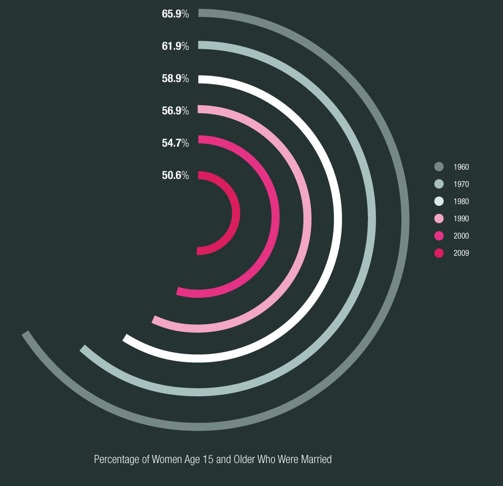
Patricia P. sent in an infographic illustrating trends in marriage, divorce, and cohabitation over the last several decades, based on data from the National Marriage Project at the University of Virginia. I found several of the images to be a bit cluttered and unclear, but this one neatly summarizes the percent of women over age 15 who were currently married, 1960-2009:

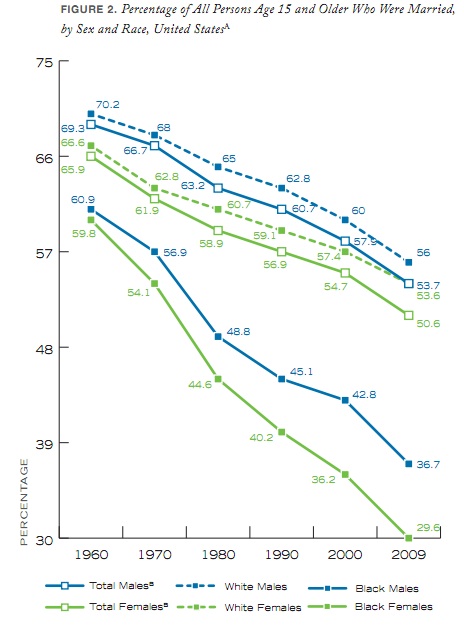
I looked through the full 2010 The State of Our Unions report. This graph, showing the percent of those aged 15 or older who were married from 1960-2009, shows that marriage has become less common for both men and women, Blacks and Whites (based on U.S. Census Data):

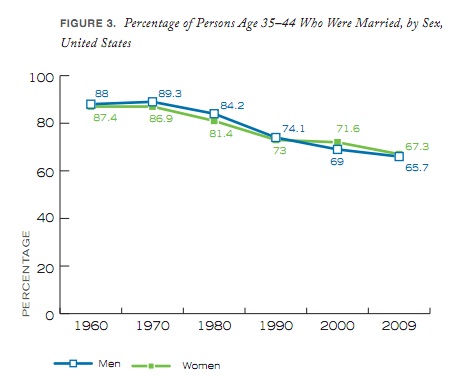
Of course, this is in large part because people in the U.S. are getting married later; not only do we not really expect a 15-year-old to be married, we’d be rather horrified if they were. If we look only at adults aged 35-44, we do see a significant decrease in marriage between 1960 and 2009, but still, about 2/3 were married:

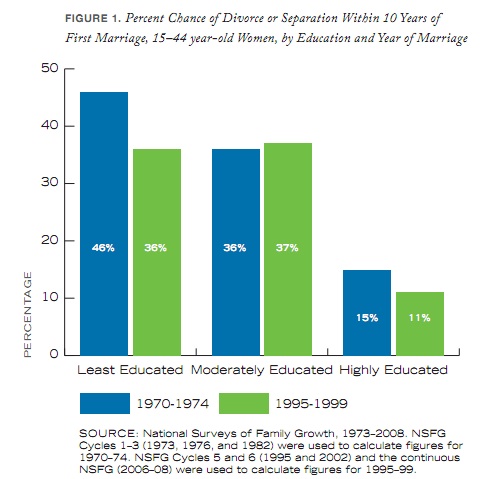
The report also includes a graph of the percent chance that a couple will divorce or separate within 10 years, broken down by education, for the early ’70s and the late ’90s (for first-marriage couples only). Least educated is defined as having less than a high school diploma; the moderately educated graduated high school but have less than a 4-year college degree; and the highly educated have a 4-year college degree or more:

Note that for both the least and most educated, the risk of divorce actually went down — though those with the least education are over three times as likely to separate/divorce than the highly educated.

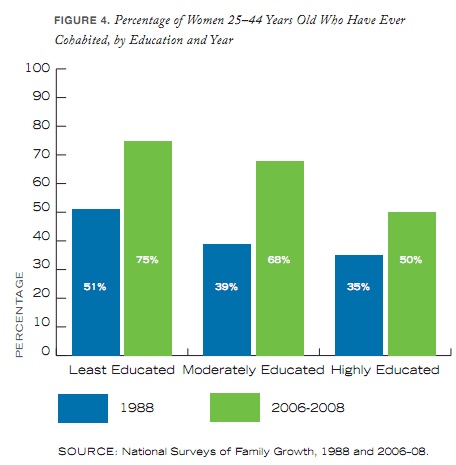
On the other hand, rates of cohabitation have gone up:

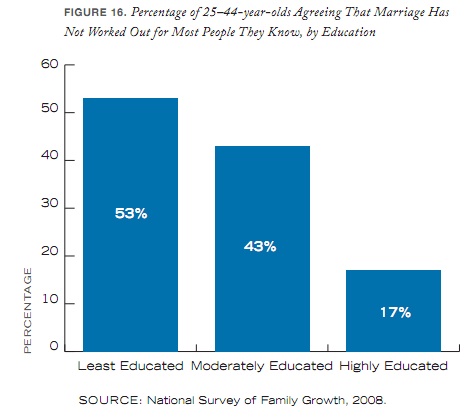
Perceptions of marriage, not surprisingly, also vary by educational level, with the highly educated feeling significantly more positively about marriage than the less educated population. Asked if they agreed that marriage hadn’t worked out for “most people” they know, 53% of the least educated and 43% of the moderately educated said yes, while only 17% of those with at least college degrees felt similarly:

So the overall trend appears to be a growing gap between the highly educated and those with less than a 4-year college degree, with the moderately educated looking more similar to those with less than a high school diploma in terms of their marriage, divorce, and cohabitation behaviors. If you’re interested in this topic, check out the full report.

I took this snapshot at a mall in Glendale, CA. I want only to point out the size of the mannequins decorating this store for “Large Size” women.  I am not going to belabor this point.  Just.  Ugh.  This is what we are being told is “so fat we have to have a special store for you.”

See also the bewildering look of “Plus Size” at Frederick’s of Hollywood.

Lisa Wade, PhD is an Associate Professor at Tulane University. She is the author of American Hookup, a book about college sexual culture; a textbook about gender; and a forthcoming introductory text: Terrible Magnificent Sociology. You can follow her on Twitter and Instagram.

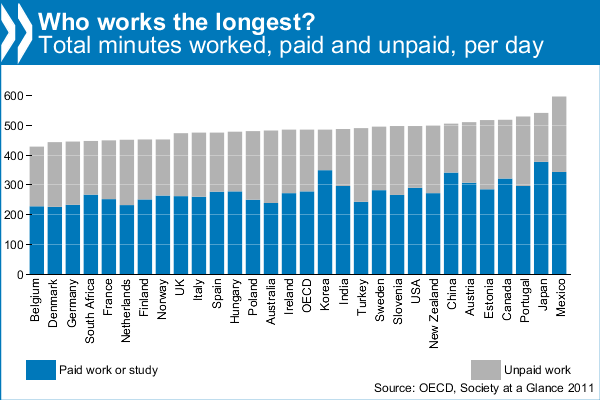
Dolores and Diego sent in a new study by the Organisation for Economic Co-operation and Development (OECD).  The study measured time use in 30 countries, demonstrating significant differences in the amount of work and leisure enjoyed, on average.

The country reporting the fewest work hours was Belgium at just about 7 hours a day.  The country reporting the most was Mexico; Mexicans reported working almost 10 hours per day.  That’s enough hours to translate into 45.5 extra days a year that Mexicans work in excess of Belgians, and a month of extra work hours compared to the average country in this study (at 8 hours a day).

The OECD has also reported gender gaps in leisure across countries (Norway had the smallest gap in that study; Italy the largest) and we’ve seen the gender leisure gap reflected in American advertising.

Lisa Wade, PhD is an Associate Professor at Tulane University. She is the author of American Hookup, a book about college sexual culture; a textbook about gender; and a forthcoming introductory text: Terrible Magnificent Sociology. You can follow her on Twitter and Instagram.