Search results for The

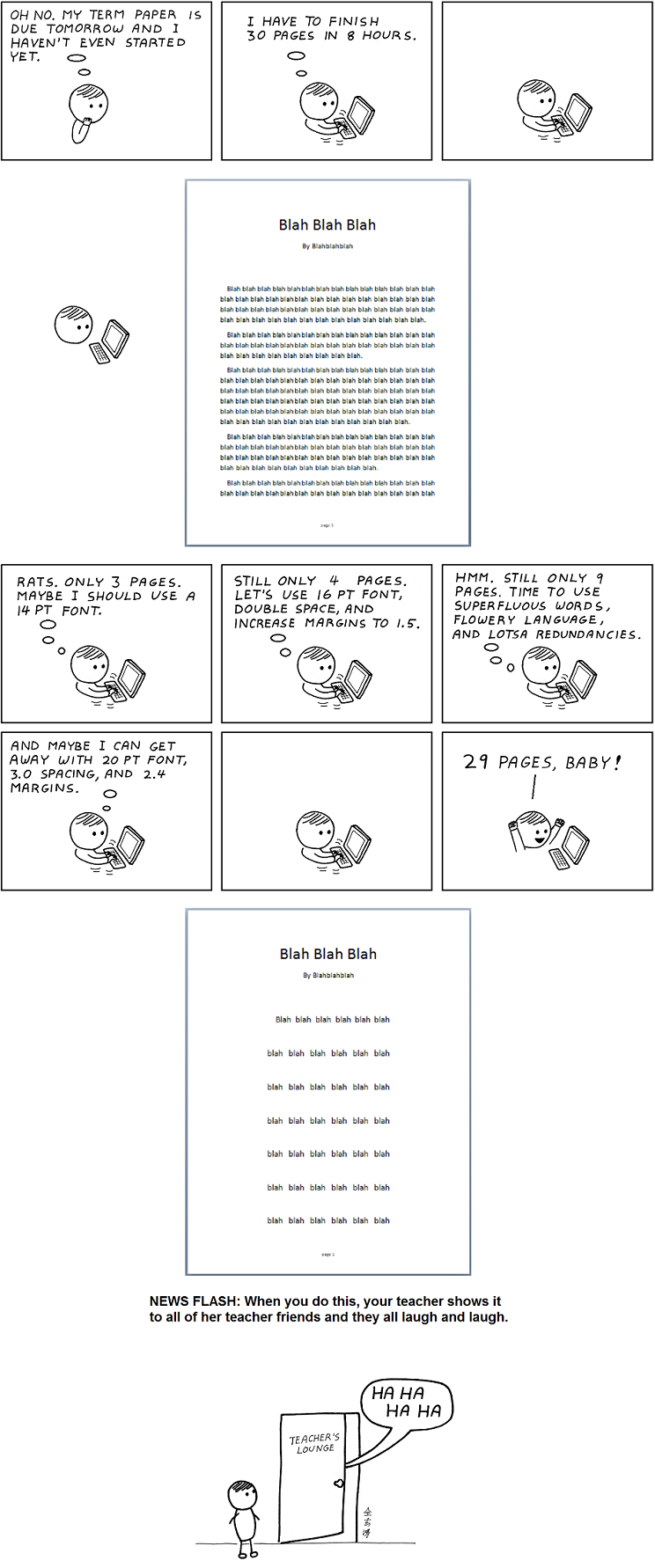
Teachers read papers. Thousands of papers. Even tens of thousands of papers over our careers. Like someone who develops an incredibly sensitive ear for jazz or taste for fine wine, we have an eye for margins. Fonts, margins, spacing… we’re like eagles, we spot even small deviations from standard formatting as if it were instinct, and it makes us want to go in for the kill.

Or maybe it’s just me. (And SocProf.)

Anyway, I was lol-ing about a format finesser with my friend Jordan G. the other day (do they really think we can’t tell?), and he forwarded me this cartoon (at Abstruse Goose):
I guess it’s not just me.

Lisa Wade, PhD is an Associate Professor at Tulane University. She is the author of American Hookup, a book about college sexual culture; a textbook about gender; and a forthcoming introductory text: Terrible Magnificent Sociology. You can follow her on Twitter and Instagram.
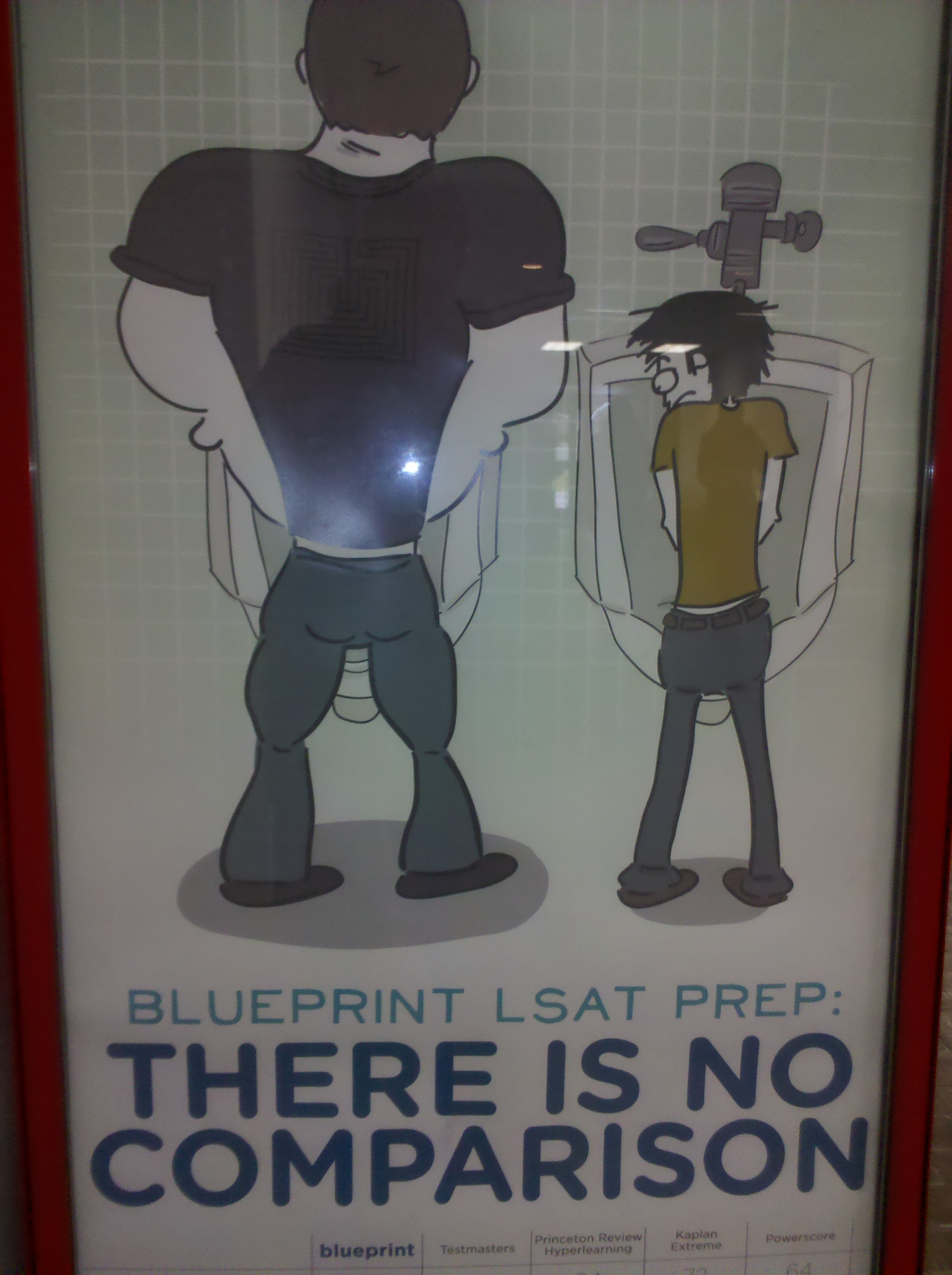
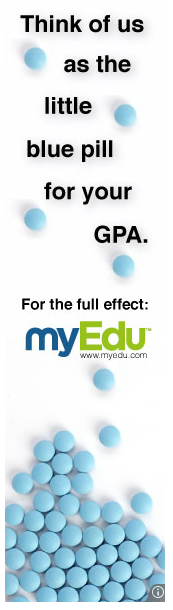
Over the past few months, a number of readers have sent in examples of college-related advertising with a distinctly sexual theme.  There’s something interesting here. College pursuit, preparation, and achievement are being conflated with sexual prowess (the size of one’s dick, no less).  I suppose it was never was really about smarts.  Still, the overt conflation of (masculine) sexual superiority with academic achievement seems new to me. Am I wrong?

Scott M. and Ed A-N. sent in which penis size is used as a proxy for preparedness for the LSAT:

Stephanie A. sent in this ad for MyEdu, a college management site (whatever that is) that makes an obvious reference to Viagra (the little blue pill that makes for not-so-little erections):

Last but not least, Becky E. and Monica Y. sent in this facebook ad encouraging women to apply to a school loan by suggesting that very-sexy-ladies do the same:

See also our post: using sex to sell the most unlikely things (like organ donation!).

Lisa Wade, PhD is an Associate Professor at Tulane University. She is the author of American Hookup, a book about college sexual culture; a textbook about gender; and a forthcoming introductory text: Terrible Magnificent Sociology. You can follow her on Twitter and Instagram.
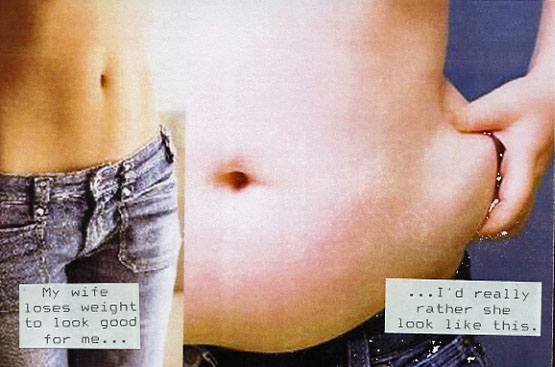
Many Westerners are constantly reminded that (very) thin women are sexy to men and (even slightly) chubby women are not.  In fact, men’s desires vary quite tremendously and often include a much wider range of body types than the media would have us believe. This is often kept secret not just by media executives, but by men themselves who might feel “weird” if they don’t prefer the culturally ideal type.

Both of these facts are nicely illustrated with this single example, from PostSecret, in which a man feels the need to confess that he prefers his wife chubby, even though she diets to try to “look good” for him.

Lisa Wade, PhD is an Associate Professor at Tulane University. She is the author of American Hookup, a book about college sexual culture; a textbook about gender; and a forthcoming introductory text: Terrible Magnificent Sociology. You can follow her on Twitter and Instagram.

Cross-posted at Montclair SocioBlog.

Is a university admissions office the same as the basketball team?  Should selecting an entire student body for the college be like selecting players for the varsity?

Remember that kid at UC Merced, the one who argued that the graduated income tax was like redistributing GPA points? He found students who supported a graduated income tax and programs for the poor but who wouldn’t sign his petition to redistribute GPA points from the A students to those with lower GPAs. None of the students could articulate, on the spot, their reasons for not signing the GPA petition (assuming that he didn’t edit out any who did offer a reasonable explanation). (My earlier post on it is here.)

He’s baaaack. This time he’s asking students to sign a petition for affirmative action in sports – specifically to give preference to whites trying out for the team. Get it? If you support affirmative action in college admissions but not in sports, you’re a hypocrite. As before, students support one use of race preference but not the other, and as before none can give a convincing reason. The students all say, “It’s different,” but they can’t explain why.*

(To save time, I’ve set the video to start near the end – most students say the same thing. To see the whole thing, just drag the slider back to 0:00.)

Nyahh, nyahh – you’re for preferences for blacks where they’re a minority but not for whites where they are the minority. You’re a hypocrite.** Either that, or your thinking has been muddled by liberal ideas, which is pretty much the same thing, isn’t it?

The video concludes with the dictum that college admissions and sports should be the same. “Race-based preferences are wrong.” Ah, moral clarity.

Is college really the same as a sports team? They are certainly different in their consequences. If you’re a student now, in the coming years when you apply for a job, will HR ask you if you played varsity? Maybe. But unless the job you’re applying for is power forward, your answer won’t matter very much. But HR will absolutely want to know if you have a college degree. And your answer will matter. A lot.

Sports and school are different in another important way. Schools seek out minorities more for the sake of campus diversity than for the benefit of individuals. Yale probably gives preference to applicants from Montana or Mauritania over those form Manhattan. (Yale also might give preference to a power foward if the team this year is short of guys who can work the low post.) The purpose of this admissions policy is not to benefit Montanans (or power forwards) but to provide other students with the experience of living with a diversity of people (and to provide the basketball team with the right diversity of skills).

That same goal of demographic diversity does not apply to the competitive teams or the glee club or orchestra for that matter because those groups have a much more narrowly defined task. It’s that difference in purpose, rather than the difference in which race gets helped, that underlies the responses in the video. Take those same liberal students who support admissions policies that bring more blacks to campus; ask then if they would also support race-based preferences to get more blacks into crew, the glee club, or the chess team. I’m sure they would say no. As in the actual video, they would probably be unable to explain why giving preference to African Americans is acceptable in admissions but not activities.

They’ll say that the two are different, even though they can’t immediately explain why. Does that make them hypocrites, natural or un-?

The next time someone shoves a microphone in your face and asks for a justification for some distinction you make, smile at the camera and say, “As Michael Polany wrote in The Tacit Dimension, ‘we know more than we can tell,’ an insight that Richard Nisbett later developed with much social science evidence in his book Knowing More than We Can Tell.” See if you make it into the version that gets posted on YouTube, or into Robin Hanson’s blog.**

————————-

*I had assumed that the petitioner and his camera people were students at Merced. But in this new video, he’s at UCR.

** As with the previous video, Robin Hanson, on whose blog Overcoming Bias I found both of these, files the students’ attitudes in the folder marked “natural hypocrisy.”


Cross-posted at Family Inequality.

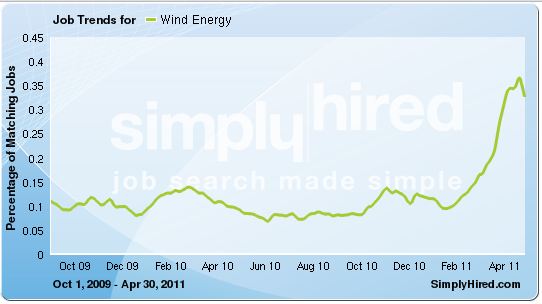
A blue-collar worker gets laid off. Maybe he or she reads an article in the Boston Globe with an image of a wind farm, like this. So he or she types “wind energy jobs” into Google, and ends up at one of many websites promoting wind energy jobs, with an upbeat graph like this:

Was this a common pattern during the recession, during which Obama has promoted the idea of moving workers into the wind energy sector? Honestly, I never would have thought of that question if not for the results of today’s poking around.

Action in context

New kinds of data have the potential to open up vast new territory in the study of patterned individual behavior. Finding and understanding aggregate patterns in micro-level behavior is more feasible than before. My prior poking around has included tracking the relentless decline of the name Mary given to children born in the U.S., the search patterns associated with having a baby across millions of Google users leading up to the recession, or patterns of divorces across states according to their unemployment levels.

In each of these situations, individual behavior assumes a social form that emerges when the data are aggregated and analyzed in relation to other patterns or time periods. And in each case it appears that separate individuals are responding similarly to larger forces — allowing us to understand those forces in new ways.

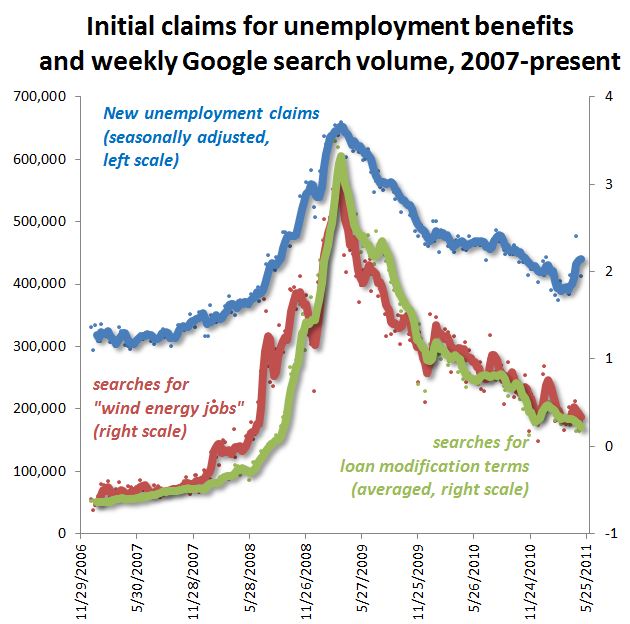
In today’s exercise I plugged the weekly number of initial claims for unemployment into the Google Correlate tool, and asked it for the 100 search term trends that were most closely correlated with the unemployment trend since 2007.* On the list were “wind energy jobs” and “green jobs.” Beyond those, it was pretty easy to group the 100 search terms into categories: 38 of them were searches for songs and lyrics (especially MGMT lyrics), 17 were Internet/technology related (such as “roadrunner webmail login”). I have no explanation for those.

But the last large group was clearly recession-related: those about loan modifications (such as “loan modification,” “loan mod,” or “mortgage hardship.”) All of these were very highly correlated with the initial unemployment claims trend (.93 or higher on a scale of -1.0 to 1.0). Here they are, plotted by week since the start of 2007.

The Google search volumes are relative (on the right axis), so we don’t know how many people were doing these searches, only that they were doing it in the same weeks that unemployment claims occurred.

A final, small group of terms were related to porn. Maybe there are just so many porn search terms that something is correlated with any trend. But the search terms “snake tube,” “uncoached” and “coomclips” track initial unemployment claims very well, with correlations over .94. Here they are together:

Maybe some brave Sociological Images reader will explain why these particular terms might follow the unemployment trend. (It could just be that they were new sites that became popular and then tapered off in 2008-2009.)

What’s the point?

It’s not news to people interested in sociology that individual, intimate behavior follows common patterns, which are related to cultural forces. What’s interesting to me here is that capacity to find patterns we couldn’t before. For example, does losing a job lead to more porn consumption? Are those porn searchers different from the people typing in “green jobs”? I’m hoping that other people will dig further and turn these tools to productive uses.

——————————

* To avoid big seasonal spikes unrelated to unemployment, I used the seasonally-adjusted unemployment claims, which basically tamp down the big jump in layoffs after Christmas and when school gets out each summer.

Philip N. Cohen is a professor of sociology at the University of Maryland, College Park, and writes the blog Family Inequality. You can follow him on Twitter or Facebook.


I am always suspicious of invocations of the phrase “human nature.”  It is not necessarily because I think there is no such thing, it’s simply that it is typically invoked with little consideration of the vastly diverse physical, cultural, and physical-cultural contexts in which human beings find themselves, and have found themselves.  This 3 1/2 minute introduction to a BBC special, Human Planet, sent in by (my mom) Kay West, illustrates some of this diversity.  While I’m a little anxious about the exotification that the clip might include (especially of “the primitive”), I still think it does a wonderful job of hinting at the wildly different contexts in which humans live:

Also, this (Gwen, do not watch!):

Found at Blame it on the Voices.

Lisa Wade, PhD is an Associate Professor at Tulane University. She is the author of American Hookup, a book about college sexual culture; a textbook about gender; and a forthcoming introductory text: Terrible Magnificent Sociology. You can follow her on Twitter and Instagram.
We have posted in the past about pre-World War II uses of the swastika as a symbol of good luck, a meaning that the Nazis’ appropriation of the swastika makes nearly inconceivable today. Matthieu S., who teaches anthropology at Vanier College in Montreal, sent in another example, a scan of a postcard he owns that was printed in the 1920s. The postcard, meant for a dad’s birthday, also includes pink-tinted flowers — evidence of a time when pink was considered a perfectly appropriate color for men and boys:

World War II and the atrocities of the Nazi party obviously significantly changed interpretations of both the formerly-benign swastika and the color pink. Pink wasn’t abandoned altogether, as the swastika was, but the Nazi’s use of pink to label gay and lesbian prisoners led pink to be stigmatized as effeminate and, thus, an inappropriate color for men…and over time it instead became the epitome of symbols of femininity.

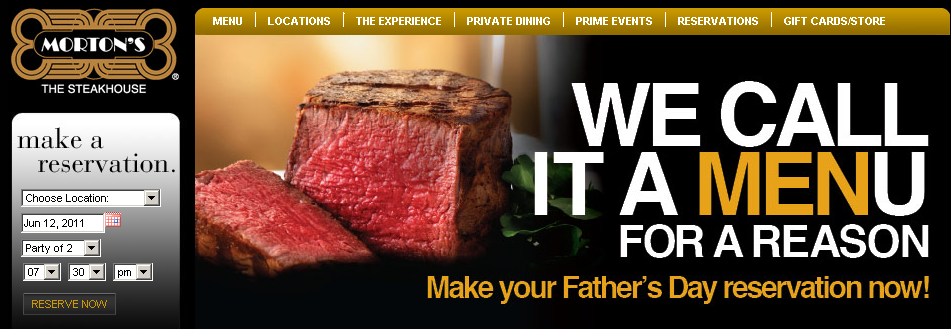
Celebrate Father’s Day this year with the weird American habit of gendering food!

(source)

Let us not forget that steak = manfood.  Like catfood and dogfood, manfood must be carefully produced so as to cater to man’s natural diet.  His ancestors hunted the wild baked potato, the shy ale, and the feisty tenderloin.  Today, Manfood Inc. scientifically calibrates each and every Father’s Day dinner to man’s instinctual stomach, so you can treat your man to the best.  We call it a MENu.

For more, see this vintage Campbell’s ad marketing meat for men, the gendered menu at Brick House, this ad campaign warning of sissified dogs, and this extensive collection of gendered and sexualized food.  See also this counter-example: a vintage ad arguing that vegetables make you tough and strong.

Lisa Wade, PhD is an Associate Professor at Tulane University. She is the author of American Hookup, a book about college sexual culture; a textbook about gender; and a forthcoming introductory text: Terrible Magnificent Sociology. You can follow her on Twitter and Instagram.