Search results for The

Chicho sent in a link to an interesting ad campaign from the Agency for Healthcare Research and Quality and the Ad Council. The campaign’s tagline is Real Men Wear Gowns:

picture-13

According to the website, “Real Men Know the Facts” about heart disease.”

As Chicho points out, it’s one of those rare examples we see of ads trying to undermine stereotypical masculinity rather than play it up: there’s still the idea of being a “real man,” but instead of associating that with rugged individualism or risk-taking (or eating high-fat bacon burgers while drinking a beer as you sit in your Dodge truck), here being a real man means taking care of yourself, going to the doctor regularly, and taking care of your family by staying healthy.

Thanks, Chicho!

Gwen Sharp is an associate professor of sociology at Nevada State College. You can follow her on Twitter at @gwensharpnv.
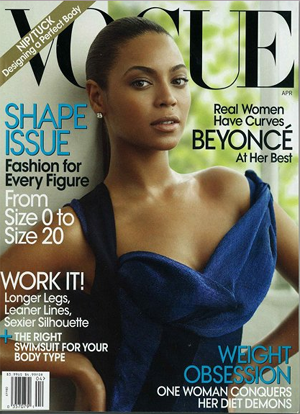
Women of color rarely grace the covers of fashion magazines like Vogue.  And yet, for the second time this year, the Vogue cover features a woman of color, Beyonce.  Unfortunately, in line with cultural stereotypes, the issue is the “Shape Issue,” contributing to the stereotype of Black women, and Latina women too, as especially “curvy.”  We document the fetishization of black women’s behinds here.

This month, Beyonce’s cover includes stories entitled:

Fashion for Every Figure: Size 0 to Size 20

Real Women Have Curves: Beyonce at Her Best

NIP/TUCK: Designing a Perfect Body

WORK IT! Longer Legs, Leaner Lines, Sexier Silhouette

THE RIGHT SWIMSUIT FOR YOUR BODY TYPE

WEIGHT OBSESSION: One Woman Conquers Her Diet Demons

beyoncecleancopy031309

The magazine sets up, essentially, an impossibility:  “Have curves, but by curves we mean something very specific: boobs and an ass.  You know, like Black women’ve got.  See Beyonce? She’s Black. So she’s got curves.  No matter that she’s extremely thin.  You should be extremely thin, too (‘WORK IT!’); eh em, we mean, ‘conquer your demons,’ we love you ‘from size zero to size 20.’  Just kidding!  We totally don’t.  Design ‘your perfect body’ with cosmetic surgery!  Then you’ll really love yourself… and we will find you acceptable… it’s win win!!!!”

Racism and sexism.  Nice work, Vogue.

(Via Jezebel.)

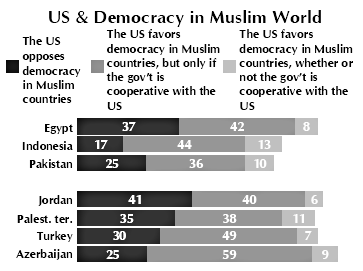
People in Muslim countries don’t think so:

blog_pipa_democracy_february_2009

(worldpublicopinion.org, via Kevin Drum at Mother Jones and Alas a Blog).

[youtube]https://www.youtube.com/watch?v=pPuIuYDDwBs[/youtube]
(Via Jezebel.)

Also interesting… I don’t think we have a concept of “swollen noodles” in the U.S.

Also in the sexualization of food:

1.  Chex Mix gives you curves.
2.  Sexy hot dog lady in a bun.
3.  Hot Indian Chicken.
4.  Sno-Ball head, sexy lady body.
5.  Chopsticks plus fork = hot sex.
6.  Vegetables are hot.
7.  Pasta, naked lady.
8. Women prefer Kellogs to hot men.
9.  Axe makes women love you like chocolate.
10.  Astroglide and Puma get in on the action.

Dozens more!

Lisa Wade, PhD is an Associate Professor at Tulane University. She is the author of American Hookup, a book about college sexual culture; a textbook about gender; and a forthcoming introductory text: Terrible Magnificent Sociology. You can follow her on Twitter and Instagram.

In this 7 1/2 minute video Hans Rosling maps the relationship between life expectancy, GDP, and sexual health and rights over 300 years of Swedish history:

Found at GapMinder.

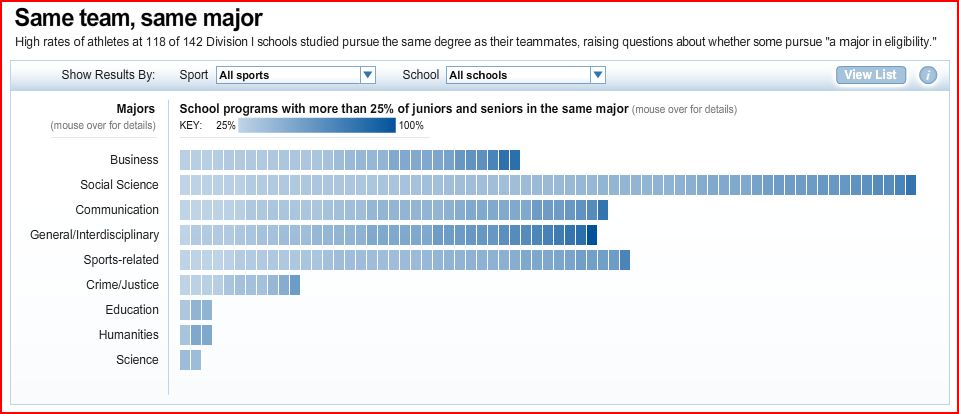
USA Today posted an interactive graphic demonstrating how different types of college athletes cluster into majors differently at different schools (via Montclair Socioblog).  For example, the screenshot below includes the data for all athletes in the study.  Each rectangle represents a school; the darker the blue, the more concentrated major choices are for that team at that school.   In this iteration, the darkest blue rectangle in the “social science” category represents Louisiana Tech at which 80 percent of male basketball players major in Sociology:

capture5

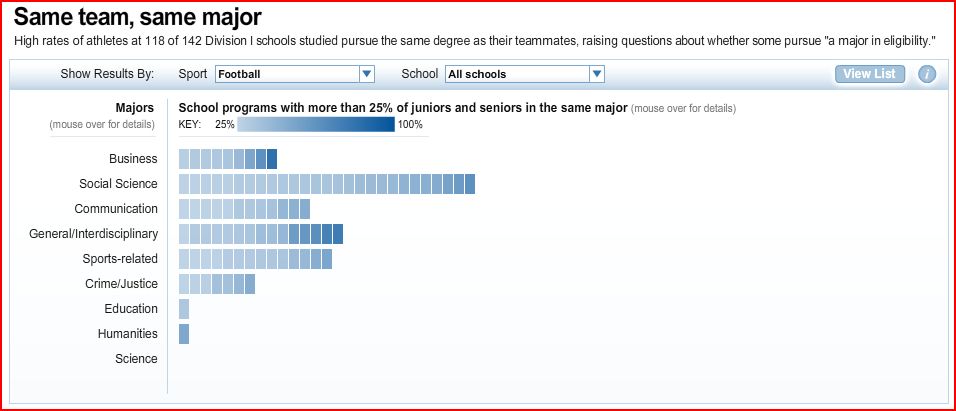
This screenshot features football players only.  At Georgia Tech, 82 percent of football players major in Business:

capture21

If you visit the site, you can manipulate the graphic as you like and see what school and team each rectangle represents.

Certain majors have long been rumored to be athlete friendly and I think this actual data sheds a lot of light on the false stereotype of both disciplines and athletes. 

The article doesn’t speculate as to why teammates cluster, but we could…

I was recently speaking to a colleague at my College who remembered a time during which a good percentage of the football players majored in Sociology.  He suggested that this was because one of the most high-profile football players, one who was very well-liked by his teammates and had a leadership role on the team, majored in Sociology.  Since that player has left the College, the percent of football players in our major has decreased.  In that sense, part of the explanation for why teammates cluster may be more social psychological than sociological.

What are your theories?

The Scion is an interesting study in marketing.  Scion (noun: descendant) is a subsidiary of Toyota.  Why Scion? Well, Toyota wanted to sell cars to young, hip, urban guys but (as we all know) Toyotas are for fuddy duddies (yeah I’m talkin’ to you).  So Toyota started Scion.  Scions are really just Toyotas, less the fuddy duddy baggage.  Toyota has marketed Scions accordingly.   Here are some commercials:

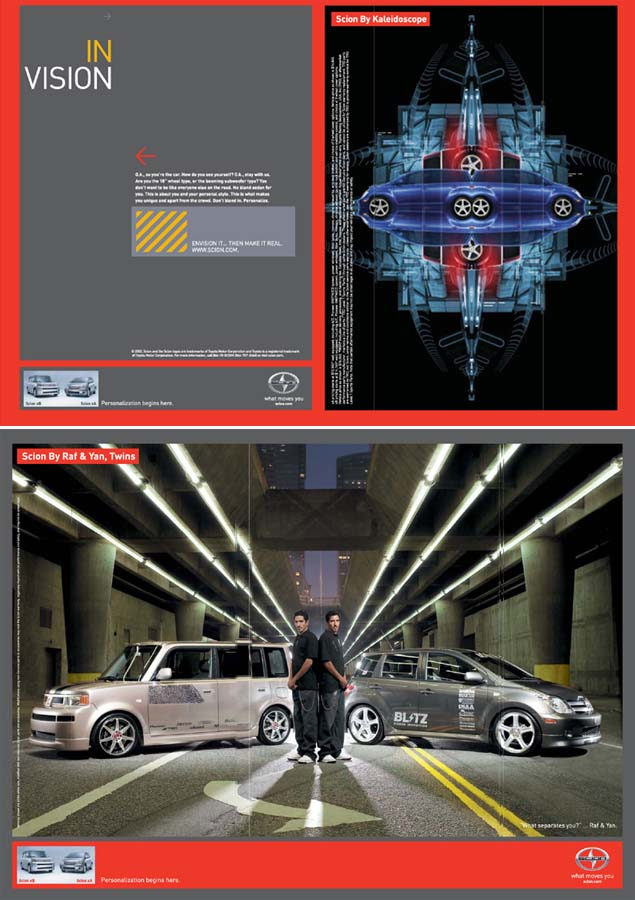
Scion advertising features young people of color, usually men, in urban spaces (found here):

1022scion14_big

I have a Scion.  This one:

dscf0127

When I walked into the Madison, Wisconsin Toyota dealer to purchase it, there were a dozen middle-aged white men with pot-bellies, and a Latina that looked about 16 years old.  She was the Scion salesperson.  (Hi Celia!)

Also appealing to its intended customers, Toyota encourages you to customize your Scion.  When I purchased the car, I had the option of adding neon trim around the bottom of the car, glowing cup holders, and giant speakers that took up the entire back seat.  Factory installed.  (I opted for all three, of course.)

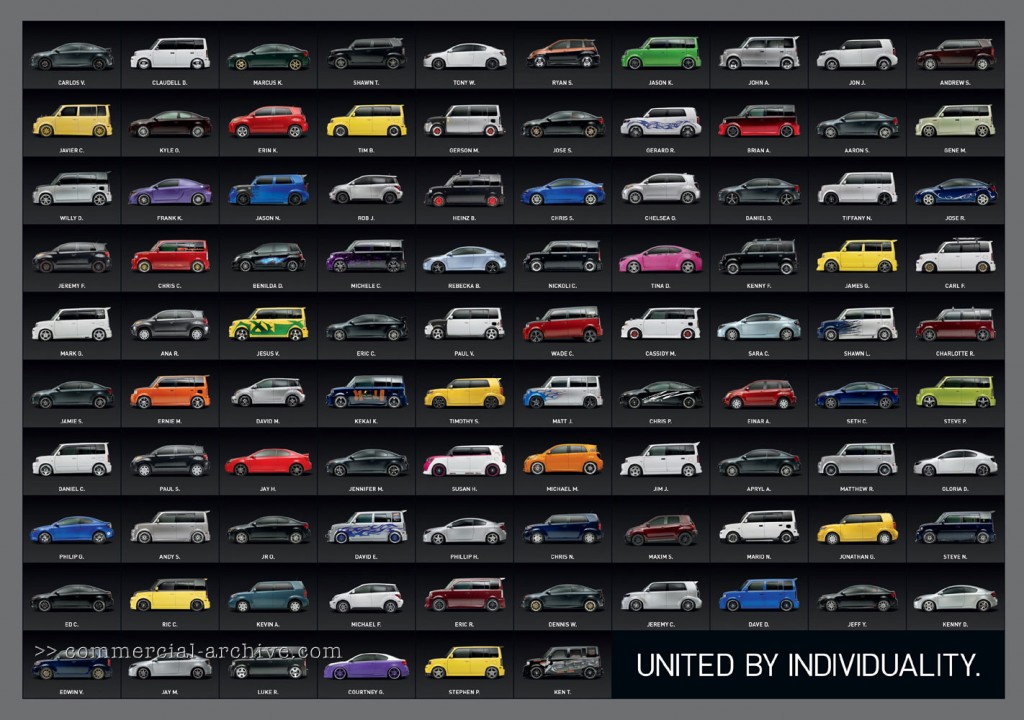
Scion encourages these additions.  As the commercials show, Scion emphasizes customization and the individualization of your car.  “United by Individuality” is one of their advertising themes (found here):

im-i-mb

Underneath each of these unique Scions is the name of its owner.  These names include Carlos V., Claudell D., Javier C., Benilda D., Jesus V., Kekai K., Nickoli C., Mario N., Einar A., Jose S., and Jose R.  They’re definitely not marketing to the stereotypical Toyota crowd.

The marketing of the Scion points to how we separate old from young and then layer the binary with further binaries: boring/exciting, suburban/urban, conformity/individuality, and even white/non-white.  Toyota doesn’t sell Scions by constantly reminding us that Scions are Toyotas (with all the dependability and efficiency that Toyotas are known for), just the opposite.  And youth, Toyota appears to believe, want to differentiate themselves from dull, grown-up, suburban, whitebread conformity as much as possible.

But here’s the twist:

Celia (who I bought my Scion from in Madison, Wisconsin) told me that, despite all of their efforts, the “boxy” Scion (the one on the left in the first print ad) is bought disproportionately by elderly people.  Why?  Because the spacious interior holds a wheelchair just as easily as a mountain bike or a drum kit and the height of the car makes it easy to get in and out of without having to pull yourself up or lower yourself down.

Marketing, thanks to human creativity and free will, has its limits and marketers can’t always predict how their strategies will play.

Laura W. sent us a link to a review of sex education in the U.K. that featured a three minute video. The video is a clip from a 1917 film, called “Whatsoever a Man Soweth,” encouraging Canadian soldiers to refrain from having sex with prostitutes. It was important for states to keep their soldiers from hiring prostitutes because soldiers filled up the sick bay with sexually transmitted infections that, during World War I, were not easily cured with antibiotics. Watch it here.

Also in soldiers and STIs: “Bad” women as disease vectors.