Another example of hair removal and standards of female beauty. Not at all subtle encouragement for women in the new ad from Schick/Wilkinson Sword razors for women. Shaving apparently makes you happy enough to sing songs with obvious innuendo.
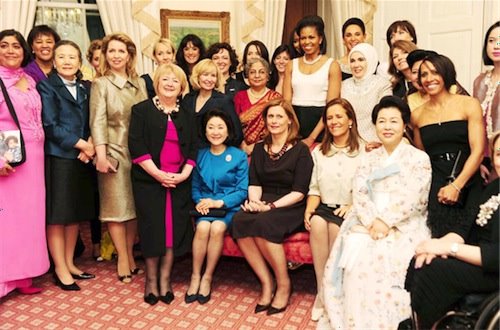
SocProf, from The Global Sociology Blog, has an interesting post about gender in the public sphere. Here is a photo (from Echidne of the Snakes) of the “first spouses” of the G20 nations (that is, the spouses of the political leaders of the G20):
Except…someone’s missing. Two of the G20 countries (Germany and Argentina) have heterosexual, married female leaders, and their husbands aren’t in the photo. I don’t know why–were they not invited to the event? Did they choose not to come? SocProf asks, “Would the husbands have looked out of place here? Would this have been embarrassing to them?”
But SocProf points out that a different disappearing act recently occurred in Israel:
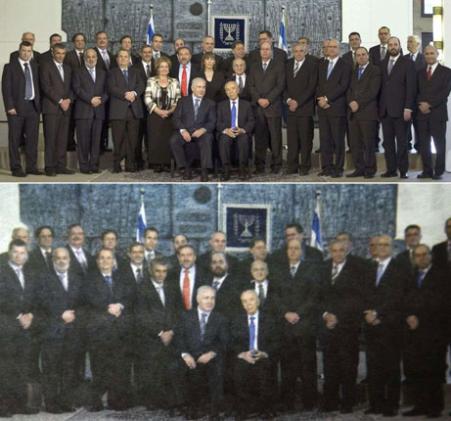
…look what happened in reverse in a group photo of the newly-formed Israeli cabinet. On top is the traditional cabinet group photo, at the bottom is the “touched-up” version that appeared in [the ultra-Orthodox newspaper Yated Neeman]… notice the difference?
Indeed, the two female Cabinet members have been photoshopped out.
SocProf says,
[In the G20 photo]…the men are not visibly absent. It is their presence that would be noticeable. And also note the setting in which the women pose, the soft colors, pink carpet and sofa with pastel background. It looks like a somewhat formal yet a little domestic setting.
The bottom photo is formal, no pink or pastel there! Icy grey with flags and orderly pose…It is a perfect illustration of the gendered domains: where men belong and where women belong.
Taken together, the three images, though taken for different purposes in different places, provide a great illustration of how we often make people who don’t fit cultural gender norms invisible…sometimes very literally.
I object to the use of the word ‘airbrushing’, because that’s not what happened: those photos were edited, manipulated, or fabricated, but airbrushing is a specific photoshop tool for minor modification. You can’t completely change the reality of a photograph with an airbrush, unless someone would like to tell me that those two male stand-ins are actually just drawings made with photoshop.
If you use the same word (airbrushing) for taking out a model’s cellulite as well as removing heads of state from photographs, you trivialise what’s been done. Digital editing is only going to become more and more common, and it’s important to find the right words to explain how a photo has been altered.
Good point–thanks for pointing the language issue out. I didn’t know what airbrushing referred to, exactly, and had just heard it used to describe altering an image in general.
When considering which media text I wanted to analyze based on its ideology, I immediately thought about the unsettling yet intriguing relationship between the main characters in one of my favorite TV shows of all time: Mulder and Scully from The X-Files. About a year ago, I began watching the show when a friend bought the entire series on DVD. Despite the fact that I absolutely loved almost every episode, the story arc of these two main characters as co-workers and a couple reinforces tired gender roles.
The below clip is a climactic scene where Mulder and Scully argue about Scully leaving the X-Files in the 1998 film “The X-Files: Fight the Future.” I think this scene exemplifies their basic relationship, and is a good example of what I would like to analyze.
[youtube]https://youtu.be/esJNnh-d2E0[/youtube]
What I like about Scully is that she is intelligent, scientific, and witty. She joins up with Mulder to be the counterpart to his obsessive interest in the paranormal. Since Scully is the fact-spouting hard ass of the two, one might think the character is breaking stereotypes. Unfortunately, she is only obscuring them.
Scully plays a traditional mother figure to Mulder more so than his love interest. She continually questions her work in the FBI duo, but she stays because Mulder needs her. In her, he has found someone who tries to understand his work, someone to care for him, and someone to love him unconditionally. The few times that she has an interest in other men is when she is trying to get over Mulder or get back at him.
Throughout the series, the fact that Mulder is a “typical bachelor” is driven home. He’s quirky and boyish. He never cooks, he’s obsessed with baseball and porn, he can’t keep house, and he usually just sleeps on his couch. Scully is seemingly unconcerned by all this. She laughs it off when he flirts with other women, she rolls her eyes at his housekeeping, and she is always there whenever Mulder decides he needs her.
The video above is an example of a sort of backwards rationale. Yes Mulder is thanking Scully for being there for him, but he’s also pleading with her to continue to deprive her own happiness. Though the scene directly references her giving up her own interests to be with him, it also romanticizes the concept of a woman selflessly caring for her man. The scene resonates with his emotional “thank you” and begs the viewer and Scully to come to his rescue. It reinforces the idea that in order for a woman to be perfect for a man, she must be willing to do anything for him at all costs and should never as for anything in return. If he so much as thanks her for years of servitude, then he’s the knight in shining armor. Read it as: The perfect women are level-headed and enjoy cleaning up the messes that their boy-in-a-man’s-body significant others create without any appreciation.
I think the X-Files is a good example of a show that manages to skirt the issue of gender roles by throwing a few curve balls. In reality though, it’s just more of the same.
————————–
Sarah Mick is a student at the University of Wisconsin – Milwaukee. She is currently double majoring in graphic design and media studies. She enjoys playing music, writing, and consuming media of various sorts in her spare time. I found her post here, where students in a Principles of Media Studies class are posting their insights. Special thanks to the instructor, Michael Newman, for facilitating the blog and allowing all of us to enjoy it!
Elisabeth R. sent us this one-minute commercial. I’ll let you experience it as designed (it has a surprise ending) and include my comments below:
We might feel that feminism and gun ownership are incompatible. An argument could be made that (especially machine) gun ownership is anti-feminist, but it’s also true that we artificially cluster rather random, unconnected ideas into political ideologies that we then understand to be compatible by definition. For example, what does being anti-gay marriage and anti-taxes have to do with each other? Nothing.
Franklin S. alerted us to the fact that someone at Complex magazine goofed. Our reward is another peek into the re-touching process that shapes nearly every image in our lives. This time the subject is Kim Kardashian. Animal made the find:
We spotted this image (left)… this morning in their “web exclusive” gallery, but by afternoon she was looking recognizably altered (right) and then removed from the site completely.
Sociological Images encourages people to exercise and develop their sociological imaginations with discussions of compelling visuals that span the breadth of sociological inquiry. Read more…