Search results for The

We’re pleased to feature a post by Robert Hariman.  Robert is a professor of Rhetoric and Public Culture in the Department of Communication Studies of Northwestern University.  Robert blogs at No Caption Needed, where we saw this great post:

—————————

I am suspicious of references to “the Arab Street,” particularly when the phase is applied–as it often is–to nations and other vast swaths of territory that are not Arab or not exclusively Arab. Several years ago Christopher Hitchens declared that it was a vanquished cliche but he was misusing it himself and not surprisingly as he was blowing the war trumpet for the Bush administration. And he wasn’t speaking of its persistence as a visual convention.
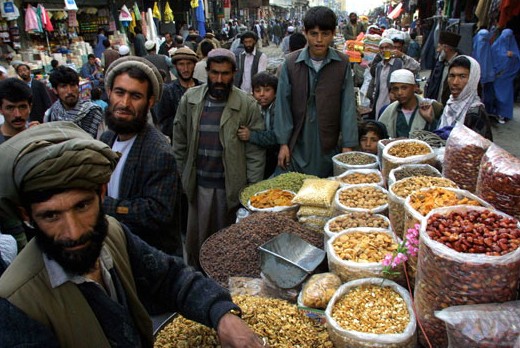
The caption of this photograph at The Guardian says only, “Nowruz celebrations in Afghanistan.” Nowruz is the name of the Iranian New Year, which is celebrated in a number of countries by people of several faiths. The baskets of dried fruits eaten during the holiday provide the only visual connection to the colorful festivities, and you have to know more than the paper tells you to see that. For many viewers, this will a thoroughly conventional image of the Middle East.

That image is one of throngs of working class men massed together in the street. What little business is there is in the open air markets lining each side of the densely packed urban space. We see small batches of everyday goods on display–probably to be bartered for, no less. The open baskets of food are a sure marker of the underdeveloped world. (Imagine how many packages it would take to wrap up all that fruit for individual snacks to be sold in the US; and even in Whole Foods the unpackaged food is in closed bins.) Everything fits together into a single narrative, but the masses of men and boys make the scene politically significant. This is the place where collective delusions take hold, where mobs are formed, and where unrest can explode into revolutionary violence and Jihad.

Which is why I get a kick out of this photograph of another Nowruz celebration.
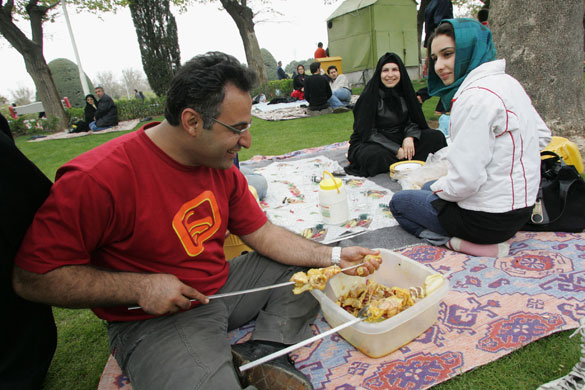
The caption reads, “An Iranian man skewers chicken for grilling as he picnics with his family.” My first thought when I saw the image was to check and make sure it wasn’t taken in Chicago. This also is a very familiar scene: grass, blankets, families and friends, plastic containers of food, dad getting ready to do the grilling.

What is astonishing is that I was able to see them at all. A typical summer holiday photo becomes a radical disruption of Western visual conventions when taken in Iran and shown in the US. Of course, it wasn’t shown in the US: this, too, is from the UK paper.

In this photo, there is no Arab street nor Iranian masses dominated by Mullahs and demagogues. A middle class tableau reveals that so much of what is in fact ordinary life for many people in Iran and elsewhere in the Middle East is never seen in the US. And it isn’t seen because it doesn’t fit into simplistic categories, outdated stereotypes, and a dominant ideology. All that is shown and implied in the cliches is of course also there, but it is there as part of a much more complex and varied social reality.

As evidence of how things might appear a bit different, notice how seeing the second image can affect perception of the first one. In the second, it seems evident that the family is posing for the photograph. They’re doing exactly what they would have been doing but now with the additional, amused awareness that it is, for a moment, also an act. And sure enough, if you look back to the first photo, you can see the same thing. And if you can see that, they no longer need appear as a mass, or poor, or threatening, or anything but people enjoying a holiday. Much like people in the US were doing this past weekend to celebrate St. Patrick’s day, thronged together, in the street.

Photographs by Natalie Behring-Chisholm/Getty Images and Behrouz Mehri/AFP-Getty Images.
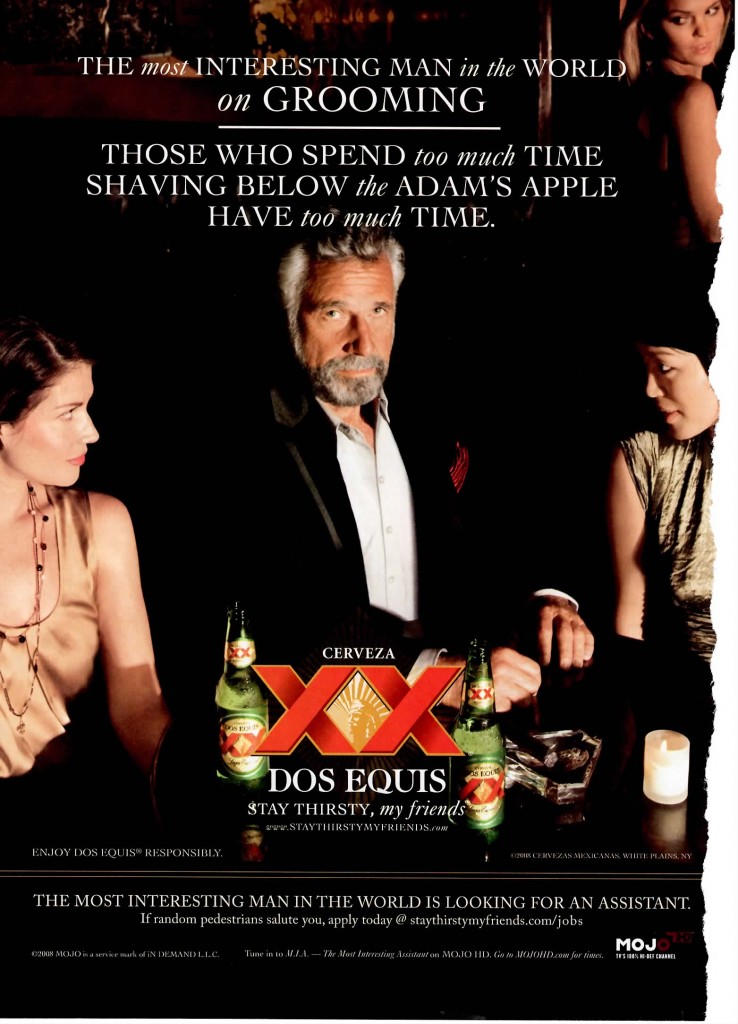
 Here is an ad from the “Most Interesting Man in the World” ad campaign by Dos Equis:

dos-equis

This ad, which is a clear attempt to harken back to the halcyon days of unfettered masculinity, is a cautionary tale against the feminizing effect of men shaving their body hair.  Contrast this message with that of the following ad for the Schick Quattro:

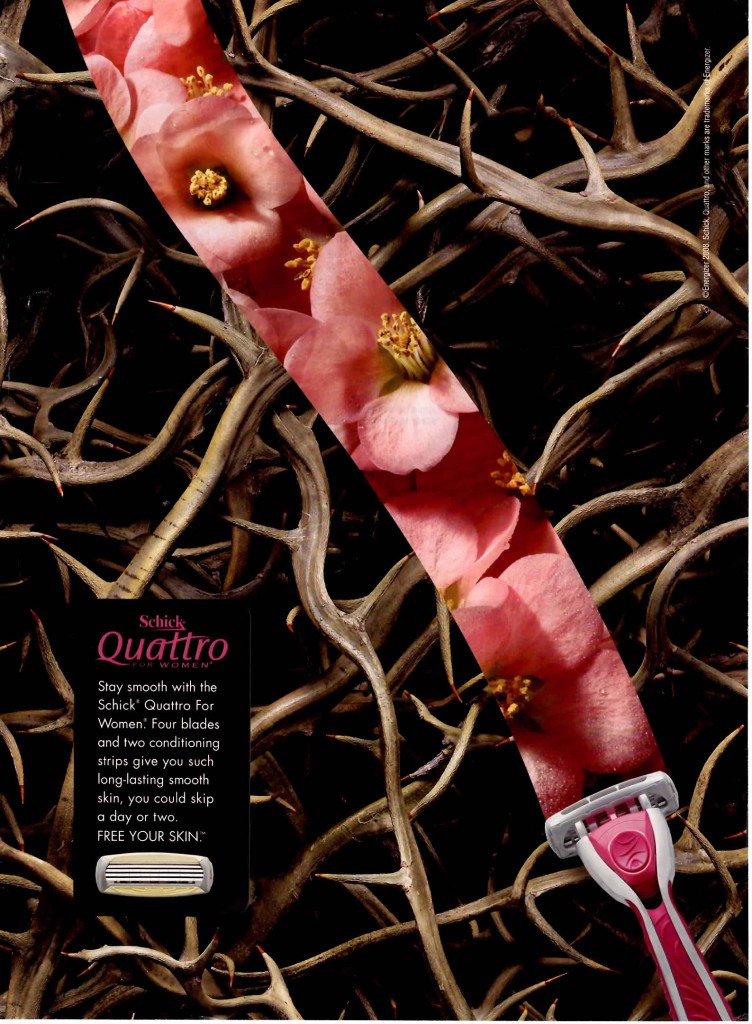
razor

Since the razor is pink, we can safely assume that it’s intended for women to use when converting their spiky brambles into beautiful flowers.

So, men aren’t supposed to shave below the neck, but women are required to.  Specifically, women are supposed to shave their “flowers” (in a nod to vulva-as-flower imagery?).

This may be helpful in discussions about social norms related to the removal of pubic hair. Of particular interest is whether the expectation of women’s pubic hair removal is objectively different from the expectation that they will remove other body hair.  Although pubic hair is considered more “private,” it’s difficult to make the argument that the impact of removing it is more sexual than that of, say, removing armpit hair (given that women’s attractiveness is partially predicated on the illusion of hairlessness).  Also, some men are beginning to remove their pubic hair (and the Most Interesting Man in the World be damned). Is this a positive shift, suggesting some parity in beauty standards, or is it a negative shift, in that superficial cosmetic norms now have the power to leapfrog over the traditional bastion of masculinity?

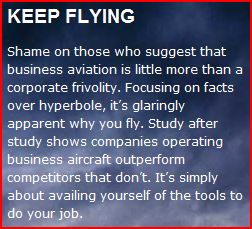
In the wake of the embarassing incident where car company executives were called out for flying in private jets to beg Congress for money, Cessna, manufacturer of private jets, is fighting back.  At their new website, www.cessnarise.com, they’re framing the attack as skeptical hyperbole that doesn’t take into account the facts and recommending that potential purchasers of private jets “rise” above it all.  Some screenshots:

capture9

Notice that Cessna frames the resistance to private-jet-flying chastisement as a “challenge” that should be overcome.

capture11

I don’t know whether private jet ownership is, in fact, economically smart.  I am rather sure that it depends on the company/person.  I do, however, think it’s interesting the way that Cessna is framing a rejection of the point made by Congress (that it is, perhaps, indulgent to insist upon private jet travel) in moral terms.  Customers should “rise” above, take on the “challenge,” fight the “naysayers,” beat the “skeptics.”    Real economics, then, appear to take a backseat to resisting the accusation that some of us enjoy extreme class privilege that is not necessarily justified by the books.

Miriam at The Oyster’s Garter offered a nice discussion about fragile ecosystems and human intervention.   She uses Macquarie Island (located between Antarctica and Australia) as an example (based on an article in the New York Times).  She writes:

Like on many isolated islands, the native birds evolved without predators and live in burrows.  Introduced cats were eating the birds and running amuck. So researchers embarked on an intensive cat-elimination program…  The only problem is that there [were] also introduced rabbits and introduced plants. With no more cats, the rabbits bred like rabbits and ate all the native plants. Introduced plants took over the bare slopes and prevented the native birds that this was all supposed to help in the first place from nesting in the best burrowing sites. 

Human intervention, then, changed the landscape (before on the left, after on the right):

macquarie-island

(Of course, human intervention had also shaped the landscape on the left. )

This before and after picture is useful for thinking about the interaction of humans with their environment, the way in which humans are part of ecosystems, and the difficulty of figuring out how to manage environments once we’ve taken on the role of custodian.

(Image from Discover magazine.)

The solutions for parentless (and unparented) children have varied tremendously over history and they vary, in part, based on the particular technological, economic, and cultural realities of the time.  For more than 75 years, one answer was the orphan train.  

In the 1850s,

…thousands of children roamed the streets of New York in search of money, food and shelter–prey to disease and crime. Many sold matches, rags, or newspapers to survive.  For protection against street violence, they banded together and formed gangs. Police, faced with a growing problem, were known to arrest vagrant children–some as young as five–locking them up with adult criminals (PBS).

At the same time, farmers in the country were having as many kids as they could because kids were great farm labor.  They could use as many hands as they could get. 

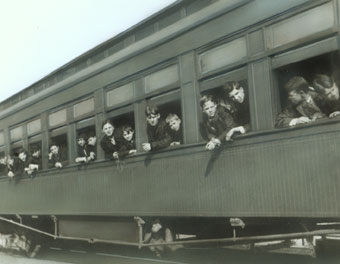
So, in 1853, a minister named Charles Loring Brace started the orphan train.  Brace believed that farmers would welcome homeless children, take them into their homes, and treat them as their own.  So he rounded up the kids, got parental permission when he needed it, and took the city kids to the country.  Between 1854 and 1929, the trains took over 100,000 children to adoptive parents in 47 states and Canada.

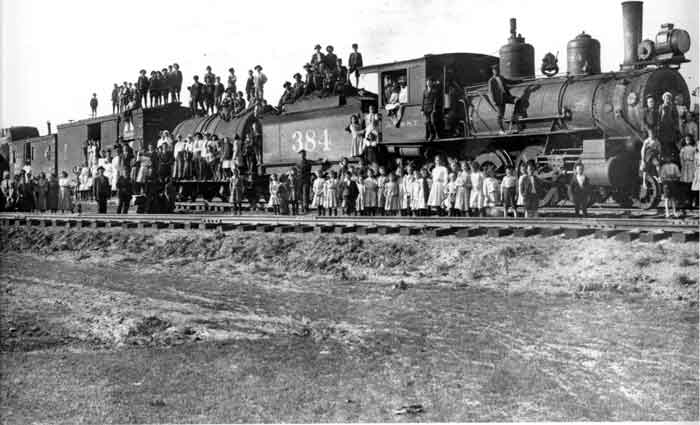
On the orphan train (image here):

train

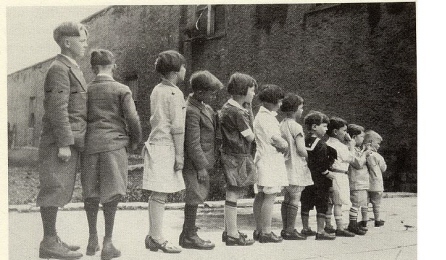
Children lined up to board the train (1920) (image here):

orphan-train


The orphan train in Michigan:

ot_train

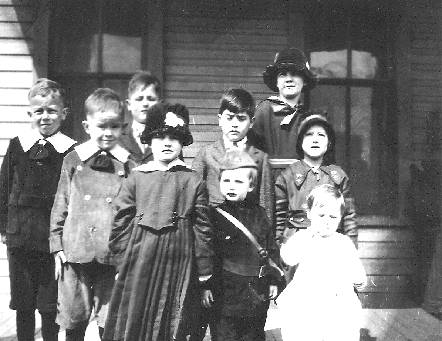
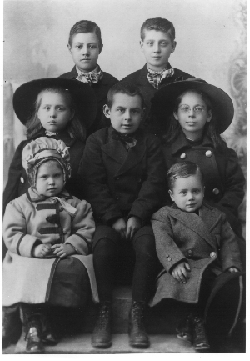
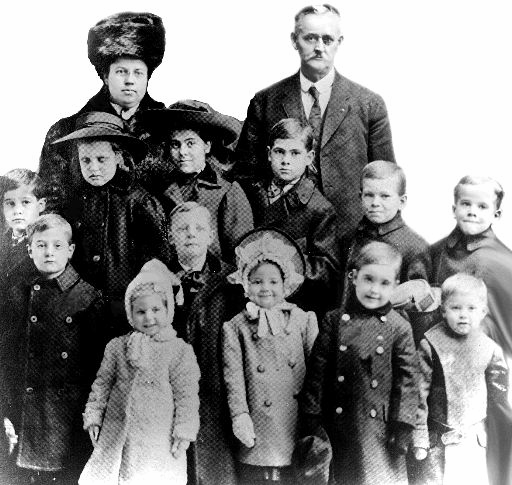
Orphan train children (images here):

orphantrainchildrenhomepagealhi126-442x341

childrenot

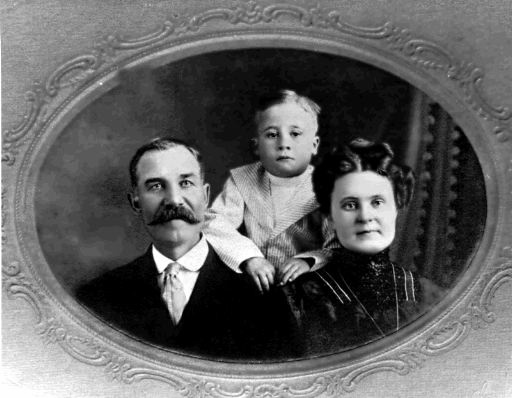
Howard with his adoptive parents, the Darnells (1910) (image here):

picture2

Orphan train children with their chaperones in Bowling Green (1910) (image here):

picture3

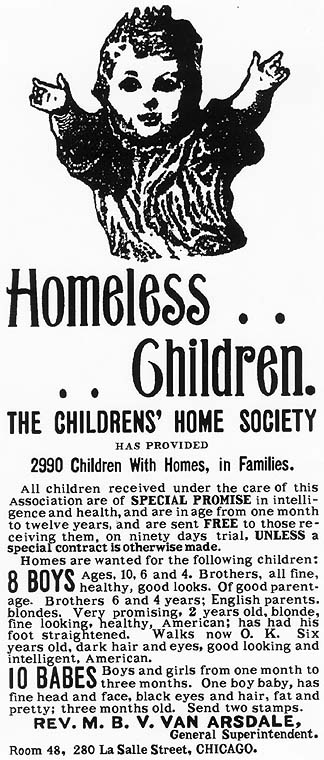
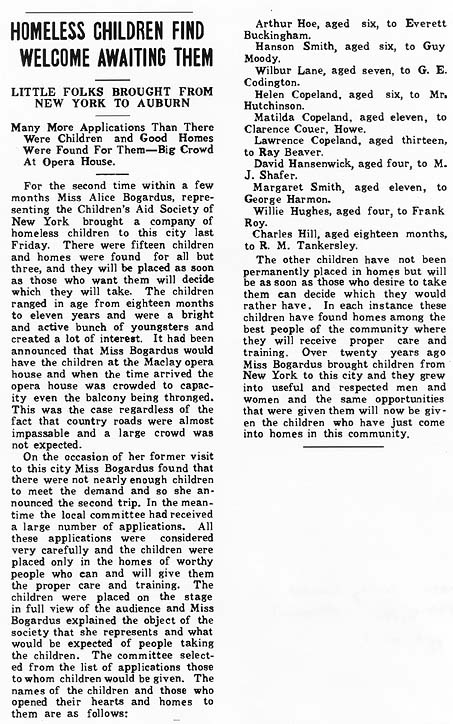
An ad and a news story from the Tecumseh Cheiftan (1893) and Nehama County Herald (1915) respectively (found here):tecumseh


nemaha

We may have flight attendants instead of stewardesses these days, but the call button on this Greyhound bus (on its way from Sioux Falls to Omaha) reminds us that the serving class is figuratively, if not literally, female:

cimg2722

Also see this post on sexism in aviation (then and now) and this contemporary Continental ad with sexual innuendo.

Thanks to Stephen W. for the picture!

Franklin suggested that we post about some points people are making about Dora the Explorer’s makeover.  Originally drawn like this…

dorathe-explorerposters

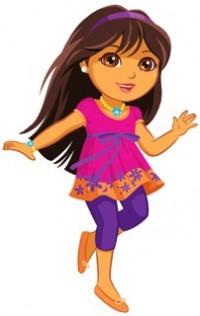
…Dora has been re-envisioned and now looks like this:

dora_the_explorer_31709-200x316

Wicked Anomie writes:

The producers insist that the new tween Dora will still be like the old one in personality and interests. Just more fashionable, with ballet flats, long hair, jewelry, and makeup. And she wears a dress. Not the choicest attire for galavanting in the woods going on adventures, but hey…

I asked my six-year old daughter what she thought of the new Dora. She likes her better. Why?

“Well, I like that her hair is longer, and she’s wearing a dress. And a necklace. And I like her shoes. And that other one, she’s fat in her belly and her clothes don’t fit right. I don’t like her shoes, either. And her hair’s all short and she doesn’t have a necklace.”

Gwen and I, however, are not surprised at this new feminized Dora.  About a year ago we were in Toys ‘R Us in Henderson, NV, and were so struck by the Dora the Explorer toys that we took pictures of every single one of them.  Almost all of them feature feminized activities such as cooking, taking care of babies, and fashion and accessories.  There are 15 images so I’ve put them after the jump:

more...

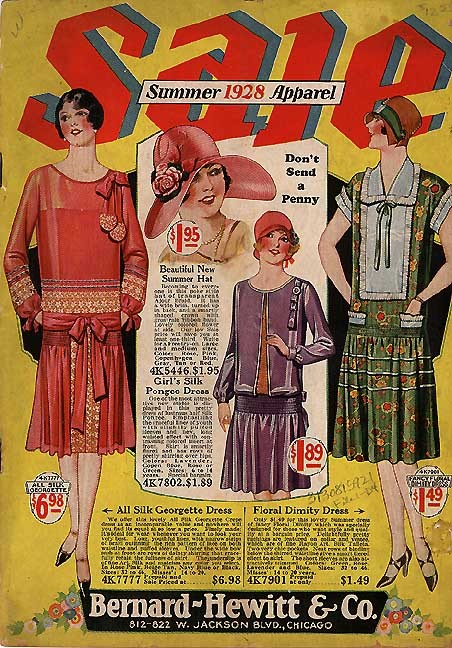
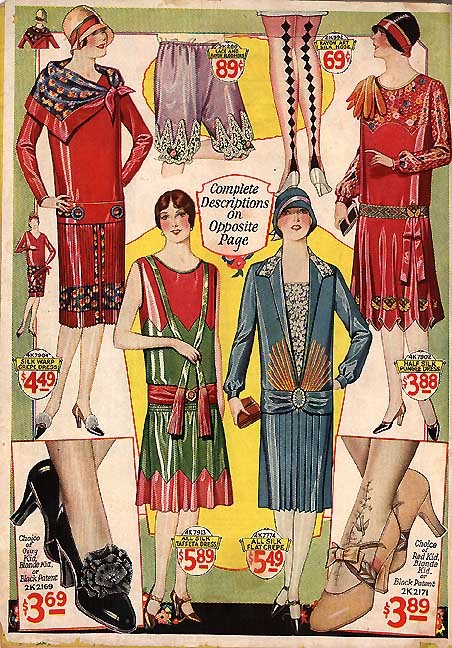
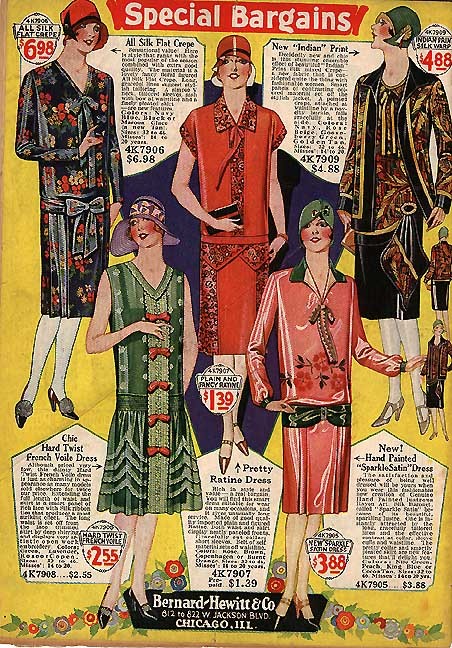
These clothing ads from 1928, featured on Jezebel, portray an ideal female form that is wildly different than the one we have today.  Note the straight lines (no hips or boobs) and very short hair cuts:

summer1928

1928shoesundies

specialbargains

I also like how the first image reads “Summer 1928 Apparel.”   Seasonal fashion, it appears, is nothing new.