Search results for The

Nate Silver, over at FiveThirtyEight.com, points out that whereas sales of beer have generally been relatively unaffected by economic conditions, the current financial situation led to a rather dramatic decrease in beer sales in late 2008:
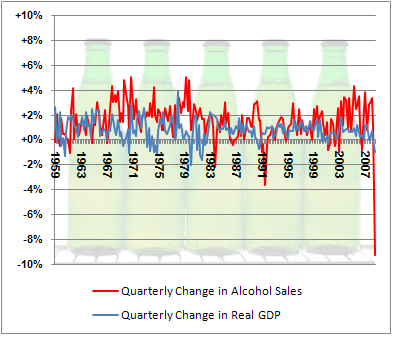
beer4

I don’t have any sociological point here. I just think it’s interesting, and since I thought so, I thought I’d make you look at it too. Nate Silver (who I have a bit of a geek crush on) hazards a few theories (in particular, perhaps people are substituting cheaper beers for more expensive ones, meaning they’re drinking as much or more, but spending less); it’s worth checking his post out.

As I said, absolutely no point to this post other than “Huh. Look at that.”

flier
Gawker, via Copyranter.

Jay Smooth over at Ill Doctrine interviewed Elizabeth Mendez Berry (who wrote an article in Vibe several years ago about domestic violence in the hip-hop community) about the issue, which has received renewed attention in the wake of the Chris Brown/Rihanna incident:

It brings up some interesting issues–the pressure on women to not ruin the reputation of men by “airing dirty laundry” and the still-common assumption that women who are abused might have deserved it, higher rates of domestic abuse experienced by African American and Latina women than White women, etc. You might also use it to talk about the fact that both men and women hit their partners, and what that dynamic means. Overall, women in the U.S. hit more often in terms of total incidents (this includes things like the stereotypical slap across the face, not just punches), but are much less likely than men to inflict significant physical harm. Though the rates of harm caused by female aggression toward males is surely underestimated, there is little doubt that women simply do not inflict the levels of physical injury on men that men do on women each year in this country, particularly harm that requires a hospital stay or that ends in death. But I often encounter the sort of equivalency argument Jay Smooth mentions in the video–if women hit, they should be expect to be hit back, etc. It’s always a really interesting discussion, and Berry’s response might be useful for sparking some thoughts about domestic violence, personal responsibility, appropriate reactions (is hitting someone who has hit you first really the most appropriate response?), and so on.

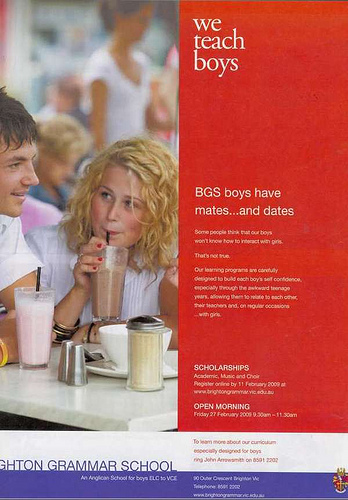
Lauredhel of Hoyden about Town sent in this ad for Brighton Grammar School, an Anglican boys’ school in Australia:

3273792366_59ff3131c1

Text:

BGS boys have mates…and dates. Some people think that our boys won’t know how to interact with girls. That’s not true. Our learning programs are carefully desgined to build each boys self confidence, especially through the awkward teenage years, allowing them to relate to each other, their teachers, and, on regular occasions…with girls.

Huh. I like how they’re using the promise of access to girls to market the school. And indeed, it appears that they do teach boys things, including to expect cute girls to gaze at them adoringly.

I don’t know much about the assumptions surrounding all-boys or all-girls schools. Is there a belief that kids who go to them won’t be able to interact with the other sex? Or is this about fears parents have about homosexuality at all-boys schools? Is the school letting them know they don’t have to worry because their sons will have tons of opportunities to hang out with pretty girls?

Aspic [noun]:  A clear jelly typically made of stock and gelatin and used as a glaze or garnish or to make a mold of meat, fish, or vegetables.

Gelatin [noun]: A jelly made with gelatin, used as a dessert or salad base.

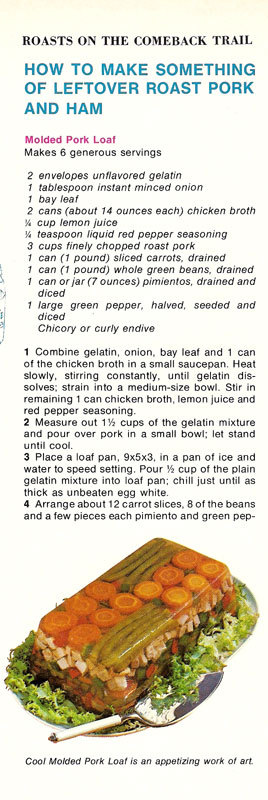
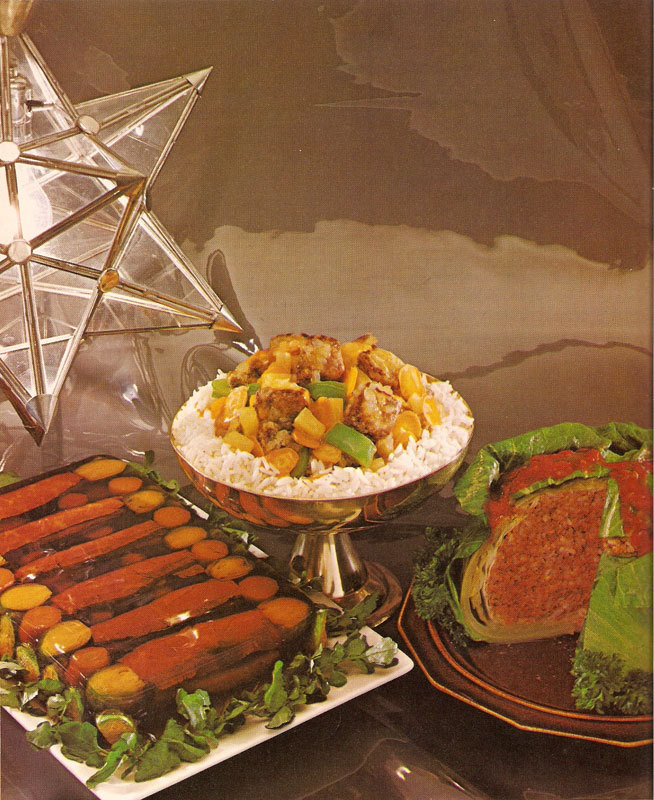
If you peruse cookbooks from the 1950s, you’ll find a ton of recipes featuring aspic and gelatin.  Many of us, today, find many of these recipes, well, repulsive.  For example:

 34lg38lg37lg

 33lg

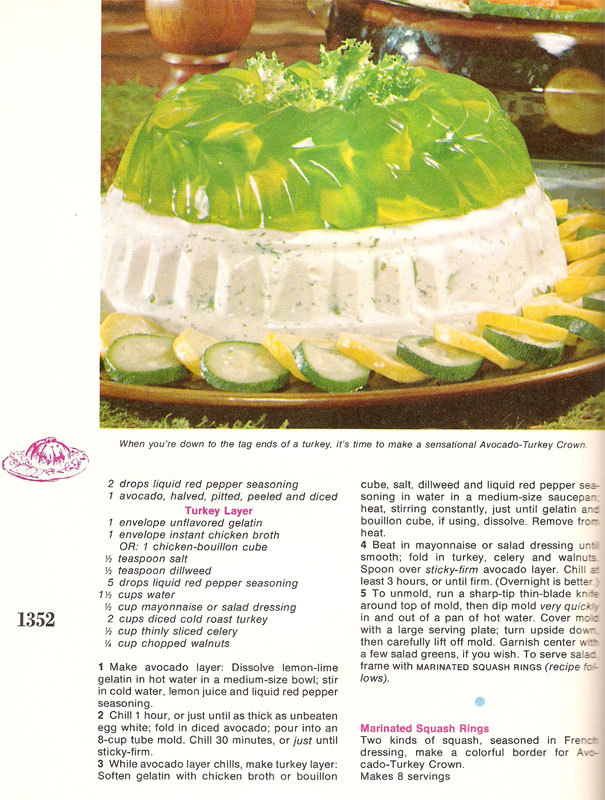
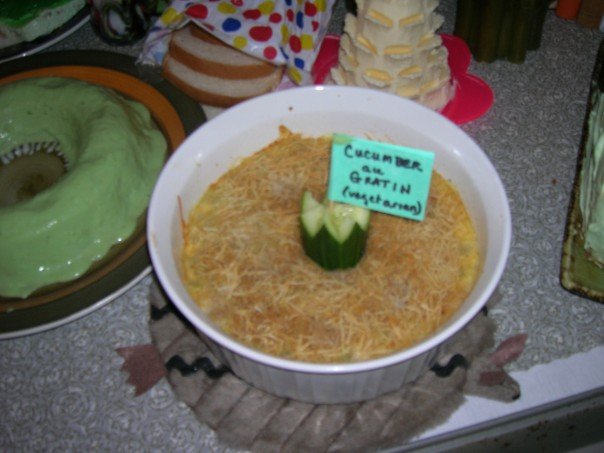
My friend, Emily, had a Mrs. Beeton party and I made avocado lime gelatin with mayonnaise (left), but it lost the competition for nastiest dish to the Cucumber Au Gratin (center):

n500252778_67922_1049

Here is the cover of a cookbook devoted to “gel cookery”:

kcb_knoxgelcookery60lg

Was it just a fad?  It turns out, no.  It was status.  Or so says a blogger at The Good Old Days:

We’ve all wondered what the hell could motivate someone to [prepare, serve, and eat so many gel-based foods] — well, it was simply so they could brag about owning a refrigerator. You can’t solidify gelatin without refrigeration, and so you couldn’t serve Jellied Bouillon with Frankfurters unless you were above a certain income level…  So people started jellying vegetables, meats, salads, cream, and pretty much everything in their kitchen.

Elizabeth N. Sent us a post from InGameNow, a networking/chat site for sports fans. The post shows women posed in “meat bikinis”–that is, with raw meat covering women’s nipples and genitals. The images don’t show totally nude women–the are, after all, dressed in raw meat–but they’re probably not safe for work.

more...

Kimi W. sent me the documentary “Married to the Eiffel Tower” (originally found at Mental Floss) which documents objectum-sexuals, or people who have relationships with inanimate objects.

[vimeo]https://vimeo.com/19783541[/vimeo]

I find this just fascinating, particularly the way most of the individuals describe the inanimate objects in insistently gendered language–they may be taking part in an unusual type of sexuality, but it is generally a specifically heterosexual one. (A couple of commenters pointed out that the Eiffel Tower was referred to as she, but most of the objects are described as he.)

I don’t quite know what to make of the fact that these are women who express some discomfort or dissatisfaction with men and/or sex. Given the small number of people interviewed, that may just be a fluke rather than a tendency among objectum-sexuals (I have no idea what proportion are male and female, have or haven’t had sex with humans at some point, etc.). I suspect most people will watch the video and just conclude that they are crazy women with emotional issues who pick often phallic-shaped objects to create elaborate sexual fantasies around. I mean, I teach all about sexualities and social constructions of “normal” and “abnormal” and all, and my first reaction was still “Uh, WTF???” Among other things, in several sections of the documentary the women just seem really sad and lost, particularly when the one talks about childhood sexual abuse, family dysfunction, and so on.

The videos might be useful for talking about the medicalization and regulation of sexuality–who gets to define what types of sexualities are “normal” or healthy? Do these women need mental health treatment? Are they hurting anyone? Is it the fact that they are turned on by physical objects or that they claim to love them in a deeply romantic way that is most disconcerting, and why? Are we partly uncomfortable that women are speaking so openly about sexual desire and having orgasms as a result of being around or thinking about objects? Are these women having “real sex” with the objects they love? By what definition?

Thanks, Kimi!

Gwen Sharp is an associate professor of sociology at Nevada State College. You can follow her on Twitter at @gwensharpnv.

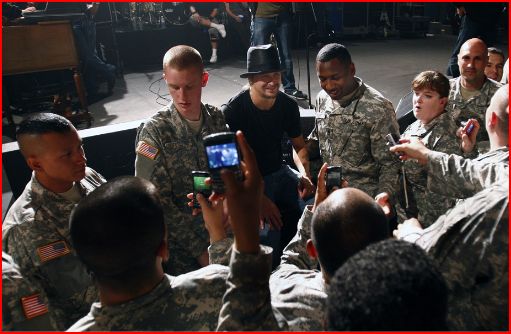
Stephen W. sent in a link to a music video promoting the National Guard.   He saw the video before a screening of Taken in Sioux Falls, SD. At the moment, the National Guard website (warning: noisy) features Kid Rock and Dale Earnhardt Jr.  The opening graphics, set to a snippet of Rock’s Warrior, feature a military helicopter followed by a race car and then a picture of an anonymous African-American National Guard member with the rock star and car star:

capture

A few clicks into the website leads you to this music video:

[youtube]https://www.youtube.com/watch?v=QeVt4j_T7-8[/youtube]

In the photographs made available, pictures of Kid Rock’s life as a rock star are mixed with pictures of people in the National Guard, and the lines between the two blur:

captureh
capturex

capturel

capturez

capturep1

Some observations on the marketing of military service:

First, the glorification of military service is an American phenomenon.  (See this post which features an American and a Swedish military recruitment commercial back-to-back.  The difference is quite amazing.)  In this video, the glorification is particularly acute when the light-skinned driver of the Hummer manages to avoid hitting the blue-eyed, olive-skinned, dark-haired boy and then comes out with his giant gun to kick the ball back to him, inspiring a look of awe from the child who’s country he is likely (given the politics in the last 8 years) invading.  We’re left, assured, that the U.S. military are all around good folk.

Second, in this case we have military service being marketed with celebrity tie-ins.  The website deliberately blurs the line between being a famous rock star, a celebrated race car driver, and a member of the National Guard.  Similarly, this Air Force recruitment ad blurs the line between various extreme sports and military service:

These links between military service, skateboarding, and being a rock star are disingenuous, to say the least.  And it reminds me of a series of recruitment ads I’ve been seeing lately that highlight the super cool jobs you could end up doing in the Air Force (like being a fighter pilot). I don’t know about you, but both of my family members who joined the military (in their cases, the Army) ended up being bus drivers.

Third, which celebrities are being used to market the National Guard tells us something about who they are trying to recruit.  Clearly, they are reaching out to young, working class, perhaps rural, white men.  This is not part of the National Guard marketing aimed specifically at this group, the entire National Guard website (warning: noisy), at this time, is entirely devoted to this theme. It speaks to who fights American wars?  Studies have shown that, while once military service was required of elites, this changed during Vietnam.  Today military service is overwhelmingly performed by working- and middle-class men.

Finally, the re-framing of the role from “soldier” to “warrior,” one who wages war, is very interesting.  I’d love to hear your thoughts about this.

More fodder for discussion, if you need it:

Lisa Wade, PhD is an Associate Professor at Tulane University. She is the author of American Hookup, a book about college sexual culture; a textbook about gender; and a forthcoming introductory text: Terrible Magnificent Sociology. You can follow her on Twitter and Instagram.