Search results for The

In a NYT blog, Catherine Rampell “plotted out the relationship between time the average person in a given country spends eating and that country’s obesity rate (as measured by the percentage of the national population with a body mass index higher than 30).”
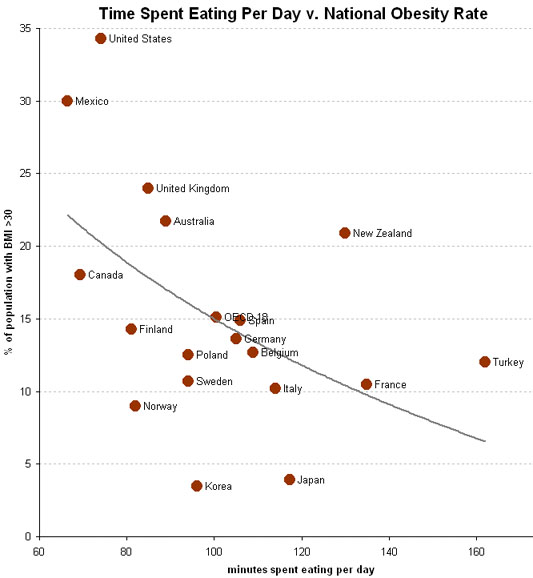
foodfatWhile the blog post is light on details and the statistics are far from conclusive, the chart holds and invites a discussion about food and culture.
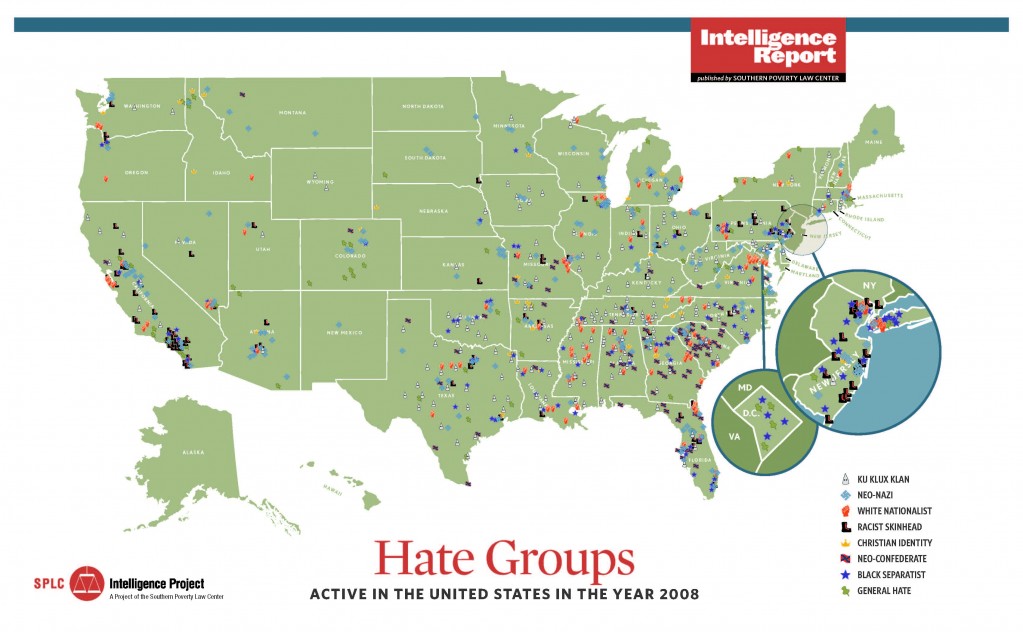
Emily K. sent in a link to the Southern Poverty Law Center’s 2009 report on hate groups in the U.S. Here’s a map (larger, not-stretched-out version available as a pdf here):

splc_hategroups208

The site also has an interactive map where you can select individual states and get more info on the hate groups that are active there, and another where “hate incidents” are marked.

Sorry for the sporadic posting lately–it’s the last week of the semester and I’m grading constantly.

UPDATE: One of my best friends just informed me that when investigating the SPLC hate incidents map, he realized he knew one of the people listed as a perpetrator in an incident in a certain Southern state; I promised to give no more details than that. This led to a discussion of the weirdness of some of the folks we grew up with, including a guy I went to school with who washed his head in gasoline to try to kill lice and ended up setting his entire head on fire. And no, I don’t know why a person would decide to use gasoline to kill lice. I also don’t know how one of my uncles managed to shoot himself in the foot while elk hunting, why that didn’t deter another uncle from going, falling down a mountain slope, and cracking his ribs, or why my mom married an evangelical Christian who didn’t like women to wear pants eight weeks after she met him on the internet. These are some of the many mysteries of life.

ANOTHER UPDATE: Commenter OP Minded says,

Kind of outrageous that the SPLC has “Concerned Citizens and Friends of Illegal Immigration Law Enforcement” in Framingham, MA listed as a hate group. There is no doubt that they are in favor of enforcing immigration law (after all, it is the law) but they don’t fall anywhere near a “hate group”. Calls into question this entire list.

Another commenter says,

To follow up on opminded@2: It’s too bad the Southern Poverty Law Center also uses these trumped-up threats to pad its already-deep coffers. Less than 70 percent of its expenses go toward its programs; the rest is for administration and fundraising.  Any human rights organization with almost $220 million in net assets isn’t doing its job.

The anonymous commenter suggests going to Charity Navigator to get more information.

I did not know about these criticisms (a problem in general about charities is not knowing for sure how the money is spent). My experience with the SPLC relates to their work with African American farmers in the South, a group that has experienced major land loss due to various factors largely involving racism and unscrupulous land developers. Their work on that particular issue was considered pretty solid. But of course there aren’t all that many organizations working on that problem, so any efforts were greatly appreciated.

Thanks for the additional info!

ANOTHER UPDATE: Commenter CLL says,

Over the years, SPLC has done terrific work helping people with little access to power receive the justice they deserve. Groups the SPLC has identified as “hate” groups have gone beyond simply disagreeing with policy (or lack of enforcement), and have instead encouraged their adherents to express discontent in more direct attacks on the object(s) of their scorn — thus qualifying as “hate” groups.

Spending 69.6% of income on programs remains a pretty normal ratio for not-for-profits that rely heavily on professional staff. Some organizations play fast and loose with their Fundraising allocations to cook the percentages down to numbers that look better on sites like Charity Navigator — but the proof of effectiveness is in accomplishment of mission.

In this cartoon, titled “Plane Dumb” (1932), Van Beuren’s Tom and Jerry put on black face in order to disguise themselves in Africa.  Putting on black face affects their intelligence as they go from being smart to dumb. Idoicy ensues. The “natives” come out at the very end:

Thanks to Steve W. for the link!

For more vintage racist cartoons, see these clips from Fantasia, these Bugs Bunny stills, this racist reinterpretation of Snow White, and this Bugs Bunny cartoon that caricatures the Japanese.

And this one’s just for fun.

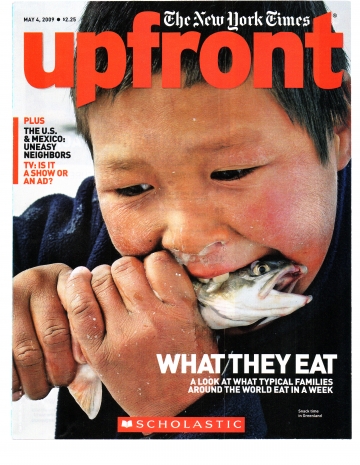
A month or two ago I commented on the New York Times Upfront magazine for high school kids. I recently came across their latest, which features a cover story titled “What We Eat.” The story is really just an interesting collection of photographs of families from nations all over the world, but with each family sitting with all the food in their house.

However, although the title of the article inside the magazine is “What We Eat,” the title listed on the cover of the magazine is “What They Eat.” The picture selected for the cover is not one of the family photos, but is, instead, a photo apparently selected to elicit the maximum negative visceral response possible from American kids:

what-they-eat

So the cover separates an “us” and a “them,” and shows the American high school students how gross and weird “they” are.

Check out the issue that preceded this one by just two or three weeks:

gun

Here American high school students learn that people around the world with dark skin are violent, dirty, and poorly dressed.

No wonder American kids grow up to be American adults whose voting habits reflect the view that American foreign policy should be paternalistic.

——————–

Missives from Marx is an Assistant Professor of Religious Studies.

If you would like to write a post for Sociological Images, please see our Guidelines for Guest Bloggers.

Gwen Sharp is an associate professor of sociology at Nevada State College. You can follow her on Twitter at @gwensharpnv.

frankie-bioThis post is dedicated to Frankie Manning.  Frankie died this morning of complications related to pneumonia   He was one month shy of his 95th birthday.  I will really miss him.  Frankie is a lindy hop legend.  He choreographed the clip below and is the dancer in the overalls.

In the 1980s, there was a lindy hop revival.  Lindy hop is a partner dance invented by African American youth in Harlem dancing to swing music in the early 1930s. Named after the “hopping” of the Atlantic by Charles Lindbergh Jr., it became wildly popular in the 1930s and ‘40s, traveling from the East to the West Coast and from black to white youth. Since its resurgence, Lindy Hoppers have enjoyed a national scene with websites, workshops, competitions, and city-wide social events that draw national and international crowds.

Though lindy hop was invented by African Americans, lindy hoppers today are primarily white.  These contemporary dancers look to old movie clips of famous black dancers as inspiration.  And this is where things get interesting:  The old clips feature profoundly talented black dancers, but the context in which they are dancing is important. Professional black musicians, choreographers, and dancers had to make the same concessions that other black entertainers at the time made. That is, they were required to capitulate to white producers and directors who presented black people to white audiences. These movies portrayed black people in ways that white people were comfortable with: blacks were musical, entertaining, athletic (even animalistic), outrageous (even wild), not-so-smart, happy-go-lucky, etc.

So what we see in the old clips that contemporary lindy hoppers idolize is not a pure manifestation of lindy hop, but a manifestation of the dance infused by racism. While lindy hoppers today look at those old clips with nothing short of reverance, they are mostly naive to the fact that the dancing they are emulating was a product made to confirm white people’s beliefs about black people.  Let’s look at how this plays out:

This clip, from the movie Hellzapoppin’ (1941) is perhaps the most inspirational clip in the contemporary lindy hopper’s arsenal:

By the way, the dancers are in “service” outfits because of the way lindy hop scenes featuring black dancers were included in movies.   Typically they would have no relationship to the plot; they would occur out of nowhere and then disappear.  This was so that the movie studios could edit out the scene when the movie was going to be shown to those white audiences that were hostile to seeing any positive representation of black people at all.  If you want to see how the scene above emerged (black “help” suddenly discovering musical instruments and spontaneously congregating), you can watch the extended clip here.

The clip features a dance troop called Whitey’s Lindy Hoppers. You can see other famous dance segments in Boy! What A Girl! and Day At The Races.

The clip below, from the Ultimate Lindy Hop Showdown (2006), reveals how powerfully contemporary lindy hoppers have been influenced by clips like the ones above.  Watch for how the styling, moves, and trick reflects the clips above:

Another good example can be found here (but the angle, audio, and visual quality are not very good).

So we have a set of (mostly) white dancers who naively and wholeheartedly emulate a set of black dancers whose performances, now 70 to 80 years old, were produced for mostly white audiences and adjusted according to the racial ethos of the time.  On the one hand, it’s neat that the dance is still alive; it’s wonderful to see it embodied, and with so much enthusiasm, so many years later.  And certainly no ill will can be fairly attributed to today’s dancers.  On the other hand, it’s troubling that the dance was appropriated then (for white audiences) and that it is that appropriation that lives on (for mostly white dancers).  Then again, without those dancers, there would likely be no revival at all.  And without those clips, however imperfect, the dance might have remained in obscurity, lost with the bodies of the original dancers.

As a white lindy hopper myself, for over ten years now, who desperately loves this dance, I find this to be a deep conundrum.

I don’t know what Frankie would have had to say about this critique.  But I do know that he loved lindy hop to his last days and he was grateful for the revival.  Here he is dancing with Dawn Hampton, another legend of lindy hop, at the age of 94:

I’lll miss you, Frankie. And I’ll keep on dancing, embodying, with ambivalence, all the great contradictions of the dance and the history of this country.


UPDATE: A couple commenters asked how, exactly, the dance was changed in order to appeal to white audiences.  This is actually really difficult to say, since few films of social dancing (black dancers dancing only for other black dancers) exist.  But we have some theories.  Evan, in the comments, had this suggestion:

For white audiences of the time, Jazz was Hot Black jungle music – Black people were sex crazy hedonists, and you can see it in the moves, the exaggerated body undulation. the speed. the sweat. the rhythmical drum.

It was like watching a tribe around a fire.

I’m with Evan.  I’d like to also add that, as a person with a trained eye for lindy hop, I see two things in those clips:

(1) I see incredibly effective technique. Unbelievable strength and precision. It’s fantastic.  (By the way, Frankie explained that, by the time they got to the take you see in the Hellzapoppin’ clip, they’d performed that routine more than 20 times in a row… they were amazing athletes.)

(2) But I also see, layered onto and facilitated by that technique, an effort to make the dance appear more out-of-control than it is. They are wild-ing the dance.

At least, that’s how it looks to me.

More than that, though.  As a dancer who has also been inspired by those clips, I know how to do that.  I know how to exaggerate the out-of-control look.  I won’t go into the technical details (I did, and then deleted!), but it’s do-able.  And it’s not that it’s not cool… adding the drama is fun and exciting to watch… but there’s a historical reason why lindy hop has that dimension and that is worth thinking about.

Lisa Wade, PhD is an Associate Professor at Tulane University. She is the author of American Hookup, a book about college sexual culture; a textbook about gender; and a forthcoming introductory text: Terrible Magnificent Sociology. You can follow her on Twitter and Instagram.

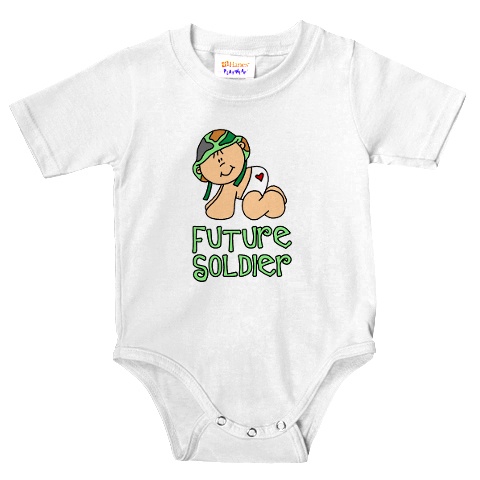
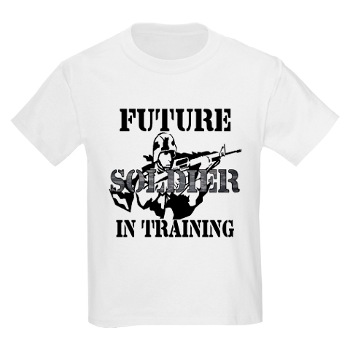
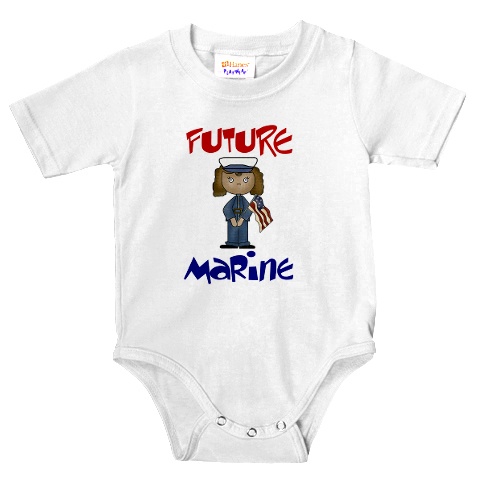
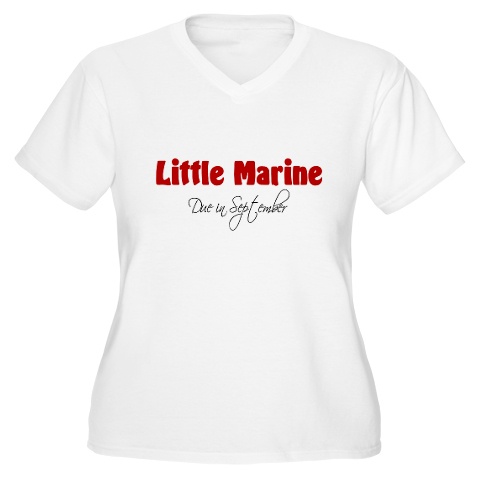
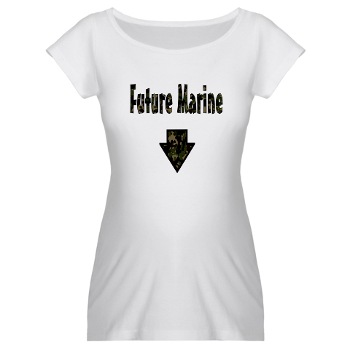
As I was digging around the internet for illustrations of mothers of service members claiming to be as tough as their enlisted children (I’ll save that for another post), I found the following “future service member” clothes for children, babies, and even pregnant women:

jitcrunch-1154477468v16_350x350_front_color-white

jitcrunch-2

jitcrunch-5

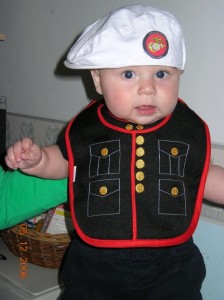
And a Marine bib/costume:

capton

And a couple maternity shirts:

jitcrunch-4

215814389v6_350x350_front_color-white

I have a few thoughts about these.

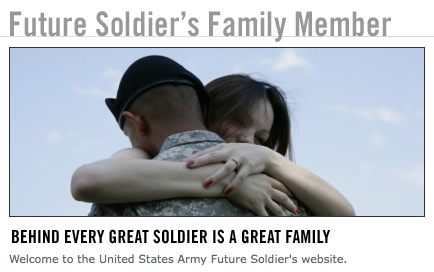
First, it’s interesting how the shirts (and the many more like them for other family members) enlist family members (and future family members) into military service along with the service member. Each branch of the military is considered a big extended family and members know they are “taken care of” to some extent by each other and by military programs that support the children and partners of those who are serving. Not only does it make practical sense to offer services to families who have a loved one deployed for months and years at a time, but it is also advantageous for the military as families are recognized as a key part of military success. Families are essential and are counted on to provide all kinds of support– from deployment readiness (moving at a moment’s notice etc.), to supplying their loved ones with emotional support, clothes and armor when they are deployed.

family

The military is also a profession that is often a viable choice for for many young people, and there are many families from strong military traditions– where multiple generations have served. It makes sense, then, that these families have a certain amount of pride in a career that has been in their families for generations. But, many who go into the military end up in combat situations where their lives and personal safety are put at high risk (especially during wartime). So, the idea of handing down the military as a profession doesn’t seem the same then as handing down pride in a university or in a sports team. Isn’t it much different to put a baby in a “future Badgers fan” outfit?

Finally, the pregnancy shirts make me think of how sociologists Nira Yuval-Davis and Cynthia Enloe talk about gendered and militarized citizenship. For Yuval-Davis, one of the primary ways women can be citizens is through reproduction– literally reproducing the people of the nation. Often reproducing soldiers to secure the nation is a part of pro-natalist policies. And Cynthia Enloe writes about the importance of mothers’ support (what she calls “militarized mothers”) for the continued recruitment and support of soldiers: “Militarizing motherhood often starts with conceptualizing the womb as a recruiting station.”

Jose at Thick Culture sent us this design for the Catholic Church’s Archdiocesan Youth Commission logo in 1973 (via The Daily Dish). 

6a00d83451c45669e201156f47782f970c-800wi

The logo nicely shows how images are polysemic.  That is, the same image can be read very differently by different people or, as this image illustrates, at different times.   Because of the shift in the social construction of the Catholic priesthood–from benevolent child chaperones to evil child molesters–the logo, though likely lovely then, would be very ill-advised today.

Two more good examples of polysemy here and here.

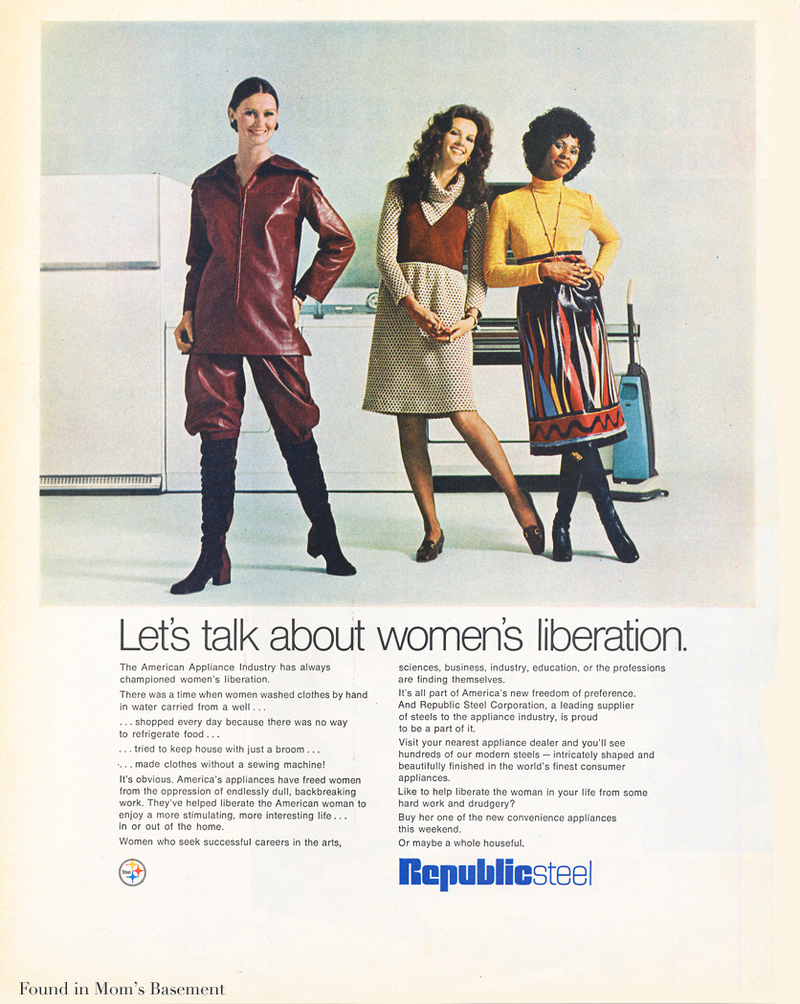
We’ve offered many examples of companies co-opting feminism in order to sell products.  In the video below, we see that the co-optation of feminism is nothing new:

(At Vintage Videosift.)

Actually, I shouldn’t be so flippant.  Inventions like the washing machine did, indeed, save women a great deal of time and effort.  From what I understand, however, as women’s cleaning became more efficient, standards of cleanliness rose.  So even as time-saving devices were introduced, the time women spent cleaning did not substantially change.  I’d love to hear more from scholars who have a better handle on this history.

Here’s another step in the trajectory, this one from 1971, also about cleaning appliances (found here):

6a00d83451ccbc69e2010535973e25970c-800wi2

Text:

The American Appliance Industry has always championed women’s liberation.

There was a time when women washed clothes by hand in water carried from a well…

…shapped every day because there was no way to refigerate food…

..tried to keep house with just a broom…

…made clothes without a sewing machine!

It’s obvious.  America’s appliances have freed women from the oppression of endlessly dull, backbreaking work.  They’ve helped liberate the American woman to enjoy a more stimulating, more interesting life…

In or out of the home.

Women who seek successful careers in the arts, sciences, business, industry, education, or the professions are finding themselves.

It’s all part of America’s new freedom of preference.  And Republican Steel Corporation, a leading supplier of steels to the appliance industry, is proud to be a part of it.

Visit your nearest appliance dealer and you’ll see hundreds of our modern steels — intricately shaped and beautifully finished in the world’s finest consumer appliances.

Like to help liberate the women in your life from some hard work and drudgery?

Buy her one of the new convenience appliances this weekend.

Or maybe a whole houseful.

Notice that women’s liberation DOES NOT involve men sharing housework responsibilities, but men replacing women’s labor with tools he purchases for her.  Ultimately, even if she has a “successful career” in “the professions,” it is her responsibility to make sure that the housework is completed (and apparently still wouldn’t be able to buy herself one of these machines).

For contemporary examples, see these posts on make up (here and here), botox, cigarettes (here and here), right-hand diamond rings, cooking and cleaning products, fashion, and other miscellaneous products (here, here, and here).