Search results for The

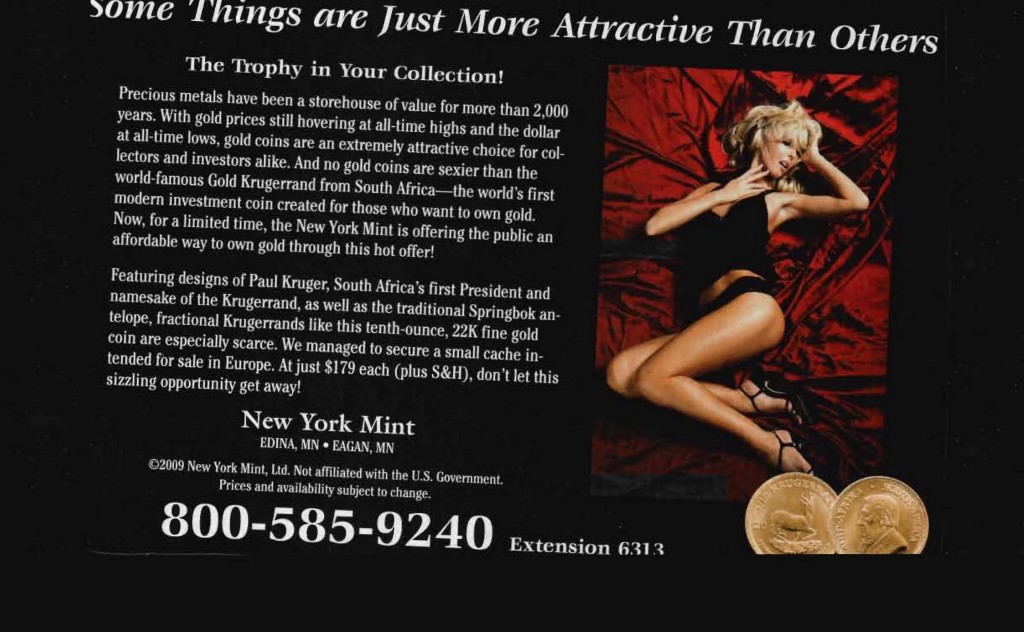
Given how common they are, ads that use a woman in a sexy pose for no good reason don’t really surprise me anymore. But every once in a while I come across one that makes me do a double-take, such as this advertisement for gold coins:
attractive2

Really? A woman in what appears to be a sexually aroused state? Who can apparently be the “trophy in your collection,” a statement which is all kinds of creepy? I also like the naturalization of current female beauty standards–thin, long-legged blond women who will lie around in lingerie and heels are “just more attractive”! It’s, like, a universal law, just the way it is.

Ugh. That is all.
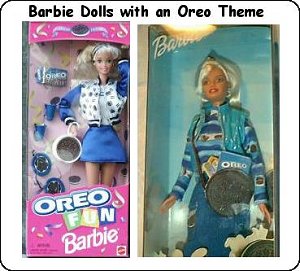
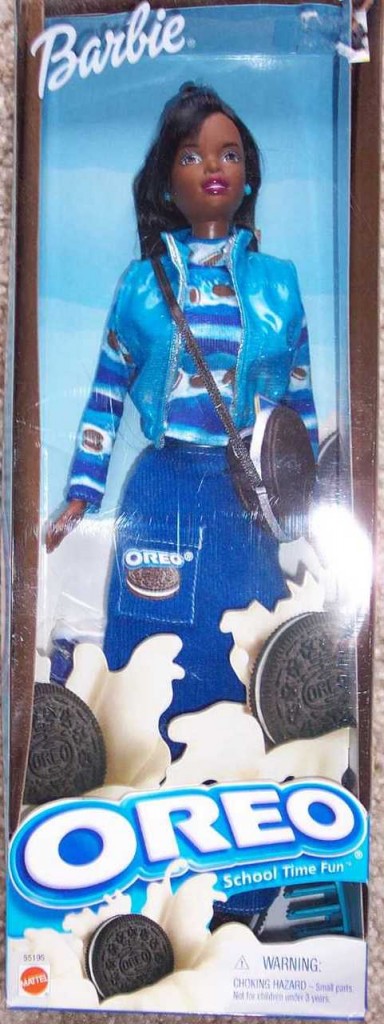
Michaela N. alerted us to the Oreo Barbie. According to Monica Roberts at Transgriot, Mattel once marketed an Oreo-themed Barbie (image here):

oreobarbie

The doll sold so well that Mattel decided to make a Black version (image here):

2001_oreo_barbie

The Black version of the doll triggered protests.  Monica explains it nicely:

…Oreo has another connotation in the Black community beyond just being a slammin’ cookie.

Calling someone an ‘Oreo’ is fighting words. It means that you are calling them Black on the outside and white on the inside. Translation, you call a Black person an Oreo, you are accusing them of being a sellout or an Uncle Tom to the race.

The doll was eventually recalled. (This was all about four years ago.)

Did Mattel intentionally produce a doll that embodied a well-known insult in the Black community?  If they didn’t (and let’s just go with that theory), it means that no one at Mattel involved in the production of this doll had the cultural competence to notice the problem.  This points to both (1) white privilege and the ease with which white people can be ignorant of non-white cultures and (2) a lack of diversity on the Mattel team.  Less employee homogeneity might have saved Mattel both face and money in this instance.  Diversity, then, is often good business.

For more on Barbie and racial politics, see this post inspired by Ann DuCille.

—————————

Lisa Wade is a professor of sociology at Occidental College. You can follow her on Twitter and Facebook.

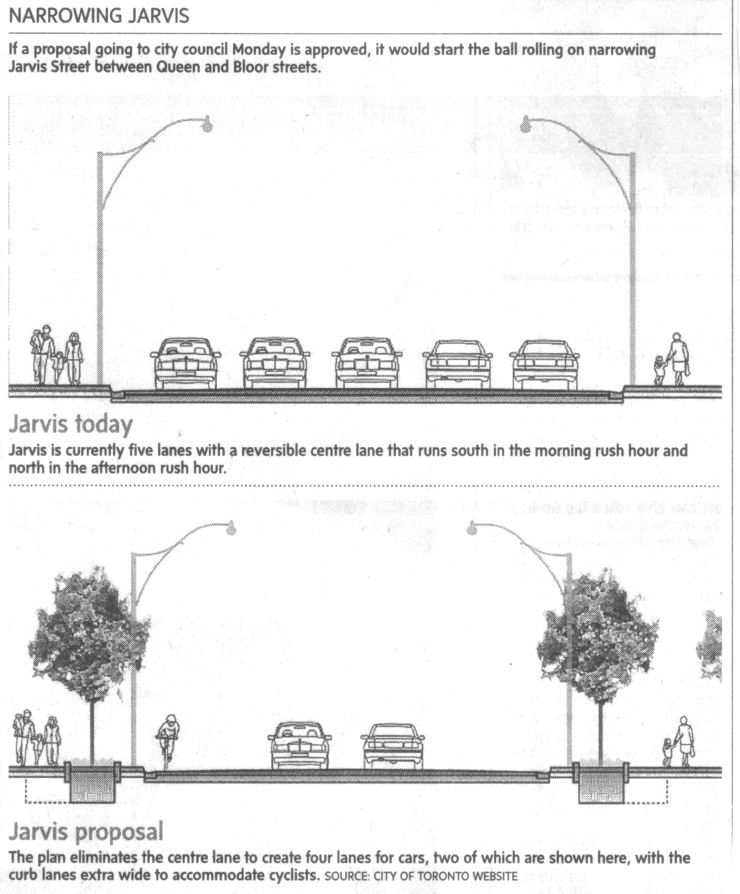
Jim C. sent us this graphic designed to illustrate a proposal to reduce the lanes on Jarvis Street in Toronto from five to four (Globe and Mail, May 22, 2009, p. A12).   As Jim points out, the text of the graphic describes the proposal accurately, and even points out that the graphic misrepresents the change, but the graphic itself still gives the impression that the reduction will be to two, not four lanes.

jarvisbikelanes2

It is a good example of how much graphics matter. Even with the text, it is potentially misleading.  Such misrepresentation can also be purposeful and political.  Jim speculates that this is the case here:

As is often the case whenever there are modest efforts to make space on city streets for pedestrians and cyclists, right-wing councillors (and affluent commuters) raised the spectre of traffic chaos and a ‘war on the car’.

If you’re interested in comparing the representation of this proposal by the Globe with its representation in the proposal itself, check out the final page of the proposal.  Thanks to Nick J. B. in the comments for the link.

—————————

Lisa Wade is a professor of sociology at Occidental College. You can follow her on Twitter and Facebook.

The new National Review depicts Supreme Court nominee Sotomayor as a Buddha:

picture1

Many commentators have criticized the cover for using racial stereotypes.   They write as if the people at the National Review are ignorant (e.g., can’t tell the different between different races).   But it’s not an accident, it’s a purposefully racist joke.  Of all the commentary I’ve seen so far, Neil Sinhababu said it the most clearly (via):

…the joke actually depends on incongruities between the stereotypes of the nonwhite ethnicities involved. The Buddha-like pose and Asian features are tied to lofty pretensions of sagelike wisdom. And what sort of person is it who’s pretending to be some kind of sage? A Hispanic woman! As if.

The in-joke in this cover is for people who have already internalized a stereotype of Hispanic women as hotheaded and not that bright. Put one of them in the Buddha suit, and if you’ve absorbed the right racist stereotypes, the incongruity is hilarious.

I think the larger story here is not that the cover is racist, but that race-based criticism is fair game in contemporary U.S. politics.  The last election should have made this abundantly clear (see here, here, here, here, here, here, here, here, here, here, and herefor examples).

—————————

Lisa Wade is a professor of sociology at Occidental College. You can follow her on Twitter and Facebook.

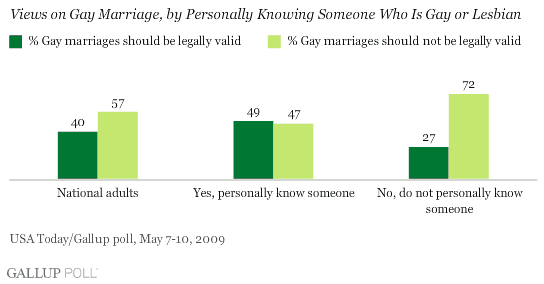
The contact hypothesis postulates that being near people of a different social group (e.g., race, class, sexual orientation, etc) translates into greater tolerance for that type of person. In other words, it’s harder to hate all Latinos (for example) when your neighbor is Latino and, damn it, you kind of like him.  Andrew Sullivan posted this figure:

6a00d83451c45669e2011570b1f019970b-800wi

Jose at Thick Culture suggests that this could be evidence for the contact hypothesis.  But he also asks whether it might also be true that less homophobic people are more likely to come into contact with gays and lesbians because of a third variable that correlates with both (like choosing to live in a big city), making the relationship spurious.

(What’s a spurious relationship?  Here’s one:  People who eat ice cream are more likely to drown.  Both incidence of ice cream eating and rates of drowning are related to summertime.  The relationship between ice cream and drowning is spurious.  That is, there is no relationship.  Yet they appear related because they are both related to a third variable.)

—————————

Lisa Wade is a professor of sociology at Occidental College. You can follow her on Twitter and Facebook.


Jason S. sent in this clip of a convention for (parents of) infants, toddlers, and tweens called Baby and Tweens Celebration L.A. It’s an example of the hyper-consumerist mentality that now surrounds child-raising, at least for the upper-middle classes and higher. It’s also an example of the way that young children, especially young girls, are encouraged by some forces to think of themselves as “princesses.” Many parents (literally) buy into this idea of what a (girl) child should be like. It has not been this way throughout history and is not this way across cultures.

[youtube]https://www.youtube.com/watch?v=HR6DpbDoyuc[/youtube]

Related posts: baby couture magazine, babies are born 2 shop, future trophy wife and milf t-shirts, boob job piggy bank, Strawberry Shortcake in the City, bangs for baby, beauty spending over a lifetimemodernizing the fairy tale, and girl culture.

—————————

Lisa Wade is a professor of sociology at Occidental College. You can follow her on Twitter and Facebook.

Lisa Wade, PhD is an Associate Professor at Tulane University. She is the author of American Hookup, a book about college sexual culture; a textbook about gender; and a forthcoming introductory text: Terrible Magnificent Sociology. You can follow her on Twitter and Instagram.

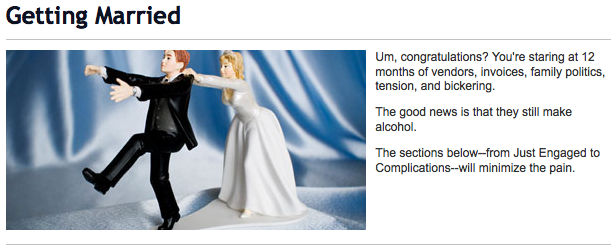
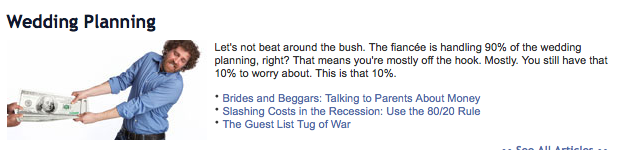
Natasha L. sent in a link to the site The Plunge, a wedding planning site for men. She says,

I’m getting married in a month.  My facebook knows this, and usually gives me wedding-related ads.  Today it had one that said, “Give us your fiance, and we’ll give you a groom.  A wedding site written by men.”

Here’s one page:

picture-1

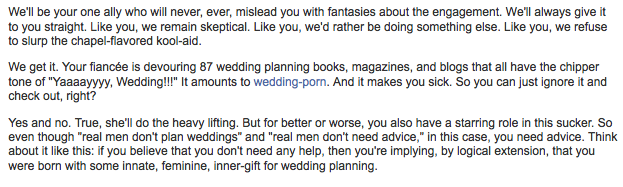
The site accepts the whole “wedding planning is women’s responsibility, and your wife is going to turn into an insane bridezilla” and “this is the end of your life, buddy” ideas so popular in our culture at the moment; this isn’t a site advocating for men to really be involved in planning weddings, or interested in them. The tone is of a fellow guy who knows how annoying it is that you have to pretend to go through all this shit and pretend you care:

picture-22

picture-3

How do you try to convince men that it’s ok for them to read something as stereotypically feminine as a wedding planning website? By implying that not reading it is unmanly, of course! Notice the last paragraph here:

picture-4

So it’s actually masculine to read the planning site, because by doing so, you are showing that you are clueless about weddings, unlike women–since our “innate, feminine” selves know immediately how to plan them. That’s why you never see wedding magazines or websites designed for women–we instinctually know how to plan them, so there’s no market.

Well, ok, there is a site for women. Here The Plunge differentiates itself from The Knot:

picture-6

The site gives you helpful tips for avoiding “emasculation”:

picture-7

There’s a whole page on tips for convincing a woman to take your last name if she’s reluctant to do so. Of course, since this is an enlightened period, The Plunge first tells you that you should maybe just accept your bride-to-be’s wishes…

picture-8

…but then provides a whole list of tactics, including playing on her future mom-ness by pointing out the kids will have a different name than her and that will be confusing and weird (who’s ever heard of children with a different name than one of their parents?). If she tries to turn the argument back on you by saying that if it’s no big deal to change last names, why don’t you take hers, then…

picture-9

What I find tiresome about this site is that it pretends

NOTE: Apparently WordPress didn’t post everything I wrote at the end, which is why the post ends abruptly with the above half-written sentence. I’m sure what I originally wrote was brilliant. I know I mentioned that what I hate is that the site pretends to reject all this traditional wedding stuff, but it really totally buys into the idea that weddings are women’s things, and men should do as little as possible. And it’s pretty selective about what parts of modern weddings and marriage it criticizes–it can point out how absurd some of the prices of things are, but not equally mention that it might be stupid to get hung up on your bride-to-be not wanting to take your name?

I don’t remember what else I said, except pointing out that the site helpfully provides tips for if you sleep with someone else before your wedding. Their advice: do not come clean about it, unless a) it happened repeatedly or b) it was with someone the bride knows and she’s gonna find out. Also, it’s not quite as bad to cheat with a stripper as a “random girl.”

picture1

picture2

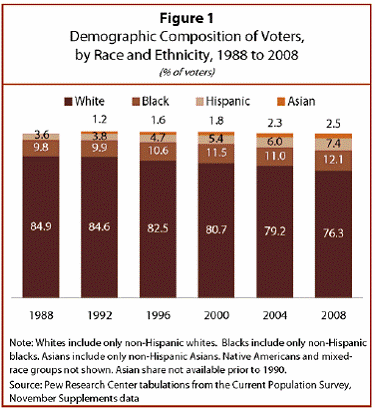
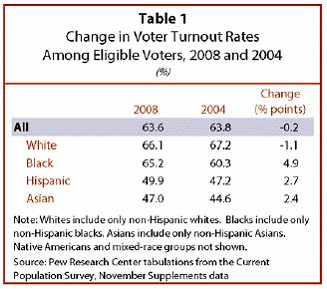
Thomas Sander at the Social Capital Blog writes: “Obviously the $1,000,000 question is whether these behavioral changes are likely to continue beyond the Obama candidacy.” I think the answer to this, at least as far as racial composition goes, is yes. What we see here is a two decade long trend, not a blip inspired by Obama.

Data compiled by the the Pew Research Center, via Thick Culture.

Lisa Wade, PhD is an Associate Professor at Tulane University. She is the author of American Hookup, a book about college sexual culture; a textbook about gender; and a forthcoming introductory text: Terrible Magnificent Sociology. You can follow her on Twitter and Instagram.