Search results for The

The Wall Street Journal published an article about “cankles” (sent in by Dmitriy T.M.). It begins: “This summer women have a new body part to obsess about.”

There’s a gender-specific warning (men apparently need not worry about cankles) and passive language. “Women” simply “have” a new insecurity. It’s not as if, maybe, perhaps, the Wall Street Journal is actively telling women they must worry about cankles.

They offered an illustration:
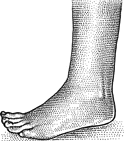
HC-GN947_cankle_BV_20090722173307

(As an aside, can you imagine being the illustrator who got this assignment? Like, do you think he drew the cankles and then went home and made himself a stiff drink, stared at his art degree diploma, and wondered what had become of his dreams?)

And!

In the guise of a history lesson, they offer a whole bunch more nasty euphemisms for body parts that you (and by “you” I mean ladies) “have” to worry about:
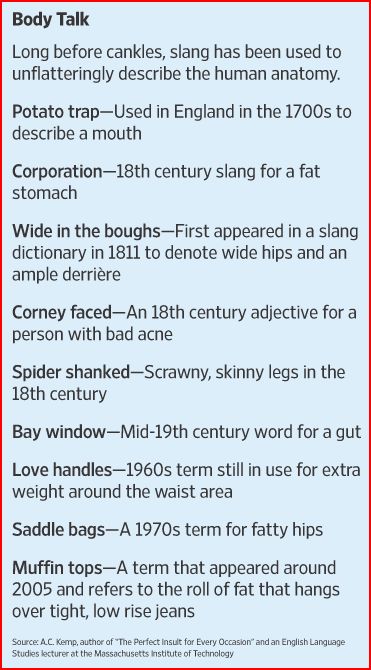
Capture

Via Jezebel.

—————————

Lisa Wade is a professor of sociology at Occidental College. You can follow her on Twitter and Facebook.

Lisa Wade, PhD is an Associate Professor at Tulane University. She is the author of American Hookup, a book about college sexual culture; a textbook about gender; and a forthcoming introductory text: Terrible Magnificent Sociology. You can follow her on Twitter and Instagram.

Many of us live in consumption economies unlike any in human history.   Consuming is a daily chore.  Acquiring is easier than ever.

What do you have?  How much of it do you need?  Do you have things that you don’t want?  How do you manage the stuff that enters your home?  Does it go?  Or does it stay?  Do you dispose of the disposable and semi-disposable goods?  Or do you try to recycle them, even if only within the boundaries of your home?  How do the shelves and drawers, the nooks and crannies of your living space, obscure our answers to these questions?  What would it look like if we had to look at it all, all at once?

Chinese artist Song Dong convinced his mother to allow him to display every item of her home as an art exhibit (article here).  She had lived in the same house for nearly 60 years.  He arranged her belongings, in a museum, around a dismantled piece of the house.  The result raises questions about consumption, economy, and the things in our lives.

—————————

Lisa Wade is a professor of sociology at Occidental College. You can follow her on Twitter and Facebook.

Lisa Wade, PhD is an Associate Professor at Tulane University. She is the author of American Hookup, a book about college sexual culture; a textbook about gender; and a forthcoming introductory text: Terrible Magnificent Sociology. You can follow her on Twitter and Instagram.
Liz C. sent us a link to a segment of The Daily Show featuring Kristen Schaal and John Stewart (aired July 1st).  They discuss Sarkozy’s ban on burkas and, in doing so, question whether the burka is truly oppressive and whether American fashion is, in contrast, oh-so-liberating.

The Daily Show With Jon Stewart Mon – Thurs 11p / 10c
Burka Ban
www.thedailyshow.com

We covered Heelarious here.

See also this confessionechoing Stewart and Schaal’s conversation.

—————————

Lisa Wade is a professor of sociology at Occidental College. You can follow her on Twitter and Facebook.

I read Naomi’s Wolf’s book The Beauty Myth when it was first published in 1991. As an undergrad growing into my own version of a third-wave feminist identity in beauty-centric southern California, her words rang so true. If knowledge is power, then I and other feminists were certain that soon the tide would turn — girls and women would stop buying into this myth, stop buying magazines that promoted body-loathing, and we would rebel against unrealistic and unhealthy social norms.

Sadly, it’s 18 years later, and her message still resonates with undergrad women (and men) today. As a professor, I had the privilege of meeting Naomi when she came to speak at my campus, California Lutheran University, to present “The Beauty Myth.” As you watch this clip of her new DVD, I encourage you to ask yourself (1) How many girls and women do I know who believe in this myth? (2) Which corporations are profiting from their misery?, and (3) What am I doing to reject the myth and help others reject it?

Personally, I think make-up/hair products/push-up bras are okay as long as you don’t feel like you cannot leave the house without them — costumes can be fun as long as you love and accept yourself when you are ‘un-costumed.’  Eating healthy and moderate exercise are good goals, as long as your self-image and self-worth are not defined by your weight/size. For this post, I won’t weigh in on cosmetic surgery…that’s a whole post unto itself. But, as the mom of a 5-year-old daughter, I make sure to never criticize my appearance in front of her (though, I’m still working on not being critical in my own head), and I aim to de-emphasize physical beauty as a value in my interactions with her. Here’s wishing that Wolf’s The Beauty Myth will strike future generations of college students as truly mythical – outdated, outlandish, and out of touch with their generation…

Adina’s book, Damaged Goods?  Women Living with Incurable Sexually Transmitted Diseases came out in 2008.  You can see an earlier post of hers, about sexually transmitted disease and stigma, here.

——————————

Adina Nack is an associate professor of Sociology at California Lutheran University specializing in medical sociology with a focus on gender inequality and sexual health.  You can visit Adina online here.  We are pleased to feature a post she wrote for us reflecting on a talk by Naomi Wolf, author of The Beauty Myth.

If you would like to write a post for Sociological Images, please see our Guidelines for Guest Bloggers.


Elizabeth H. sent in the trailer for the movie Precious (based on the novel Push), which should be released later this year:

As Elizabeth says,

It seems to reinforce…negative associations [of] underclass or working class African-Americans: poor education, single motherhood, teenage pregnancy, abuse, child obesity, etc.

The trailer brings up some interesting issues about skin color as well. Precious’s desire for a light-skinned boyfriend highlights the emphasis placed on skin color as a measure of attractiveness: a light-skinned boyfriend would indicate her own success in the world, just as fame and wealth would. Elizabeth points out that all the “good” adult characters are light-skinned (and thin) as well.

Also see our posts on kids’ perceptions of skin color and attractiveness, an ad for skin lightener, a club letting light-skinned girls in for free, Malaysian anti-racism parody of skin lightening cream ad, and an ad that shows darker skin as more exciting.

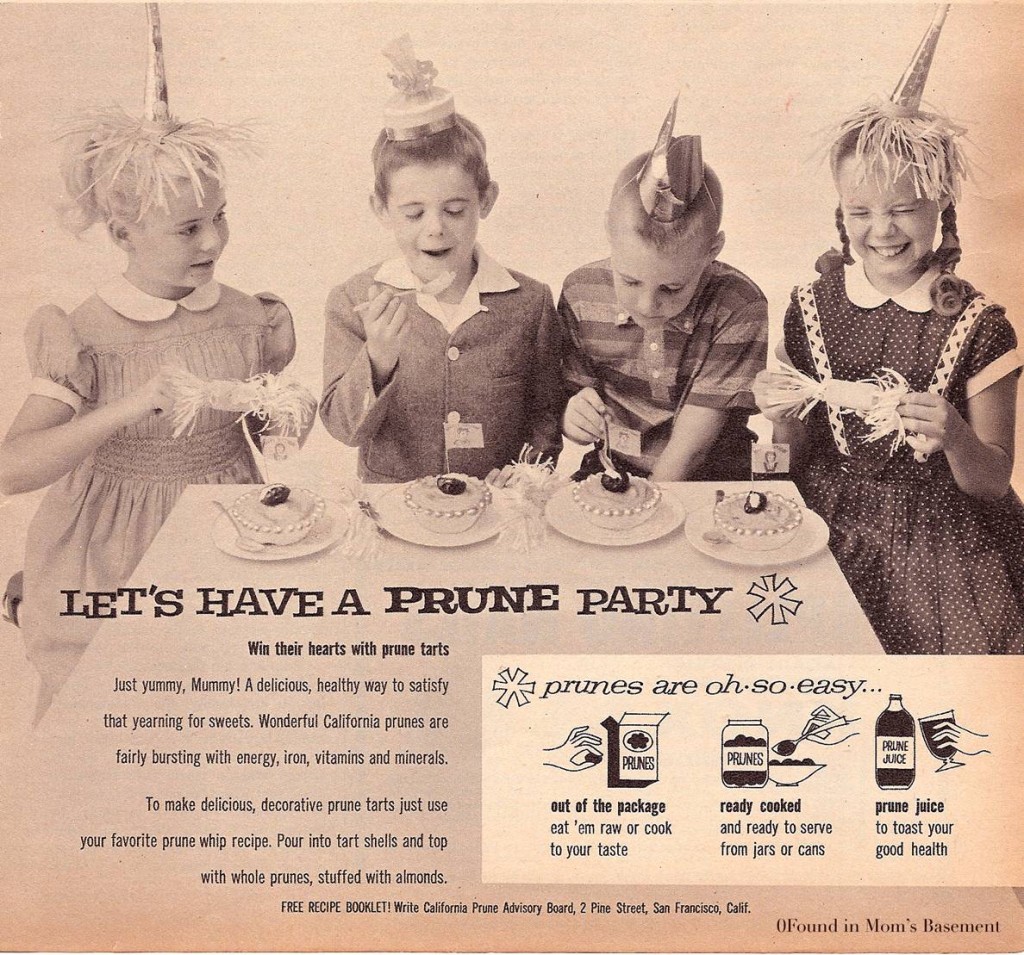
Today we think of prunes as something old people eat.  But, as this ad from 1958 reveals, the California Prune Advisory Board hoped to make prunes a favorite with moms and kids.

Picture1

Text:

Win their hearts with prune tarts

Just yummy, Mummy!  A delicious, healthy way to satisfy that yearning for sweets.  Wonderful California prunes are fairly bursting with energy, iron, vitamins and minerals.

To make delicious, decorative prune tarts just use your favorite prune whip recipe.  Pour into tart shells and top with whole prunes, stuffed with almonds.

—————————

Lisa Wade is a professor of sociology at Occidental College. You can follow her on Twitter and Facebook.


Jason S. sent in this (pretty hilarious) three-minute “ad” for Zima.  While modern motherhood takes many different forms, the ad is a great illustration of one stereotype of the modern mother:

So, according to the ad, moms…

1. …are middle class. She and her husband can afford a nice, new minivan.

2. …provide their children with active social and educational lives. Since they live in the suburbs, she spends a lot of time shuttling them from place to place.

3. …are frazzled. Likely a full time wage worker and the primary care taker for the children, the condition of the inside of the minivan suggests that she does not have time to clean or organize her family’s life.

4. …feed their kids fast food (french fries) because, being overwhelmed, she doesn’t have time to feed them what she’d thinks they should eat.

5. …have husbands who still take on the masculine jobs but, being white collar workers, no longer have the skill to effectively perform them.

—————————

Lisa Wade is a professor of sociology at Occidental College. You can follow her on Twitter and Facebook.

Mark Thoma at Economist’s View posted the following graphical representation of changes in the age distribution of the population of the U.S. between 1950 and today, and projected to 2050:

agedist_9_19_05

The bump, slowly moving off to the right, is the baby boom generation. The downward slope in the lines as you move to the right represents a population with a larger percentage of older people or, in other words, an older average age. If the forecast is correct, about 10 percent of the U.S. population will be over 75 by 2050.

Mark observes that many examinations of historical trends likely need to take into account this changing age distribution. For example, he asks:

…with a larger and larger fraction of the population moving into the asset liquidation phase of their life-cycle, how is the saving rate affected? How much of the change in the saving rate in recent years is attributable solely to changes in the age-distribution of the population?

—————————

Lisa Wade is a professor of sociology at Occidental College. You can follow her on Twitter and Facebook.