Search results for The

Remember the hymen? The hymen is that flap of skin that “seals” the vagina until a woman has sexual intercourse for the first time. Supposedly one could tell whether a girl/woman was a virgin by whether her hymen was “intact.” (It bears repeating that neither of these things are true: it doesn’t “seal” the vagina and is not a sign of virginity at all.)

Because an intact hymen signaled virginity, and virginity has been considered very important, preserving and protecting the hymen was, at one time, an important task for girls and women. You can imagine how tricky this made the marketing of that brand new product: the tampon. Early marketing made an effort to dispel the idea that sticking just anything up there de-virginized you. It worked. (In fact, some partially credit tampon manufacturers for the de-fetishization of the hymen that’s occurred over the last 60 years.)

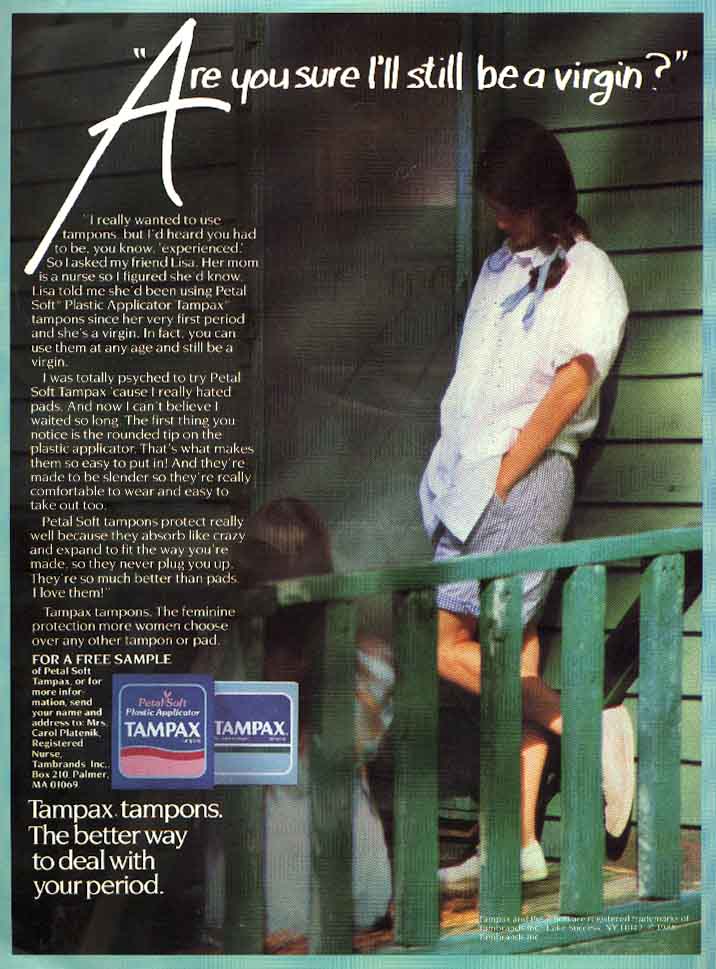
We still see tampon marketing addressing the question. Here’s a link to a website where it’s a FAQ and here’s an example of an advertisement from the ’70s ’90s:
virginad

Selected text:

I really wanted to use tampons, but I’d heard you had to be, you know, ‘experienced.’  So I asked my friend Lisa.  Her mom is a nurse so I figured she’d know.  Lisa told me she’d been using Petal Soft Plastic Applicator Tampax tampons since her very first period and she’s a virgin.  In fact, you can use them at any age and still be a virgin.

See this post, too, on the marketing of tampon to women in the workforce (wearing pants!) during World War II.

—————————

Lisa Wade is a professor of sociology at Occidental College. You can follow her on Twitter and Facebook.
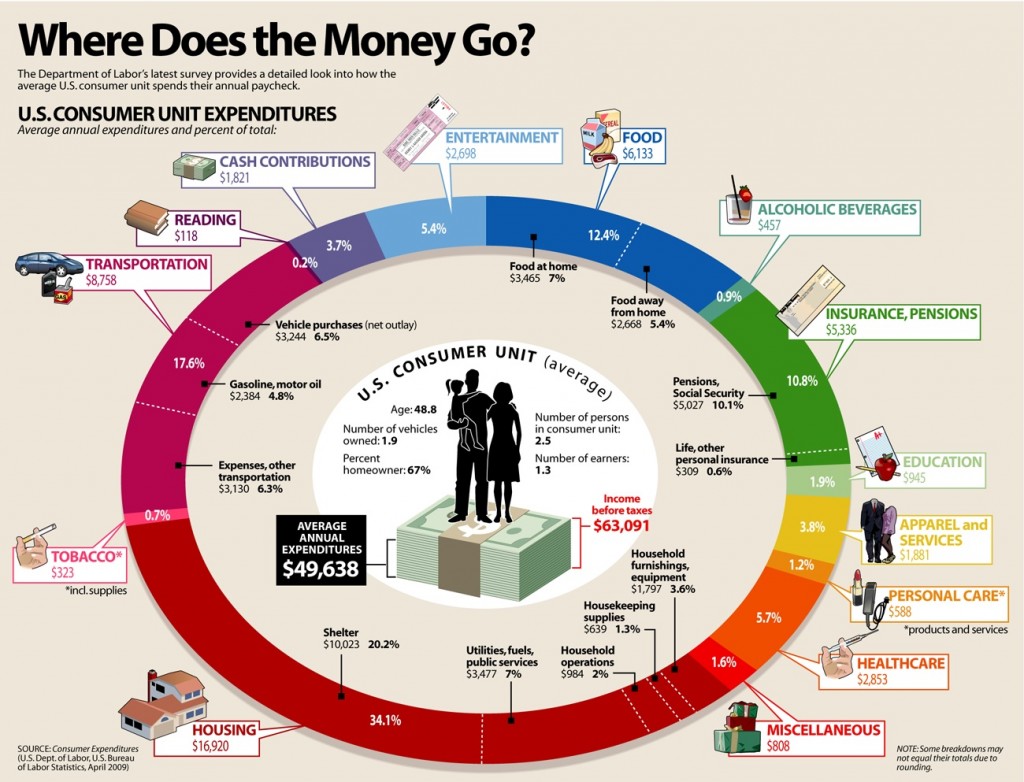
Via Visual Economics. Though often presented as the domain of economists, sociologists have a lot to say about patterns of consumption and their effects. Though patterns of consumption and their effects are often presented as the domain of economists, sociologists have have a lot of interesting things to say about this topic.

wheredidthemoneygo1

Of course, some have wondered, if sociology sucks, why do economists keep on doing it?

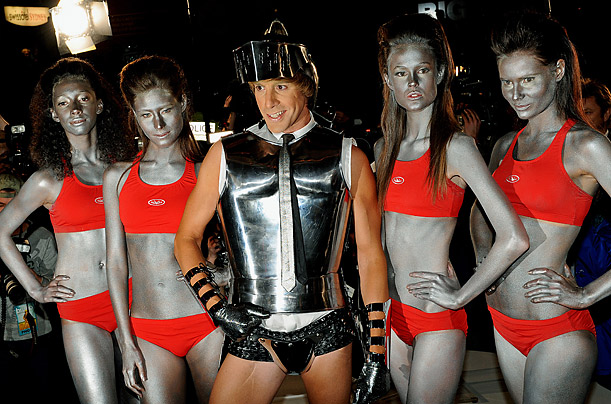
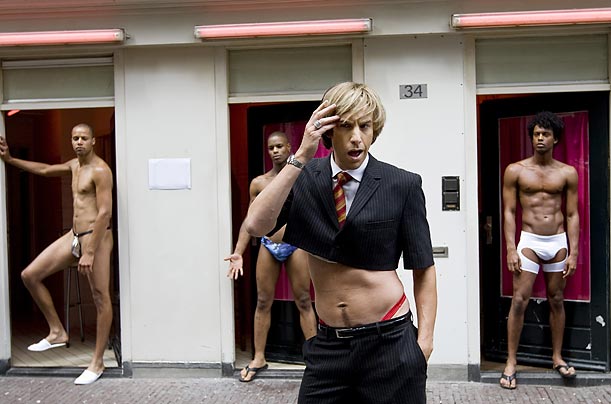
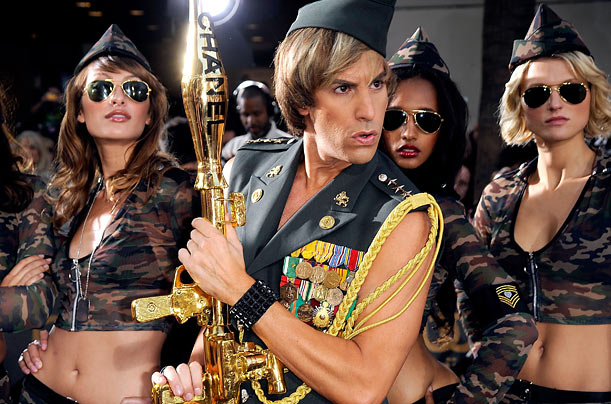
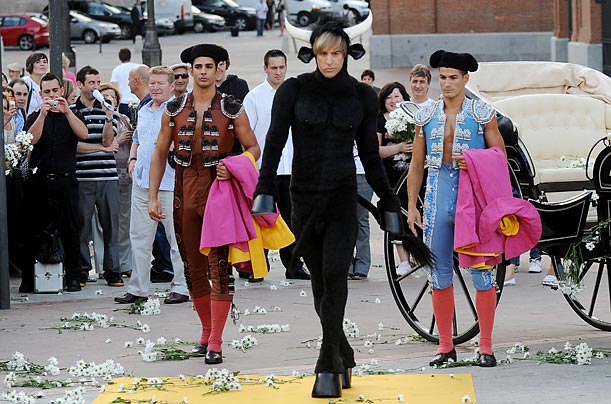
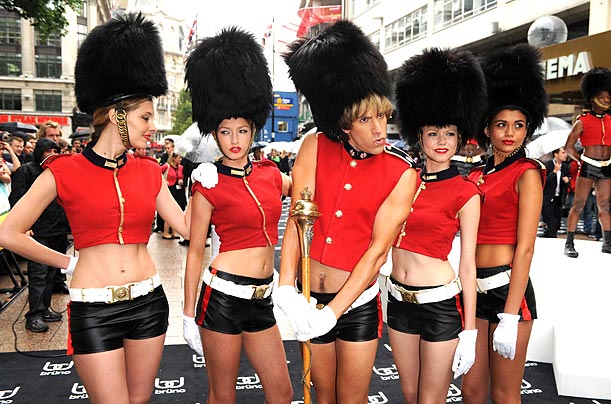
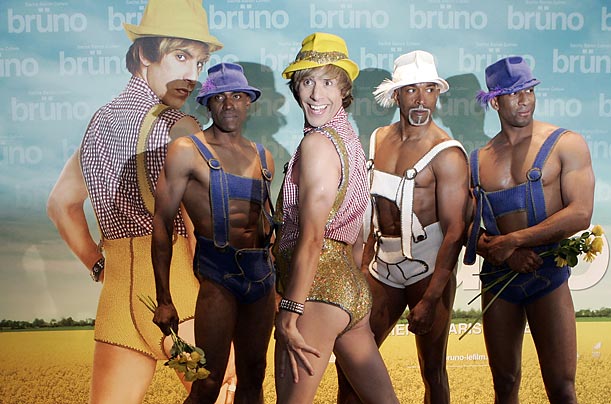
I’m not quite sure what to make of this but, after clicking through this Time magazine slide show of Bruno hype by Sacha Baron Cohen, I noticed that there appears to be a rule regarding his entourage: all its members must differ from him in one consistent way and, in that same way, they must all be alike.  This translates, in these images, into his entourage always being (a) women or (b) men of color, but never both:

bruno_01

bruno_01a

bruno_02

bruno_03

bruno_04

bruno_21

Any thoughts? Is there some social psychologist out there with some speculation? Readers, what do you think?

P.S. – To the person who commented in the thread of our last Bruno-related post about never wanting to see his face again: I say, “Sorry.”

—————————

Lisa Wade is a professor of sociology at Occidental College. You can follow her on Twitter and Facebook.
Ryan G. alerted us to a commercial for First Response pregnancy fertility tests. He noticed that the commercial cuts off the pregnant mother’s head, turning her into a faceless baby incubator (like in these editorial cartoons and not unrelated to this photography).  Ryan writes: “It’s clear what’s most important in this picture.”

firstresponse

While Ryan couldn’t find the commercial to embed, he did take down the narration and sent in some screen shots.  Here is the text of the voiceover:

The moment we pass from womanhood to motherhood, we cross a threshold. For many of us, that step is filled with wish and worry, hope and how, wonder and when. Fertility is a woman’s most sacred birthright. For over twenty years, First Response has been there, helping women answer the most important questions of their lives. Now we bring you new help: the First Response fertility test for women.

Ryan offered commentary, so I’ll rely on him.  He writes:

…”womanhood” and “motherhood” are presented as two separate things, with motherhood trumping womanhood. I’m assuming this is partly because a woman is not allowed to have a sex drive after she becomes a mother, and we all know that a woman without a sex drive is the higher form of woman.

womanhoodmotherhood

He continues:

“Fertility is a woman’s most sacred birthright.” God knows the most important thing any woman can contribute to society is being a baby farm. Strangely, I never see Viagra commercials arguing that knocking people up is a man’s most sacred birthright.

sacredbirthright

“[H]elping women answer the most important questions of their lives.” The most important question in a woman’s life doesn’t involve her own personal needs, but the needs of her children and soon-to-be children.

wishworryhopehowwonder
Finally, Ryan writes:

And of course, there’s no father pictured here, or even a passing mention of one. Why would there be?  Conceiving, planning for, and raising a child is exclusively the job–ahem, the “sacred birthright”–of the mother.

Thanks for the excellent and provocative analysis, Ryan!

—————————

Lisa Wade is a professor of sociology at Occidental College. You can follow her on Twitter and Facebook.
Animals Awake, a Dutch organization for animals akin to PETA in the U.S., “takes a page from [their] playbook,” according to David at Adfreak.   This commercial, in which a stripper is brutally murdered in front of a live audience, is so shocking that my first I thought was that it was a parody. It’s not.

Major major major trigger warning:

[vimeo]http://vimeo.com/5323112[/vimeo]

The critique, of course, is that Animals Awake is contributing to an atmosphere in which violence against women is ubiquitous (see Jezebel, for example).  But I actually think that this commercial works in that we are (I hope) genuinely horrified by the murder at the end.  I don’t think it normalizes violence against women like so many other ads/media/products do (see here, here, here, here, here, here, here, here, and here for examples).

BUT it does normalize the connection between violence and sex.  There is absolutely no reason why the person murdered in this ad had to a stripper.  There is no reason to spend the first half of the commercial titillating us, only to have it suddenly turned into a horror show.  There’s absolutely no connection.  But because sex and violence are so frequently linked in the American imagination, it actually took me a few minutes of thinking about it to remember that.  And I’m kind of horrified that, in my mind, sex and violence go together like peas and carrots.  This ad only reinforces that connection.

Sorry I made you watch it.

More images of sexualized violence here, here, here, here, here, here, here here, here, here, here, here, here, here, and here.

Here’s another PSA, this one from the U.K., with exactly the same idea.

UPDATE: In the comments, jeffliveshere points out that the commercial is based on a pun:

I agree that the sex and violence connection is unnecessary–but, to be clear, there is wordplay involved–“stripping fish” is apparently a technical term for removing the guts of fish…

Okay, so maybe there isn’t “absolutely no connection.” Even so?

—————————

Lisa Wade is a professor of sociology at Occidental College. You can follow her on Twitter and Facebook.
Lisa Wade, PhD is an Associate Professor at Tulane University. She is the author of American Hookup, a book about college sexual culture; a textbook about gender; and a forthcoming introductory text: Terrible Magnificent Sociology. You can follow her on Twitter and Instagram.


I mean, it’s Ellen DeGeneres. She’s a comedian. Everyone knows she’s just being funny.

Besides, she’s totally gay. Gay ladies don’t really care about beauty, am I right or am I right?

What do you think?

I’ll tell you what I think. Satire or no, Cover Girl’s done a lot of market research and they think it’s going to make people buy make up just like any old advertisement.  And I think they’re right.

In fact, I think satire is disarming.  When we see this commercial, our “don’t fuck with us” response doesn’t kick in because it’s just funny ol’ Ellen bein’ wacky.  Advertising counts on us thinking it doesn’t affect us.  Otherwise we’d be pissed.  I think satire is a useful tool with which advertisers trick us into letting down our guard.

We’ve been hitting satire hard lately.  I think it’s because it’s really pretty tricky to figure out.  See our previous posts on or featuring satire here, here, here, here, here, and here.  Here’s one that actually refers to data (as opposed to just involves us mouthing off.)

(Via Moody Springs.)

—————————

Lisa Wade is a professor of sociology at Occidental College. You can follow her on Twitter and Facebook.
Lisa Wade, PhD is an Associate Professor at Tulane University. She is the author of American Hookup, a book about college sexual culture; a textbook about gender; and a forthcoming introductory text: Terrible Magnificent Sociology. You can follow her on Twitter and Instagram.

I know I’ve been negligent in my posting for a few days. I was grading and busy watching old Michael Jackson videos and performances on YouTube and feeling unexpectedly sad about everything his life represented, and also the realization that people I idolized as a kid are now in their 50s.

Anyway, Sarah N. sent in a link to a story at the Mail Online about how women’s perceived attractiveness plays a part in deciding which matches will be played on the main court at Wimbledon. The organizers of Wimbledon don’t try to hide the fact that the appearance of the competitors is taken into account when scheduling matches:

…the All England Club admitted that physical attractiveness is taken into consideration. Spokesman Johnny Perkins said: ‘Good looks are a factor.’

Some women who were scheduled to play on Center Court, the main area, and their world rankings:

World No. 45 (unseeded) Gisela Dulko

87977985MT050_The_Champions

World No. 59 (unseeded) Maria Kirilenko

TENNIS Wimbledon 136

No. 28 seed Sorana Cirstea

All England Lawn Tennis Championships Day 5

Women who played on the other courts, with their rankings:

No. 5 seed Svetlana Kuznetsova

Britain Wimbledon Tennis

No. 2 seed Serena Williams:

w6

Attractiveness doesn’t seem to play such a factor in scheduling the men’s matches:

In the men’s tournament, five-times winner Roger Federer and British hope Andy Murray invariably play on Centre.

The scheduling of women by perceived attractiveness may have something to do with attracting television viewers. A comment from a BBC television employee:

But obviously it’s advantageous to us if there are good-looking women players on Centre Court…Our preference would always be a Brit or a babe as this always delivers high viewing figures.

Of course, it’s nothing new that female athletes are judged on their appearances as well as their athletic abilities. Female athletes have often felt pressure to meet conventional standards of beauty. This isn’t just about looks; it’s also about doing heterosexual femininity. Female athletes have long been suspected of being lesbians, particularly if they did not seem to actively seek male sexual approval. In fact, WNBA players have been encouraged to wear make-up and jewelry, have their hair long, and bring up their boyfriends, husbands, and/or children to prove their heterosexuality. Thus, in the end women’s appearances, and willingness to play up their gender in an approved way, often trumps their athletic accomplishments in a way that male athletes don’t usually face.

Other posts about female athletes and attractiveness are here, here, here, here (watch the second video), here, and here.

We’re pleased to feature a post by Macon D.  About himself, Macon writes, “I’m a white guy, trying to find out what that means. Especially the ‘white’ part. I live in that heart of the heart of American whiteness, the ever-amorphous ‘Midwest.’”  Macon’s blog, Stuff White People Do, is an excellent source of insights about race and racism.  We thought this post grappled nicely with the complicated phenomenon of (literal and figurative) black face, while addressing a difficult and contemporary form of humor:

————————————

chicagolakeoutdoor

Chicago-Lake Liquors
Minneapolis, Minnesota
(click here for larger version)

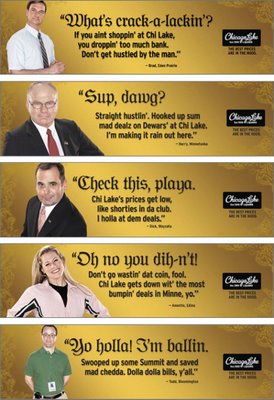
On the absorbing and informative blog Kiss My Black Ads, Craig Brimm responds to an ad campaign currently being run by Chicago-Lake Liquors, a store located in a largely black area of Minneapolis, Minnesota.  The images above are apparently billboards, and I’ve embedded below the three TV commercials also included in this campaign. (If you can’t view them, they’re also running now on the store’s site here.)The ads include “black” language, gestures, body language and so on, as performed by white, middle-class men (why no white women?). As I understand it, the joke is that these white folks are making fools of themselves by imitating black people.

Are these ads racist? Or are they making fun of racist white people? And if they’re “only” doing the latter, does that really make the contemporary blackface here any more acceptable?

Does context matter here, with Chicago-Lake Liquors located in a largely black area? Given that, perhaps the ads allow black people to feel superior in a way to these white people, by laughing at their silly efforts to get hip by acting “black.” Maybe, but that seems like a stretch.

Speaking of context — while blackface is largely condemned in the U.S., because it perpetuates and solidifies racist stereotypes, it serves other purposes in some other countries. Take a look at these other examples; as a United States citizen trying to become more aware on a daily level of racism and my own whiteness, I have increasing trouble ever seeing blackface, literal or otherwise, as acceptable. And yet, I’m a strong believer in the meaning-generating significance of social, historical, and cultural context. Many things have different meanings in different contexts.

So, I do find the Chicago-Lake Liquors ads racist. Even though the satiric butt of their central joke is clueless white people instead of black people, their version of blackness is insultingly cartoonish. They also basically revive what amounts to an American white supremacist tradition that deserves to die, blackface minstrelsy.

Still, I wonder — if we consider geographic, sociohistorical context, are some versions of blackface okay? Perhaps even, given its urban location, the contemporary American version in Chicago-Lake Liquors’ ad campaign?

* As Restructure! notes in a comment, Ganguro is one of three such modes of teenage blackface identified in the video; Yamanba, which means “mountain hag,” is the name of the one that’s tied to a comic’s racist parody of an aboriginal Australian. Jonathan Ross, the narrator of the video, notes that when Ganguro appeared after Yamanba, “many thought it was simply an homage” to the comic’s “beloved creation,” but apparently it’s not.

—————————

Lisa Wade is a professor of sociology at Occidental College. You can follow her on Twitter and Facebook.
Lisa Wade, PhD is an Associate Professor at Tulane University. She is the author of American Hookup, a book about college sexual culture; a textbook about gender; and a forthcoming introductory text: Terrible Magnificent Sociology. You can follow her on Twitter and Instagram.