Search results for The

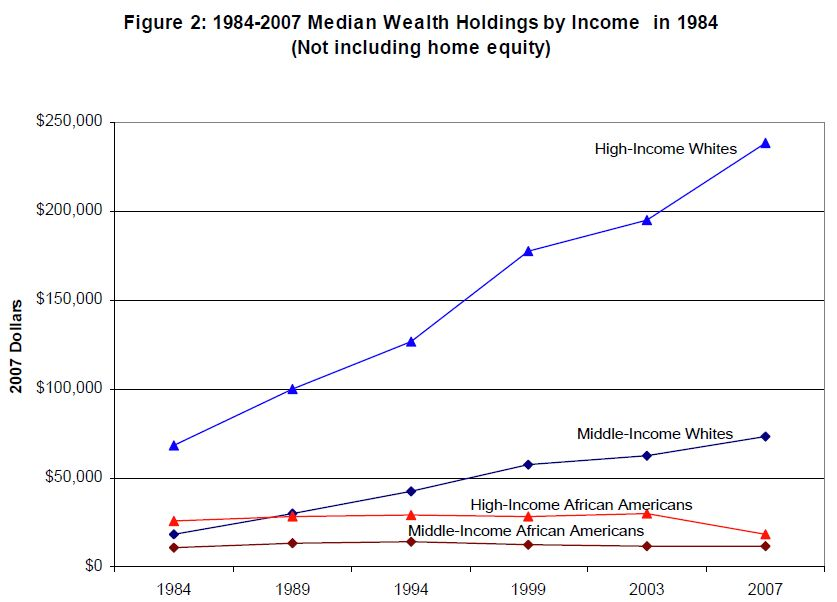
In addition to differences in income, there is a persistent wealth gap between black and white families in the U.S. The term “wealth” refers to all of your assets (the home you own, money in savings and investments, etc) minus your debt. According to a new research and policy brief by Thomas Shapiro, Tatjana Meschede, and Laura Sullivan, the wealth gap has increased from $20,000 in 1984 to $95,000 in 2007.

The authors explain the growth in the gap this way:

The [increase in the] racial wealth gap… reflects public policies, such as tax cuts on investment income and inheritances which benefit the wealthiest, and redistribute wealth and opportunities. Tax deductions for home mortgages, retirement accounts, and college savings all disproportionately benefit higher income families.

There are also much variety in how much wealth is held by people within any given race. The figure below, shows that the gap between high-income and middle-income whites has tripled since 1984. Both groups, however, have seen an increase in the amount of wealth they hold.

In contrast, the wealth of middle-income black families has stagnated and the wealth of high-income black families has recently dropped, flattening differences in wealth among middle- and high-income blacks, but dramatically increasing the wealth gap between blacks and whites.
So why don’t we see an increase in the wealth gap among blacks? The authors point to “…the powerful role of persistent discrimination in housing, credit, and labor markets.”

For example, African-Americans and Hispanics were at least twice as likely to receive high-cost home mortgages as whites with similar incomes. These reckless high-cost loans unnecessarily impeded wealth building in minority communities and triggered the foreclosure crisis that is wiping out the largest source of wealth for minorities.

The authors conclude:

Public policies have and continue to play a major role in creating and sustaining the racial wealth gap, and they must play a role in closing it.

Hat tip to Philip Cohen, Family Inequality.

—————————

Lisa Wade is a professor of sociology at Occidental College. You can follow her on Twitter and Facebook.
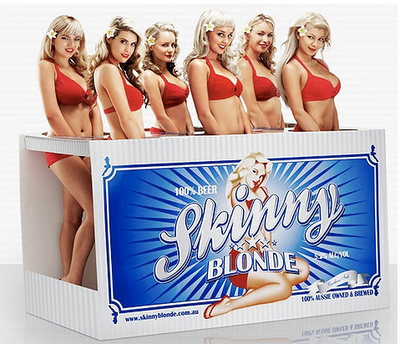
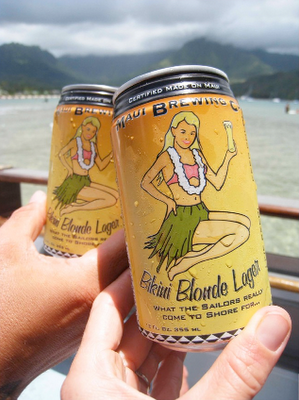
One example of the pervasive sexualization of beer is the ubiquitous personification of “blond” ales as blond women.  Tom Megginson at Change Marketing made this observation and collected a number of examples of this particular example of the gendering and sexualizing of food:

See more at Megginson’s post.  See also our other posts on gender and beer here, here, and here.

—————————

Lisa Wade is a professor of sociology at Occidental College. You can follow her on Twitter and Facebook.

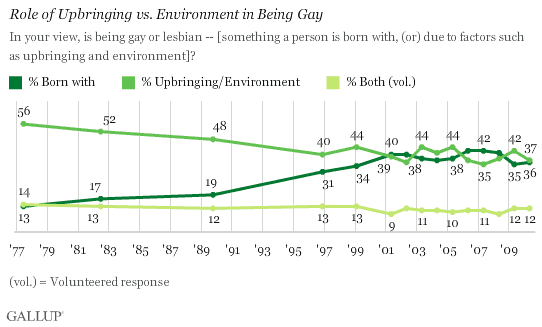
A blog post at Gallup, sent along by Michael Kimmel, discussed nearly 25 years of US opinion on the cause of homosexuality.  The data shows a slow decline in the percent of people who think that people are “made” gay or lesbian by their upbringing or environment (the nurture argument) and a slow rise in the number of people who think they are “made” gay or lesbian by biology (the nature argument).  The two meet in the late 1990s and, throughout the 2000s, they’ve been more-or-less neck-and-neck.

I welcome speculation as to why the trend didn’t continue such that nature ended up beating nurture good by 2010.  I can’t think offhand of a reason why.

—————————

Lisa Wade is a professor of sociology at Occidental College. You can follow her on Twitter and Facebook.

In this video they posted at Feministing, Chloe and Samhita discuss Sex and the City 2. Enjoy!

Nathan Yau, at Flowing Data, calls BP out on a piece of data representation trickery.  In a video on the BP website explaining the progress they were making cleaning up the oil, Kent Wells offered the following graph:

The bars represent oil collected over time.  But, as Yau points out, the data offered by Wells is cumulative.  It’s not the case that each consecutive day (May 16 to May 23) they are collecting more oil.  Instead, each collective day they have collected more oil overall.  If they keep collecting oil, we should expect nothing less.

Instead of showing the data cumulatively, they could have presented how much oil they collected each individual day.  But the data, in that case, doesn’t look as good.  Yau put this together:

This graph suggests that BP’s collection of oil is diminishing and makes viewers want to know why.  The graph they offered, however, hides their decreasing efficacy.

—————————

Lisa Wade is a professor of sociology at Occidental College. You can follow her on Twitter and Facebook.

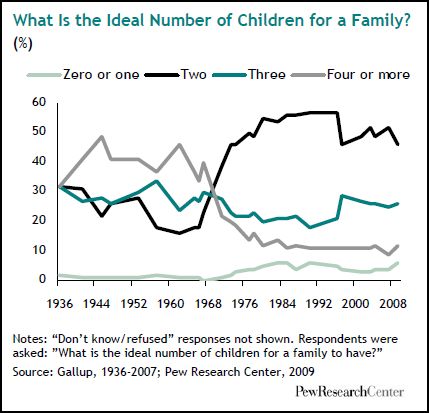
The new Pew Research Center report on the changing demographics of American motherhood (discovered thanks to a tip by Michael Kimmel) reveals some pretty dramatic changes in the ideal family size between 1990 and 2008.  In the late 1960s and early ’70s, two suddenly overtook three and four or more and it’s never looked back:

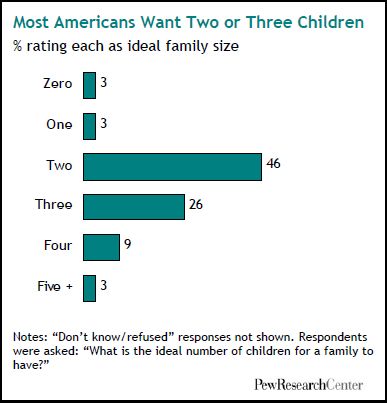
Here are today’s preferences (notice how few people want to remain childless or only have one child):

I’d love to hear ideas as to why this change happened at that moment in history.  Is it possible that the introduction of the contraceptive pill, which was the most effective method of contraception that had ever been available to women (I think that’s true), made smaller families an option and that people became interested in limiting family size once they knew that could actually do it?

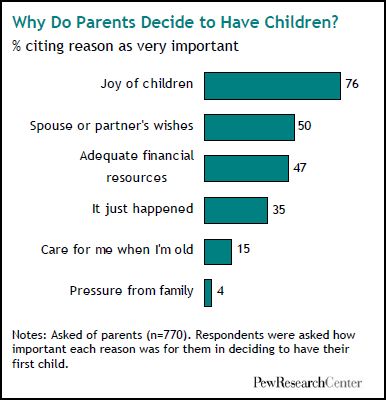
Interestingly, people still overwhelmingly say that they want children because they bring “joy.”  But apparently two bundles of joy are enough!

UPDATE! A number of commenters have pointed out that both I and the authors of the study are conflating people’s opinions about ideal family size and the number of children they personally want to have (see the second figure especially).  I think they’re right that asking the question “What is the ideal family size?” will not necessarily get the same response as “How many children do you want to have?”   A very nice methodological point.

For more on this data, see our posts on age and racetrends in American motherhood.

—————————

Lisa Wade is a professor of sociology at Occidental College. You can follow her on Twitter and Facebook.

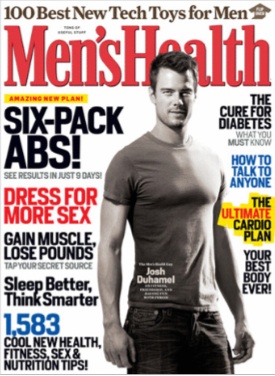
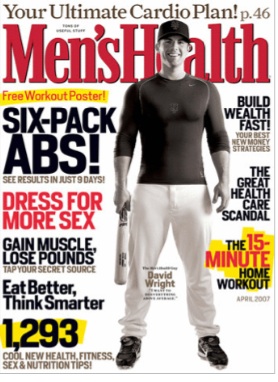
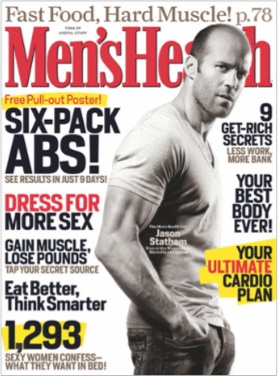
Sabriel let us know about a story at Gawker about the repeated use of nearly identical covers for Men’s Health. For instance, here are the “Six-Pack Abs!” covers from December 2006, April 2007, March 2006, and April 2008 (it was used a couple of other times, too):

They used the “Lose Your Gut!” template repeatedly, including in May 2009, October 2008, and March 2005, among others:

The editor responded by saying that the reused covers are only on the newsstand editions; subscribers get different versions, though even then, there’s quite a bit of repeating.

But regardless, I’m not interested in the fact that a magazine was recycling covers per se. I was struck by two things. First, the repeated covers make clear how much men’s midsections have become objects of scrutiny, the area to work on and obsess about, and by which your physique is judged. From Gawker:

Since 2007, Men’s Health has led with “Flat-Belly Foods,” “Get Back Into Shape,” and “Lose Your Gut” at least twice a year, and a “Six-Pack Abs” at least once a year since 2005.

Second, the degree to which cover lines can be reused, and content is interchangeable, underscores the degree to which these types of magazines — whether aimed at men or women — are selling us the same story, month after month. That story is: you aren’t good enough, your body isn’t good enough, but we have the secret to fixing it (lose weight, gain muscle), getting great sex (or, in the case of women, pleasing your guy), and improving your life in other ways (men = make more money, women = deal with a difficult coworker). The magazines are selling you slightly modified versions of that story because that story is what advertisers want you to get.

This might be a particularly literal repackaging of that theme, but other fashion/health/exercise/gossip magazines are doing the same thing in a somewhat more subtle form.

This being the opening weekend for Sex and the City 2, it seems like a perfect time for this video of sociologist Tracy Scott, from Emory University, discussing the cultural impact and contradictions of the SATC franchise. Enjoy!

Thanks to Nicole J. for sending it in!