Search results for The

PART ONE:

Drinking lowers your GPA. So do smoking, spending time on the computer, and probably other forms of moral dissolution. That’s the conclusion of a survey of 10,000 students in Minnesota.

Inside Higher Ed reported it, as did the Minnesota press with titles like “Bad Habits = Bad Grades.” Chris Uggen reprints graphs of some of the “more dramatic results” (that’s the report’s phrase, not Chris’s). Here’s a graph of the effects of the demon rum.

Pretty impressive . . . if you don’t look too closely. But note: the range of the y-axis is from 3.0 to 3.5.

I’ve blogged before about “gee whiz” graphs , and I guess I’ll keep doing so as long as people keep using them. Here are the same numbers, but the graph below scales them on the traditional GPA scale of 0 to 4.0.

The difference is real – the teetotalers have a B+ average, heaviest drinkers a B. But is it dramatic?

I also would like finer distinctions in the independent variable, but maybe that’s because my glass of wine with dinner each night, six or seven a week, puts me in the top category with the big boozers. I suspect that the big differences are not between the one-drink-a-day students and the teetotalers but between the really heavy drinkers – the ones who have six drinks or more in a sitting, not in a week– and everyone else.

—————————-

PART TWO:

Some time ago, the comments on a post here brought up the topic of the “gee whiz graph.” Recently, thanks to a lead from Andrew Gelman, I’ve found another good example in a recent paper.

The authors, Leif Nelson and Joseph Simmons, have been looking at the influence of initials. Their ideas seem silly at first glance (batters whose names begin with K are more likely to strike out), like those other name studies that claim people named Dennis are more likely to become dentists while those named Lawrence or Laura are more likely to become lawyers

But Nelson and Simmons have the data. Here’s their graph showing that students whose last names begin with C and D get lower grades than do students whose names begin with A and B.

The graph shows an impressive difference, certainly one that warrants Nelson and Simmon’s explanation:

Despite the pervasive desire to achieve high grades, students with the initial C or D, presumably because of a fondness for these letters, were slightly less successful at achieving their conscious academic goals than were students with other initials.

Notice that “slightly.” To find out how slight, you have to take a second look at the numbers on the axis of that gee-whiz graph. The Nelson-Simmons paper doesn’t give the actual means, but from the graph it looks as though he A students’ mean is not quite 3.37. The D students average between 3.34 and 3.35, closer to the latter. But even if the means were, respectively, 3.37 and 3.34, that’s a difference of a whopping 0.03 GPA points.

When you put the numbers on a GPA axis that goes from 0 to 4.0, the differences look like this.

According to Nelson and Simmons, the AB / CD difference was significant (F = 4.55, p < .001). But as I remind students, in the language of statistics, a significant difference is not the same as a meaningful difference.
Amanda brought our attention to a photo project by L. Weingarten called “A Series of Questions.” The ongoing project is designed to draw our attention to how the kinds of questions we ask transgender people makes them feel like inexplicable Others. From a description of the project:

The subjects, self-identified people of transgender, transsexual, genderqueer, gender-variant, or gender non-conforming experience, hold signs depicting questions that each has had posed to them personally — some by strangers, others by loved ones, friends, or colleagues. Presented on white wooden boards, the questions are turned on the viewer, shifting the dynamics under which they were originally asked, and prompting the viewer to cast a reflective, self-critical eye upon him or herself, revealing how invasive this frame of reference can be.

In other words, these questions get asked not only because transgender people break the rules, they get asked because the rest of us can be so inflexible, utterly confounded when other around us challenge our assumptions about the world.


Lisa Wade, PhD is an Associate Professor at Tulane University. She is the author of American Hookup, a book about college sexual culture; a textbook about gender; and a forthcoming introductory text: Terrible Magnificent Sociology. You can follow her on Twitter and Instagram.

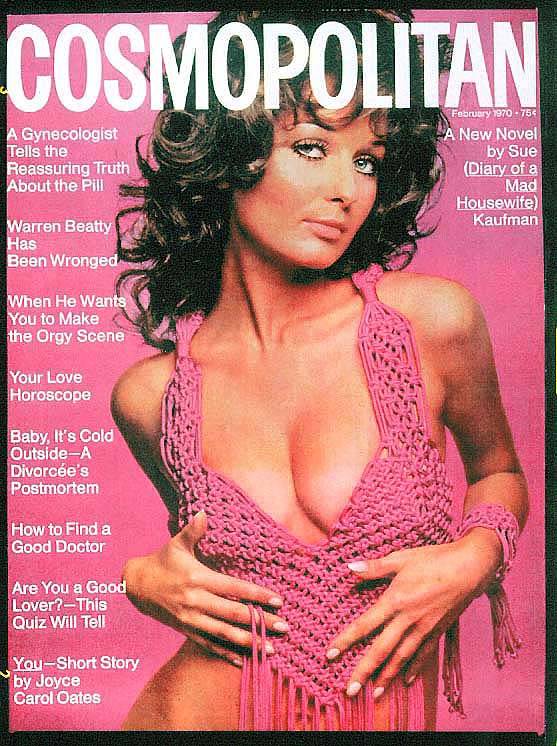
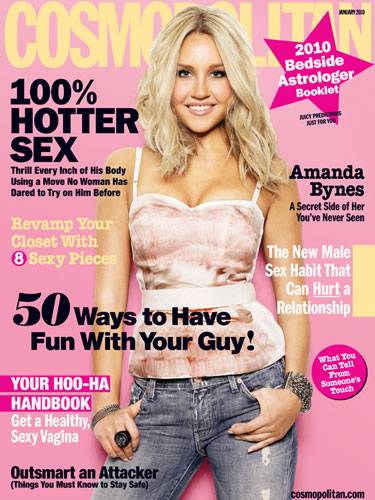
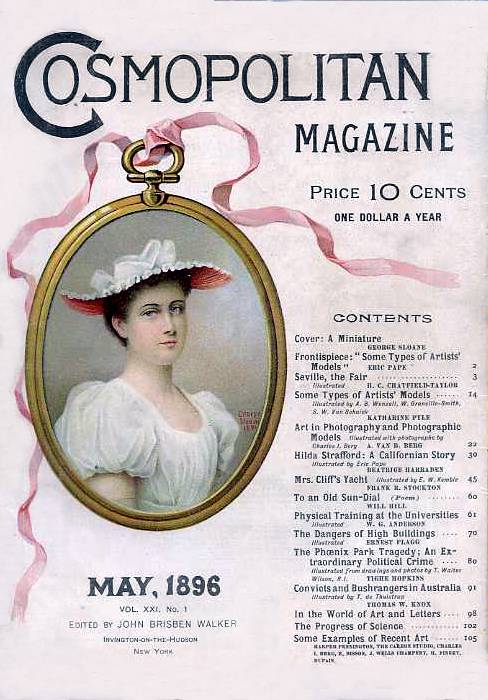
Cosmopolitan Magazine has been around since 1886 so it has seen quite a great deal of change over that time. The evolution of The Cosmopolitan Magazine into what is known today as Cosmo shows just how dramatic that change has been. In its early days, The Cosmopolitan was billed as a woman’s fashion magazine that included articles on the home, family, and cooking, but also included articles like “Some Examples of Recent Art” and “The Progress of Science.”


Later it became more focused as a showcase for new fiction and published works by authors like Upton Sinclair, Sinclair Lewis, Kurt Vonnegut, Willa Cather, and H. G. Wells. Typically, each issue would have five to eight short-stories, a full novelette, a full short novel, and some article on fashion and health. During this time, the cover art was almost exclusively illustrated — even when the covers featured celebrities.

With the introduction of television, there was a drastic decline in the demand for fiction-based magazines. In response to the waning sales there was a radical shift in the direction of Cosmopolitan. In the mid sixties, Helen Gurley Brown stepped in as editor in chief. She brought with her the message of sexual freedom for single women, and started replacing the cover illustrations with photos of young models in minimal clothing.  Sales increased as a result.

Since then the magazine has become more sexually centered. It still features many articles on having pleasurable sex and maintain fulfilling relationships. There is a much greater emphasis on how women can make themselves more desirable to men. One look at the website reveals the tone of the magazine. These are the first three articles listed:

“4 Traits Men Find Irresistible”
“What Men Secretly Think of your Hair and Makeup”
“What You Should Do if He Cheats”

The late Kurt Vonnegut (who had multiple short stories featured in Cosmopolitan in the fifties) had this to say about the magazine: “One monthly that bought several of my stories, Cosmopolitan, now survives as a harrowingly explicit sex manual.”  Indeed, browsing through the cover art of the past few years gives one the impression that there are an infinite number of sex positions. It is hard to feel sexually liberated while reading a magazine that talks about the vagina (or Hoo-Ha) like it’s something you can buy at a pet store. They have also been criticized for perpetuating a nearly impossible standard of beauty and for retouching models to make them appear thinner.  Today Cosmopolitan retains almost no reminants of its origins. It is fascinating to see how it has shifted with the culture and how our culture has changed because of it.

Sources: herehere, here, here, here, here, and here.

—————————–

Lauren McGuire is a SocImages intern and an assistant to a disability activist.   She recently launched her own blog, The Fatal Foxtrot, that is focused on the awkward passage into adulthood.

If you would like to write a post for Sociological Images, please see our Guidelines for Guest Bloggers.

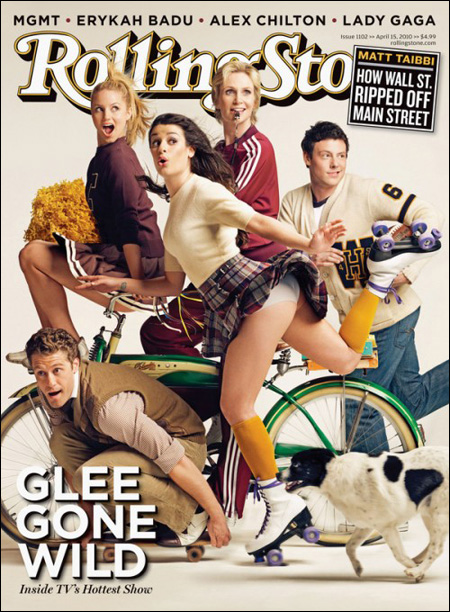
Or, as Angry Asian Man noticed, the white cast of Glee.

I get it, these are the show’s main characters. It’s just a obvious reminder that it’s awesome to see such great diversity on Glee… but never forget who the show’s real stars are supposed to be, and who usually gets relegated to the periphery.

With panties, of course.  Because without panties, there would be nothing at all going on on this cover.  Booooriiiiiiing.

Lisa Wade, PhD is an Associate Professor at Tulane University. She is the author of American Hookup, a book about college sexual culture; a textbook about gender; and a forthcoming introductory text: Terrible Magnificent Sociology. You can follow her on Twitter and Instagram.

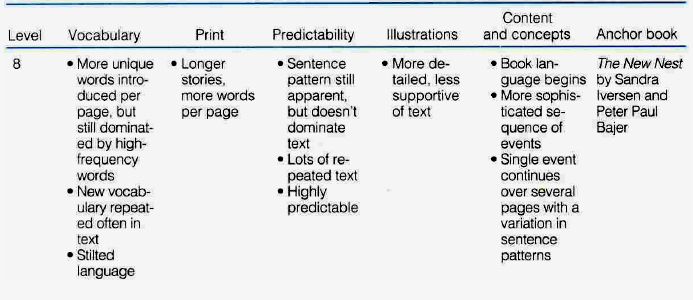
A 6-year-old I know brought home a reading assignment from kindergarten. It’s called The New Nest, by Sandra Iversen, with illustrations by Peter Paul Bajer. An innocent tale of Mama Bird and Papa Bird working together to build a nest from 20 twigs, straw and wool. At the end, Mama Bird is sitting on her eggs wearing pearls. Papa Bird is in a white collar and blue tie.

It’s curious to use men’s and women’s accessories (tie, necklace) to identify the gender of the couple, when the species itself provides a reasonable degree of sexual dimorphism.

That’s seems comparable to the dimorphism found in humans.

Using both gendered clothes and bodies is not necessary, but together they are a powerful teaching tool for children, forming a lesson on the concordance of gender and sex differences: matching the different bodies with the appropriately different clothes.

This book is actually featured in a write-up on teaching reading from the journal The Reading Teacher.

I don’t know what the intentions of the article writers were, but there is nothing in there about teaching about sexual dimorphism, or gender norms and practices.

Philip N. Cohen is a professor of sociology at the University of Maryland, College Park, and writes the blog Family Inequality. You can follow him on Twitter or Facebook.

Crossposted at Jezebel.

The role of women as both fans of and participants in organized sports has varied greatly in the U.S., as Karlene Ferrante demonstrates in her article* about gender and baseball. In the Victorian Era, a number of women’s baseball teams existed, and some women even played on men’s teams. For instance, Jackie Mitchell joined the Chattanooga Lookouts, a men’s team, when she was 17. In an exhibition game against the Yankees, she struck out Babe Ruth and Lou Gehrig…which people then attributed to them being nice and striking out on purpose. Discomfort with women in baseball increased over time, and eventually softball was created to provide an alternative perceived as being less strenuous and fast-paced.

In baseball and other sports, a taboo against women emerged. Many sports were seen as too rough to be appropriate for women to watch, but players and fans also worried that women presented a threat to male players, who might be distracted by the presence of women and thus not focus exclusively on the game (for a more recent example, see our post about Jessica Simpson and Tony Romo). Many believed that sex sapped a player’s strength, and many players avoided sex for several days before a game. Ferrante writes,

…in the early days of baseball women were allowed to watch games only if they were escorted. Unescorted women, and sometimes even escorted women, were harassed by cursing, spitting [fans]. (p. 249-250)

I thought of this when I saw the article Larry Harnisch (of The Daily Mirror) sent me from the L.A. Times, published on April 17, 1910. The story is about Maud Effinger, a woman who dressed in her husband’s clothing so she could attend a prizefight, which women were barred from attending (she writes about having to slip past police at the entrance):

Photobucket

The story, written by Maud herself, who seems rather saucy (sorry the last image is so small):

Photobucket

Photobucket

Photobucket

I don’t know why, exactly, women weren’t allowed into boxing matches. I suspect it might have been a combination of a belief that it was too rough for women’s delicate sensibilities, that scantily-clad men were inappropriate for them to see, and the taboo against women and their distracting ways. But the fact that she had to go incognito, slip past police, and sit in an area where she wouldn’t attract much attention indicates that the ban on women was taken quite seriously.

* Karlene Ferrante. 1994. “Baseball and the Social Construction of Gender.” Women, Media and Sport: Challenging Gender Values.


French sociologist Pierre Bourdieu popularized the notion of the habitus. The term refers to both the knowledges and physicalities that maintain distinctions between groups (examples in a sec). It’s a great concept for helping us understand the reproduction of class differences without relying strictly on economics. It takes more than money to make money, it also takes knowing the right things, the right people, and the right way to act.

The habitus, then, is one way to show that you “belong” to the group. Imagine being on a really fancy job interview for a really fancy job. Can you talk knowledgably about what vintage of which wine was really excellent in any given year? Do you know which fork is the salad fork? What parts of your body are allowed on the table? When? How quickly do you eat? What is the sign that you are finished with your food?

People who grow up in wealthy families that prioritize these things tend to absorb this knowledge naturally while growing up, just as a kid who grows up on a farm knows how to wrassle a lamb for fixin,’ mend a barbed wire fence, and spot a good steer at the auction. Both of these types of knowledges are useful, but they don’t transfer; my colleagues, for example, are forever unimpressed that I can tell the breed of most horses just by looking.

In any case, while these examples refer to class and rural or urban upbringings, Missives from Marx offered a great example of the habitus as a marker of religious belonging.

In the video below, made by evangelicals, the evangelical habitus is satirized. “Lost at an evangelical meeting?” the video asks, “Here’s how to do evangelicalism!”

* Title, post idea, and video stolen from Missives From Marx.

Lisa Wade, PhD is an Associate Professor at Tulane University. She is the author of American Hookup, a book about college sexual culture; a textbook about gender; and a forthcoming introductory text: Terrible Magnificent Sociology. You can follow her on Twitter and Instagram.

One of the criticisms sociologists sometimes have of economics is related to the assumption of rational choice. Many economic models assume that individuals will always act to maximize their benefit.

Sociology, however, is premised on the idea that humans make meaning. To begin with, what is “rational” is socially constructed and, further, humans value many things beyond pure strategic economic gain.

The photo below illustrates this concept quite well:

If you had a found iPod touch, which number would you call? Certainly some of you might call for the $51 reward, but many of us would call for the $50 reward. We would sacrifice that extra dollar because we would know that the second person is scamming, while the first is (probably) honest.

The proportion of people that would call the scammer, of course, goes up as his reward gets increasingly large compared to the original reward. But this doesn’t mean that rational choice theory is correct, it just means that we’re rational. That is, many of us are more willing to do the less-right thing when there is more to gain from it (though our tipping points are going to vary tremendously). Pure rational choice theory, though, would have us calling the scammer every time, even if only for a buck, as if nothing else matters.

The High Definite, via MontClair SocioBlog (where Jay first spoke to rational choice theory in his post).

Lisa Wade, PhD is an Associate Professor at Tulane University. She is the author of American Hookup, a book about college sexual culture; a textbook about gender; and a forthcoming introductory text: Terrible Magnificent Sociology. You can follow her on Twitter and Instagram.