Search results for The


Leah S. asked us to talk about Beyoncé’s new video, Why Don’t You Love Me, and I think Ann at Feministing had some interesting things to say, so I’m going to borrow her insights.

Noting both Beyoncé’s video and the recently released video for Babyfather by Sade, Ann observes:

…both Sade and Beyonce are cast as “traditional” homemakers in retro-styled videos. Beyonce’s retro romp seemed (at least to me) a bit tongue-in-cheek, whereas Sade pretty earnestly makes Jell-O and keeps house. But regardless, they’re both wearing vintage-looking sexy slips, making dinner, hanging out at home during the day, etc.

But they’re not simply nods to the ’50s.  Because both women are black, the videos also potentially subvert the idea of the perfect housewife of that era.  Ann continues:

I know there were certainly upper-middle-class women of color in the ’50s and ’60s, but this image of the happy-but-secretly-unhappy housewife is stereotypically white. By virtue of race, Beyonce and Sade are twisting that stereotype.

And that twist is very political.  Consider this: In American politics today, the “perfect” mother is one who does not work and stays home with her children.  Unless she’s poor.  Poor women who want to stay home with their children are called lazy, welfare cheats.  If you’re poor, you can only be a good mother by working.

Because race and class are correlated in U.S. society, and the “welfare queen” is a race-specific trope that usually refers to poor, black women, these videos might very well challenge the white-middle/upper-class-homemaker conflation.

Beyoncé, Why Don’t You Love Me:

Sade, Babyfather:

Lisa Wade, PhD is an Associate Professor at Tulane University. She is the author of American Hookup, a book about college sexual culture; a textbook about gender; and a forthcoming introductory text: Terrible Magnificent Sociology. You can follow her on Twitter and Instagram.
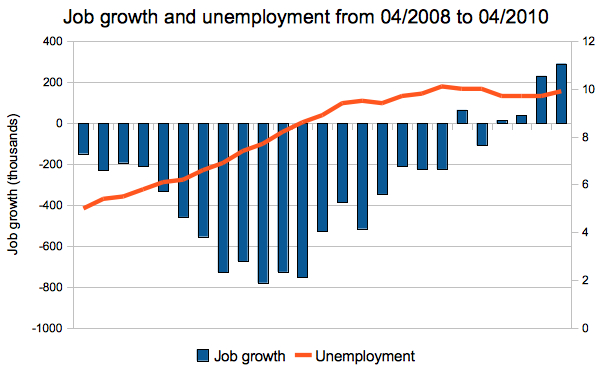
You might have heard that the U.S. added 290,000 jobs in April.  At the same time, the unemployment rate rose!  Bwhat!?

The unemployment rate doesn’t measure how many people are unemployed.  It sounds like it should, being that it includes the words “unemployment” and “rate” and all, but it doesn’t.  Instead, the unemployment rate measures how many people are looking for jobs.  When things are really bad, some people get discouraged and give up, or go to school instead, or stay home to take care of their kids and save day care money.

So the number of jobs and the unemployment rate are not directly correlated.  Ezra Klein posted this visual:

It shows unemployment rising as job growth remains negative, leveling off as (perhaps) people drop out of active job seeking, and than actually going up again there at the end in response to two months of solid job growth.

So it turns out that, in this case, a rise in the unemployment rate is good news.  It means some people are hopeful again.

Lisa Wade, PhD is an Associate Professor at Tulane University. She is the author of American Hookup, a book about college sexual culture; a textbook about gender; and a forthcoming introductory text: Terrible Magnificent Sociology. You can follow her on Twitter and Instagram.

Crossposted at Jezebel.

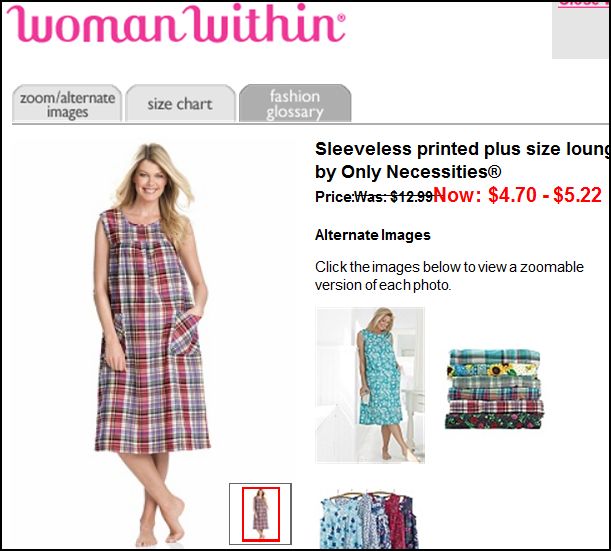
Meg R. noticed something funny at Woman Within, a website that sells clothing sizes 12w to 44w.  All of the models were very thin, thus not representative of the intended customer base at all.  But, even odder, they were all swimming in clothes that (by today’s standards) were far too large for them.  So the website featured thin models selling plus-size clothes (not, in itself, that surprising), but didn’t scale down the clothes to fit them!  We might imagine that using thin women would make customers, even if they aren’t thin, like the clothes (because we all internalize thin preference), but modeling poorly fitting clothes, as Meg said, wasn’t doing the product any favors!  We’re both baffled by the logic.

Some examples:

NEW! (July ’10): Liz R. sent in another example. This ad is for clothing sized 16-24 but with a very thin model:

Lisa Wade, PhD is an Associate Professor at Tulane University. She is the author of American Hookup, a book about college sexual culture; a textbook about gender; and a forthcoming introductory text: Terrible Magnificent Sociology. You can follow her on Twitter and Instagram.


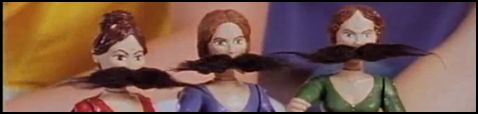
Tanita sent in this funny short video that addresses the sexism female authors have often faced when trying to get their work published or taken seriously in literary circles (some, such as Mary Ann Evans, better known as George Eliot, resorted to using male pen names to combat these problems).

What better way for female authors to deal with the situation than use their action-hero superpowers to combat sexist publishers? I present to you the Brontësaurus:

Confession: I know this will make many of you scream in horror, and that the book has all kinds of feminist overtones and is greatly beloved and majorly influenced literature, and I’m showing myself to be a literary heathen with no appreciation for the arts, but I read Jane Eyre once, and I think Charlotte Brontë’s most effective weapon might be her ability to get you bogged down reading lengthy Gothic descriptions of moors and stuff.

Though if you ever need to make me cringe and run, tell me you’re going to make me read Tess of the d’Urbervilles. I tried reading it just for fun once, and I have never been so pained.

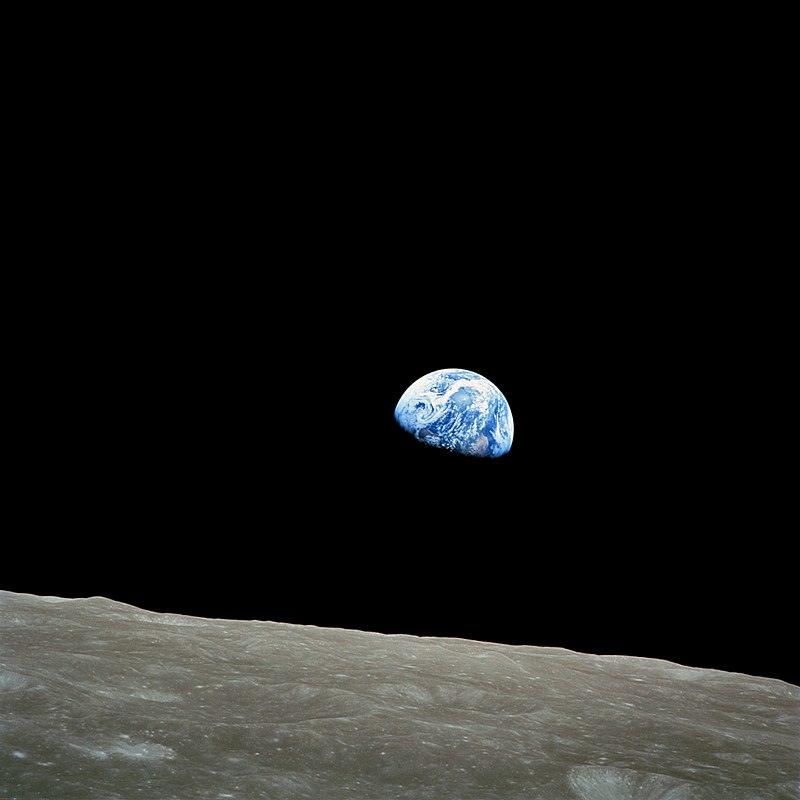
Photographs have played a major role in framing the environmental movement, and groups have used images to draw public attention and concern to specific issues. A famous example is the “Earthrise” image taken in 1968 from Apollo 8, the first time an image of this sort was taken by an actual person, rather than a satellite. The seeming fragility of the planet, clearly shown as an interconnected and isolated entity, has been largely credited with increasing concerns about and awareness of environmental issues:

Life magazine included it in a list of “100 photographs that changed the world.”

On June 22, 1969, the Cuyahoga River in Ohio caught on fire. News spread, and the story — the shock many Americans experienced when they heard that rivers were catching on fire — increased concerns about water pollution, eventually leading to the 1972 Clean Water Act. Dramatic photos of the Cuyahoga burning appeared.

There was one small detail with the images that often went unnoticed: as far as anyone can tell, no one took any photos of the river burning in 1969. If you look online now, you’ll find lots of images from a fire in 1952, but none from 1969. At the time, rivers catching on fire in the former industrial centers around the Great Lakes weren’t really shocking; it happened pretty frequently and had been for decades. The 1969 fire was, if anything, unexceptional. It only lasted half an hour and didn’t do much damage.

Of course, context and timing are everything. The story about the 1969 fire emerged at a time when concerns about environmental pollution and safety were increasing, so an event that might have been completely ignored outside the local area, as they had been in the past, instead became a flashpoint in the environmental movement, and images of rivers on fire now seem shocking to us. I think most Americans would see a river catching on fire as inherently problematic, an automatic sign of a major environmental problem, rather than an unavoidable and unremarkable outcome of economic progress.

Given the force of images in these instances (and others), I can’t help but wonder what the effects will be of photos of the current oil spill in the Gulf of Mexico, particularly as it approaches the coasts. Dmitriy T.M. sent in a set of images. The oil spill, and the images we’ll continue to get of it, come soon after President Obama announced his support for offshore drilling in a number of areas, including the Atlantic coast and the Gulf of Mexico. The plan, already controversial, is likely to meet even more resistance now, particularly from residents in communities that are not dependent on oil drilling for their livelihoods and fear the effects of an oil spill. Public concern is likely to increase even further when the oil hits coastal areas and we begin to see images of oil-covered wildlife, beaches, and so on, much as we did after the Exxon Valdez spill.

These images are already striking, but the power of an image is highly connected to the social/historical context in which is arises (much as photos of rivers on fire didn’t cause a huge national stir until they became emblematic of the need for environmental regulations). I can’t help but think that the last photo I posted above will have more resonance than it might have otherwise because of the way it will intersect with memories of Hurricane Katrina bearing down on New Orleans — I suspect that a story that would be attention-getting regardless will be even more so now that it will connect to ideas of New Orleans as a beleaguered city, endangered by a string of natural and human-caused disasters.

——————————-

See also our post on how photographs of the fetus changed how we think about pregnancy and abortion and, for an interesting controversy regarding photography, see our post on Shelby Lee Adam’s images of Appalacians.

Gwen Sharp is an associate professor of sociology at Nevada State College. You can follow her on Twitter at @gwensharpnv.

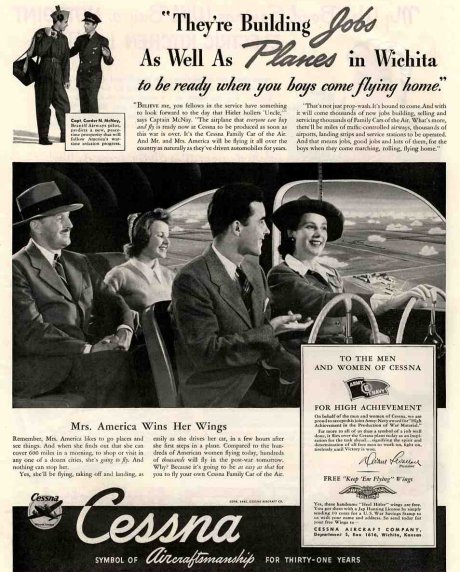
Peggy R. sent in this great vintage ad for Cessna private planes.  Placed in 1941, it suggests that all families should have private planes after the war:

I spoke with my friend and Cessna expert, Stephen Wilson.  He explained that the G.I. Bill, which reimbursed veterans for educational expenses, applied to flying lessons.  Veterans, then, could be reimbursed for learning to fly and Cessna was trying to encourage all veterans and their families to take to the skies.

Lisa Wade, PhD is an Associate Professor at Tulane University. She is the author of American Hookup, a book about college sexual culture; a textbook about gender; and a forthcoming introductory text: Terrible Magnificent Sociology. You can follow her on Twitter and Instagram.

Asa D. sent in an animated 1958 Disney segment titled “Magic Highway USA.” The cartoon extols the virtues of the highway system of the future (the interstate highway system was authorized by President Eisenhower in 1956). Apparently it is farther into the future than 2010, as my windshield does not have a radar, and road construction around here doesn’t seem to be instantaneous:

The segment of course illustrates gender expectations of the time — dad goes off to work while mom and the kid(s) go shopping. But as Asa points out, this example of the “techno-utopianism” of the post-World War II era, with faith that modern technologies will lead to a happy future that increasingly frees us from unpleasant work, boredom, wasted time, and so on, is truly fascinating.

Providing a nice contrast to that earlier vision, Dmitriy T.M. let us know about the stop-motion short video Metropolis by Rob Carter. The entire video, which is 9 1/2 minutes long, gives an abridged history of Charlotte, North Carolina.

Here are the last 3 minutes (you can see the entire video here). In this segment, we see the unfolding of a large highway system and urban construction/destruction/reconstruction. At about a minute in, “the video continues the city development into an imagined hubristic future, of more and more skyscrapers and sports arenas and into a bleak environmental future” (quote found here):

Metropolis by Rob Carter – Last 3 minutes from Rob Carter on Vimeo.

NEW! (May ’10): Kris H. sent in another example of envisioning the future. The Futurama, an exhibit at the 1939 World’s Fair, promised a future in which interstate highways will allow people to bypass slums, relieving us of the work of fixing them (found at Neatorama):

Jose Marichal, who blogs at Thick Culture, forwarded us this compilation of Bob Barker’s infantilizing and harassing behavior on The Price is Right during the 1970s.  It’s pretty stunning:

I’d like to say that men don’t call women “girls” these days… but I’m watching Jaime Oliver’s Food Revolution.

Source: FourFour via The Daily Dish.  More examples of calling women girls, both vintage and contemporary.

Lisa Wade, PhD is an Associate Professor at Tulane University. She is the author of American Hookup, a book about college sexual culture; a textbook about gender; and a forthcoming introductory text: Terrible Magnificent Sociology. You can follow her on Twitter and Instagram.