
Search results for The

At BoingBoing, German professor Michael Shaughnessy offered his insights regarding how Americans and Germans see and talk about color differently.  Among other things, he noted how few foods in the U.S. are described as blue.  Blueberries, of course.  And blue cheese, I suppose.  (Or “bleu” cheese, as TheophileEscargot points out.)  But little or nothing else.

In contrast, Shaughnessy suggested that many more foods are described as blue in southern Germany.  Notably, blue onions, blue grapes, and blue cabbage (pictured):
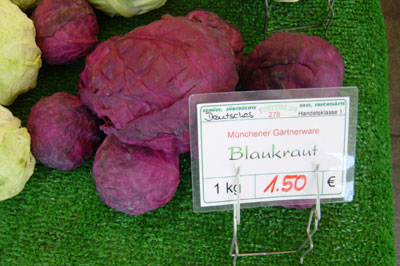
In northern Germany, however, “Blaukraut” is “Rotkohl.”  That is, the same color (“blau”) is described as red “(“rot”).  He ponders whether “red onions [in the U.S.] are truly red.” In fact, their better described as purple.

He continues, “Words, impacted by the visual, often vary at the crossroads between colors.”  In other words, perception may be influenced by language and culture.  Where does blue end and red begin?

UPDATE: In the comments Alissa notes:

German wikipedia tells me that the south/north naming difference results from the difference in prepararation of the food. in northern germany it is usually prepared with acidic substances like vinegar giving it a more reddisch color, thus “Rotkraut” (very good with apples), in southern germany sugar or natron is the ingredient of choice, which enhances the blue of the original purple color, hence “Blaukraut”.

Interesting!

Lisa Wade, PhD is an Associate Professor at Tulane University. She is the author of American Hookup, a book about college sexual culture; a textbook about gender; and a forthcoming introductory text: Terrible Magnificent Sociology. You can follow her on Twitter and Instagram.
K. sent in a trailer for a new comedy called Outsourced.  In it, a white call center manager is sent to India to  manage a company full of Indian workers who take orders for gag items (including jingle jugs).  I think the it is both troubling and promising at the same time.  My thoughts after the trailer:

On the one hand, a lot of prior experience and several aspects of this trailer make me worry that this show is going to capitalize on negative stereotypes of Indians, especially ones that suggest that they are goofy and nerdy and are hilariously unfamiliar (e.g., “stupid” names and “scary” food)… with a handful of stereotypes about Americans thrown in for good measure.  The show threatens to reaffirm a binary where the U.S. and India are completely different in every way.

On the other hand, I am encouraged by the fact that the show includes a wide range of Indian characters.  In some cases, our stereotypes are upset by traits that Americans are conditioned not to expect in Indians (such as the guy who likes to dance); in other cases, characteristics are clearly attributed to individuals instead of “Indians” (such as the girl who is afraid to talk).  Further, it becomes clear in the trailer that the employees in the manager’s office are misfits because they’re misfits, not because they’re Indian.  The competitor call center employees are not misfits at all.  They are clearly super-effective and excellently-trained (though, perhaps, also Westernized).  The ridiculousness of the main ensemble cast, then, isn’t attributed to their Indianness per se.

So, yes, I fear that this is going to be a show that makes (white) Americans laugh by suggesting that Indians are dorky and weird.  At the same time, I see promise in a show that actually casts Indians as individuals instead of representatives of their nation/race.

Lisa Wade, PhD is an Associate Professor at Tulane University. She is the author of American Hookup, a book about college sexual culture; a textbook about gender; and a forthcoming introductory text: Terrible Magnificent Sociology. You can follow her on Twitter and Instagram.
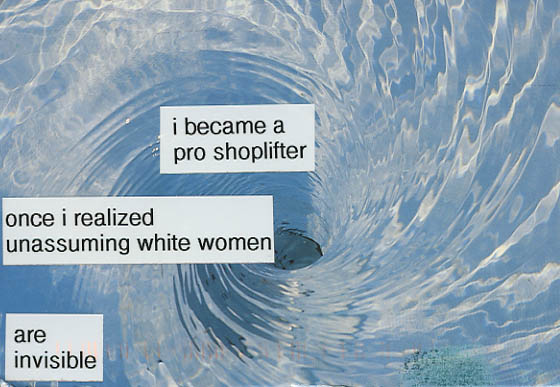
Heather J. sent along a nice illustration of white privilege, courtesy of PostSecret.  PostSecret features anonymous confessions on postcards and, in this confession, a person confesses that being white and female facilitates her shoplifting: The card is a great example of the flip side of racial profiling: those who do not carry the stigmatized features aren’t simply treated fairly, they’re given a benefit of the doubt that allows them to get away with the very thing that others are suspected of doing.

Lisa Wade, PhD is an Associate Professor at Tulane University. She is the author of American Hookup, a book about college sexual culture; a textbook about gender; and a forthcoming introductory text: Terrible Magnificent Sociology. You can follow her on Twitter and Instagram.
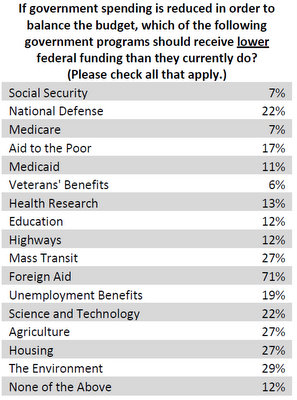
Sixty-two percent of Americans think that the country should reduce spending in order to cut the deficit.  What do they think we should cut?  Nothing really.

Well, nothing except foreign aid.

Kevin Drum at Mother Jones reminds us that foreign aid is about one percent of the U.S. budget.

…there were only four [other] areas that even a quarter of the population was willing to cut: mass transit, agriculture, housing, and the environment. At a rough guess, these areas account for about 3% of the federal budget. You could slash their budgets by a third and still barely make a dent in federal spending.

The Economist, via BoingBoing.

Lisa Wade, PhD is an Associate Professor at Tulane University. She is the author of American Hookup, a book about college sexual culture; a textbook about gender; and a forthcoming introductory text: Terrible Magnificent Sociology. You can follow her on Twitter and Instagram.
This cute two-minute video explains it:

Feminist Frequency, via my friend Ronke O.

Lisa Wade, PhD is an Associate Professor at Tulane University. She is the author of American Hookup, a book about college sexual culture; a textbook about gender; and a forthcoming introductory text: Terrible Magnificent Sociology. You can follow her on Twitter and Instagram.
Nationalist white supremacy organizations, and their gentler counterparts in the U.S., sometimes argue that non-white women are having more children than white women.  The result is a shift in the national demographic (that they don’t like).

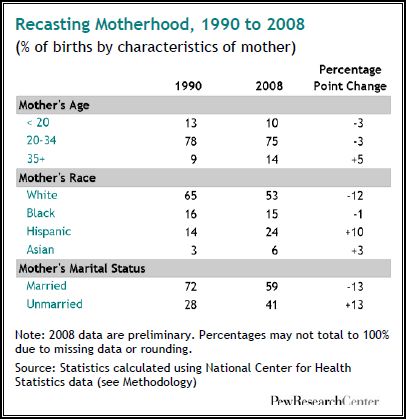
This month the Pew Research Center released a report on the changing demographics of American motherhood (discovered thanks to a tip by Michael Kimmel).  Under “Mother’s Race,” we see that there has been a 12 percentage point decrease in the share of births to white women between 1990 and 2008.  In contrast, births to Asian and, especially, Hispanic women have increased (a combined 13 percentage points):

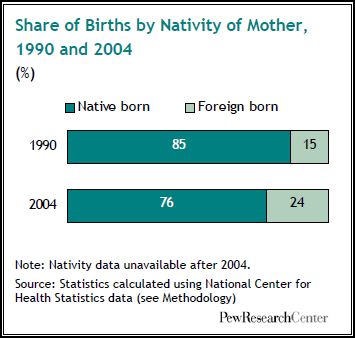
The share of births to native versus foreign born women has also shifted, with a quarter of births now to women who have immigrated to the U.S.:

They summarize:

White women made up 53% of mothers of newborns in 2008, down from 65% in 1990. The share of births to Hispanic women has grown dramatically, to one-in-four.

So, whether you agree with the national white supremacists’ evaluation of the data or not (I assume you do not), they’re right about the data.

UPDATE: Sabrina, in the comments, rightly points out that my comments assume that the father’s race matches the mother’s.

Lisa Wade, PhD is an Associate Professor at Tulane University. She is the author of American Hookup, a book about college sexual culture; a textbook about gender; and a forthcoming introductory text: Terrible Magnificent Sociology. You can follow her on Twitter and Instagram.

In the U.S. today we largely accept and encourage girls’ experimentation with boy-coded things, but we are still extremely ambivalent, if not downright condemnatory, of boys experimenting with girl-coded things.

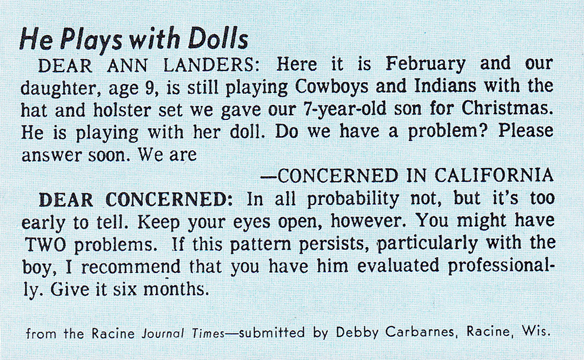
This excerpt from an Ann Landers advice column from 1974 shows that Landers had the same asymmetrical concerns almost 40 years ago.

The parents ask about the sex-crossed play behavior of both their daughter and their son, but Landers fixates on the son, suggesting that if he continues such play he should get checked out.

From Ms.

Lisa Wade, PhD is an Associate Professor at Tulane University. She is the author of American Hookup, a book about college sexual culture; a textbook about gender; and a forthcoming introductory text: Terrible Magnificent Sociology. You can follow her on Twitter and Instagram.

Why does the iconic New York City paper cup look so… Greek?

Flickr creative commons Steve McFarland.

The designer of the cup, Leslie Buck, arrived in the U.S. after fleeing the Nazis during World War II.  He joined a new company called “Sherri Cup” in the ’60s.  He designed the cup, with no art training, with a Grecian theme and in the colors of the Greek flag, to appeal to… Greeks.  It turns out that a large portion of the city’s diners at that time were owned by Greeks.  It was an instant hit.

So, we have immigration, ethnic occupational segregation, and Buck’s ingenuity to thank for decades of cozy, New Yorky feelings inspired by that little cup.

Buck died this April.  You can read his obituary, and the whole story of the cup, at the New York Times.

Lisa Wade, PhD is an Associate Professor at Tulane University. She is the author of American Hookup, a book about college sexual culture; a textbook about gender; and a forthcoming introductory text: Terrible Magnificent Sociology. You can follow her on Twitter and Instagram.