Search results for The

The Center for American Progress released a report detailing the state of border policing and the projected impact of immigration policies.  First, notice that spending on border patrol and the number of border patrol agents in the southwest have increased significantly between 1992 and 2009:

Still, despite this, the number of people illegally crossing the border has increased:


So the policing hasn’t deterred a rise in disallowed border crossings, but it has made it more dangerous:
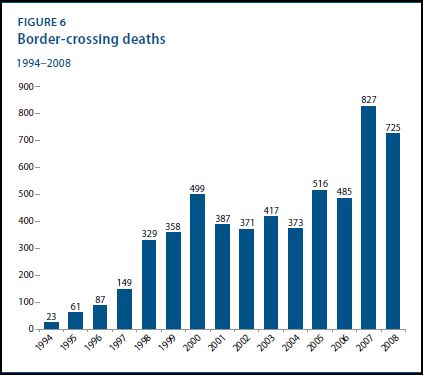
So, the U.S. is spending a lot of money trying to keep undocumented non-citizens out.  Is it worth it?

The report also discusses projected changes in the GDP under three different scenarios: immigration reform, allowing temporary workers only, and mass deportation.
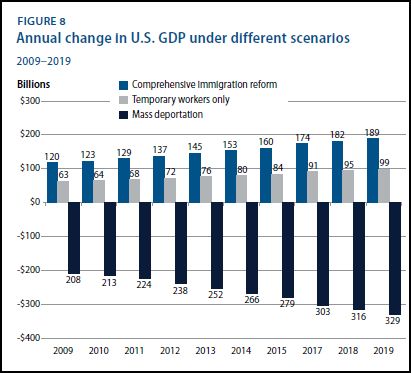
The figure suggests that undocumented workers are making a substantial contribution to the well-being of the U.S. economy, one that would decrease under conditions of mass deportation.  Temporary workers are helpful, but real immigration reform that would bring in greater numbers of permanent and temporary workers is the best thing for America.

Hat tip to Graphic Sociology.

Lisa Wade, PhD is an Associate Professor at Tulane University. She is the author of American Hookup, a book about college sexual culture; a textbook about gender; and a forthcoming introductory text: Terrible Magnificent Sociology. You can follow her on Twitter and Instagram.

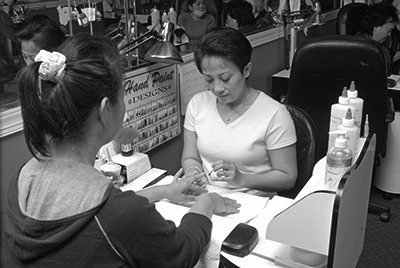
AGM, while perusing the U.S. Bureau of Labor Statistics website and discovered that the U.S. government has seen fit to illustrate various jobs with photographs.  The photographs reveal quite dramatic assumptions about who does what jobs.  I’ll let you be the judge as to what they are, in alphabetical order.

Authors:

Child care workers:

Cooks and Food Preparation Workers:

Dentists:

Dental Assistants:

Executives:

Personal Appearance Workers:

Physicians:

Physician and Medical Assistants (fixed):

Security Guards:

Sociologists!

AGM thought the picture of sociologists deserved the caption, “Sociologists have nothing but contempt for one other, both as scholars and as human beings.”

Lisa Wade, PhD is an Associate Professor at Tulane University. She is the author of American Hookup, a book about college sexual culture; a textbook about gender; and a forthcoming introductory text: Terrible Magnificent Sociology. You can follow her on Twitter and Instagram.

Talking Points Memo posted a campaign ad for Rick Barber, a Tea Party-aligned Republican running for Congress in Alabama. In the ad, Barber first speaks briefly to George Washington about taxes. Then he turns to Abe Lincoln and makes a comparison between funding social services and slavery. The screen then flashes photographs of slaves, prisoners in Communist work camps, and Nazi concentration camps…because paying taxes and those historical events are all basically the same, you know:

Aside from the trivialization of some of the most horrendously cruel acts against humans in modern history, it’s rather ironic that Barber says, “We shed a lot of blood in the past to stop that, didn’t we?” I understand there were many conflicting allegiances in both the North and the South during the Civil War; I have ancestors who owned slaves and sided with the Confederacy and others who fought for the Union. You certainly can’t paint all Southerners with a broad brush. However, it still seems odd to have a guy running for office in a state that seceded from the nation, whose platform emphasizes opposition to social programs that disproportionately help non-Whites (that is, Whites are the majority of recipients, but non-Whites are represented at rates higher than their proportions in the U.S. population as a whole), co-opting the anti-slavery position, which certainly wasn’t a mainstream attitude among Southern conservatives at the time. [Note: I am not implying that opposing social programs is the same as slavery, but only that because the discourse around opposition to them is so often racialized — think the “welfare queen” stereotype — that it makes a jarring companion to associations with ending slavery.]

In another re-writing of history, the ad ignores the following (from the TPM post):

…Lincoln was a lifelong champion of the traditional Whig policies of “internal improvements” — that is levying taxes, usually through tariffs, to fund infrastructure projects throughout the country, and incorporating the principle of central banking. In addition to prosecuting the Civil War, Lincoln’s administration put all of those policies into effect, as his Republican Party’s political coalition was built upon the foundation of the northern Whigs.

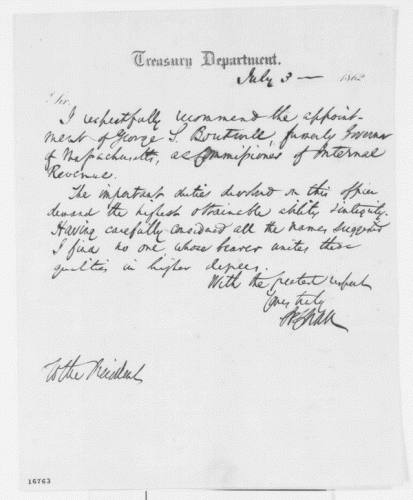
Also, Lincoln was president when Congress passed the first income tax, implemented to raise money for the Civil War (U.S. Treasury):

When the Civil War erupted, the Congress passed the Revenue Act of 1861, which restored earlier excises taxes and imposed a tax on personal incomes. The income tax was levied at 3 percent on all incomes higher than $800 a year.

Here’s a letter from the Treasury Secretary to President Lincoln recommending someone for the new position of Commissioner of Internal Revenue (Library of Congress):

It’s a great example of the re-writing of, or ignoring huge parts of, history (which certainly both Democrats and Republicans do) to suit current political positions. Lincoln is useful as a symbol, not as a complex figure whose policy positions (including ambivalence about ending slavery) actually matter.

Related posts: MTV PSAs reference Holocaust, PETA’s Holocaust on Your Plate ads, romanticizing picking cotton, different ways of remembering national tragedies, Mammie souvenirs, Black women tend to White women, and the corporate plantation.

Thomas S. sent in this photo of the toy options for kids meals available from Burger King as part of their tie-in with the Marmaduke movie. The dogs are helpfully divided, as in most kids’ meals at fast-food chains, into those for girls and boys:

Notice the gendering of the dogs. Both girls and boys have the option of a Marmaduke figurine, though they are posed in different ways: the girl version is lying down, while the boy version seems posed to run or jump. The other girls’ options are passive in their poses, the descriptive words in their names (cuddly, loungin’, comb ‘n’ style), and what they do:

  • Comb ‘n’ Style Jezebel: you can comb her hair
  • Bone Catchin’ Marmaduke: his tail wags when you move the bone
  • Loungin’ Giuseppe: he just sits on the tassled cushion
  • Cuddly Raisin: he’s soft

On the other hand, the boys’ options are given active descriptive names and different types of actions:

  • Pouncin’ Marmaduke: leaps in the air
  • Darting Lightning: you wind him up and he moves
  • Stick ‘n’ Move Bosco: you attach his leash and he walks
  • Turn ‘n’ roll Mazie: you wind up her tail and she rolls over

So the boys get the option of a doberman (or maybe a Rottweiler?) and what looks like an Australian shepherd, while the girls get a toy dog (a papillon, I think) and a collie, which is also a herding dog but here is presented as something to groom.

Obviously, the breeds and names (Bosco, Giuseppe, etc.) come from the movie, so Burger King didn’t create that part. But in creating the tie-in toys, different dogs from the movie were defined as girls’ or boys’ toys, and were designed accordingly.

It’s a great example of the feminine = passive, masculine = active gender dichotomy and the way children are socialized into it. Toys aimed at girls emphasize posing and appearance/grooming, while boys’ toys are usually more active and rarely involve grooming or dressing up (unless you count changing out the weapons G.I. Joe dolls action figures carry).

Of course, this doesn’t mean that kids and their parents will request the gender-intended toy. My sisters and I didn’t get kids’ meals often, but when we did, my mom almost always requested boys’ toys because they were usually more fun and did something, whereas the girls’ toys often just sat there. I’ve heard similar stories from lots of women. Given that men are discouraged from crossing gender lines more than women are, though, I wonder if parents are as willing to get their sons the girls’ toys if the son asks for it. And if we found the girls’ toys boring and wanted the boys’ versions, it seems likely that boys would generally reject them too.

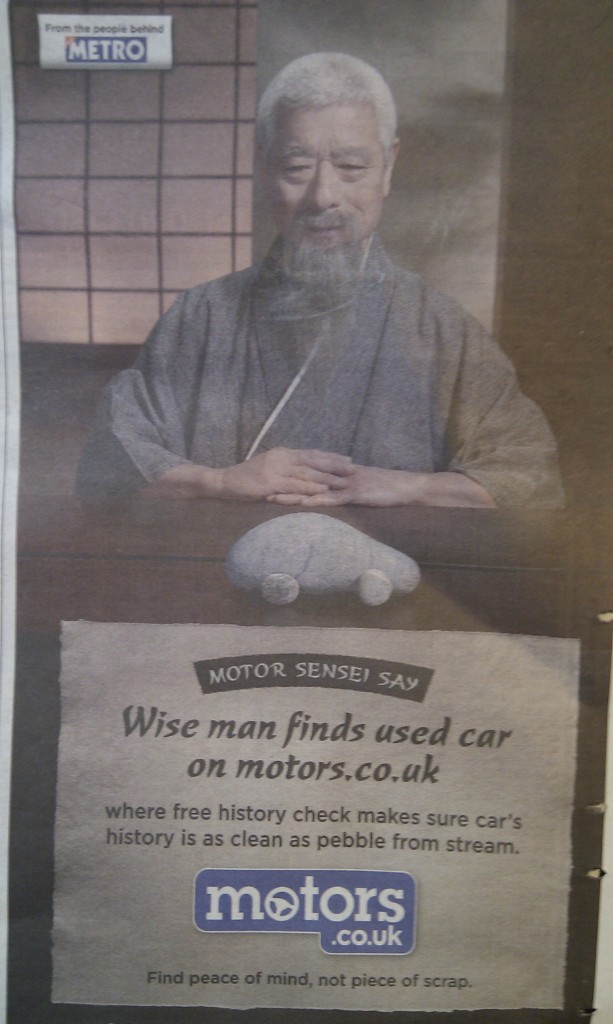
Sebastian sent in this ad for a used car website that uses the stereotype of the wise Japanese “sensei”:

We’ve got all the elements: the wise older man in a robe, stylized letters similar to what Margaret Cho describes as “feng shui Hong Kong fooey font,” the broken English, the reference to nature (“clean as pebble from stream”).

Related posts: Asian enlightenment used to sell food, and more food.

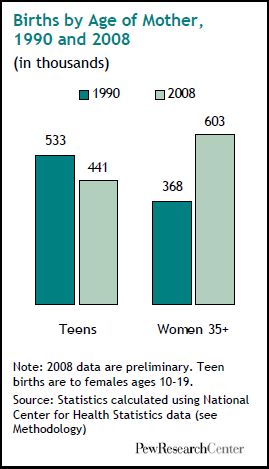
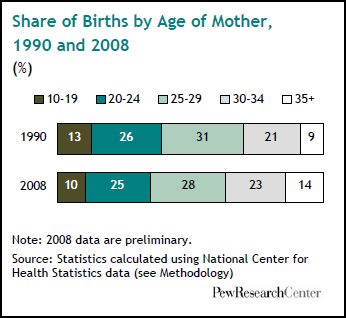
A Pew Research Center report on the changing demographics of American motherhood (discovered thanks to a tip by Michael Kimmel) shows that there has been a significant rise in childbearing among women at the later end of their childbearing years.

Not quite twice as many U.S. women over 35 gave birth in 2008 compared to 1990 (while we see the opposite trend for teen births):

The share of all births that were to women over 35 also increased from 9% to 14%:

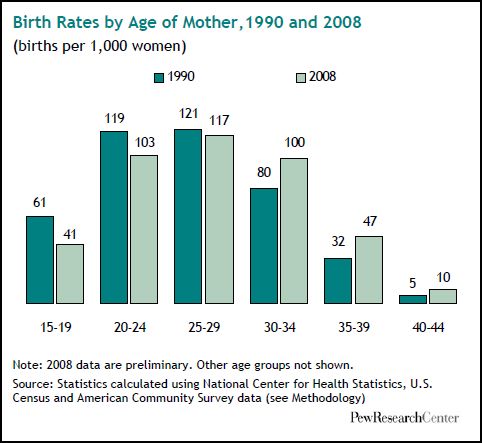
A look at the birth rates across women from 15 to 44 shows that fewer women between 15 and 29 are giving birth, but the numbers are up for all women 30 and over.

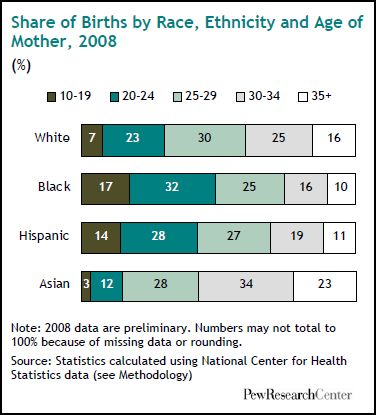
The data broken down by race also suggests that it is white and Asian women who are driving this trend:

For more from this report, see our post on race trends in motherhood.

Lisa Wade, PhD is an Associate Professor at Tulane University. She is the author of American Hookup, a book about college sexual culture; a textbook about gender; and a forthcoming introductory text: Terrible Magnificent Sociology. You can follow her on Twitter and Instagram.

Jessica B. sent in an excellent example of the way that symbols evolve.  Language is just a set of symbols.  The squiggles and lines that make up “cat” don’t look anything like a cat, but English speakers will know what it refers to.

And language, of course, evolves and sometimes that evolution has odd and unintended consequences.  Consider all those companies, like Object Management Group, whose acronym, out of nowhere, had a new, blasphemous meaning.

Jessica’s example involves the new word, “lol,” which just happens to also be a symbol for drowning:

(source)

She writes:

This is a great example of the social construction of language and thus, the social construction of our reality. We, as a society, have agreed that “lol” has a meaning separate from itself and the overall accepted meaning of this symbol is laughter, as opposed to the original intended meaning of a person drowning. While this is a simplistic and comical example, it clarifies the results of differences between intended meaning and interpreted meaning, as well as indicating the importance of social construction of language and society as a whole.

Lisa Wade, PhD is an Associate Professor at Tulane University. She is the author of American Hookup, a book about college sexual culture; a textbook about gender; and a forthcoming introductory text: Terrible Magnificent Sociology. You can follow her on Twitter and Instagram.


Chloe Angyal (from Feministing) sent me a link to an interesting, if disheartening, segment of her from GRITtv with Laura Flanders about women’s willingness to suffer as they try to meet beauty ideals. Seems that if you want to discourage women women from using tanning beds, don’t warn them about skin cancer. Just tell them it’ll make them ugly. For instance:

The women in the study were more concerned about avoiding ugliness than about avoiding potentially deadly cancer.

UPDATE: Be sure and check out the comments to the video over at YouTube. Really fascinating: lots of comments about Angyal’s appearance and statements like, “chole looks like a feminist, very ugly.” For an interesting discussion of the “feminists are ugly” reaction, read this post at Yes Means Yes.