Search results for The

Chris Marshal and Captain Crab sent along this gem from The Second City Network:

Borrowed from Evolving Thoughts, via Pharyngula.

More on Disney: media consolidation and Tinkerbell, the real Johnny Appleseed, fallen princesses, modernizing the fairy tale, pickaninny slaves in Fantasia? yes, racist Disney characters, infantilizing adult women, gendered Disney t-shirts for kids, Deconstructing Disney princesses, are the new Disney princesses feminist?, race and gender in Princess and the Frog, socializing girls into marriage, and…

…did you know that the very first political tv commercial was made by Disney?  I like Ike!

Lisa Wade, PhD is an Associate Professor at Tulane University. She is the author of American Hookup, a book about college sexual culture; a textbook about gender; and a forthcoming introductory text: Terrible Magnificent Sociology. You can follow her on Twitter and Instagram.

In New Orleans sidewalk corners are adorned with delightful blue-and-white tiles, originally dating from the 1870s, telling you the name of the street you are crossing:

As I stepped over some of these, it occurred to met that they told a story about city planning.  Unlike the street signs in most cities (including New Orleans) that are attached to poles and displayed high, these can’t be seen by drivers.  These are designed for pedestrians, and perhaps bikers, using sidewalks.  They reflect a time when planners were designing the city for people on foot.

Lisa Wade, PhD is an Associate Professor at Tulane University. She is the author of American Hookup, a book about college sexual culture; a textbook about gender; and a forthcoming introductory text: Terrible Magnificent Sociology. You can follow her on Twitter and Instagram.

We recently introduced the idea of “astroturfing.” Coined to contrast with the idea of a “grassroots” movement (led and supported by “regular” people), an astroturf movement is one that looks like it’s grassroots, but is actually driven and funded by a corporation. But is it always easy to distinguish between astroturf and grass? F.T. Garcia sent in this confounding example.

The Wall Street Journal reports that some labor unions are hiring non-union workers to “staff” picket lines, usually at or near minimum wage.  In this picture, for example, employees-for-the-day protest on behalf of union workers for a union they do not belong to:

It turns out, protesting is costly.  Workers have to take time off of work, travel to the location of the protest, pay for parking, make sure someone is taking care of their kids, etc.  Plus it’s often hot and involves a lot of yelling and stomping. Accordingly, some unions decide that it’s easier and cheaper to hire protesters than it is to mobilize their own workers.

So, you tell me, astroturf or grassroots?

Lisa Wade, PhD is an Associate Professor at Tulane University. She is the author of American Hookup, a book about college sexual culture; a textbook about gender; and a forthcoming introductory text: Terrible Magnificent Sociology. You can follow her on Twitter and Instagram.

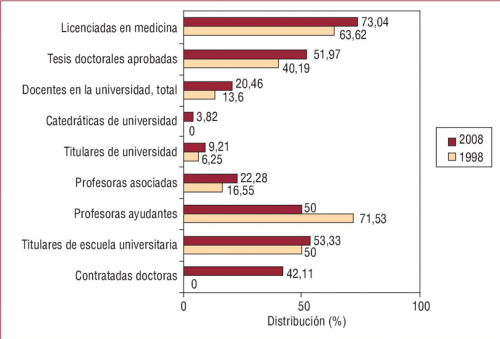
Nia A. sent in a chart from an article in the Revista Española de Cardiología about gender in medical schools in Spain. Overall, the medical field is increasingly feminized. In 2008, 73% of new medical school graduates (licenciadas en medicina) were female (note that in Spain they use commas where we would use a decimal in a number in the U.S., so 73,04 = 73.04):

It’s a significant increase, but women also earned a significant majority of medical degrees by 1998, so this isn’t a new phenomenon. Women also earned just over half (52%) of Ph.D.s in 2008 (tesis doctorales aprobadas).

When we look at faculty (docentes en la universidad, total), women are a distinct minority, making up only 20%. This varies quite a bit by position (I’m relying on Nia’s comments and Wikipedia to translate Spain’s academic ranks to the U.S. equivalent; please let me know if I’ve misunderstood a category):

  • The percentage of women serving as teaching assistants (profesoras ayudantes) has gone down from 72% in 1998 to 50% in 2008 (the only area where the percentage of women decreased).
  • Women make up 22% of lecturers (profesoras asociadas, who may or may not be tenured) and 9% of titulares de universidad (which I think are what we would call associate professors in the U.S.). They make up a sizable minority of contratadas doctoras, a tenured position similar to a professor (42%).
  • Women made up a larger percentage of titulares de escuela universitaria (53%), a position at non-Ph.D. granting and technical colleges; however, this position was abolished in some academic restructuring in 2007. Those holding it keep their jobs, but no new hires will be made.
  • However, women make up only a tiny portion (4%) of catedráticas de universidad (roughly the same as a full professor — received tenure and then met a number of other requirements for promotion). Only this group is eligible to become a rector (university president)

This pattern is widespread in universities (see our post on engineering and tech faculty), and likely due to a number of factors. There is always lag time between demographic changes in a field and changes in faculty, since unless a lot of new positions are created, potential faculty have to wait until current ones retire. All things being equal, we’d expect the % of women faculty to go up steadily over time as more female Ph.D. candidates apply for positions previously held by men. Of course, women have been earning the majority of medical degrees since before 1998, so there’s been sufficient time for gender changes in the field to affect the composition of faculty.

But all things aren’t equal in university hiring. Historically women have faced significant gender discrimination, and this continues to occur. However, a large body of evidence indicates that family/work conflicts play a huge role. Because women still, as a group, have primary responsibility for childcare, they are more likely than men to face difficulties balancing family time with work requirements, such that they are less likely to advance to tenure or promotions. They are more likely to opt out of more demanding positions — applying to be Dean, say, or accepting a position at a research-heavy university as opposed to a community college — but also find that they may be “mommy tracked” by hiring committees who assume they’ll be taking too much time out of the paid workforce to raise their kids (and often make these assumption whether or not the woman has or plans to have kids or stay home with them).

I also suspect that if the data were broken down into specialty, we’d see more women earning degrees or teaching in areas associated with women or the family (ob/gyns, for example) as opposed to more masculinized specialties, often perceived as very high-status, like neurosurgery (we see more women than men in pediatrics and ob/gyn in the U.S., for instance).

Will the percent of female med school faculty in Spain and elsewhere increase? Undoubtedly over time it will. But due to factors including those I just discussed, it’s also likely that the increase will lag significantly behind what we’d expect just based on the number of women earning medical degrees.

Jenny Knopinski snapped these photos of the new Safeway brand of baby care products, Mom to Mom.  The branding of the product as “for moms, by moms” is another great example of the way that mothers are held responsible for childcare, while fathers are simultaneously excluded from the sphere altogether.

Lisa Wade, PhD is an Associate Professor at Tulane University. She is the author of American Hookup, a book about college sexual culture; a textbook about gender; and a forthcoming introductory text: Terrible Magnificent Sociology. You can follow her on Twitter and Instagram.

Joel S. sent in a link to an article by Gonzalo Frasca at Serious Game Source about a management simulation game the U.K. branch of Intel released back in 2004. It was called The Intel IT Manager Game: The Simulation of an IT Department and was a free promotional program:

The player had to hire IT employees, as well as manage a budget and buy computer equipment, the latter of which was either generic or Intel-branded.

When you started out you selected the sex of your IT manager:

But then, when you went to hire employees…they forgot to include an option to hire any women. You could get a guy with a green mohawk, though:

After a few days the game was taken down and Intel said they were making revisions; it re-launched a month later, this time with  female employee options, including this one, whose hair looks like alien antennae to me:

You can see the current version here.

Frasca argues that such oversights are more important than the lack of female avatars in some video games:

The Intel game is not merely an entertainment product: it is a piece of corporate advertising that simulated an IT workplace for an audience of real IT workers. Unlike what happens in the fantasy world of Fable, gender inequality is a very real problem for IT workers.

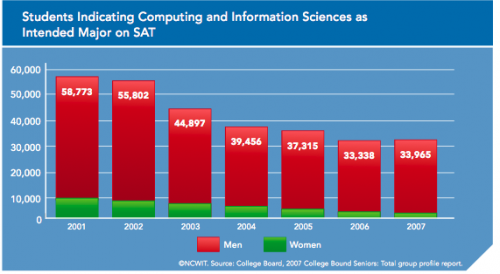
The post mentions the National Center for Women and Information Technology, so I went over and looked at some of their data. Gender of students who take the SAT and say they plan on choosing computer/IT majors:

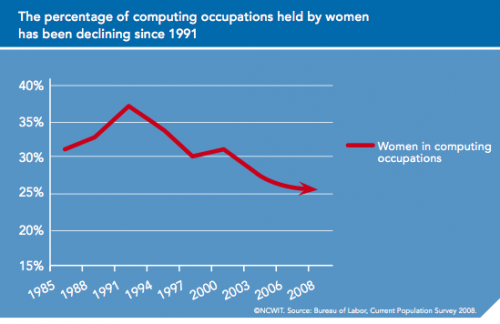
If anything, it looks like the gender segregation of computer/IT occupations is increasing:

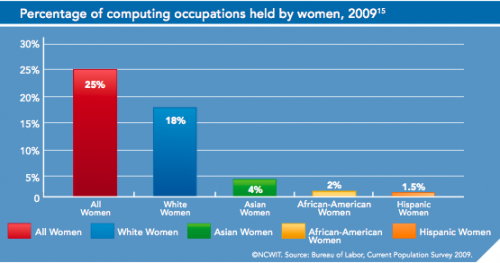
Broken down by gender and race/ethnicity:

Asian/Asian American women are actually overrepresented compared to their percentage of the U.S. population (all Asian Americans make up just about 5% of the entire U.S. population, obviously Asian American women make up less than that, though I don’t recall the exact proportion). All other racial/ethnic groups listed here are significantly underrepresented in computing jobs.

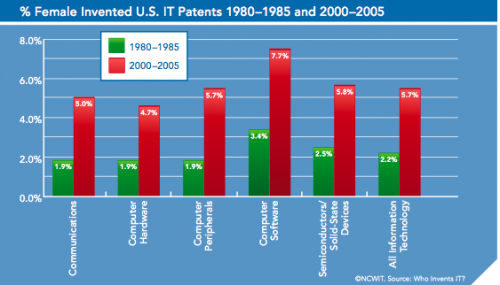
The percent of patents in various fields invented by women in the early ’80s and the early…’00s (?):

Frasca suggests that one reason for the Intel snafu might be a lack of women working on the project — if there were women, they might have noticed the lack of female employee options. That’s possible. It’s also likely that having more women in a workplace makes their male colleagues more aware, and thus a guy might think, “hey, maybe we should add some women employees to the game.”

This is totally anecdotal, I know, but forgive me. I have a number of female friends who work in computing jobs; almost all of them have generally found themselves to be the only, or one of just a few, women in their office. And with few exceptions, they say that the men they work with aren’t openly hostile or unfriendly. They don’t deviously exclude them from projects or social events or make lots of sexist remarks. But they forget they exist (for instance, inviting everyone else in the office to lunch where they talk about new project possibilities, and then seeming genuinely sorry later when they realize they left out the only woman in the office…but doing it again anyway).

And things like the Intel game reflect and reinforce the invisibility of women in such fields.

We’ve written several posts about how the words “nude” and “flesh” tend to be used to refer to colors associated with light-colored skin.  For examples, see our posts on “flesh-colored,” Michelle Obama’s “nude” colored dress, the new in-color, “nude is the new black” (and by black we mean white), lotion for “normal to darker skin,” and color-assisted medical diagnosis.  Readers have sent in an additional example and several counter-examples.

Catherine M.P. snapped this photo of an ad for Ripley in Santiago, Chile (she says English is often used to make a product seem “edgy”):

Lisa Wade, PhD is an Associate Professor at Tulane University. She is the author of American Hookup, a book about college sexual culture; a textbook about gender; and a forthcoming introductory text: Terrible Magnificent Sociology. You can follow her on Twitter and Instagram.

Sociologist Geographer David Harvey’s analysis of the current economic crisis is engagingly illustrated in this 11-minute video.  Harvey evaluates individual, institutional, ideological, cultural, and policy explanations for the recession.  He then explains Marx’s insights into the “internal contradictions of capital accumulation”:  capitalists want to pay low wages, but if they’re paying low wages, then no one can buy their stuff.  If both high wages and low wages translate into no profits, where does that leave capitalism?

From Cognitive Media via BoingBoing and Karl Bakeman.

Buy Harvey’s book, The Enigma of Capital and the Crises of Capitalism.

Lisa Wade, PhD is an Associate Professor at Tulane University. She is the author of American Hookup, a book about college sexual culture; a textbook about gender; and a forthcoming introductory text: Terrible Magnificent Sociology. You can follow her on Twitter and Instagram.