Search results for The

The phrase “nature/nurture debate” refers to an old competition between those who think that human behavior and psychology is determined by biology (that is, genetics, both evolutionary and individual, hormones, neurology, etc) and those who believe that it is determined by environment (that is, socialization, cultural context, experiences in childhood, etc).  While the nature/nurture debate rages in the mass media, most scholars reject it altogether.  Instead, social scientists and biologists alike recognize that our behavior and psychology is the result of an interaction between nature and nurture (yep, even sociologists like myself).

A recent story on NPR illustrates this beautifully.  James Fallon, a neuroscientist specializing in sociopaths, had been scanning the brains of murderers for 20 years.  His research had demonstrated that sociopath brains have a distinct appearance: dark patches in the orbital cortex, the part of the brain responsible for moral thinking and controlling impulses.

You can see the dark patches in the brain on the right, the brain on the left is a “normal” brain:

At a family gathering one day, Fallon’s mom mentions that there were some pretty violent types in Fallon’s own family history (it apparently didn’t come up anytime in the previous 20 years !!!) and, so, he investigates. It turns out that there were eight proven and alleged murders in his ancestral line, including Lizzy Borden, one of the most famous murderers in history.  Because Fallon knows that the atypical neurology associated with sociopaths runs in families, he decided to scan the brains of all his family members.  No one had the dark patches.

Except him.  Fallon had the dark patches.  In fact, that brain on the right: that’s him.

Not only did he have the neurology of a typical sociopath, he also carried a genetic determinant known to be associated with extreme violence.

Fallon doesn’t have the answer to why he’s not a sociopath, but scientists think that a person needs to have some sort of experiential trigger, like abuse as a child, in addition to a biological predisposition.

Significantly, [Fallon] says this journey through his brain has changed the way he thinks about nature and nurture. He once believed that genes and brain function could determine everything about us. But now he thinks his childhood [and his awesome mom] may have made all the difference.

For related examples, see our posts on the response of testosterone levels to political victories and the historical shift in the average age of menstruation.

Lisa Wade, PhD is an Associate Professor at Tulane University. She is the author of American Hookup, a book about college sexual culture; a textbook about gender; and a forthcoming introductory text: Terrible Magnificent Sociology. You can follow her on Twitter and Instagram.
I’ve written previously about the portrayal of women in the military — in particular, the U.S. Navy’s attempts to redefine femininity to make the Navy more appealing to women by assuring them they can be strong, smart, and still go shopping and stuff. In another example, a number of former female Israeli Defense Force soldiers posed for Maxim magazine back in 2007. The first line of the article:

They’re drop-dead gorgeous and can take apart an Uzi in seconds. Are the women of the Israeli Defense Forces the world’s sexiest soldiers?

I’m putting the images after the jump because they’re potentially not safe for some workplaces — the women aren’t nude, but they are quite scantily clad.

more...

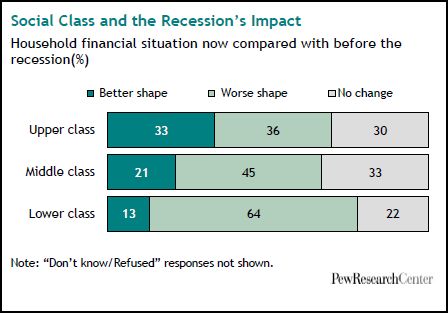
Data from the Pew Research Center shows us the extent to which the recession has hurt the economic health of American households, especially the middle and working classes:

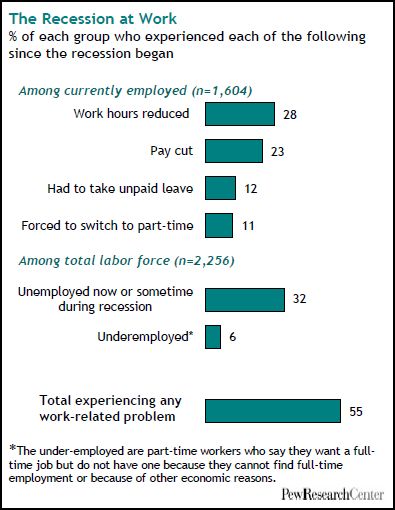
More than half of all Americans report some sort of work-related disruption:

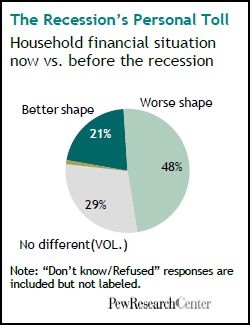
Nearly half state that they are worse off than they were before the recession:

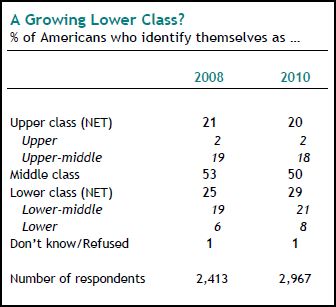
An additional four percent (since 2008) identify themselves as lower class:

Pew specifies:

Blacks, as a group, are an exception to this overall pattern. The share of blacks who now identify with the upper class has gone up during this recession, to 20% now from 15% two years ago.

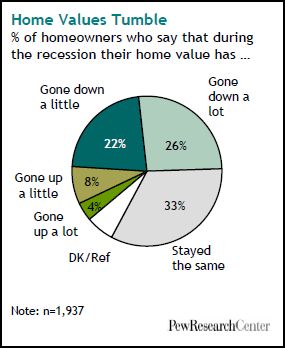
Forty-eight percent have lost equity in their homes:

Sixty percent of Americans fear that they may have to delay retirement:

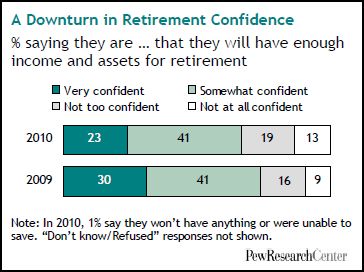
A larger percentage lack the confidence that they have enough income and assets for retirement, even compared to last year:

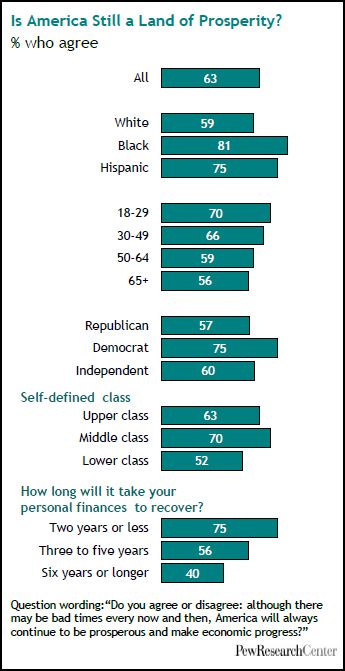
“Is America still a land of prosperity?”

The question in some historical perspective:

Lisa Wade, PhD is an Associate Professor at Tulane University. She is the author of American Hookup, a book about college sexual culture; a textbook about gender; and a forthcoming introductory text: Terrible Magnificent Sociology. You can follow her on Twitter and Instagram.
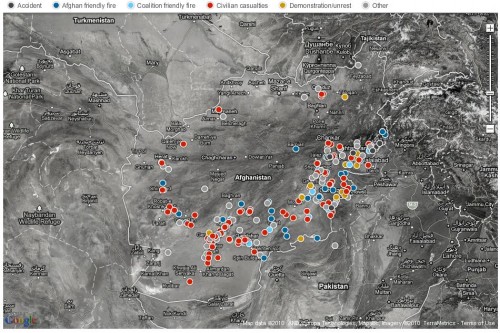
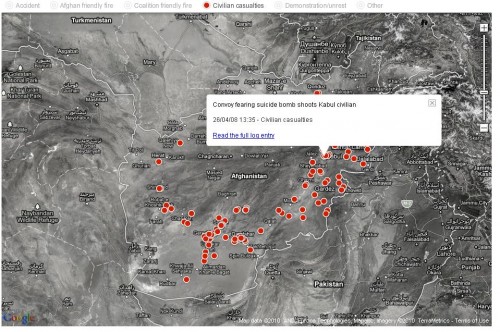
Henry H. sent in a link to an interactive map at the Guardian based on the recently leaked collection of over 92,000 records about the war in Afghanistan. The map shows the location of incidents in the reports broken down by category: accident, Afghan friendly fire, Coalition friendly fire, civilian casualties, demonstration/unrest, and other:

You can hide any of the categories you want to get a better picture of only some of them, and if you roll over a dot it will give you a brief summary with a link to the full report about it. Here’s the map with everything hidden except civilian casualties and the summary of one incident:

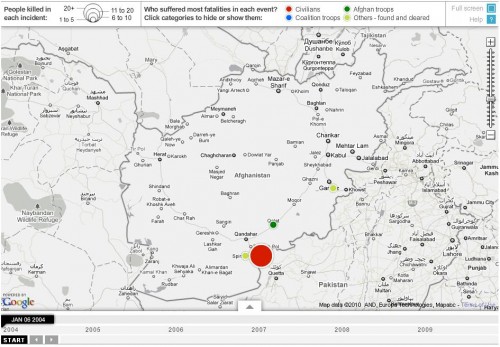
You can also see the locations of all IED attacks that occurred on any day between January 1st, 2004 and January 1st, 2010. The size indicates the number of people killed and the color tells you the category of most of the casualties (civilians, Afghan forces, etc.). Here’s the map from January 6th, 2004 (the light green indicates that an IED was planted but that it was found and defused without any casualties):

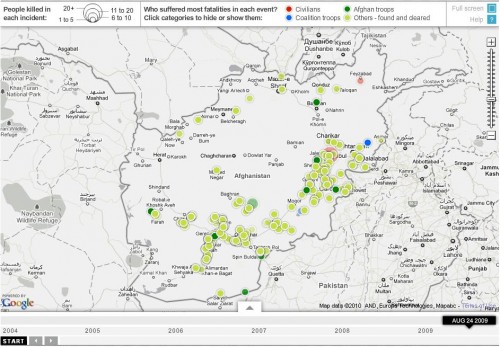
Compare to the map for August 24, 2009, which shows that the incidence of attempted IED attacks has gone up significantly, though most of them that day were discovered before they harmed anyone:

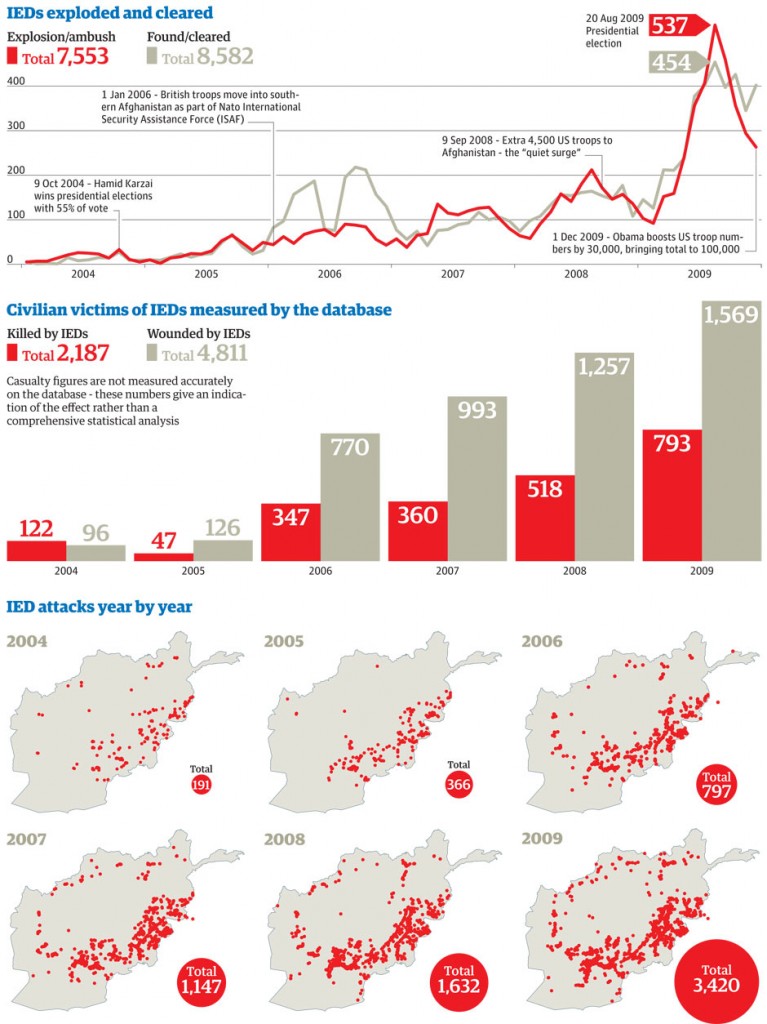
I can think of a possible explanation for the increase in the use of IEDs over time. One could be that their use diffused from other war zones, particularly Iraq, and were increasingly adopted as a technique in Afghanistan; perhaps Afghans opposed to the Coalition weren’t familiar with IEDs in the early years of the invasion and they were therefore relatively infrequent. The other, which doesn’t exclude the first, is that it indicates an increase in resistance to the Coalition forces and their Afghan allies over time.

The increase in the number of IEDs that are discovered and defused before they go off would seem to show how groups adapt to forms of warfare; presumably the Coalition forces have become more aware of the danger of IEDs and thus look out for them more and are more skilled at clearing them.

I might be totally wrong on both counts, so if you have other thoughts, please share them.

More data on IED attacks over time, including civilians wounded:

It’s a fascinating resource for information on the war. I think it’s really interesting as an illustration of the rationalization and bureaucratization of warfare by the U.S. military: that is, events are carefully categorized and described, and military leaders have an enormous amount of data them. While individual soldiers may very well experience war as chaotic or disorganized, those overseeing it have a wealth of information that methodically distills that chaos and disorganization into statistics associated with particular events whose location is clearly identified.

Crossposted at Jezebel.

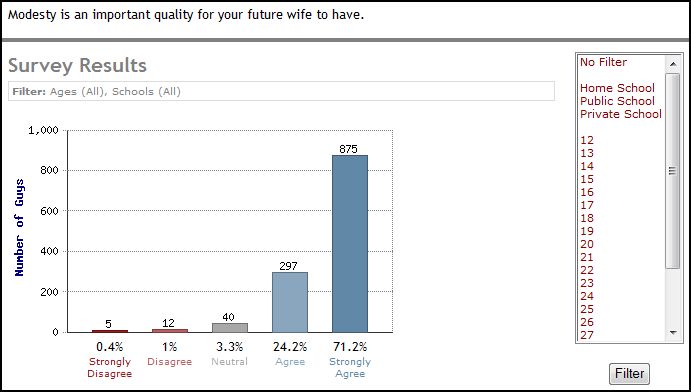
Robin E. sent us to a downright fascinating set of survey results.   Administered by a Christian website, the survey questions were submitted by “Christian girls” who wanted to know what “Christian guys” think is modest.  1,600 guys then answered the survey, offering both quantitative and qualitative answers.   Why would girls care what guys, as opposed to God, think?  Because Christian guys, their future husbands, are judging them on their modesty.  Ninety-five percent of them say that modesty is an important quality in their future wife (see the question in the upper left corner):

So, how do these “guys” define immodesty?  The most common theme was dressing to draw attention to the body instead of the heart or spirit.

Something that is immodest is something that is designed to arouse lust within me (male, age 24).

Something that is immodest is something that is unnaturally revealing (male, age 20).

Something immodest draws attention to a girl’s body (male, age 28).

Many of the guys stressed that they really wanted to interact with girls as people.  Borrowing language from feminism, they expressed a desire to think of a girl as a whole person, not just a hot body.

Something attractive draws you toward them. It makes you respect the person. Something immodest is usually unattractive. It makes you think less of that person, thinking of them as an object… (male, age 16).

My responsibility is to not treat women as objects for my satisfaction, even if they dress and act like it. It devalues them, and makes me a user of people… (male, age 26).

In a move that is in contrast to (most) feminist values, however, girls are supposed to help men treat them like people by not dressing like an object.  That is, by not dressing immodestly.

So what rules for girls did guys identify?

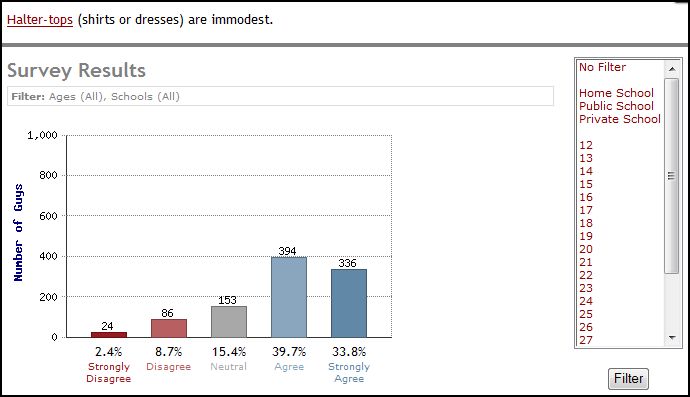
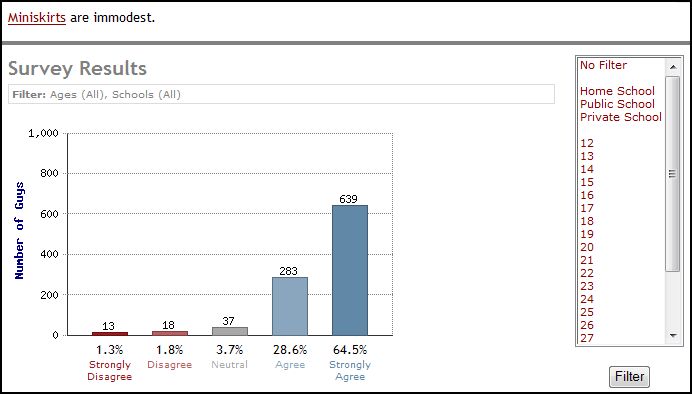
Well, first, guys largely agreed that revealing clothes were immodest (again, see the question in the upper left corner):


Halter tops and mini skirts, I suppose, are obvious candidates for immodesty.  There were lots more subtle rules, too, though with less agreement.

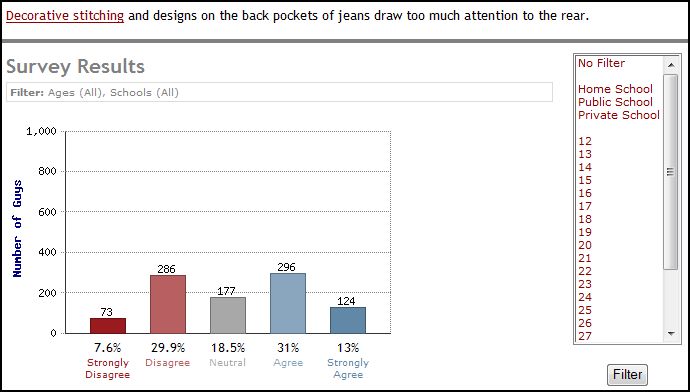
Forty-four percent of guys think that designs on the back pockets of jeans are immodest (19% aren’t sure):

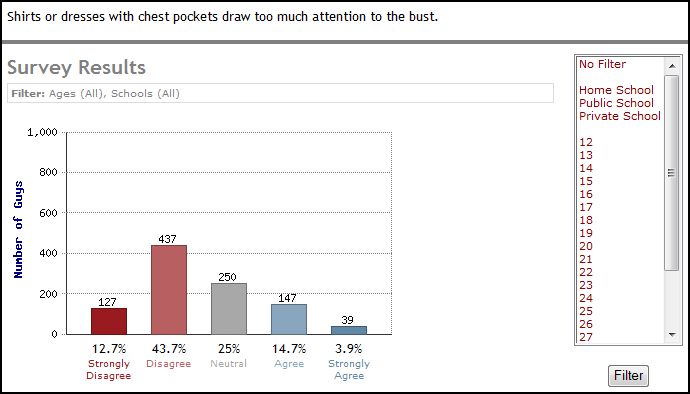
A minority, 19 percent, think that shirts with pockets are immodest (25% aren’t sure):

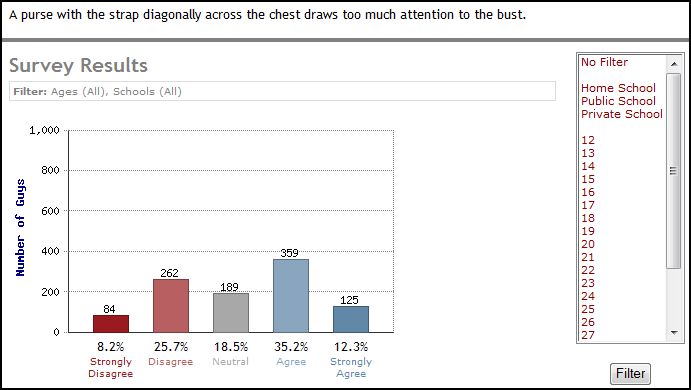
Forty-eight percent think that purses should not be worn across the body (19% aren’t sure):

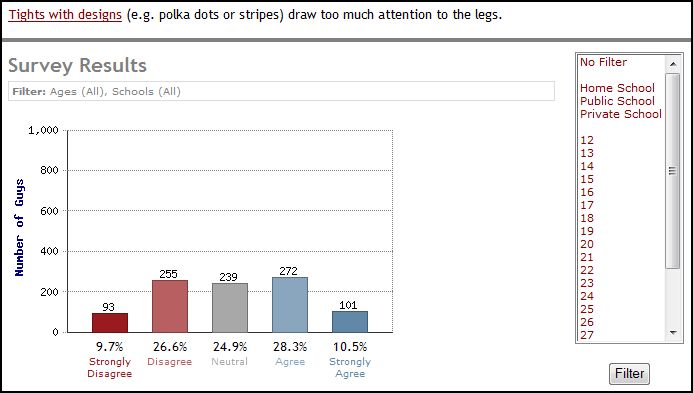
Thirty-nine percent oppose tights with designs (25% aren’t sure):

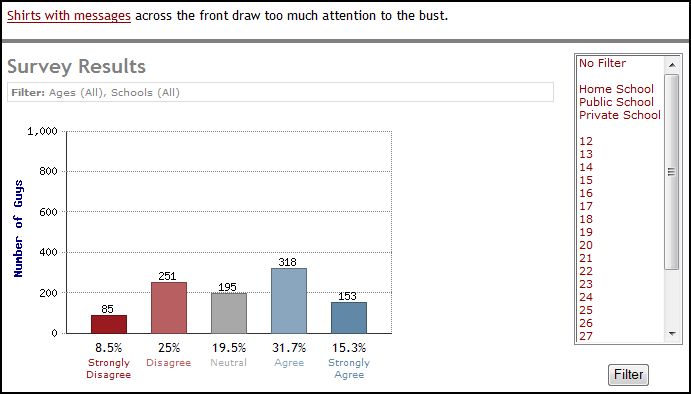
Forty-seven think that t-shirts with messages across the front improperly draw attention to breasts:

But being modest wasn’t simply a matter of clothes.  Guys defined immodesty, also, as an “attitude” or a “carelessness.”  Attaining modesty was also about how you use your body and the way you act, “sexually or otherwise.”

An immodest lady is loud, proud, and dresses in a way that communicates such an attitude (male, age 24).

Something becomes immodest when the person wearing it has an attitude of carelessness (male, age 17).

As one guy said:

If you are dressing to get attention from a guy, then anything you wear can be immodest (male, age 13; my emphasis).

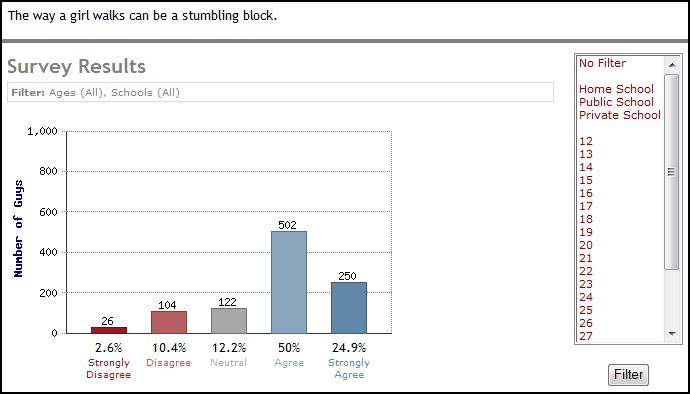
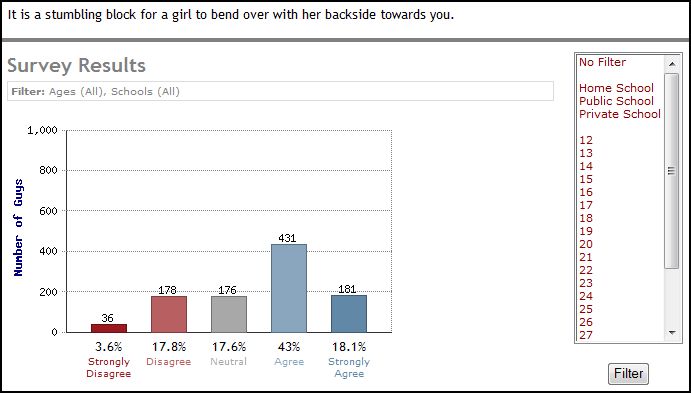
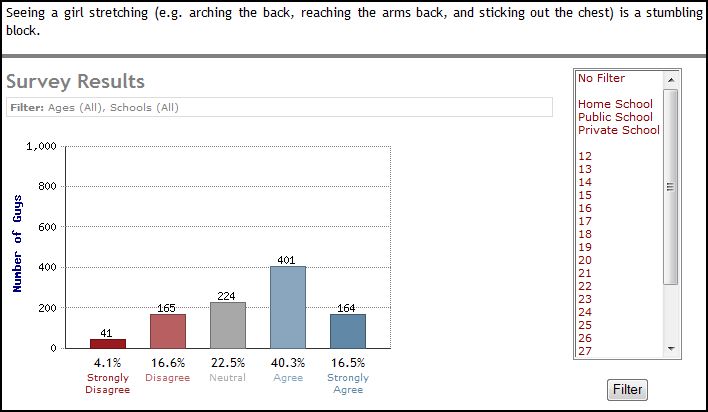
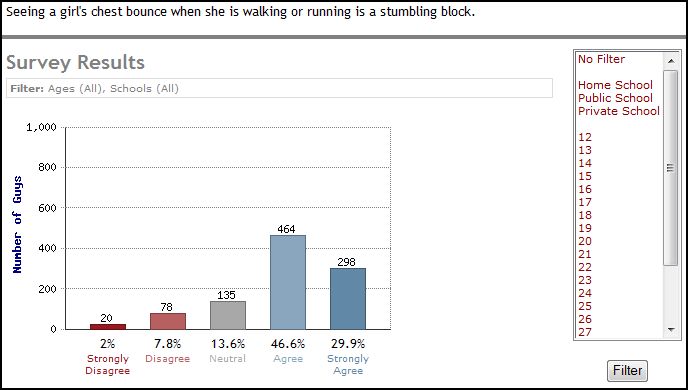
Some examples of behavior the guys mostly agreed was immodest:


Immodesty, then, is not simply about being vigilant about your clothing (don’t wear a purse that falls diagonally across your body, don’t show your arms or your thighs), it’s a constant vigilance about how you display your body (don’t stretch, bend, or bounce).  “Clothing plays a part in modesty, but it is only a part,” an 18 year old male explains, “Any item of clothing can be immodest” (his emphasis).

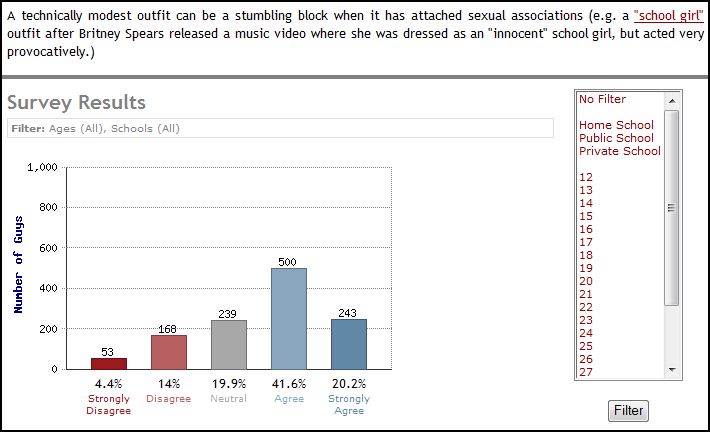
In addition, these rules are potentially changing all the time.  A “technically modest” outfit, such as a school uniform, can suddenly have immodest connotations (so watch MTV, girls, to stay on top of these shifting meanings):

This is a great deal of self-monitoring for girls.  Not just when they shop, but when they get dressed, and all day as they move, and with constant re-evaluation of their clothes and how they fit.  But, the rationale is, they must be vigilant and obey these rules in order to protect guys from the power of all bodies (both their own sexiness, and men’s biological response to it).  Guys are burdened with lust, they insist.

A lot of the guys in this survey talked about temptation.  In some cases, the men would use very powerful words, such as this guy defining immodest:

Immodest:  Screams that her body is different than mine. Attempts to manipulate me. Forcefully offers to trade what I want (in the flesh) for what she wants: attention (male, age 30).

This language — suggesting that women’s bodies “scream” at him, attempt to control him, and “forcefully” tempt him — is reminiscent of Tim Beneke’s interviews with men about sexual violence in Men on Rape.  Michael Kimmel (summarizing Beneke in Guyland) discusses how lots of the terms used to describe a beautiful, sexy woman are metaphors for danger and violence: “ravishing,” “stunning,” bombshell,” “knockout,” “dressed to kill,” and  “femme fatale.”  “Women’s beauty,” Kimmel surmises, “is perceived as violence to men” (p. 229).

This is very much like the rationale for the burqa.  Women’s bodies incite men’s sexual desires, sometimes to violence; they must be kept hidden.

These Christian guys, however, did claim responsibility for their own thoughts, feelings, and actions.  When asked about their role in avoiding lust, many were adamant that it was their own responsibility.  Many felt that innocent, shameless, platonic interaction between men and women was a team effort:

Sisters in Christ, you really have no concept of the struggles that guys face on a daily basis. Please, please, please take a higher standard in the ways you dress. True, we men are responsible for our thoughts and actions before the Lord, but it is such a blessing when we know that we can spend time with our sisters in Christ, enjoying their fellowship without having to constantly be on guard against ungodly thoughts brought about by the inappropriate ways they sometimes dress. In 1 Corinthians 12 the apostle Paul presents believers as the members of one body – we have to work together. Every Christian has a special role to play in the body of Christ. That goal is to bring glory to the Savior through an obedient, unified body of believers – please don’t hurt that unity by dressing in ways that may tempt your brothers in Christ to stumble (male, age 24).

The asymmetry of this project, however, is striking.  The lust is men’s; the bodies are women’s.  It’s an asymmetry built right into the survey design. Modesty is something pertains to only girls and immodesty is something that guys get to define.  This may be even more pernicious than women’s constant self-monitoring.  It erases women’s own desires and the sex appeal of men’s bodies, leading women to spend all of their time thinking about what men want.  By the time they do have sex, and most of them will, they may be so alienated from their own sexual feelings that they won’t even be able to recognize them.

Sources:
Beneke, Tim. 1982.  Men on Rape. New York: St. Martin’s Press.
Kimmel, Michael. 2008. Guyland: The Perilous World Where Boys Become Men.  New York: Harper Collins.

Lisa Wade, PhD is an Associate Professor at Tulane University. She is the author of American Hookup, a book about college sexual culture; a textbook about gender; and a forthcoming introductory text: Terrible Magnificent Sociology. You can follow her on Twitter and Instagram.

Danielle Q. sent us this gem, a 1980s commercial for a doll called My Child. It teaches girls all the important parts of being a mom:

  • Others will judge you as a mother based on how well-dressed and groomed your kids are.
  • Mothering requires a lot of repetitive, time-consuming work, but good moms think “it’s a pleasure.”
  • At age 8 or so, you should already be thinking of yourself as a “little mommy.”

Here you go:

Claude Fischer at Made in America offered some data speaking to the idea that Americans are especially patriotic. That they, in other words, are more likely than citizens of other nations to think that “We’re Number One!”

Fischer provides some evidence by Tom Smith at the International Social Science Programme (ISSP; Tom’s book).  The ISSP, Fischer explains…

…involves survey research institutions in dozens of countries asking representative samples of their populations the same questions. A couple of times the ISSP has had its members ask questions designed to tap respondents’ pride in their countries… One set of questions asked respondents how much they agreed or disagreed with five statements such as “I would rather be a citizen of [my country] than of any other country in the world” and “Generally, speaking [my country] is a better country than most other countries.”

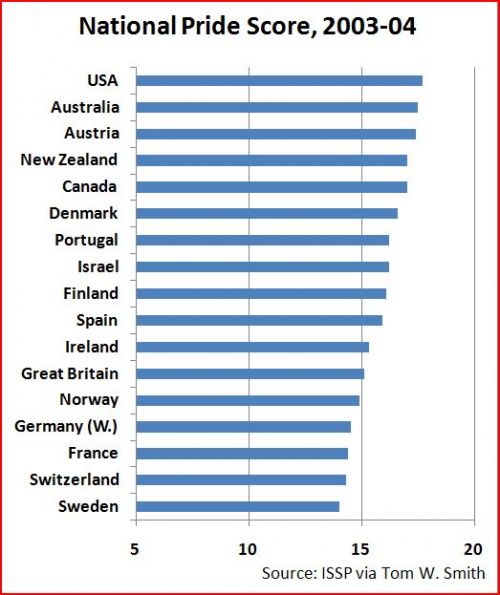
Smith put responses on a scale from 5 to 25, with 25 being the most patriotic.  Here are the results from some of the affluent, western democracies (on a shortened scale of 5 to 20):

As Fischer says, “Americans were #1 in claiming to be #1.”  Well, sort of.  Americans were the most patriotic among this group.  They turned out to be the second most patriotic of all countries.  Venezuela beat us.

(In any case, what struck me wasn’t the fact that the U.S. is so patriotic, but that many other of these countries were very patriotic as well!   The U.S. is certainly no outlier among this group.  In fact, it looks like all of these countries fall between 14 and 18 on this 20-point scale.  Statistically significant, perhaps, but how meaningful of a difference is it?)

Fischer goes on to ask what’s good and bad about pride and closes with the following concern for U.S. Americans:

We believe that we are #1 almost across the board, when in fact we are far below number one in many arenas – in health, K-12 education, working conditions, to mention just a few. Does our #1 pride then blind us to the possibility that we could learn a thing or two from other countries?

Lisa Wade, PhD is an Associate Professor at Tulane University. She is the author of American Hookup, a book about college sexual culture; a textbook about gender; and a forthcoming introductory text: Terrible Magnificent Sociology. You can follow her on Twitter and Instagram.
Pew Research Center has released data suggesting an age gap in optimism for the future of American young adults.

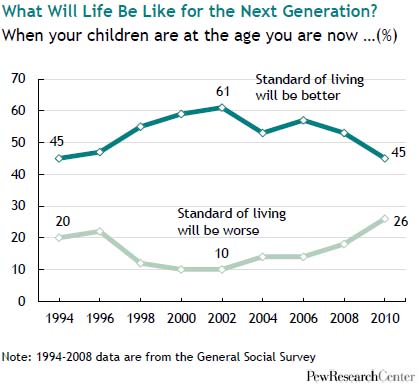
When asked if their children will be better off or worse off than they are, less than half of U.S. parents say “better off” and a full 25 percent say “worse off.”  This is the most pessimistic we’ve seen parents in 16 years.

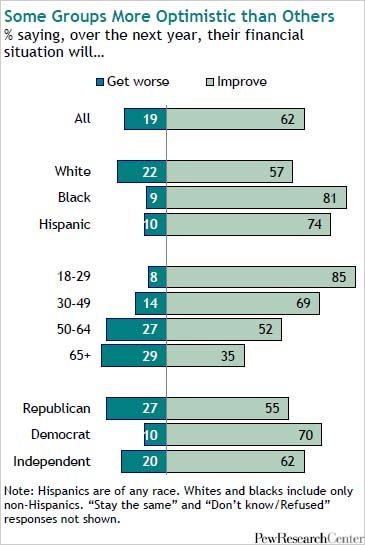
But their kids are more optimistic than anyone else, with 85% saying that they expect that their financial situation will improve next year:

Of course these data aren’t entirely compatible, but it’s an interesting comparison nonetheless.  The idealism of youth?  The pessimism that comes with bad backs and mortgage payments?  The possibility that 18-29-year-olds have nowhere to go but up?

Economix, via Karl Bakeman.

Lisa Wade, PhD is an Associate Professor at Tulane University. She is the author of American Hookup, a book about college sexual culture; a textbook about gender; and a forthcoming introductory text: Terrible Magnificent Sociology. You can follow her on Twitter and Instagram.