Search results for The

I often find myself bemused at our insistence on using sex (i.e., male or female) as the defining thing that describes our sexual orientation.  We are homosexual, heterosexual, or bisexual, right?  These words supposedly mean that we are sexually attracted to the same sex, the other sex, or both.  Right?

No! Not by a long shot! Essentially no one is attracted to men, for example, no matter what their sexual orientation.  I’m straight and female, but I am attracted to a very, very, very small subset of men. I’m generally only attracted to men within a certain age range, with kind faces (I find the chiseled look a bit intimidating); also, I prefer them to be relatively clean.  If I can add non-physical characteristics, then being aggressive with buddies or rude to waitstaff or prone to jealousy are all turn-offs, as are certain politics.  I’ll stop here.  Suffice to say, suggesting that I’m attracted to men is a vast overstatement.  Sexual orientation, as we think of it, simply doesn’t describe my proclivities. I suppose this is true for most of us.

I was reminded of this idea when I came across an OK Cupid post.  Christian Rudder drew on the profiles of over 250,000 heterosexual users, discovering that a large percentage of them had (positive) sexual experiences with people of the same sex, or wanted to (source).

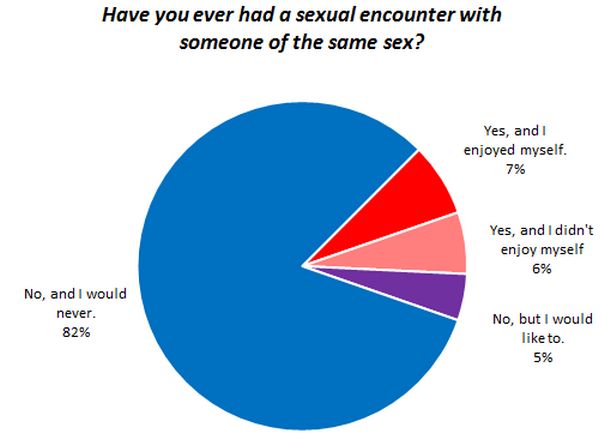
Thirteen percent of self-identified straight men have had a sexual encounter with another man.  Seven percent of them enjoyed it.  Another 5% haven’t had the pleasure, but they would like to.
Significantly more self-identified straight women, 33%,  have had a sexual encounter with another woman.  Twenty-six percent of them enjoyed it.  Another 18% haven’t, but they would like to.  Less than half reported that they hadn’t and figured they never would.
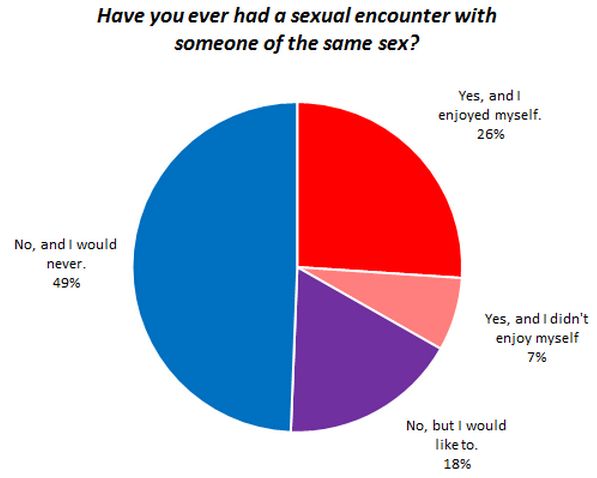
Reported sexual orientation, then, simply doesn’t map perfectly onto desires or behaviors, in addition to failing to capture the full complexity of our sexualities.

For more of OK Cupid’s data, see our posts on the racial politics of datingwhat women wanthow attractiveness mattersage, gender, and the shape of the dating poololder women want more sex, and the lies love-seekers tell.

Lisa Wade, PhD is an Associate Professor at Tulane University. She is the author of American Hookup, a book about college sexual culture; a textbook about gender; and a forthcoming introductory text: Terrible Magnificent Sociology. You can follow her on Twitter and Instagram.


In The Lucifer Effect: Understanding How Good People Turn Evil, Philip Zimbardo tries to explain how seemingly ordinary, average people can become involved in, or passively fail to oppose, evil acts. Zimbardo is the researcher who designed the (in)famous 1971 Stanford prison experiment,  in which students were randomly assigned as “prisoners” or “guards” for an experiment on how prison affects human behavior. The experiment, meant to last two weeks, had to be called off after 6 days because of the extreme negative effects on, and brutality emerging among, the participants. Zimbardo’s study, as well as others such as Milgram’s obedience experiment, highlighted the role of conformity to social norms and obedience to apparent authority figures in leading people to engage in actions that would seem to be so ethically unacceptable that any decent person would refuse.

Dolores R. sent in a Candid Camera clip from 1962 that illustrates the power of conformity:

As Zimbardo says on his website,

We laugh that these people are manipulated like puppets on invisible strings, but this scenario makes us aware of the number of situations in which we mindlessly follow the dictates of group norms and situational forces.

From Open Culture, via Boing Boing.

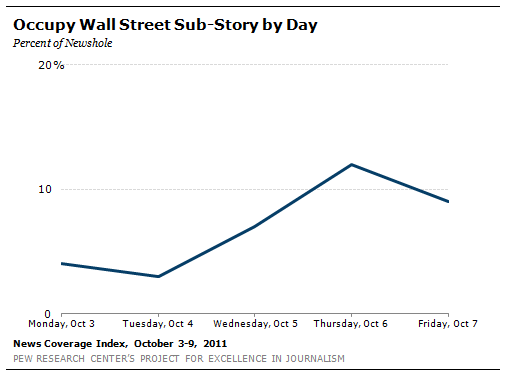
The Pew Project for Excellence in Journalism reports that coverage of the economy went up in October:

Overall economic coverage accounted for 22% of the newshole from October 3-9, up from 14% the week before (when it was No. 2).

(The word “newshole” refers to the limited space/time devoted to news in a day.)

Coverage of the protests is rising too, suggesting that Occupy Wall Street can take at least part of the credit:

The protests [themselves]… constituted the largest single thread in that coverage, making up about one-third of the economic storyline. That amounted to roughly 7% of the overall newshole, or nearly four times the amount of protest coverage from the week before.


So, is Occupy Wall Street also changing the discourse?

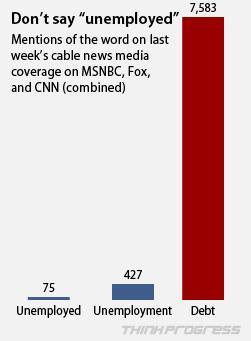
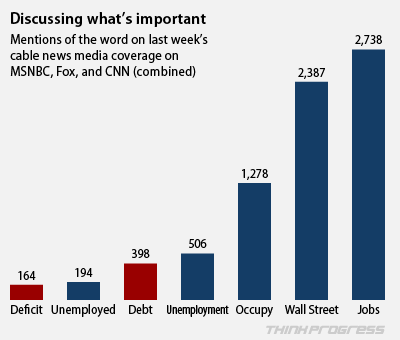
Jeremiah sent a link to data collected by Think Progress that suggests it is.  They counted the number of times MSNBC, CNN, and Fox used the terms “unemployed,”  “unemployment,” and “debt” during the last week in July, before the protests began.  They found that news coverage emphasized the debt (and the need to cut spending to reduce it) much, much more than the fact that there were large numbers of unemployed people (who would be helped by spending).

During the week of October 10-16, though, the language was different.  News coverage talked about the protests themselves, and the problem of jobs for the unemployed. The specter of the debt is now taking a back seat to the suffering of individuals.

It’ll be interesting to see what happens.

Lisa Wade, PhD is an Associate Professor at Tulane University. She is the author of American Hookup, a book about college sexual culture; a textbook about gender; and a forthcoming introductory text: Terrible Magnificent Sociology. You can follow her on Twitter and Instagram.

A group of conservative research institutes led by W. Bradford Wilcox’s National Marriage Project, with support from the Bradley Foundation, have produced a website called The Sustainable Demographic Dividend. They argue:

…the long-term fortunes of the modern economy rise and fall with the family. The report focuses on the key roles marriage and fertility play in sustaining long-term economic growth, the viability of the welfare state, the size and quality of the workforce, and the profitability of large sectors of the modern economy.

The analysis is not important, mostly focusing on promoting religion and marriage (I wrote more about one of the articles here). But they do make a unique appeal to corporate America:

Companies whose fortunes are linked to the health of the family, such as Procter & Gamble, spend billions of dollars each year on advertising. … Executives with oversight across brands should ask themselves a simple question: Do the messages used in our advertising make family life look attractive? Or do they exalt single living? Obviously, it’s in their long-term interest to do more of the former.

And they offer as a positive example this video from Proctor & Gamble, celebrating the company’s 75th anniversary in the Philippines.

One of the essays in the report says,

A turning point has occurred in the life of the human race. The sustainability of humankind’s oldest institution, the family—the fount of fertility, nurturance, and human capital—is now an open question.

Would more of this kind of advertising help to bring back the traditional family?

Cross-posted at Montclair SocioBlog.

If your survey doesn’t find what you want it to find . . .

. . . say that it did.

Doug Schoen is a pollster who wants the Democrats to distance themselves from the Occupy Wall Street protesters.   (Schoen is Mayor Bloomberg’s pollster.  He has also worked for Bill Clinton.)  In the Wall Street Journal,  he reported on a survey done by a researcher at his firm.  She interviewed 200 of the protesters in Zucotti Park.

Here is Schoen’s overall take:

What binds a large majority of the protesters together—regardless of age, socioeconomic status or education—is a deep commitment to left-wing policies: opposition to free-market capitalism and support for radical redistribution of wealth, intense regulation of the private sector, and protectionist policies to keep American jobs from going overseas.

I suppose it’s nitpicking to point out that the survey did not ask about SES or education.  Even if it had, breaking the 200 respondents down into these categories would give numbers too small for comparison.

More to the point, that “large majority” opposed to free-market capitalism is 4% — eight of the people interviewed.  Another eight said they wanted “radical redistribution of wealth.”  So at most, 16 people, 8%, mentioned these goals.  (The full results of the survey are available here.)

What would you like to see the Occupy Wall Street movement achieve? {Open Ended}

35% Influence the Democratic Party the way the Tea Party has influenced the GOP
4% Radical redistribution of wealth
5% Overhaul of tax system: replace income tax with flat tax
7% Direct Democracy
9% Engage & mobilize Progressives
9% Promote a national conversation
11% Break the two-party duopoly
4% Dissolution of our representative democracy/capitalist system
4% Single payer health care
4% Pull out of Afghanistan immediately
8% Not sure

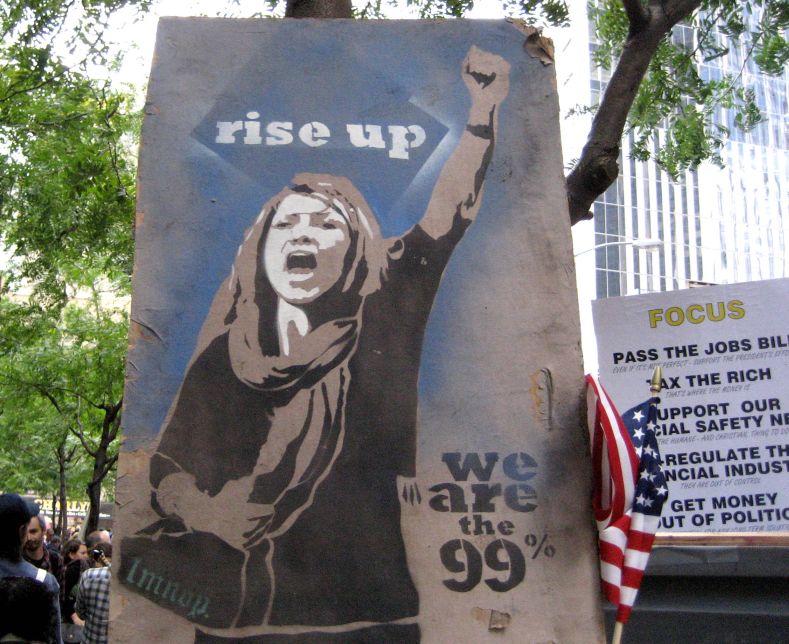
Schoen’s distortion reminded me of this photo that I took on Saturday (it was our semi-annual Sociology New York Walk, and Zucotti Park was our first stop).

The big poster in the foreground, the one that captures your attention, is radical militance — the waif from the “Les Mis” poster turned revolutionary.  But the specific points on the sign at the right are conventional liberal policies — the policies of the current Administration.

There are other ways to misinterpret survey results.  Here is Schoen in the WSJ:

Sixty-five percent say that government has a moral responsibility to guarantee all citizens access to affordable health care, a college education, and a secure retirement—no matter the cost.

Here is the actual question:

Do you agree or disagree with the following statement: Government has a moral responsibility to guarantee healthcare, college education, and a secure retirement for all.

“No matter the cost” is not in the question.  As careful survey researchers know, even slight changes in wording can affect responses.  And including or omitting “no matter the cost” is hardly a slight change.

As evidence for the extreme radicalism of the protestors, Schoen says,

By a large margin (77%-22%), they support raising taxes on the wealthiest Americans,

Schoen doesn’t bother to mention that this isn’t much different from what you’d find outside Zucotti Park.  Recent polls by Pew and Gallup find support for increased taxes on the wealthy ($250,000 or more) at 67%.  (Given the small sample size of the Zucotti poll, 67% may be within the margin of error.)  Gallup also finds the majorities of two-thirds or more think that banks, large corporations, and lobbyists have too much power.

Thus Occupy Wall Street is a group of engaged progressives who are disillusioned with the capitalist system and have a distinct activist orientation. . . . .Half (52%) have participated in a political movement before.

That means that half the protesters were never politically active until Occupy Wall Street inspired them.

Reading Schoen, you get the impression that these are hard-core activists, old hands at political demonstrations, with Phil Ochs on their iPods and a well-thumbed copy of “The Manifesto” in their pockets.  In fact, the protesters were mostly young people with not much political experience who wanted to work within the system (i.e., with the Democratic party) to achieve fairly conventional goals, like keeping the financial industry from driving the economy into a ditch again.

And according to a recent Time survey, more than half of America views them favorably.

The Hall of Fame

The Hall of Shame

Lisa Wade, PhD is an Associate Professor at Tulane University. She is the author of American Hookup, a book about college sexual culture; a textbook about gender; and a forthcoming introductory text: Terrible Magnificent Sociology. You can follow her on Twitter and Instagram.
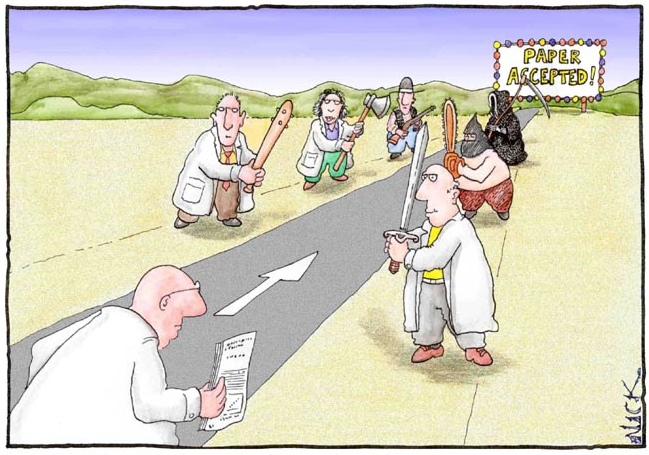
If you’re not (or not yet) an academic, this cartoon may not make much sense to you.  But if you are…

(cartoon by Nearing Zero; via Philip Cohen)

For the uninitiated:

To get a paper published in an academic journal, scholars have to submit a draft to a journal and wait up to a year for feedback that is, not-uncommonly, rather brutal.  This is because writing a journal article is difficult and our colleagues are rather smart.  And busy. So there’s no time for hand-holding.

Decisions are usually “reject” (we never want to see this paper again as long as we live) or “revise-and-resubmit” (right now this paper sucks, but if you spend another six months of your life working on it, there is some possibility that we might publish it… maybe… but for now it’s important that you understand that it really sucks).

It’s typical to have to submit a paper to two or three journals before it’s finally accepted.  And it’s not unheard of to have to submit it to five or six.  So… yeah, it can feel like being beaten, repeatedly. For sure.

I’ll take harrowing publication stories in the comments, if you’ve got ’em!

Lisa Wade, PhD is an Associate Professor at Tulane University. She is the author of American Hookup, a book about college sexual culture; a textbook about gender; and a forthcoming introductory text: Terrible Magnificent Sociology. You can follow her on Twitter and Instagram.
OccupyWallStreet has given rise to Occupy actions all over the United States and other countries as well.   One of the many slogans of this growing grassroots movement is “We are the 99%.”  This is a powerful slogan—highlighting the ways in which our current system serves the interests of a very small number of people.  Case in point: the top 1% of income earners captured 65% of all the growth in income over the period 2002 to 2007. 

Before this movement, there was another movement of 99ers.  Those were the unemployed facing life without a job and without any unemployment benefits.  Their ranks are about to grow again.  According to the Wall Street Journal, some 2.2 million people currently receiving unemployment benefits will lose them by Feb. 11, 2012 if Congress doesn’t renew our expanded unemployment benefits programs before the end of the year.

 na-bn729_number_d_20111014160903.jpg

Here is some background on the two programs slated to end, the federal Emergency Unemployment Compensation (EUC) program and the federal-state Extended Benefits (EB) program. Workers in all states are typically eligible to receive up to 26 weeks of Unemployed Insurance (UI) benefits from the regular state-funded unemployment compensation program.  Workers in any state who exhausted their UI benefits became eligible for up to 34 additional weeks of benefits thanks to the EUC program. That number went up to 53 weeks in states that had especially high unemployment rates (see chart below). Workers who exhausted their UI and EUC benefits were eligible for a maximum 20 additional weeks of coverage through the EB program if their state’s unemployment insurance laws allowed it.

policybasics_ui_weeks_table1-rev8-30-10.jpg

So, depending on what state you live in and how bad the unemployment rate is, an unemployed person would receive the base 26 weeks, possibly an additional 53 weeks under the EUC program, and possibly a further 20 weeks under the EB program, for a maximum of 99 weeks. What is up for renewal now is not an extension of benefits beyond the 99 weeks, but continuation of the EUC and EB programs. 

If Congress lets those programs expire, people who would have received benefits beyond the 26 week limit will lose them once they run though the weeks corresponding to the program that now provides them benefits.  For example, workers receiving EUC benefits will not be eligible for EB benefits.  And workers receiving UI benefits will not be eligible for EUC benefits.  And of course all new unemployed will be limited to 26 weeks. 

The assumption seems to be that there are jobs out there for the taking.  In reality, people just cannot find work.  Here are two charts from the Federal Reserve Bank of St. Louis that illustrate just how bad the job market has been for American workers.  The first shows the percentage of unemployed who have been out of work for 27 weeks or more.  The second shows the median duration of unemployment.

picture1.jpg


picture2.jpg

Here is what the Wall Street Journal has to say about recent and projected unemployment trends:

The number of Americans out of work for more than six months rose by 208,000 to 6.2 million in September, the Labor Department said last week. Some 44.6% of all of those who are unemployed have been sidelined for at least six months. Most of those individuals — nearly 4.4 million — have been out of work for at least a year.

In past recessions, unemployment extensions continued until the unemployment rate dropped below 7.5%. That’s a long way from the 9.1% rate recorded for September. Indeed, economists in the latest Wall Street Journal forecasting survey see the rate still elevated at 8.2% in December 2013.

So, why is Congress reluctant to renew our extended unemployment benefits programs, a renewal which doesn’t even help those that have gone through their 99 weeks?  According to the Wall Street Journal:

The Congressional Budget Office estimates that it would cost around $44 billion to extend benefits through 2012. That makes it a tough sell in a Congress looking to trim deficits. 

That’s right–$44 billion is just too much money to spend in a budget that includes close to a trillion dollars to fund the Pentagon, fight wars in Afghanistan and Iraq, and maintain costly and intrusive domestic security programs.

What can we do?  The best response is to deepen our support for the Occupy America movement and force a change in priorities. 

312296_10150419637402518_638522517_10164775_1895526551_n.jpg