Search results for The

Cross-posted at The Sociological Cinema.

Back in 2007, Dr. Oz stood on the set of The Oprah Winfrey Show and infamously promoted to an audience of 8 million viewers the idea that African Americans experience higher rates of hypertension because of the harsh conditions their ancestors endured on slave ships crossing the Atlantic. This so-called “slave hypothesis” has been roundly criticized for good reason, but I was struck that it was being promoted by such a highly educated medical professional.

The episode got me thinking about the sociologists Omi and Winant’s notion of a racial formation as resulting from historically situated racial projects wherein “racial categories are created, inhabited, transformed, and destroyed” (p. 55-56). These projects take multiple forms but in at least one version, there is an attempt to collapse race—a socially constructed concept—into biology. Such projects are similar insofar as they suggest that the socially constructed distinctiveness between people of different racial categories roughly approximates a meaningful biological distinctiveness. Scientists have been centrally involved in this effort to establish a biological basis for race. In the middle of the 19th century Dr. Samuel Morton attempted to show that average cranial capacities of people from different racial groups were significantly different. Today, many people scoff at the misguided racism of the past, but I think Dr. Oz’s promotion of the slave hypothesis demonstrates that the search for a biological, and therefore “natural,” basis for race continues.

So how do proponents of the slave hypothesis explain hypertension? In 1988 Dr. Clarence Grim first proposed the theory, which is the idea that the enslaved people who survived the Middle Passage were more likely to be carriers of a gene that allowed them to retain salt. Grim argued that this ability to retain salt, while necessary for a person to survive the harsh conditions of a slave ship, would ultimately lead to hypertension as the person aged. Thus Grim proposed that African Americans living in the United States today are the descendants of people who have this selected feature. As I mentioned above, this theory has been soundly refuted but reportedly still remains in many hypertension textbooks. Looking at the clip above, which is from January of this year, it seems that medical professionals like Dr. Oz may be still promoting it.

I think it is important to recognize that this particular racial project persists in many forms, and one final example is from 2005, when the FDA approved BiDil as a customized treatment of heart failure for African Americans. The approval was based on highly criticized research, but the approval also implicitly makes the case that a racial group might be so biologically distinct from others as to warrant its own customized medication. Much like the search for different cranial capacities, the propagation of the slave hypothesis, and the marketing of drugs designed for different racial groups, BiDil’s emergence can be seen as an attempt to deploy racial categories as if they were immutable in nature (see Troy Duster’s article in Science).

Criticizing this racial project is more than an academic exercise. As a social construct, race is already a central principal of social organization, which benefits whites at the expense of other racial groups. It is already a powerful basis upon which privileges are meted out and denied. In my view, the effort to loosen race from its moorings as a social construct and anchor it again as a biological fact of nature is an attempt to fundamentally alter the discussion on racial inequality. If this project prevails and race comes again to reflect a biological truth, then fewer people will acknowledge racial inequality as the result of a human-made history. It will instead be seen as the result of humans being made differently.

———-

Lester Andrist is a Ph.D. candidate at the University of Maryland, College Park, specializing in the role of social capital and personal networks in finding jobs in India and Taiwan and cultural representations of groups in indefinite detention. He is a co-editor of the website The Sociological Cinema.

If you would like to write a post for Sociological Images, please see our Guidelines for Guest Bloggers.

Cross-posted on Reports from the Economic Front.

The Occupy Movement has clearly transformed conversations about the economy.  It is now inequality — in particular, the gap between the top 1% and everyone else — rather than the national debt that dominates the news.

To review, this gap is real, as the following charts from the Economic Policy Institute make clear.  This chart shows the percentage increase in household income over the period 1979 to 2007 by income group.  While the top 1% enjoyed income gains of 224% over the period, the gains enjoyed by the bottom 90% were far more modest: 5%.  Equally striking is the fact that the household income of top 0.01% shot up an astounding 390%.

income-growth.jpg

Unfortunately, there is another income gap that has not received nearly as much attention.  It is the white-nonwhite gap.  The Portland, Oregon based Coalition of Communities of Color recently published a report on the socioeconomic situation of people of color in Multnomah Country (which includes Portland).

As the chart below reveals, the mean income of families of color in the top decile (10%) actually declined by $6,002 over the years 1979 to 2007.  By contrast, the mean income of white families in the top 10%  rose by $122,591.  White families and families of color in the bottom half of the distribution all suffered losses.

multnomah.jpg

The following two charts show the mean earnings of each group by decile and their change between 1979 and 2007.

Portrait in 1979:

1979.jpg

Portrait in 2007:

2007.jpg

This last chart shows poverty rates by color.  Clearly, as we work to create a more equitable society, our efforts must also be guided by awareness of the existence of serious racial and ethnic inequities.

poverty.jpg

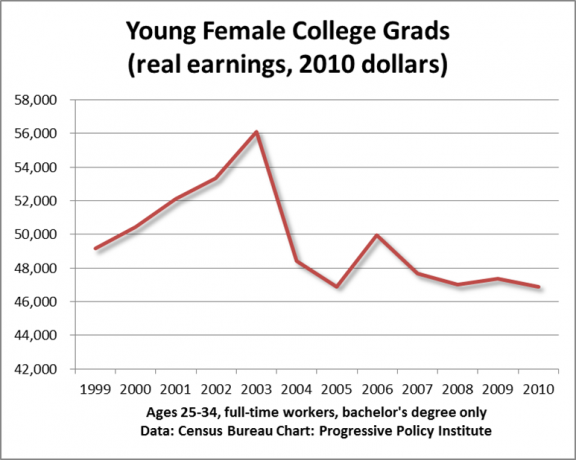
Economist Michael Mandel, at Mandel on Innovation and Growth, posted these two figures showing that the real earnings of college graduates (full-time workers ages 25-34) have been declining since before the recession. According to Mandel:

  • Real earnings for young male college grads are down 19% since their peak in 2000.
  • Real earnings for young female college grads are down 16% since their peak in 2003.

Mandel poses the following questions:

…no one has given me a good explanation yet of why young American college grads should have been hit so hard. Is there increased competition with young college grads around the world?  Are new college grads lower quality than their predecessors? Has information technology reduced the need for young grads? I really would like to know.

For more depressing news about the earnings of college graduates, see these posts on how the economic recession will depress the earnings of college grads for their entire lifetime and a look at the trend in college graduate earnings since 1979.

Lisa Wade, PhD is an Associate Professor at Tulane University. She is the author of American Hookup, a book about college sexual culture; a textbook about gender; and a forthcoming introductory text: Terrible Magnificent Sociology. You can follow her on Twitter and Instagram.

I like this post. And it’s the two-year anniversary of Bruce Snowdon’s death. So, here’s my toast to the last sideshow fat man.

He’s so big and so fat it takes four girls to hug him and a box car to lug him.  When he dances you’ll swear he must be full of jelly, cause jam don’t shake that way.  And you know girls!  He is single and lookin’ for a wife, he’ll make some lucky girl a fine husband, why he’s so big and fat, he’ll provide you with a lot of shade in the summertime, keep you nice and warm in the winter time and give you lots of good heavy lovin’ all of the time!

— Carnival Spiel by Ward Hall

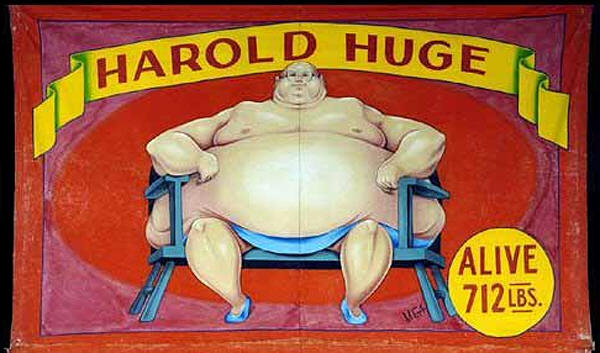
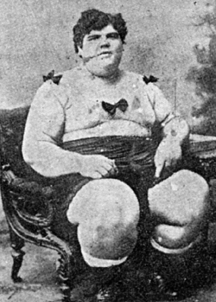
On Nov. 9th 2009, Harold Huge, a man billed as the very last sideshow fat man, died.  He weighed 607 pounds or so.

Harold’s real name was Bruce Snowdon.  He had degrees in paleontology, anthropology and chemistry. In 1977, he found himself bored with his work and stumbled across the idea of being a Fat Man:

I had put on a lot of weight between the time I was 20 and 25. I was up to about 450 in those days. I went to the local library, and I was poking through some old circus books and I see this one picture about a sideshow, maybe circa 1905, and I’m looking at this fat man and I’m saying to myself, “He can’t weigh more than 350 pounds.”

Now, I ask myself, how the hell would I go about getting into a sideshow? I’d never even seen a sideshow in my lifetime. In the late ’70s the industry was a very pale ghost of its former self. Instead of thousands, there were maybe dozens left then. So I figured, logically, there’s got to be some sort of trade journal for the carnival industry. It’s Amusement Business. And I’m looking through the AB. Taking a lucky stab, I wrote the editor, Tom Powell. And Tom Powell happens to be a very good friend of Ward Hall. Bingo. I had the job.


In an interview with James Taylor (from which the above quote is also taken), Snowden explained:

I don’t mind being enormously fat… I come from a long line of fat people. My old man tortured himself for 40 years going from 200 to 300 [pounds] and back again. He eventually lost the weight, but he also lost his mind.

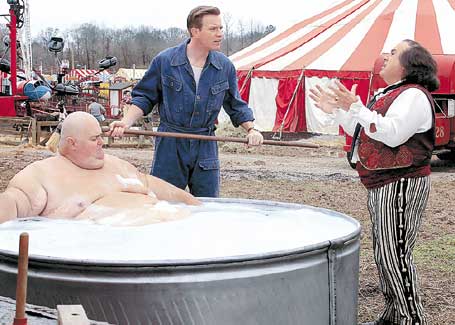
Snowdon played Harold Huge for 26 years.  The year of his retirement, in 2003, he played himself in the movie, Big Fish:

So the sociological question I would like to pose is: Why is Snowdon the last fat man?

Marc Hartzman suggests that fat men and woman became less of a curiosity because “waistlines expanded and obesity became less of a laughing matter.  As the years went by, spotting a man who weighed more than quarter of a ton was not that unusual…”  So there’s two  hypotheses: (1) we see fat people everywhere and so it’s no longer a curiosity and (2) obesity has become a very serious matter, not to be played with at sideshows or elsewhere.

Another hypothesis might involve (3) a growing distaste for objectifying and dehumanizing those who are unusual.   As the human rights era evolves, we increasingly embrace difference and promote tolerance.

(4) Perhaps sideshows themselves are simply out-of-fashion, a drab alternative to Avatar in 3D or a Wii.  Or, (5) maybe the internet has made all curiosity easier to quench.  With a click of the button, we can see DD breasts, thalidomide babies, and cats playing the piano… who needs a sideshow?

I can think of reasons to endorse and reject all of these hypotheses.

So, in honor of Snowdon’s 26 years of service and delightful sense of humor (“If there’s a bitchy type of human being, it’s somebody on a diet”), let’s speculate.

Sources: Sideshow World, AOL News, Shocked and Amazed, Randall Levenson photography, and Shapely Prose.

Lisa Wade, PhD is an Associate Professor at Tulane University. She is the author of American Hookup, a book about college sexual culture; a textbook about gender; and a forthcoming introductory text: Terrible Magnificent Sociology. You can follow her on Twitter and Instagram.

Arlie Hochschild, in her book The Second Shift, discusses a modern tension in American households resulting from a “stalled gender revolution,” i.e., the fact that women and the social construction of femininity have changed and men and masculinity have not caught up with these changes.  These tensions erupt when assigning responsibilities in the second shift of household labor and childcare, which often fall upon wives’ shoulders.  Traditionally, the dominant construction of masculinity does not allow men to participate in housework, such as laundry, since it is threatening to their sense of masculinity.  In fact, as argued by Julie Brines, the economic model of dependency holds for women but not for men.  Men can essentially trade in their salaries for the domestic labor performed by their wife; however, when women out-earn their husbands, they cannot seem to strike a similar bargain.  In this case, since the man is not fulfilling his traditional role as provider, he essentially refuses to further damage his reputation by engaging in “woman’s work” in the home.

Enter Tide:

In this Tide commercial, we see this threatening element of housework, as the “Dad Mom” tries to justify his laundry proficiency by reasserting his masculinity.  At the end, he confirms that he is still a man as he declares that he will “go do pull ups and crunches,” one would assume in order to build up his manly muscles.  Beyond this direct statement of his attempts to embody masculinity, throughout the commercial, we see three themes — normative heterosexuality, competition among men, and the codification of laundry as feminine — used to excuse his role as homemaker.

He first makes the claim that he is at home “being awesome,” and proceeds to explain how.  He stresses his unique (and alluring) mixture of masculinity and nurturing.  By describing himself in this way for the sake of the “Mom Moms,” he alludes to his heterosexuality, a basic element of hegemonic masculinity, in an attempt to establish some sex appeal.

Second, there is a competitive element to his dialogue as he boasts to other dads about his ability to dress a four-year-old and skills at folding a “frilly dress with complete accuracy.”  By making it a competition, he rationalizes his participation in housework. Boom!

Finally, this “dad mom” uses the “brute strength of dad” in combination with the “nurturing abilities of my laundry detergent” to complete this basis household task.  The task of doing laundry and the detergent, itself, is codified as feminine.  This combination is a “smart” one because this is exactly what women need: more men doing the laundry.

——————————

Amanda M. Czerniawski is an Assistant Professor of Sociology at Temple University. She specializes in bodies and culture, gender and sexuality, and medical sociology.  Her past research projects involved the development of height and weight tables and the role of plus-size models in constructions of beauty.  Her current research focuses on the contested role of the body in contemporary feminist discourse.

If you would like to write a post for Sociological Images, please see our Guidelines for Guest Bloggers.


My colleague and co-author, Lisa Wade (you’d know her better as one of the people behind SocImages), gave a seven-minute speech at an Occupy Teach-In at our shared institution, Occidental College.  She said I could post it for you.

In the video she says she’s optimistic about the movement because it’s deeply sociological, drawing our attention to the way we organize our society, not just the individuals in it.  She contrasts this ability to critique the system with the early years of the Great Depression, during which many of the unemployed felt like they had failed their families because of personal faults (leading to a rise in the suicide rate).  Then, using the truly inspirational story of the 1955 Montgomery bus boycott (in which people walked to work and rode carpools for over a year!), she warns students that the movement is about to stop being fun and require real commitment. She ends by asking the the audience whether they can rise to the occasion and make the sacrifices needed to move Occupy forward to achieve specific demands.

Also see the three-minute bit on hook up culture that she did for MTV Canada.

Scholars who study journalism, myself included, have found that efforts by journalists to stay neutral often backfire, resulting in exactly the opposite effect they desire.  Journalists, for example, may try to balance “both sides” of a contentious issue, seeking out authoritative sources to give a credible account of each position.  But, in seeking out authoritative people, they simultaneously offer a public platform to the very people who are already powerful.

Along these lines, Describing early coverage of the Vietnam War, Hallin (1986: 25) writes:

…most of the reporting, in the best tradition of objective journalism, ‘just gave the facts.’  But they were not just any facts.  They were official facts, facts about what the president said and what ‘officials here believe.’  The effect of ‘objectivity’ was not to free the news of political influence, but to open wide the channel through which official influence flowed (my emphasis).

More, because journalists need highly-authoritative sources in order to do their job, they need to cultivate relationships with them.  Likewise, authorities need reporters to help them get their stories to the public.

Powerful reporters and powerful people, then, become… friendly.  Reporters may try to avoid saying these that their regular sources wouldn’t want said, partly because they like them and are influenced them, and partly because they need them for the next story and the next.

I thought of this research when Jay Livingston posted this picture, on the Montclair SocioBlog, of Alan Greenspan and David Brooks having lunch together:

Note: The photo was removed at the request of the person who took it. Sorry.

Greenspan is the former Chairman of the Federal Reserve, Brooks is a decorated journalist.

Source: Hallin, D. (1986) The ‘Uncensored War’: The Media and Vietnam. New York and Oxford: Oxford University Press.

Lisa Wade, PhD is an Associate Professor at Tulane University. She is the author of American Hookup, a book about college sexual culture; a textbook about gender; and a forthcoming introductory text: Terrible Magnificent Sociology. You can follow her on Twitter and Instagram.

This is a whimsical trailer for an animated movie with a progressive pro-environment message based on Dr. Seuss’ The Lorax.  Pretty to watch, fantastical, heart-warming, and progressive… it draws you in and then, just as yoiur defenses had been lowered, BAM! It ends with a sexist joke.

Sigh.

Lisa Wade, PhD is an Associate Professor at Tulane University. She is the author of American Hookup, a book about college sexual culture; a textbook about gender; and a forthcoming introductory text: Terrible Magnificent Sociology. You can follow her on Twitter and Instagram.