Search results for The

Cross-posted at Bytes of China.

Oh how this Toyota Highlander advertisment is reflective of the new global order.  I saw this picture in Guangzhou’s domestic terminal. A Chinese couple is getting out of their Japanese brand car into what appears to be a private yacht. A white male greets them, taking their travel items and appears to be eager in their service.
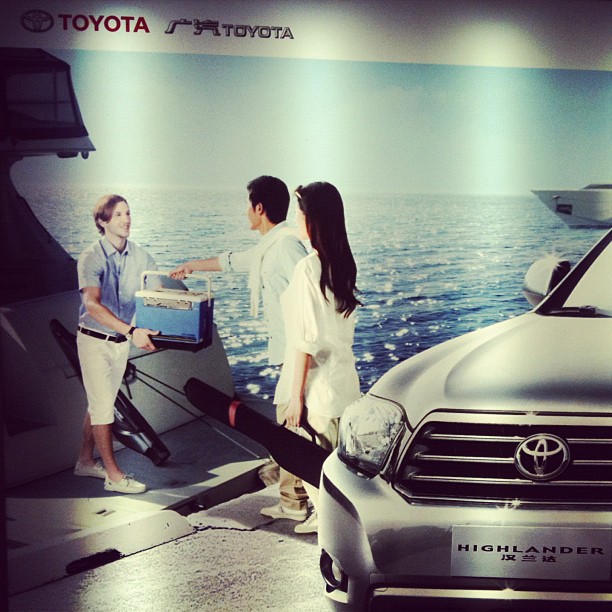
This advertisement reflects a new Chinese imaginary — one that is global, expansive, unlimited, and exploratory. It also tells us who has the power to live out this imaginary. Ten years ago or even five years ago, I don’t think this advertisement would’ve existed. But now companies have turned to the Chinese consumer, encouraging them to participate in this lifestyle. The entire global economy right now depends on the Chinese elite and middle-class to spend. But how long can this go on for until we see the next crisis? For how long can each system create “value”?

————————

Tricia Wang is an ethnographer, sociologist, and researcher. She is on a Fulbright in China observing how digital technologies are mediating new conceptions of information and desire among youth & migrants. She is a student at UC San Diego’s PhD Sociology program.  She blogs at Bytes of China.

Thanks to Benjamin B. for the tip!
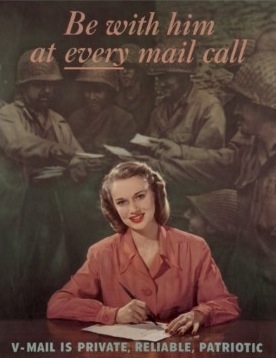
Homefront war support is a critical part of war; care packages, letters, emails, and phone calls greatly increase troop morale. Typically homefront war support is gendered. In the U.S., women are usually the ones at home providing support to the men serving. During various wars the military has encouraged women to support male troops. It’s patriotic, as this WWII poster notes:

The wars in Iraq and Afghanistan have altered our images of the gendered make up of the homefront and warfront. Today 16% of the military is female, and even though women are not officially allowed in combat positions, they are often in combat situations in the current wars, where the lines of combat are blurred. As a result, over 115 women have been killed in combat. We’re still used to seeing these kinds of images:

Embed from Getty Images

But images such as this are becoming more common:

Embed from Getty Images

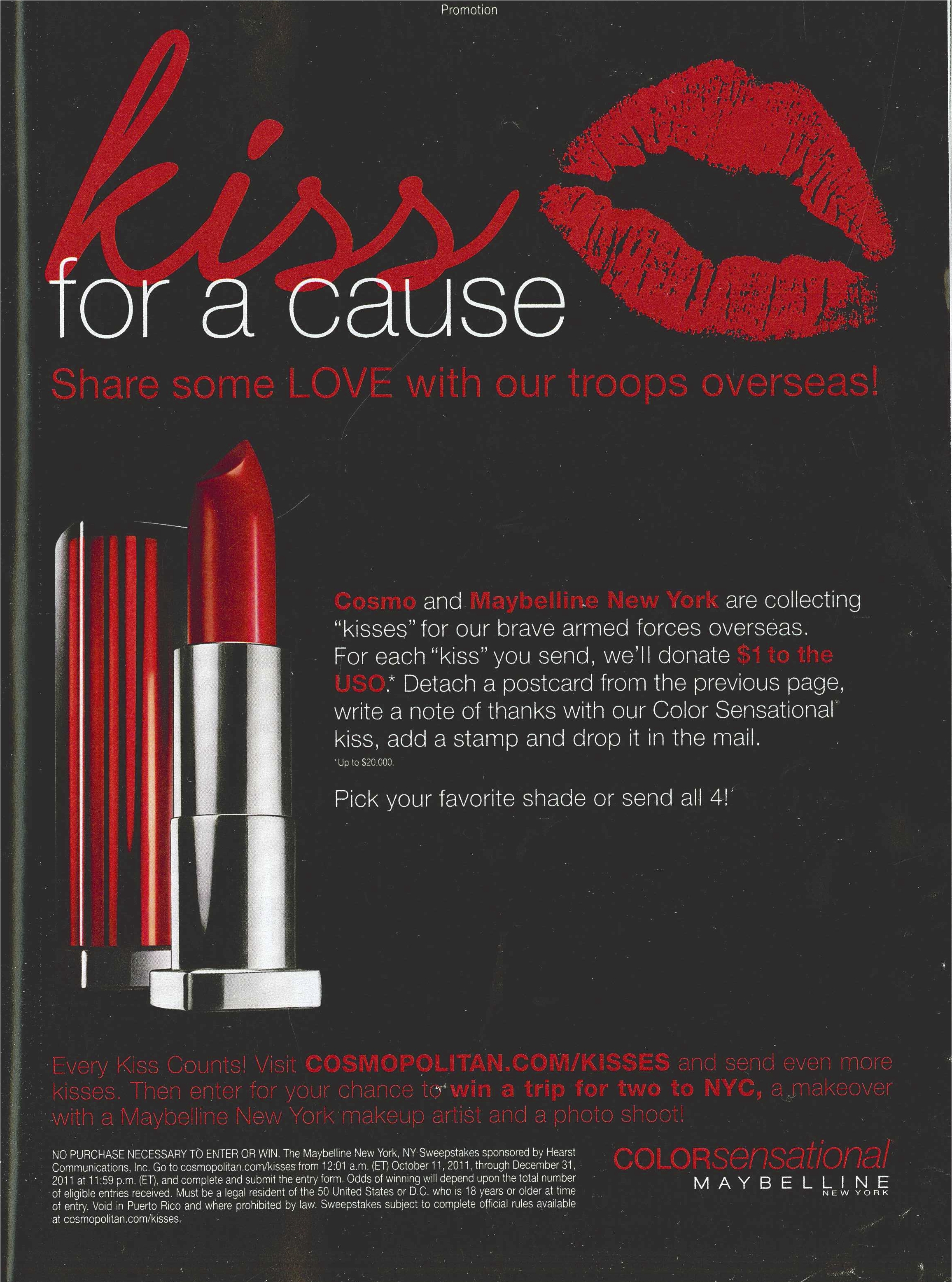
But a student of mine brought me the following ad from the most recent issue of Cosmopolitan:

Main text:

Cosmo and Maybelline New York are collecting ‘kisses’ for our brave armed forces overseas. For each ‘kiss’ you send, we’ll donate $1 to the USO.* Detach a postcard from the previous page, write a note of thanks with our Color Sensational kiss, add a stamp and drop it in the mail. *Up to $20,000

So Maybelline has teamed up with the USO (United Service Organization- a private, non-profit organization) to send support, in the form of “kisses,” and up to $20,000, to the troops overseas.

The assumption here is that armed service members are male and need the support of “kisses” from the homefront—a homefront that is comprised of women. The campaign is also an example of heteronormativity (the often unnoticed ways that heterosexuality is normalized and privileged) because it assumes that (men) serving overseas are heterosexual and will want to receive lipstick kisses from (presumably heterosexual) women. While women service members have been more visible during the wars in Iraq and Afghanistan, this campaign reminds me that war is still largely gendered in a heteronormative fashion. The warfront is still thought of as men’s domain, the homefront women’s domain, and war support relies on heterosexual relationships.

Cross-posted from Family Inequality.

The Congressional Budget Office has a new report on trends in the income distribution. The big news is the 1%’s blitzkrieg assault on equality.*

The headline image will be this one, which shows the changing share of after-tax-and-transfer household income. Every group except the top 1% had a smaller share of income in 2007 than they did in 1979, or just an equal share in the case of the 81st-99th percentile group. That means the gains in the top quintile are all concentrated in the top 1%.

That is very important and a source of outrage for the hundreds of thousands of Facebook users posting, commenting, or “liking” Occupy Wall St. and its related pages.

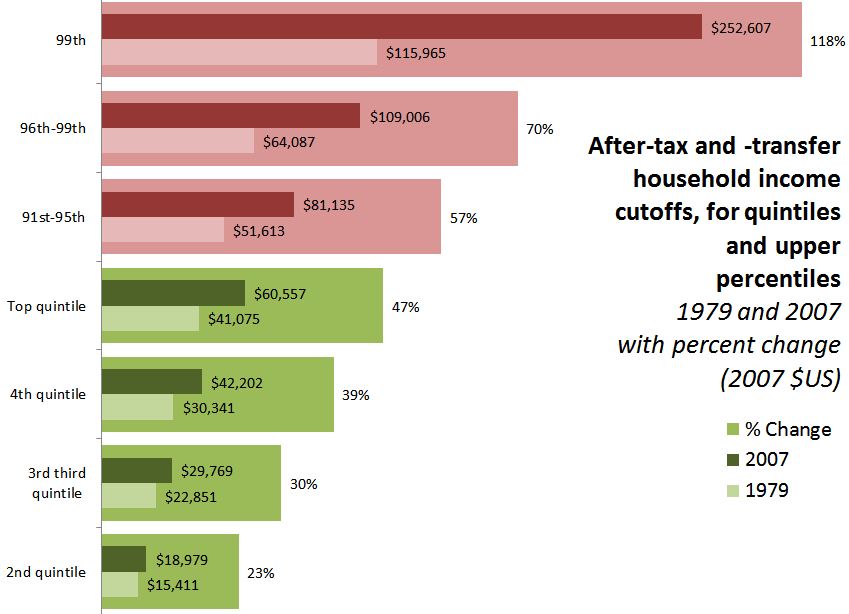
But it would be misleading to view the chart as showing that incomes fell for the other groups, since it shows shares of the total income. Income growth has been very skewed toward the top, but it is by no means confined to the top 1%. Here is my graph showing the income cutoffs for each quintile, and for the top slices separately. These are the cutoffs in 1979 and 2007 (in inflation-adjusted dollars), with the percentage change in the backgrounded bars.

(Note there is no lower cutoff for the bottom quintile — the price of entry for that group is always $0).

Two thoughts about this.

  • Even if there were no 1%, if the graph only included the green bars, there would be plenty of increasing inequality for what might then be called “the 80%” to protest. The 81st-99th folks may be lucky to have the popular anger directed at the grotesque opulence of the sliver above them. (I’m not diminishing the extremity of the gains for the top 1%, but, as Matt Taibbi describes, the object of opposition is not just their income, but their influence.
  • If you look at the families and networks of the top 1%, how many of them have relatives, friends, and even co-“workers” who are only in the top 10%? Would a self-respecting 1% family be appalled if their son married someone from a stable 5%-er family?

What I’m wondering is whether the 1% folks are merely a statistical convenience rather than a socially cohesive group (dare I say, class?). That’s an empirical question that national income distributions can’t necessarily answer.

*I should mention that the report is not just another rehash of Census numbers, though. Two adjustments they made seem especially good. First, they used a tricky matching method to combine Current Population Survey numbers (which do better at benefits and low-income households) combined with Internal Revenue Service data (which is better for high-end data). Second, they adjusted for household size and composition, and calculated distributions before and after taxes and transfers, and among different kinds of income. The report is here, a summary is here, and the blog post version is here.


Today cheerleading can be an incredibly athletic and risky sport. Because it is associated with women, though, and serves a sideline function for football and other male-dominated sports, cheerleading is often not considered a sport at all. Less than half of U.S. high school athletic associations define high school cheerleading as a sport and neither the U.S. Education Department or the National Collegiate Athletic Association categorize it as one.

Instead, cheerleading is frequently labeled an “activity,” akin to the chess club.  Accordingly, cheerleading remains unregulated by organizations responsible for ensuring the safety of athletes, leading to rates of injury among cheerleaders higher than even those among American football players.

A similar logic appears to be at play regarding the Lingerie Football League, 12 teams of women that play live tackle football in underwear.  Here are some highlights from a game:

So, here’s the thing.    Last month 16 of the 26 players on the Triumph, a team in Toronto, resigned over safety concerns. From a story at the Toronto Star sent in by Emily M.:

…four players described the ill-fitting hockey helmets and one-size-fits-all shoulder pads designed for young males that they had to wear.

“We would have headaches during practice… They made a hockey helmet a football helmet, and that’s not what it’s for.”

Sprained ankles, concussions and pulled hamstrings were among the injuries sustained by Triumph players in their first game… their team had no medical staff.

One of the players reported that, when they brought their concerns to the coach, he shrugged and said: “You know, it is what it is.”

“You know, it is what it is.”  In other words, “You’re women in underwear. It doesn’t matter what you do, you’re not really playing football.”  Ideology triumphing over reality.

Lisa Wade, PhD is an Associate Professor at Tulane University. She is the author of American Hookup, a book about college sexual culture; a textbook about gender; and a forthcoming introductory text: Terrible Magnificent Sociology. You can follow her on Twitter and Instagram.

People seem to love to draw distinctions between social categories. Gender, race, age, class, sexual orientation, religion… you name it; difference is something that we all tend to be a bit obsessed with. But even when there is difference, there is overlap. Often, lots and lots of overlap.

Case in point, sent in by Christie W. and Jordan G.: reactions to the super scary bit at Nightmares Fear Factory in Niagara Falls. These photos suggest that no matter who you are, scary is scary! There are lots and they are just as awesome.

Lisa Wade, PhD is an Associate Professor at Tulane University. She is the author of American Hookup, a book about college sexual culture; a textbook about gender; and a forthcoming introductory text: Terrible Magnificent Sociology. You can follow her on Twitter and Instagram.

At the intersection of the trivializing of horrific violence aimed at ethnic/religious groups and the pornification of American culture, comes this “Anne Skank” costume:

[APOLOGIES: We were asked to remove the photograph and complied.]

Yes that is, indeed, a woman dressed up like Anne Frank, the Jewish child who hid from the Nazis for two years, only to be discovered and moved to a concentration camp where she died from Typhus.  Her companions are dressed up like Nazi soldiers.  The Halloween revelers who made the choice to sexualize and laugh at this 15-year-old victim of the holocaust are graduate students in a Creative Writing program.

UPDATE: Comments thread closed.

Lisa Wade, PhD is an Associate Professor at Tulane University. She is the author of American Hookup, a book about college sexual culture; a textbook about gender; and a forthcoming introductory text: Terrible Magnificent Sociology. You can follow her on Twitter and Instagram.

Cross-posted at Montclair SocioBlog.

Newspapers report facts – thing that actually happened.  They run photos of things that actually happened.  They don’t make stuff up.  But they do choose which facts to report, and they do choose which photos to run.    Usually the two are congruent.

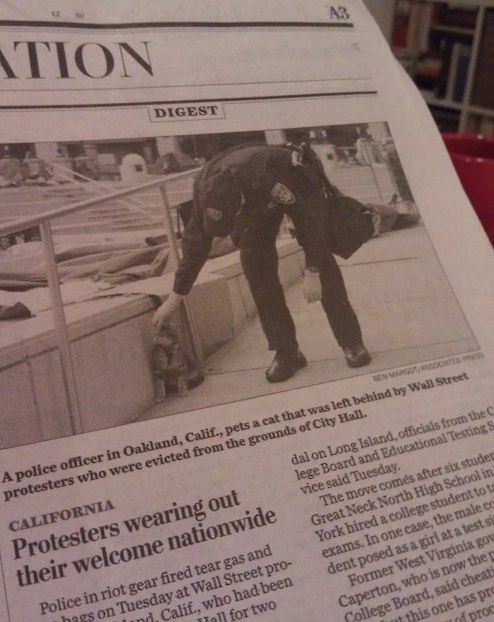
But not always.  Wonkette ran this photo of a page from the Washington Post:


Wonkette and other sites have contrasted the photo with this video of a cop deliberately firing a tear gas canister at close range directly at a group of demonstrators who had come to aid of someone who had been hit in the head with a tear gas canister.

But what’s also noteworthy is the contrast between the photo (nice cop, nice kitty, nothing violent happening here) and the Post’s own lede:   “Police fired tear gas and beanbags. . . .”

A confession to PostSecret this week inspired me to add to and revise this post from 2009.

—————————

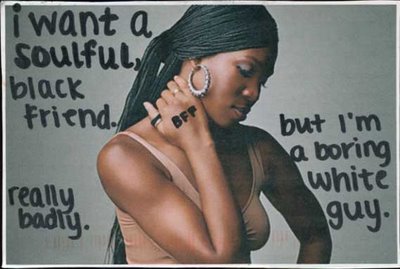
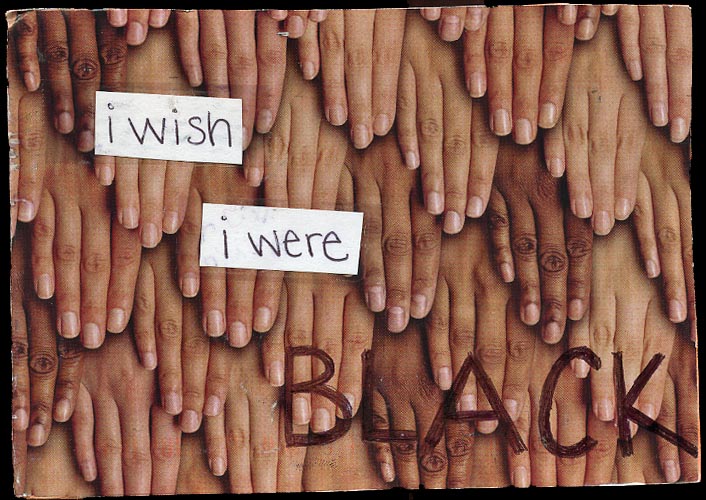
I have posted before on the way that black people are fetishized in the U.S.  It is as if they are, literally, more colorful, more interesting, cooler, hipper, even spicier than white people.  Whites, in contrast, can seem bland, boring, vanilla, even whitebread.  From this perspective, being a “boring white” person can seem, well, boring.  Both of these confessions can be read as suggesting as much (though there are surely other readings as well):

bff

It’s important to remember that this projection of soulfulness and other positive characteristics onto black people specifically is problematic, even if it’s not derogatory (for posts on the “magic negro,” see here, here, and here).   People of color often report that they feel like white folks are friends with or date them specifically because they aren’t white.  This is no compliment.  Most of us desire to be friends with people who see us as individuals and not stereotypes.

Lisa Wade, PhD is an Associate Professor at Tulane University. She is the author of American Hookup, a book about college sexual culture; a textbook about gender; and a forthcoming introductory text: Terrible Magnificent Sociology. You can follow her on Twitter and Instagram.