Search results for The

I know a guy, bless his heart, who is unendingly surprised to learn that women do things to themselves to try to be more conventionally attractive.  Most recently he learned that bleach blondes are almost always, well, bleached. He thought it was a common natural hair color for adult women. LOL.

In any case, I thought the photographs below — by Zed Nelson, and sent along by zeynaparsel — were neat. They disembody the tools women use to enhance their beauty — eyelash extensions, breast implants, hair extensions — revealing them as undeniably artificial.


Lisa Wade, PhD is an Associate Professor at Tulane University. She is the author of American Hookup, a book about college sexual culture; a textbook about gender; and a forthcoming introductory text: Terrible Magnificent Sociology. You can follow her on Twitter and Instagram.
Cross-posted at Thick Culture.

The Occupy Wall Street protests have garnered a great deal of attention in recent weeks. The core argument is that the “top one percent” has gotten a free ride in the last few decades, particularly during the last few years where the financial sector has seemingly not been held to account for their role in the financial crisis. But who is the “top one percent”?

Suzy Khimm on Ezra Klein’s blog sheds light on this question.

You’d be in the top 1 percent of U.S. households if your income in 2010 was at least $516,633. Your net worth in 2007 was $8,232,000 or more, and your average income this year is $1,530,773.

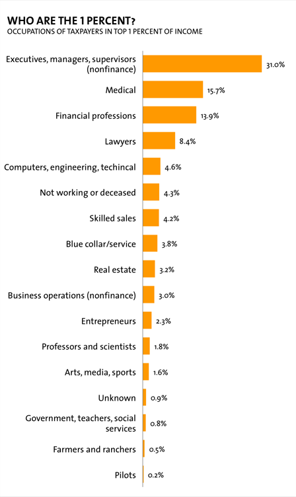
Khimm also shares some charts from Dave Gilson that looks deeper into who these “1 percenters” really are. In this chart, he notes that those in the top one percent have a broad range of professions. You’ll note from the chart than only 14 percent come from the financial sector, and a scant 2 percent are classified as “entrepreneurs.” As a side note, how did any professors make this list (1.8 percent)!

This data doesn’t play into the story the “99 percenters” want to tell about the “top 1 percent.” The preferred narrative is that the top one percent come from the financial sector (e.g. their wealth is not earned in the same way an entrepreneur’s wealth is earned).

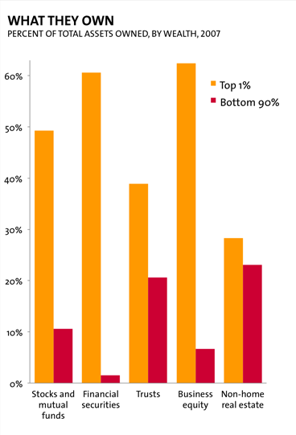
But another of Gilson’s charts does help the 99 percenter’s story. According to this chart, the top one percent owns a majority share of the nation’s stock/mutual funds, securities, and business equity) when compared to the “bottom 90 percent.”

What does this say about the validity of the Occupy Wall street movement? Should they be focusing their efforts on challenging concentrated wealth regardless of whether it is in the financial sector or not? Or is Wall Street the perfect villain?  Does it matter if the story of who constitutes the “top 1 percent” is more muddled if the objective is met? Do the means justify the ends?

——————————

Jose Marichal, PhD, is an assistant professor of political science at California Lutheran University. He teaches and writes about: public policy, race and politics, civic engagement, the Internet and politics, and community development.  He is founder of the blog ThickCulture.

If you would like to write a post for Sociological Images, please see our Guidelines for Guest Bloggers.

(source)

Amanda Knox, an American exchange student, was convicted in 2009 of murdering her flatmate, Meredith Kercher.  In 2011, on appeal, her conviction was overturned.

At The Guardian this month, Ian Leslie discusses the way that Knox’s body language and facial expressions were used in arguments as to her guilt.  He quotes jury members, police officers, court watchers, and others making such arguments.  The lead investigator, Edgardo Giobbi, for example, was quoted saying:

We were able to establish guilt by closely observing the suspect’s psychological and behavioural reaction during the interrogation. We don’t need to rely on other kinds of investigation.

A bystander speculated: “Her eyes didn’t seem to show any sadness, and I remember wondering if she could have been involved.”  The head of the murder squad, Monica Napoleoni, discussed the video below, arguing that kissing wasn’t the kind of behavior an innocent person would engage in:

Leslie argues that the tendency to think we can read “someone else’s state of mind simply by looking at them” is a common social psychological tendency.  Describing the work of Emily Pronin, a psychologist at Princeton University, he explains:

…there is a fundamental asymmetry about the way two human beings relate to one another in person. When you meet someone, there are at least two things more prominent in your mind than in theirs – your thoughts, and their face. As a result we tend to judge others on what we see, and ourselves by what we feel. Pronin calls this “the illusion of asymmetric insight.”

Unfounded belief into the insight into others’ minds has been shown to hold experimentally.  Certainty that Knox was guilty, then, may very well have been born of an overconfidence in our ability to read the mental states of others.

Thanks to Matt Vidal for sending the link!

Lisa Wade, PhD is an Associate Professor at Tulane University. She is the author of American Hookup, a book about college sexual culture; a textbook about gender; and a forthcoming introductory text: Terrible Magnificent Sociology. You can follow her on Twitter and Instagram.
An April 2011 Gallup poll found that 29% of Americans thought that the U.S. economy was in a depression.  Another 26% thought it was only a recession.   This is scary since, according to the National Bureau of Economic Research, we have been in an economic expansion since June 2009.

Why would so many Americans feel this way you might ask.  Here is one reason.  According to recent Census Bureau data, during the recession, which lasted from December 2007 to June 2009, inflation-adjusted median household income fell by 3.2%.  Between June 2009 and June 2011, a period of economic expansion, inflation-adjusted median household income fell by 6.7%.   This decline is illustrated in the New York Times chart below.

1010-nat-incomeweb.jpg

I recently appeared on the Alliance for Democracy’s “Populist Dialogue” TV show to talk about our economic crisis and possible responses to it.  You can watch the show here or below.

In this 21-minute talk, Bruce Schneier does a great job of explaining the difference between feeling secure and being secure.  The difference between risk and the perception of risk is one of the things that sociologists in the “social problems” sub-area study.  Whether problems are seen as problems at all, whether non-problems are believed to be problems, and whether they are seen as social (versus individual, for example, or natural)… all of these things must be established by people who have the power to put issues on the agenda and frame them in particular ways.

Schneier’s discussion of security is a great illustration of this phenomenon, and his talk is full of concrete examples and psychological mechanisms that nicely balance the sociological import:

Lisa Wade, PhD is an Associate Professor at Tulane University. She is the author of American Hookup, a book about college sexual culture; a textbook about gender; and a forthcoming introductory text: Terrible Magnificent Sociology. You can follow her on Twitter and Instagram.

Cross-posted at Sociology in Focus.

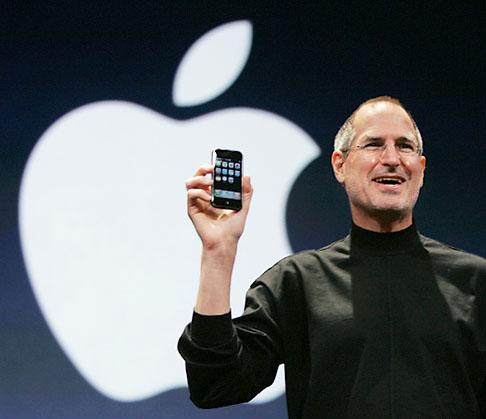
Steve Jobs, co-founder of Apple, died this week. I didn’t know him and yet his death moved me deeply. It shook me awake. When I woke up sad the next morning I did the only thing I know how to do, I thought about Steve Jobs and his passing sociologically.

Of all the things you could say about Steve Jobs, without a doubt, one of them was that he was a great charismatic leader. During his presentations his words, energy, and style could create a “reality distortion field” that would make mundane aspects of his products sound revolutionary. His spirit worked almost like a Jedi mind trick telling reporters what they were to write in their reviews. His charisma seemed superhuman.

(source)

A charismatic authority figure is one of three styles of authority that Max Weber talked about. Authority can be thought of as the use of power that is perceived as legitimate. Some statuses have power simply because of tradition (e.g. parents have power over children). Other statuses have power because they have been “routinized” or built in the structure of social institutions. Weber calls this type of authority rational-legal authority and the president of the United States is a good example of this type.

Charismatic authority can be thought of as the the use of power that is legitimized by the exemplary characteristics of a person or by their accomplishments that inspire others to follow or be loyal to them. Steve Jobs accomplishments have gained him a rabid fan base; to the point that Apple fans are oft referred to as members of the “Cult of Mac”. It was because of who Jobs is (or at least how he was perceived) that many people admired, respected, and followed his work.

The problem for Apple is that any organization that gains its authority because they have a charismatic leader must eventually deal with the loss of that leader. How can you hold on to your authority and legitimacy with the charismatic figure gone? You have to build the revolutionary ideas and practices of the figure into the bureaucracy or formal structure of the organization. Weber called this process of transferring authority from a charismatic person to a bureaucratic organization the “Routinization of Charisma”. In the corporate world they call this process a “succession plan.”

When Jobs resigned on August 24th Tim Cook succeeded him and became the CEO. A few weeks later on October 4 Cook took the stage for the first time to lead Apple’s announcement of the iPhone 4S. The announcement was nearly identical in form to the announcements led by Jobs. During the announcement Cook said multiple times, “There is a lot of momentum here at Apple” which could be interpreted sociologically as, “nothing has changed; we still deserve the authority our previous leader gained through his charisma.” The entire announcement was almost identical to the announcements except many viewers noted that Tim Cook did not have the charisma of Steve Jobs.

Jobs was a master at getting the media to write the headlines he wanted, but after this weeks talk ABC’s headline read “Apple Unveils Anti-Climatic iPhone 4S.” Anti-climatic!?!  Comedians ripped Cook for his poor stage presence in a video. Traders showed their disapproval as Apple’s stock price dropped a half percent after the announcement. I’m not trying to pile on here, I’m just pointing out that transitioning from a charismatic authority figure to less charismatic figure is hard; or as Weber would say it, the “routinization of charisma” is difficult if not impossible.

Now that he is gone, I’m sad because I enjoyed so much listening to him speak about his work. He was an artist in so many ways and I’m sad I won’t get to see anymore of his work. Rest in peace Mr. Jobs.

——————————

Nathan Palmer is a visiting lecturer at Georgia Southern University. He is a passionate educator, the founder of Sociology Source, and the editor of Sociology in Focus.

If you would like to write a post for Sociological Images, please see our Guidelines for Guest Bloggers.

Children are our most important resource.  Everyone says it, but we don’t really mean it.

Exhibit one: the percentage of children under the age of 18 that live in poverty. In 2007, at the peak of our previous economic expansion, the child poverty rate was 18%.  In 2009, it hit 20%.  The figure below provides a look at child poverty rates in each state.  New Hampshire had the lowest rate: 11%.  Mississippi the highest rate: 31%. According to a recently released Census Bureau study, the 2010 national child poverty rate was 22%.


poverty.jpg


How Do We Measure Poverty?

Children under the age of 18 are counted as poor if they live in families with income below U.S. poverty thresholds.  There are a range of poverty thresholds which are based on family size and number of children.  These poverty thresholds are far from generous.  The 2009 poverty threshold for a family of two adults and two children was$21,756.

Sadly our poverty rates understate the seriousness of our poverty problem, for children and adults.  The history of how we developed and calculate our official poverty thresholds provides perhaps the clearest proof of the inadequacy of current statistics.  First introduced in 1965, the thresholds were based on previous work by the Department of Agriculture (DOA).  The DOA created an “economy” food plan in the 1950s that was designed for “temporary or emergency use when funds are low.”  DOA surveys had also established that families of three or more persons spent approximately one-third of their after tax income on food.  Our initial thresholds were set by multiplying the cost of the economy food plan (adjusted for family size) by three.

From 1966 to 1969, these poverty thresholds were revised annually by the yearly change in the cost of the items contained in the economy food plan.  After 1969, and still today, the poverty thresholds were adjusted by the rise in the consumer price index.

Our poverty rates are calculated by comparing pre-tax family incomes to these thresholds.

Why the Poverty Threshold is Deficient

This methodology has produced a poverty standard and estimates of poverty that are deficient for several important reasons:

First, our knowledge of nutrition has significantly changed since the 1950s.

Second, families now spend approximately one-fifth of their after-tax income on food, not one-third.  That correction alone would mean that the food budget should be multiplied by 5 rather than 3, thereby producing higher thresholds and poverty rates.

Third, poverty is best thought of as a relative condition, which means that it should not be measured by comparing incomes to an unchanging standard based on the cost of a 1950’s economy food plan.

Fourth, poverty rates should be calculated using after-tax family income adjusted to include the value of government support programs like food stamps (which are also fluctuating and often cut in hard times), not unadjusted pre-tax family income.

A Better Measure

Researchers, drawing on the work of the National Academy of Sciences Panel on Poverty and Family Assistance Economists, have developed an alternative experimental approach to measuring poverty.  They start with a reference family, two adults and two children.  Then, using Consumer Expenditure Surveys, they calculate the dollar amount of spending on food, clothing, shelter, utilities and medical care by all reference families in a given year.

The poverty threshold for the reference family is set at the midpoint between the 30th and 35th percentile of the spending distribution for all families with two adults and two children.  Small multipliers are then used to add spending estimates for other needs, such as transportation and personal care, slightly raising the poverty threshold.   This threshold is adjusted for families of other compositions.

The chart below shows national poverty rates for the years 1996 to 2005.  We see that the rates produced by this experimental methodology are significantly higher than the official rates.

comparison.jpg

Strikingly, while the official poverty rate is lower in 2005 than in 1996, the 2005 experimental poverty rate is the highest in the period.  The difference is largely explained by the fact that the experimental measure incorporates changes in the availability of social programs and the relative importance of non-food goods and services in family spending.

Returning to the issue of child poverty, the table below highlights the difference between the two measures for specific demographic groups.  Notice that the child poverty rate calculated using the experimental measure is always higher than the official rate.  As previously stated, the official 2010 child poverty rate is 22 percent.  The experimental rate would no doubt be several percentage points higher, closing in on 25 percent.

poverty-table.jpg

What can one say about a situation where between one-fifth and one-fourth of all children in the United States live in poverty?  Language like “outrageous,” “unacceptable,” and “indicator of a flawed economic system” comes to mind.  What also comes to mind is the fact that these poverty statistics rarely get the attention they deserve, as does the question of why that is so.

A new submission is a nice addition to this old post.  The newest iteration of this gender-bending game — men in pin-up poses — can be found in the middle of this collection.

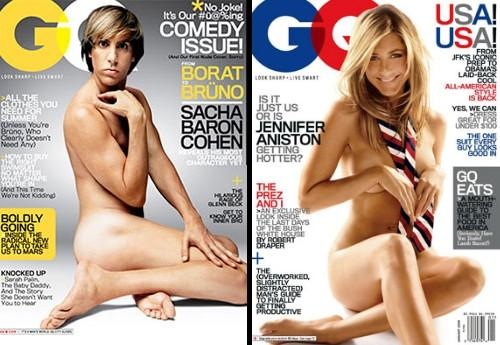
Dmitriy T.M. sent in this month’s cover of GQ featuring Sasha Baron Cohen, in Bruno character.  Cohen adopts a pose often used to showcase women’s bodies.  The contrast between the meaning of the pose (sexy and feminine) with the fact that he’s male draws attention to how powerfully gendered the pose is.  His facial expression highlights the ridiculousness of such a powerful gender binary (women look sexy when they pose like this, men look stupid when they do).

Consider:

mark-seliger-bruno-gq-56

Commenter MB noted that GQ has some news stands have decided to cover the cover (as if it were porn):

custom_1247066887550_gq

The interesting question might be: When we pose women like men, does it look ridiculous or badass?  And, if it looks badass, what does that say about the way we expect women to look and move?

For a similar project, see Yolanda Dominquez’s photos of “regular” women in “fashion” poses.

Lisa Wade, PhD is an Associate Professor at Tulane University. She is the author of American Hookup, a book about college sexual culture; a textbook about gender; and a forthcoming introductory text: Terrible Magnificent Sociology. You can follow her on Twitter and Instagram.