Search results for The

On January 18th, 2012 many sites on the internet went “black” to protest the Stop Online Piracy Act (SOPA) and the Protect Intellectual Property Act (PIPA), including Wikipedia, Boing Boing, Reddit, Cheezburger, Craig’s List, WordPress, Wired, and Sociological Images too, to name a few (in solidarity, Google blacked out it’s logo).  While written ostensibly to make it easier to stop pirating of music, movies, and other media, opponents argue that the Acts are so penalizing and over-reaching that they would essentially criminalize sharing and creativity.  There’s a great slideshow of the blacked out sites at the Los Angeles Times.

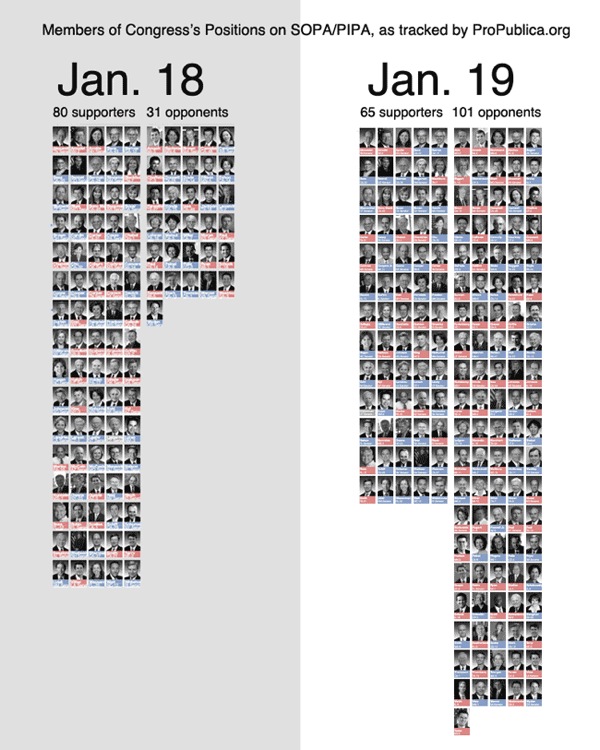
The next day proved that this online action made a large difference, at least in the short run. Seventy Congress members switched their positions or newly decided to stand against the Acts (Boing Boing). Congress has postponed actions on the Act, which was slotted for today.
From the point of view of Sociological Images, this is a much needed victory. From a sociological point of view, it is another illustration of how the internet creates both new legal issues and facilitates new social movement tactics.

Lisa Wade, PhD is an Associate Professor at Tulane University. She is the author of American Hookup, a book about college sexual culture; a textbook about gender; and a forthcoming introductory text: Terrible Magnificent Sociology. You can follow her on Twitter and Instagram.

Sociologists and others use the term “agenda setting” to describe the way that the media focuses our attention on some things and not others.  In this way, media actors may not control how we think about things, but they may very well control what we think about.

This instance of agenda setting involves SOPA, the Stop Online Piracy Act.  Media Matters put together this figure illustrating the relative number of television segments given to SOPA and other issues — the British Royal Family, the football player Tim Tebow, Casey Anthony and her missing daughter, Alec Baldwin’s behavior on a plane, and the Kardashian divorce — between October 26th, 2011 and January 12th of this year.

Data like this is often used to explain why Americans tend to be quite uninformed about important issues.  For more examples, see this post comparing the covers of TIME and Newsweek in the U.S. and elsewhere.  See also: Setting the Agenda on Trump and Setting the Agenda on Janet Jackson’s “Wardrobe Failure.”

Thanks to Dolores R. for the tip!  Via Socialist Texan.

Lisa Wade, PhD is an Associate Professor at Tulane University. She is the author of American Hookup, a book about college sexual culture; a textbook about gender; and a forthcoming introductory text: Terrible Magnificent Sociology. You can follow her on Twitter and Instagram.

“Hey look! Fox News, American Idol, and Monday Night Football had a threesome and it made a baby named the Southern Republican Presidential Debate!”

That was my first thought, anyway, as I watched my first Republican Primary debate of the season two nights ago. I was really surprised at the opening dramatization of the event on CNN.  If you don’t know what I’m talking about, you absolutely must watch the first few minutes of the video below (especially :40 to 2:30):

So, what do you think?  Does this smack of sensationalism to you?  Is this just what TV looks like these days?  Without being overly nostalgic, how does this compare to the mood of previous debates?  How might this framing of the debates affect how people think of the presidency, our government, the process?

Lisa Wade, PhD is an Associate Professor at Tulane University. She is the author of American Hookup, a book about college sexual culture; a textbook about gender; and a forthcoming introductory text: Terrible Magnificent Sociology. You can follow her on Twitter and Instagram.

The Federal Reserve Bank recently released 1,197 pages of transcripts of its 2006 closed door meetings.  As the Wall Street Journal comments: “The transcripts paint the most detailed picture yet of how top officials at the central bank didn’t anticipate the storm about to hit the U.S. economy and the global financial system.”  

Federal Reserve officials suspected that housing prices were peaking (see chart below).  But since they didn’t believe that prices had been driven up by a well entrenched bubble, they were not very concerned that they were coming down. 

p1-be338_fed_ns_20120112181819.jpg 

The Financial Times described the general Federal Reserve stance as follows:

Almost every Fed policymaker concluded that weaker housing would cause a slowdown in consumption and investment but expected that to offset strength elsewhere in the economy, leading to continued growth overall.

“Housing is the crucial issue. To get a soft landing, we need some cooling in housing,” said Ben Bernanke, Fed chairman, in his summing up of the economic situation in March 2006. “I think we are unlikely to see growth being derailed by the housing market.”

Indeed, a number of Fed officials saw the housing slowdown as welcome news that would help resolve a potential threat to the economy. “As to housing, we are in fact, as all have noted, squeezing out of that sector the speculative excesses that developed with the low interest rates of recent years — and doing so is unavoidable if we want to correct the sector,” said Thomas Hoenig, then president of the Kansas City Fed, at the September 2006 meeting of the FOMC. 

The transcripts show that the Federal Reserve was so confident that the economy was on solid footing that many officials were, according to the Wall Street Journal:   

…offering praise for outgoing Fed Chairman Alan Greenspan, who attended his final Fed meeting in January 2006. Timothy Geithner, then president of the Federal Reserve Bank of New York and now Treasury Secretary, playfully offered this forecast about Mr. Greenspan’s legacy: “I think the risk that we decide in the future that you’re even better than we think is higher than the alternative.”

The transcripts also suggest that Fed officials misgauged the potential for housing problems to spill over into the broader economy.

“Our recent financial-market data don’t, in my view, provide a convincing case for a substantial increase in the probability of a much weaker path for growth going forward,” Mr. Geithner said at a meeting in December 2006.  

So how did the best and the brightest get it so wrong?

Perhaps the major reason is because it served their interests to pretend there was no housing bubble.  The recovery from our 2001 recession was driven by consumption and that consumption was supported directly and indirectly by the housing bubble.  In other words stopping the bubble would have revealed the weakness in our economy and the need for serious structural change.  It was far easier and more lucrative for those at the top to just let the bubble go on expanding and pretend that it didn’t exist.

The following chart from the New York Times puts the movement in housing prices highlighted above into a longer term perspective, revealing just how strong speculative pressures were in the housing market.

shiller-housing-bubble-graph.jpg

As Dean Baker, one of the very few economists to warn about the dangers of the bubble, explains 

First, what happened is very straightforward: we had a huge run-up in house prices that had no basis in the fundamentals of the housing market. After 100 years in which nationwide house prices just kept even with the overall rate of inflation, house prices began to sharply outpace inflation, beginning in the late 1990s.

By 2002, when some of us first noticed the bubble, house prices had already risen by more than 30 per cent in excess of inflation. By the peak of the bubble in 2006, the increase in house prices was more than 70 per cent above the rate of inflation.

This was a huge problem because this bubble was driving the economy. It drove the economy directly by creating a boom in residential housing construction. We were building housing at a near record pace in the years 2002-2006. This was in spite of the fact that we had an ageing population and record levels of vacancies at the start of that period.

The other way in which the bubble was driving the economy was through its effect on consumption. The bubble created more than US $8tn [trillion] in ephemeral wealth in housing. Homeowners thought this wealth was real and spent accordingly. The result was a massive consumption boom that sent the saving rate down to zero in the years from 2004-2006.

In reality, a lot of the consumer spending driving growth was financed by home refinancing, which helped many housholds compensate for stagnant wages and weak job creation at the cost of a sharp rise in debt.  As a Wall Street Journal blog post pointed out, “From 2000 to 2007, household debt doubled from $7 trillion to $14 trillion, with debt related to housing responsible for 80% of the increase. By 2007, the household debt to GDP ratio reached its highest level since 1929.”

As we now know only too well, the collapse of the housing bubble reverberated through the economy, including the financial sector, triggering the Great Recession.  Tragically, many of the “best and brightest” remain in leadership positions today, still arguing for the soundness of economic fundamentals. 

I’ve posted in the past about differences I’ve noticed in the language used in signs in the girls’ and boys’ clothing sections at Target, which seemed to reinforce the idea that boys are rough and rowdy while girls are sweet. Eric B. sent in another example that he recently saw in Target’s infants’ department. The store he went to had five aisles; each aisle had a set of large signs along the top. Three of the five were focused on boys, and they all emphasize activities:

So boys actively do things (they play, they learn to feed themselves, they discover) that merit adult attention and admiration. What about girls?

Oh, they sleep:

For other examples of how we reinforce the boys are active/girls are passive binary, see our posts on the binary in Lego City, in kids’ meal toys, and in magazines.

The NYT posted an interesting interactive graphic showing the occupations of the wealthiest 1% of U.S. households, broken down further by industry. You can hover over a rectangle to see how many people in a particular type of job in each industry are in the top 1%, as well as what percent of people in that job/industry are in the top 1%. For instance, 27.2% of physicians in offices or clinics (not hospitals) are in the top 1%:

The relative size of the rectangle tells you how many people in that category are in the top 1% (so overall, the single largest occupational group of the top 1% is management), while the color indicates the % of people in each occupation/industry who are in the top 1% (lightest = less than 1%, darkest = over 20%). Definitely worth going over to the NYT post and playing around for a little while.


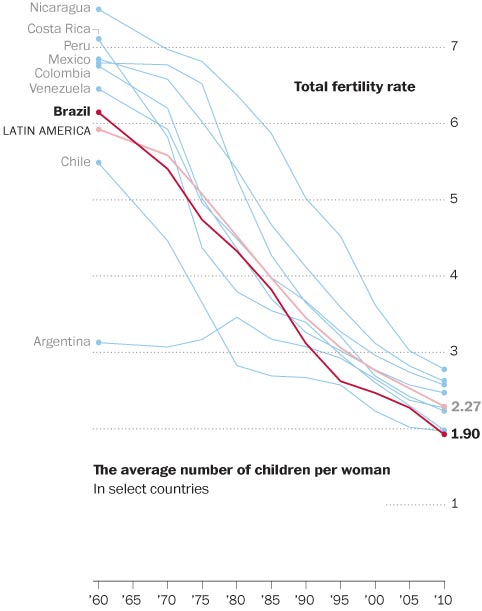
The declining birth rate in Latin America, depicted in this graph, is a nice example of the way that both cultural and social change affects individual choices.  Brazil is highlighted as an extreme case. It’s birthrate has fallen from over six children/woman in 1960 to under 1.9 today.

The accompanying Washington Post article, sent in by Mae C., explains that the decrease in the birthrate since the 1960s is related to migration to cities.  In rural areas children are useful. They can help with crops and animals.  In crowded and expensive cities, however, they cost money and take up space.  Economic change, then, changed the context of individual choices.

This transition — from a largely rural country with high birthrates to an industrialized one with lower birthrates — has been observed across countries again and again.  It’s no surprise to demographers (social scientists who study changes in human population).  But Brazil did surprise demographers in one way:

…Brazil’s fertility rate fell almost uniformly from cosmopolitan Sao Paulo, with its tiny apartments and go-go economy, to Amazonian villages and the vast central farming belt.

The decline in birthrate, in other words, has occurred across the urban/rural divide. Demographers attribute this to cultural factors.  The idea of “an appealing, affluent, highflying world, whose distinguishing features include the small family” has been widely portrayed on popular soap operas, while Brazilian women in the real world have made strong strides into high-status, well-paid, but time-intensive occupations.  They mention, in particular, Brazil’s widely-admired first female president, Dilma Rousseff, who has one child.

Ultimately, then, the dramatic drop in the birthrate is due to a combination of both economic and cultural change.

Lisa Wade, PhD is an Associate Professor at Tulane University. She is the author of American Hookup, a book about college sexual culture; a textbook about gender; and a forthcoming introductory text: Terrible Magnificent Sociology. You can follow her on Twitter and Instagram.

In this minute-and-a-half, sociologist Nikki Jones talks about the way that the idea of the ghetto has been commodified — especially in rap and hip hop — in ways that informs Americans who don’t live in inner-city urban areas, but potentially mystifies the reality of that life as well:

Lisa Wade, PhD is an Associate Professor at Tulane University. She is the author of American Hookup, a book about college sexual culture; a textbook about gender; and a forthcoming introductory text: Terrible Magnificent Sociology. You can follow her on Twitter and Instagram.