Search results for The

Katrin sent in an interesting example of an effort to (re)masculinize an occupation. Often when we see these efforts, they’re aimed at attracting men to traditionally-female jobs such as nursing by asserting that only “real men” would be able to handle the demands of the job, or emphasizing compatibility with masculinity.

In this case, the occupation that is being framed as highly masculine isn’t one dominated by women; it is, in fact, open only to men: the Catholic priesthood. The image, originally posted at NYPriest, is taken from Fishers of Men, a video released as part of the Archdiocese of New York’s Office of Vocations “The World Needs Heroes” campaign, meant to attract men to the priesthood:

Usually, a male-dominated occupation wouldn’t be in need of having its masculinized character stressed so openly. However, the child sex abuse scandals that have rocked the Catholic Church in the U.S. and elsewhere have damaged the image of the priesthood. Not only did many priests sexually abuse children, but many of the abused children where boys. Had the abuse involved primarily girls girls in late childhood or their teens, the public may very well have expressed revulsion and disgust, but we also have cultural narratives available, such as the idea of the sexually precocious Lolita who entices men against their better judgement, that are often used to at least partially justify or explain adult men’s sexual attraction to or abuse of even young girls (such as the judge who, in 1982, called a 5-year-old rape victim “unusually sexually promiscuous” and gave the adult man who assaulted her only 90 days in a work-release program).

But the fact that so many victims were boys meant those cultural narratives, which implicitly reinforce assumptions about adult masculine sexuality (men can’t quite control themselves; they’re easily led astray by female temptresses, even inappropriately young ones) didn’t apply. Abusing boys undermines the assumption of heterosexuality that is essential to hegemonic masculinity.

Given this social context, it’s not surprising that the NY Archdiocese felt the need to reassert the priesthood as masculine as one element of their image rehabilitation campaign.

Late Night TV host Jimmy Kimmel encouraged his viewers to film their children getting early Christmas presents that they would surely hate.  The result is a collection of children acting badly: bursting into tears, saying they hate their parents, lecturing them on proper gift giving protocol, etc.  It’s funny and also a great illustration of the gift-giving rules that Theodore Caplow meticulously lists in his article, Rule Enforcement Without Visible Means: Christmas Gift Giving in Middletown (pdf) (btw: this is the very first article I assign in Soc101).

(UPDATE: I was quoted briefly on this phenomenon in a New York Times story on the prank.)

In a number of cases, the gift is considered bad because the recipient is a boy and the gift is for a girl.  One boy, for example, gets a Hello Kitty gift, another gets a pop star-themed coloring book.  The boys’ reaction at being presented with a girls’ gift reveals their internalization of androcentrism, the idea that masculinity is superior to femininity.   They express both disgust and, in some cases I think, fear at being poisoned by contact — especially such personal contact as “I got this for you” — with girlness.

More posts on androcentrism: “woman” as an insult, being a girl is degradingmaking it manly: how to sell a car, good god don’t let men have long hairdon’t forget to hug like a dudesaving men from their (feminine) selvesmen must eschew femininitynot impressed with Buzz Lightyear commercialdinosaurs can’t be for girls, and sissy men are so uncool.

Lisa Wade, PhD is an Associate Professor at Tulane University. She is the author of American Hookup, a book about college sexual culture; a textbook about gender; and a forthcoming introductory text: Terrible Magnificent Sociology. You can follow her on Twitter and Instagram.

Cross-posted at Montclair SocioBlog.

Children in American movies are typically superior to adults.  The kids are not only all right, they are wiser, less corrupt, and more competent.  “Home Alone” is a classic example, where the plucky, resourceful kid triumphs over both the vindictiveness of the burglars and the mindlessness of his parents.  (An earlier post on children in films is here.)

“The Descendants,” the recent film with George Clooney (I saw it last night), starts more like a French film, where children are, well, children, and it’s the parents who must endure and learn to cope with the kids’ immaturity and thoughtlessness.

Clooney is Matt King, and the name is a deliberate irony.  Kinglike, he must decide the fate of a huge tract of pristine Kauai land that his family has owned for many generations.  The money from the sale will make him and his many cousins and their families rich.  Which developer will he sell the land to?But as a husband and father he is far being monarch of all he surveys.  His wife has been in an accident and lies in a coma.  His two daughters are unapologetically impudent and insufferable.  As the film starts, Scottie, age ten, has sent a nasty, obscene text to a classmate.  Alex, seventeen, now at an expensive private rehab/therapeutic school, first appears on screen drunk, having  sneaked out of her room at night with another girl.  Then there’s Sid, Alex’s friend, a slightly older boy, all stupidity and insensitivity, a chubby incarnation of Beavis and Butthead.Then the film magically transforms the kids.  Each has been introduced as obtuse, obscene, or obnoxious. But now Alex, it turns out, knows more than her father does, at least in one crucial area – that his wife, now on life support, had been cheating on him.

The kids change from being French, a burden for the grown-up, to becoming almost classically American, not superior but equal.  They are now his partners.  Teens and adult are a team trying to discover the identity and location of the seducer so that King can confront him.  The teenagers are suddenly much less difficult and much more helpful, while King sometimes appears uncertain and even silly, peering over hedges to spy on his wife’s lover.   He asks his daughter for advice.  He even asks Sid what he should do.(You can get some sense of this transformation in the trailers here and here, which also outline the rest of the story.)

Still, the movie doesn’t go pure Hollywood.  It does not present the world as a character contest where good faces evil, where the right action is clear and the only question is how the hero will come to make it.  Instead, it shows a grown-up trying to understand and cope with problems and people he cannot really control.

And nobody blows up a helicopter.

Cross-posted at Ms.

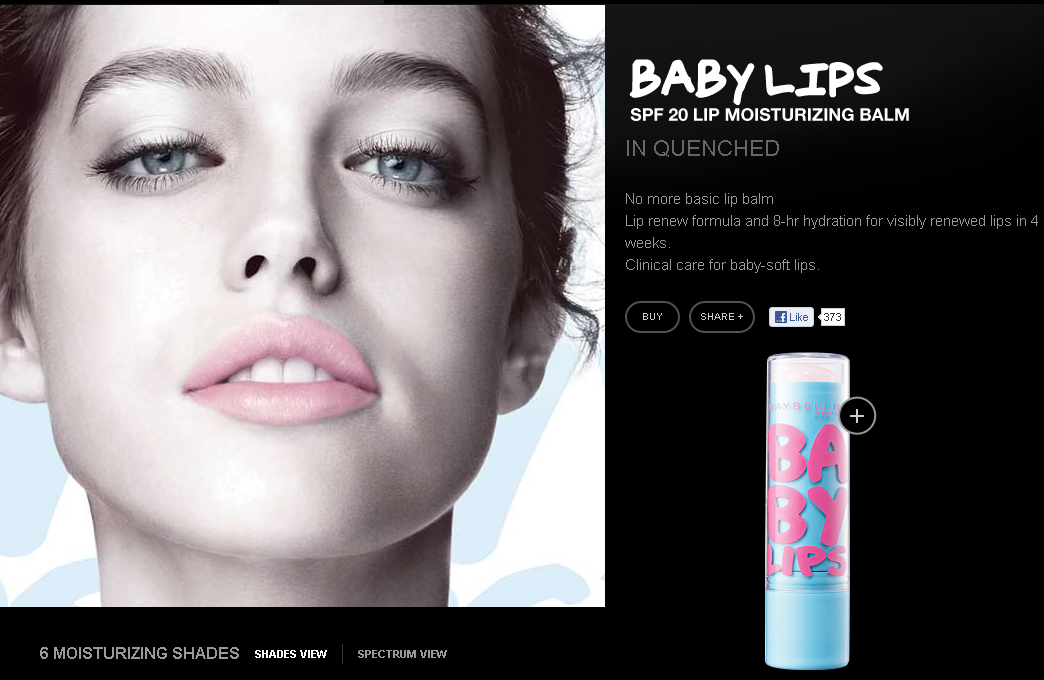
Maybelline’s brand of lip gloss, “baby lips,” is a straightforward example of the infantilization of adult women:

We should be worried about the infantilization of women for two reasons:

First, it’s directly related to the sexualization of young girls.  The two phenomena, when considered together, clearly point to the convergence of female children and adult sexuality.  As I wrote in a previous post:

…on the one hand, women are portrayed as little girls, as coyly innocent, as lacking in power and maturity. On the other hand, child-likeness is sexy, and girls are portrayed as Lolitas whose innocence is questionable.

Second, the need for women to look like babies to be beautiful (and the requirement for women to be beautiful), turns aging into a trauma for women.  Susan Sontag, in her (truly beautiful) essay The Double Standard of Aging, put it this way:

The great advantage men have is that our culture allows two standards of male beauty: the boy and the man… A man does not grieve when he loses the smooth, unlined, hairless skin of a boy. For he has only exchanged one form of attractiveness for another…

There is no equivalent of this second standard for women. The single standard of beauty for women dictates that they must go on having clear skin. Every wrinkle, every line, every gray hair, is a defeat.

A very lucrative defeat for Maybelline, if we buy into it.

More of the quote at a previous post.  And, for more on the infantilization of women, see our posts on baby teethlady spankingGleethis collection of examples, a vintage example, and the Halloween edition. Link via BagNewsNotes.

Lisa Wade, PhD is an Associate Professor at Tulane University. She is the author of American Hookup, a book about college sexual culture; a textbook about gender; and a forthcoming introductory text: Terrible Magnificent Sociology. You can follow her on Twitter and Instagram.

Cross-posted at The Hipster Effect.

I know, I know – you hate hipsters. Maybe somebody called you one once, but they were clearly mixing you up with the real hipsters. You know the ones.

Hipsters have beards. Or mustaches. Or neither. They wear skinny jeans. Or maybe they don’t. They’ve got thick-rimmed glasses. Or sometimes not. You may not be able to describe one offhand, but you know one when you see one. Right?

As elusive as a unicorn yet as common as an ant, the hipster seems to be everywhere and nowhere at once. The only definite thing about a hipster is that nobody wants to be called one (yet pretty much all of us are guilty of having called other people hipsters). It’s become one of the worst insults you can bestow upon somebody (yet it’s also among the most common). If you want to completely discount a person and everything that they stand for, just break out the H-word and watch their credibility to go down the drain. Once you’ve been dubbed a hipster, you yourself become meaningless in that context.  You become one of those people and we all know what those people are like.

Or do we?

The definition of a “hipster” is at best a collection of vague cultural artifacts that we associate with a certain set of personality traits, very few of which actually exist in tandem. The prototypical hipster is a trust-fund baby who spends his days talking about art projects that he never gets around to starting. He drinks the cheapest beer available even though he can afford better. He does this ironically, and he wears his clothes in the same way. He judges you, the non-hipster, based solely on your appearance, quickly dismissing you as a non-member of the hip elite. He listens to bands you’ve never heard of and thinks it’s sad that you can’t keep up with his cooler-than-cool musical tastes. In short, the prototypical hipster is an asshole – but for the most part, he doesn’t even exist.

In a way, we’ve vilified the hipster archetype as a way of dealing with our own insecurities. Being cool was something most people never worried about once they graduated high school. Our internet-fueled society has since changed that, bringing the hunt for the newest and most interesting things into our day-to-day lives. There is a burden to be cool that now follows you into your 20s and 30s and beyond, whereas before these things were safely relegated to lunchtime cafeterias and high school auditoriums. And with the internet now spitting out a different concept of cool with each and every day that goes by, it’s almost impossible to keep up. Eventually we throw up our hands in exasperation and, whenever we see somebody who looks like they’re trying harder than us, we spit out the word: hipster.

—————————

Sophy Bot is the author of the forthcoming book, The Hipster Effect: How the Rising Tide of Individuality is Changing Everything We Know about Life, Work and the Pursuit of Happiness.  Bot also runs The Hipster Effect blog, examining how identity, society and work have metamorphosed in the age of perpetual connectivity.

Cross-posted at Montclair SocioBlog.

The best way to lie with statistics, says Andrew Gelman, is just lie.  This graph from Fox news is a visual version of that.  It’s published at Flowingdata.com via Media Matters.

The numbers are correct, but the Foxy graphmongers are making up the Y-axis as they go along.  The 8.6% of November is higher than than 8.8%, 8.9%, and maybe even the 9.0% of the first three months of the year.

Or maybe it’s an optical illusion.

[HT:  Max Livingston]

Back in November, Conan O’Brien officiated at the wedding of two gay men on his show. This received a decent bit of media coverage, it being the first time a same-sex couple was married on TV. My friend John McQuiston pointed out a great video showing the intros of many stations’ coverage of the story. John says CBS Newspath released a tease with the phrase “pushing the envelope,” and the phrase stuck. The clip illustrates the way that, despite the many media outlets available to us, norms of news reporting (and, according to John, general laziness) mean that we often hear the same message or framing of issues repeated over and over, reinforcing a particular understanding of events to the exclusion of other interpretations:

Cross-posted at Montclair SocioBlog.

The equation of wealth and virtue seems to come almost naturally, at least among the wealthy.  The logic is simple:  Virtue leads to success, therefore wealth is evidence of one’s virtue.  Virtue, in this case, means the Protestant Ethic – hard work and a willingness to forgo or postpone pleasures.  It follows then that those who are not wealthy must have turned their back on virtue.

David Brooks, in his Friday column (here),  applies this explanation to the wealth of nations.

Why are nations like Germany and the U.S. rich? . . . It’s because many people in these countries believe in a simple moral formula: effort should lead to reward as often as possible.

People who work hard and play by the rules should have a fair shot at prosperity. Money should go to people on the basis of merit and enterprise. Self-control should be rewarded while laziness and self-indulgence should not.

The US, Germany, and the Netherlands are Brooks’s exemplars of these virtues (Brooks uses the word ethos).  The bad countries, the ones whose economies are teetering on the brink, are the grasshoppers to our ant.  There they were – Brooks points his finger at Greece, Italy, and Spain – fiddling and dancing the summer away, refusing to live within their means or “reinforce good values.”

This seems accurate, doesn’t it – the dolce far niente Italians and other Mediterraneans, taking hours at midday for meals and siestas while the industrious Americans, Germans, and Dutch are working away, wolfing down a sandwich at their desks.

Just to be sure I downloaded some OECD data from 2007 – the last year before the big crash – on the number of hours people in different countries work. (Brooks’s three “ant” countries are red, the “grasshoppers” dark blue.)This is puzzling.  The US is slightly above the OECD average, but workers in Greece and Italy spend more hours at work than do Americans, while the Dutch and Germans are down at the low end of the scale.  (I do not know why the OECD still gives data for West Germany as well as Germany.)

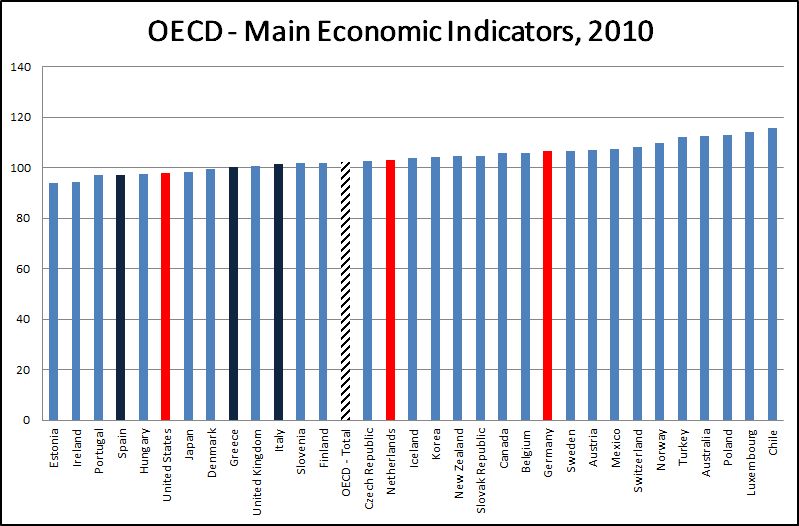
I noticed that the OECD also had a measure of “employment protection,” which is basically how hard it is to fire someone.  I figured that workers in non-virtuous countries would be highly protected.  Since it’s nearly impossible for them to be fired, they know they can slack off on the job.  By contrast, virtuous countries would foster Brook’s ethos of “effort, productivity and self-discipline”  in workers, rewarding the industrious, firing the lazy and self-indulgent.I wasn’t surprised that the US anchored the low end of the scale.  Workers here have less job-protection than those in any of the other countries.  And Greece and Spain are above the average.  But so are Germany and the Netherlands, though only slightly, while Italy is slightly below the average.  There’s really not much difference between these three.  And if you look at the array of countries, there seems to be no strong connection between job protection and how well the country is weathering the current long recession.  I’m not sure what the best measure of the overall economy is, but the OECD has composite figure made up from ten main economic indicators.* I just wish we had better measure of Brooks’s “ethos.”

——————-

*  “The Labour Force Survey (MEI) dataset itself covers countries that compile labour statistics from sample household surveys on a monthly or quarterly basis. It is widely accepted that household surveys are the best source for labour market key statistics. In such surveys, information is collected from people living in households through a representative sample. Surveys are based on standard methodology and procedures used all over the world. The 10 subjects available cover labour force, employment, unemployment (including harmonised unemployment), and employees.”