Search results for The

Cross-posted at Montclair SocioBlog and in Portuguese at Conhecimento Prudente.

This ad illustrates some sociological idea, something I could use in class. I’m just not sure what it is.  (You may have already seen it. It’s been around on the Internet for a few months.)

Yes, it’s a beer commercial, not a documentary, not “reality.”  But the couples are real and unscripted – like the victims in a “Candid Camera” bit (or the subjects in some social psychology experiments).  Real and unscripted too is our reaction as viewers.  I don’t know about you, but after the ad was over, I realized that I had shared something of the couples’ anxiety at being different and hence excluded.  The bikers are neutral, maybe they are even silently hostile, so when they suddenly became accepting, my sense of relief was palpable.  I laughed out loud.

So sociological point one is that we are social animals.  Excluded we feel fear, accepted and included we feel comfort.  Point two is that laughter is social.  Here (and in many other situations) it’s a kind of tension-meter.  There ad had no joke that I was laughing at.  It was just a release from tension.  No tension, no laughter.

The ad also illustrates “definition of the situation.”  The rigged set-up shatters the couples’ standard definition of going to the movies. They are anxious not just because they are different but because they nave no workable definition and therefore no clear sense of what to do.

Finally, the ad raises the issue of stereotypes.  Stereotypes may actually have some general statistical accuracy.  The trouble is that the stereotype converts a statistical tendency to absolute certainty.  We react as though we expect all members of the stereotype to be that way all the time or most of the time.  Is it reasonable when you see 148 bikers to be fearful even to the point of leaving (I think some of the couples didn’t take the available seats)?  You don’t need to have read Hunter S. Thompson  to know there is some truth in the image of bikers as above the mean on violence.  But in a theater where you find them quietly awaiting the movie?

What other sociological ideas does the ad suggest?

In honor of Prune Breakfast Month, we’re re-running this post on the prune.

What’s a prune?

Answer One, the social construction: Prunes are dried fruit you serve to old people who need help with their bowel movements (though, hilariously, it wasn’t always that way).  This is epitomized by the Sunsweet slogan, “The Natural Way to Go” and illustrated in the following eclectic combination of cultural items:

Not exactly an appetizing advertising campaign, eh?  (Though my grandpa, and all three uncles, would totally wear that hat.)

Answer Two, the purely descriptive answer: Prunes are dried plums. Which, of course, they are.  Lovely, gorgeous, beautiful plums:

Mariani, not stupid, recently changed the name of their product from “prunes” to “dried plums,” instantly transforming their product from one for the constipated elderly to one for connoisseurs of exotic dried fruits.

From prunes:

To dried plums:

Words matter, is all.

(Images borrowed from herehere, here, here, here, and here.)

Lisa Wade, PhD is an Associate Professor at Tulane University. She is the author of American Hookup, a book about college sexual culture; a textbook about gender; and a forthcoming introductory text: Terrible Magnificent Sociology. You can follow her on Twitter and Instagram.

Cross-posted at Caroline Heldman’s Blog.

In early 2009, I had dinner with a prominent, conservative political operative. He calmly (and accurately) predicted that the 2010 mid-term election would see the largest Republican gains in half a century. He then leaned in and half-whispered, “but you haven’t seen anything yet. Just wait until 2012 .” I pressed him on specifics, but he would only allude to a campaign that would rewrite the political rules. With the revelation that a centralized, state-by-state voter suppression campaign is underway, I now know what he was alluding to.

The New Voter Restriction Laws

In 2011, a sudden wave of state-level voter restrictions in Republican-controlled states has swept the nation, just in time for the 2012 election, with 19 new laws and two executive actions on the books. Some of these laws reduced or eliminated early voting, while others did away with weekend voting and same-day registration. All 50 states require voters to prove their identification at the polls, but 17 states have pending or approved law mandating government-sponsored IDs in order to vote, despite the fact that approximately 11% of citizens don’t have such IDs (for various reasons). For some Americans, even those with ample resources, getting an ID can be quite a challenge (even for nuns!).

The Brennan Center for Justice estimates that 5 million eligible voters face disenfranchisement from these new voter ID laws.


Voter ID laws disproportionately affect Black AmericansLatino/a voters, U.S. citizens who were born in other countrieselderly peoplepeople with disabilitiestransgendered people, and students — all of whom are less likely to have the required ID for different reasons. A 2006 Brennan Center study finds that 25% of Black , 16% percent of Latino/s, and 18% percent of elderly Americans lack the necessary ID. Some on the left have accurately likened these new laws to Jim Crow Era poll taxes because the expense involved in obtaining an ID place a disproportionate burden on many groups that have been historically disenfranchised.

What do all of these groups have in common? With the exception of elderly Americans who have shifted Republican in recent years (although they still comprise the most active voting group for Democrats), the Americans who will be disproportionately affected by voter ID laws all vote overwhelmingly Democratic.

There is little doubt, then, that voter ID efforts will affect the upcoming presidential election. The states that have restricted voting rights also have 185 Electoral College votes, two-thirds of the 270 needed to win the presidency. Out of the twelve battleground states in the upcoming election, five have already restricted voting rights and two others are considering new limitations.

Who’s Behind the New Laws?

The corporate organization behind the new spate of voter ID laws is the American Legislative Exchange Council (ALEC), which claims to be a “nonpartisan public-private partnership” between legislators, the private sector, and the general public to promote “principles of free markets, limited government, federalism, and individual liberty.” (How is requiring government-issued ID to vote a promotion of “limited government” and “individual liberty”?) In actuality, ALEC is a hyper-conservative Republican organization that receives 98% of its funding from corporate entities, such as Exxon Mobil, Atria (formerly Phillip Morris tobacco), AT&T, Coca-Cola, and the Charles G. Koch Charitable Foundation.

And ALEC is more than just a corporate lobbying organization. They work directly with legislators (who are ALEC members) to craft model legislation that is then introduced in statehouses across the country without acknowledging that corporations drafted the bill. ALEC drafted model ID voter legislation, and every single new voter ID law was passed with ALEC member involvement. ALEC’s policy agenda for 2011 included bills to deregulate polluting industries, privatize education, eliminate unions, and voting restrictions.

David and Charles Koch, two brothers who have quietly promoted their radical, free-market agenda with $100 million in contributions to conservative causes, including bankrolling Scott Walker’s election and subsequent recent assault on public unions in Wisconsin, have long ties to ALEC. Koch Industries has been one of a select group of members on ALEC’s governing board for nearly two decades, and from what little financial information is available, the Koch contribution to ALEC likely exceeds $1 million. The lead lobbyist for Koch Industries formerly chaired ALEC. Koch brother involvement in voter ID laws should be of particular interest for the Occupy Movement considering that David Koch’s project, Citizens for a Sound Economy, spearheaded the effort to repeal Glass-Steagall that enabled banking institutions to gamble in securities and tank the economy in 2008.

The purpose of new voter ID laws is to demobilize certain portions of electorate who are more likely to vote for Democrats, a goal laid out by ALEC founder, Paul Weyrich many decades ago who stated that “I don’t want everybody to vote… Our leverage in the elections goes up as the voting populus goes down.”

In short, this is a corporate-sponsored attack on democracy, spearheaded by Republicans intent on disenfranchising certain groups in the electorate in order to gain political control.

But Don’t We Need to Enhance Voting Security?

No. The voter ID movement is based on a bald-faced lie that voter impersonation is an issue. It’s not. As the DNC humorously notes, a person is 39 times more likely to be struck by lightning than to engage in voter impersonation, and 3,600 times more likely to report a UFO.

This voting fraud figure is based on a Bush Administration investigation into the matter that involved only 70 prosecutions nationwide, some of which were honest mistakes.

The Real Problem: Voter Turnout

We don’t have a voter impersonation fraud problem in the U.S., but we do have a voter turnout problem. Turnout in presidential years has declined since 1960, and pitifully hovers below 60% of the eligible electorate. We should be undertaking Herculean efforts to increase voter turnout, not erecting barriers to voting based on trumped-up problems to serve partisan ends. Yet, despite the data, untold resources are being spent to “correct” a problem that simply doesn’t exist. These new laws will cost taxpayers millions of dollars annually to implement, not including the cost of certain litigation. When a situation like this arises in politics, it means there are other motives at play.

We don’t need new barriers to voting, we need a state-by-state response with the concrete goals of getting people ready to vote, registering new voters, and overturning these laws.

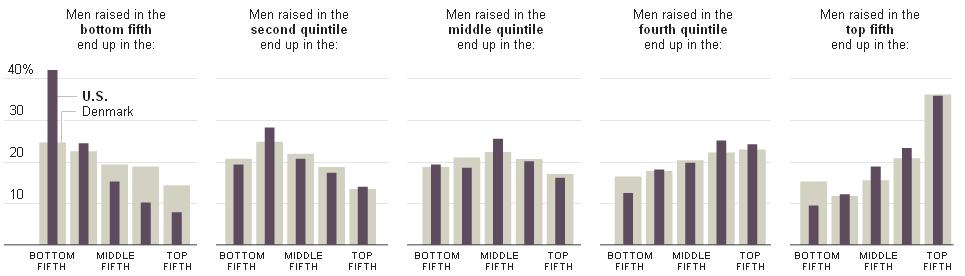
Tara B. drew my attention to a New York Times article on economic mobility in the U.S. and Europe. This chart compares intergenerational mobility in the U.S. and Denmark, showing where men raised in each quintile of the population (based on income) end up as adults (lighter bars = Denmark, dark bars = U.S.):

For both countries, there is more movement in the middle of the income distribution than at the extremes. However, there are important differences. As we see, in the U.S. men whose dads were in the bottom fifth in terms of income are much more likely to remain in the bottom earnings tier than men in Denmark are, with over 42% experiencing no mobility. We also see that they are less likely to move to the highest levels of the income ladder than are their Danish equivalents. However, this is partially due to differences in the overall distribution in income; because there is more income inequality in the U.S., an individual would have to gain much more income to make it from the lowest to the highest quintile than would someone living in Denmark, where the income distribution is more compact.

The full article from which this data is drawn, “American Exceptionalism in a New Light: A Comparison of Intergenerational Earnings Mobility in the Nordic Countries, the United Kingdom and the United States,” is available for free here.

While most Americans think of the witch as a possibly evil character associated with Halloween in the U.S., many Italians would see a motherly figure who keeps a clean house (hence the broom) and gives candy or coal to children.  The character’s name is Befana.  Thanks to Katrin for drawing my attention to her.

Italians celebrate the end of the Christmas season today,  January 5th.  Tonight is the night before the Feast of the Epiphany (celebrating the understanding that Jesus was God in human form) (source).  According to Italian mythology, Befana will visit children’s homes, filling their shoes with candy (if they’ve been good) or coal (if they’ve been bad) (source). Epiphany Eve is celebrated throughout Italy.

For more examples of variation in the culture of Christmas, see our posts on Krampus: Santa’s Evil Side KickThe ChristKind, Snegurochka: Santa’s Granddaughter, and Black Pete (trigger warning for blackface).

Lisa Wade, PhD is an Associate Professor at Tulane University. She is the author of American Hookup, a book about college sexual culture; a textbook about gender; and a forthcoming introductory text: Terrible Magnificent Sociology. You can follow her on Twitter and Instagram.

Cross-posted at Reports from the Economic Front.

Here is a short (less than 4 minute) video that illustrates the fact that 53% of our tax dollars, conservatively estimated, go to finance our military.

And here is a link to a recent study by Robert Pollin and Heidi Garrett-Peltier on the employment effects of military spending versus alternative domestic spending priorities, in particular investments in clean energy, health care, and education.

The authors first examine the employment effects of spending $1 billion on the military versus spending the same amount on clean energy, health care, education or tax cuts.  The chart below shows their results.

defense.jpg

Moreover, even though jobs in the military provide the highest levels of compensation, the authors still find that “investments in clean energy, health care and education create a much larger number of jobs across all pay ranges, including mid-range jobs (paying between $32,000 and $64,000) and high paying jobs (paying over $64,000).”

Let’s see if these facts come up in the next Congressional budget debate.

Cross-posted at Ms.

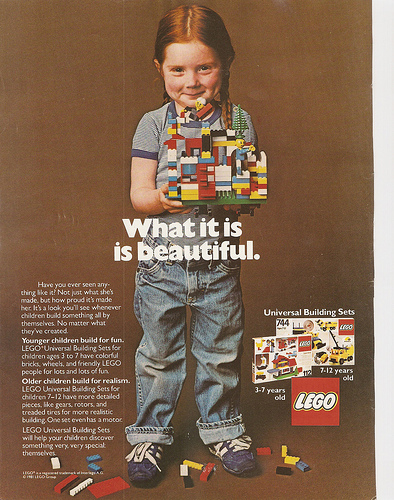
A few years back we published this fantastic ad for Legos as an example of gender-neutral advertising. It appeared in 1981; during my childhood, I’m happy to say.

The ad offers nice context for the new effort by Lego to capture The Girl Market.  Their new line of Legos, Lego Friends, has gotten a lot of attention already. In the circles I run in, it’s being roundly criticized for reproducing stereotypes of girls and women: domesticity, vanity, materialism, and an obsession with everything being pastel.  Kits include a house, cafe, animal hospital, tree house, beauty salon, and an inventor’s lab.  Choice examples:


The new line also includes a new Lego figurine that is taller, thinner, and more feminine, with boobs.  There is no innovation here; it is the exact same makeover that we’ve seen in recent years with Dora the ExplorerStrawberry Shortcake, Holly HobbieLisa Frank, Trolls, Cabbage Patch Kids, My Little Pony, Rainbow Brite, and Candy Land (or visit our Pinterest collection of Sexy Toy Make-Overs).

Examples of the old “mini-fig” and the new “mini-doll” available at The Mary Sue.

The company is framing their new line for girls with “science.” Executives are going to great lengths to explain that the line is based on research, using anthropologists who spent time with girls in their homes. The frame gives the company an excuse for reproducing the same old gender stereotypes that we see throughout our culture.  They can shrug their shoulders and say, “Well, what are we to do? This is what girls want.”  In this way they are trying to make it clear that they shouldn’t be held accountable for the messages their products send.

But it’s no accident that girls feel alienated from Lego.

According to Business Week, Lego has spent most of the last decade focusing their products on boys.  They have deliberately designed products that they expect will appeal to boys and included boys almost exclusively in their marketing material. Today Legos are shelved in the boy aisle is most toy stores.

So, basically, what Lego has done over the last few decades is take a truly wonderful gender-neutral toy, infuse it with boyness, and tell every kid who’ll listen that the toy is not-for-girls.  Now, stuck with only 50% of the kid market, they’re going after girls by overcompensating.  And, to top it all off, they’re shaking their heads and doing “science” to try to figure out girls, as if they’re some strange variant of human that regular humans just can’t get their head around.

In fact, girls don’t feel like the toy is for them because Lego has done everything in its power to ensure that they will not.

The market research manager sums up Legos’ impression of what girls want this way: “The greatest concern for girls really was beauty.”  How ironic, because the true beauty of Lego is its ability to inspire creativity, not enable conformity.  They somehow knew that back in 1981.

(An ad that deserves being looked at over and over.)

Thanks to Anjan G., Sangyoub P., Rachel W., Dolores R., Erin B., Christie W., and Paul K. for suggesting that we write about this!

Lisa Wade, PhD is an Associate Professor at Tulane University. She is the author of American Hookup, a book about college sexual culture; a textbook about gender; and a forthcoming introductory text: Terrible Magnificent Sociology. You can follow her on Twitter and Instagram.

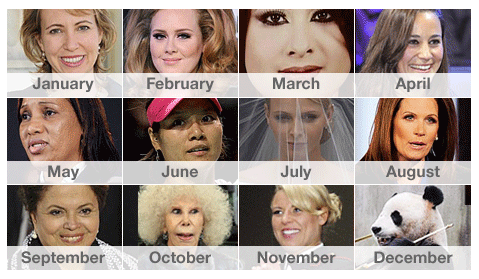
As reported at Jezebel, 2011 “was either lacking severely in girlchievements or a banner year for lady pandas.”

Summarizing BBC’s “Faces of the Year,” Erin Gloria Ryan writes:

…the rest of the list will leave people who were hoping for a progressive set of female movers and shakers disappointed. Sure, it includes Michele Bachmann… and Dilma Rousseff, the first female President of Brazil. But the list also includes Charlene Wittstock, a woman famous for almost not marrying a prince, a very wealthy Spanish duchess who married a younger man, and Pippa Middleton, a woman famous for being related to a woman who married a prince. We’ve also got two sexual assault victims on the list— Eman al-Obeidi, the Libyan woman who was dragged away from reporters while trying to tell them she’d been raped by Gaddafi forces, and Nafissatou Diallo, the woman who accused Dominique Strauss-Kahn of trying to rape her in his $12 zillion per night hotel room. And then there’s the US Marine who successfully asked Justin Timberlake to go to a dance with her.

All in all, more than half… are rape victims, princesses and thereabouts, or bears.

And as SocImages reader @ThatJohn pointed out after comparing the BBC’s lists, men are noteworthy for doing things, women for having (often violent) things done to them.

Who would you nominate as a woman of the year?

Lisa Wade, PhD is an Associate Professor at Tulane University. She is the author of American Hookup, a book about college sexual culture; a textbook about gender; and a forthcoming introductory text: Terrible Magnificent Sociology. You can follow her on Twitter and Instagram.