Search results for The

In the 3 1/2 minute video below, CGP Gray explains the nonsense behind the word “continent.”  It’s a cultural construct, with some geological rationale, but not enough to rationalize the seven that we recognize.

Also from CGP Gray: What the Bleep is the United Kingdom?! and The Economics of Royalty.

Lisa Wade, PhD is an Associate Professor at Tulane University. She is the author of American Hookup, a book about college sexual culture; a textbook about gender; and a forthcoming introductory text: Terrible Magnificent Sociology. You can follow her on Twitter and Instagram.

Cross-posted at Jezebel.
American Studies professor Jo B. Paoletti has announced the publication of her book, Pink and Blue: Telling the Boys from the Girls in America.  I’ve been eagerly anticipating getting my hands on a copy. It was from Paoletti that I learned that the idea that pink was a feminine and blue a masculine color was a relatively new invention in American history (one that even now does not necessarily extend to other countries).  See, for example, this pink 1920s birthday card for a man (with a pre-Nazi swastika too).

The book asks “When did we startdressing girls in pink and boys in blue?”  To answer this question:

She chronicles the decline of the white dress for both boys and girls, the introduction of rompers in the early 20th century, the gendering of pink and blue, the resurgence of unisex fashions, and the origins of today’s highly gender-specific baby and toddler clothing.

In an analysis of baby cards from the 1960s, she notes that many of the cards are gender-neutral and include both pink and blue, but that even the gender-specific cards (this particular baby was a girl) use both colors. These cards, then, reveal that pink and blue had emerged as recognizable baby colors by the 1960s, but the use of blue in the “for girl” cards and the preponderance of gender-neutral cards suggests that the importance of gender differentiation hadn’t taken hold.

She has a large collection of examples.

At her website Paoletti says she has a book planned on “old lady clothes, mother-of-the-bride dresses, cougars and other age-appropriate nonsense.” I can’t wait.

Lisa Wade, PhD is an Associate Professor at Tulane University. She is the author of American Hookup, a book about college sexual culture; a textbook about gender; and a forthcoming introductory text: Terrible Magnificent Sociology. You can follow her on Twitter and Instagram.
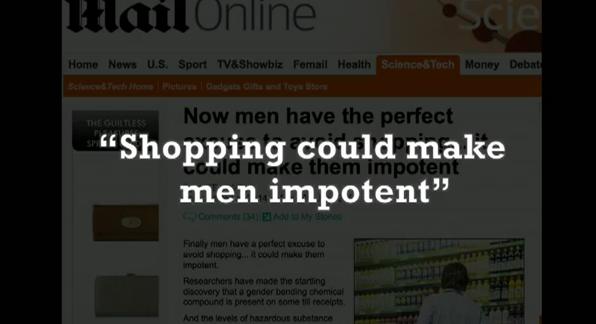
Dmitriy T.M. sent in a TED talk in which Ben Goldacre discusses the problems with many of the scientific findings we hear about in the media, highlighting the importance of scientific literacy and critical consumption of science reporting:

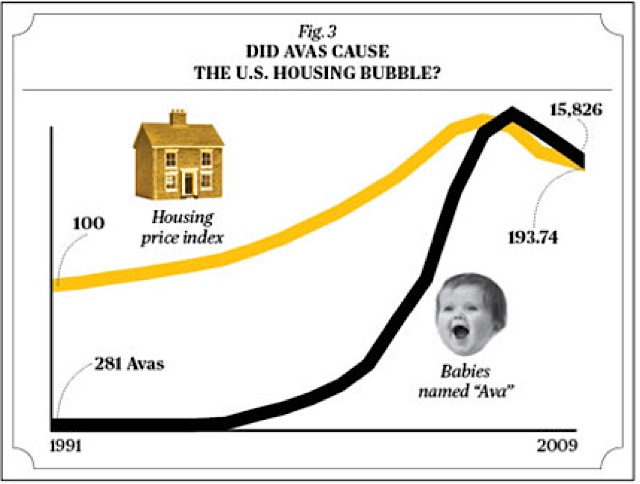
And while we’re on the topic of potentially misleading statistics, Dolores R. and Sarah E. sent in an image posted at boing boing as one of “the best set of infographics ever,” helpfully illustrating the difference between correlation and causation:

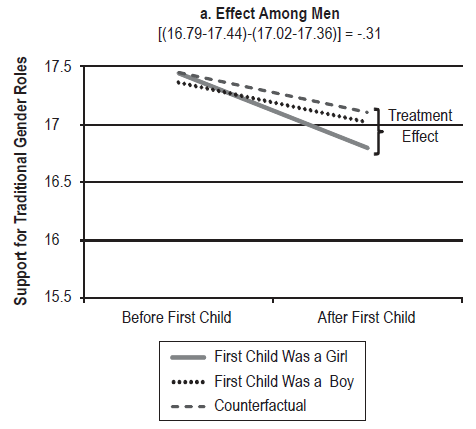
You might have heard that, after the birth of his daughter with Beyonce Knowles in January, Jay-Z has sworn off calling women “bitches.”His change of heart is illustrative of a trend among fathers documented by sociologists Emily Shafer and Neil Malhotra.  Their article measured the effect of a new baby’s sex on a parent’s gender ideology.  Their findings?  Men’s support for traditional gender roles weakens after they have a daughter; no similar result was documented for new mothers.

This first graph shows the average change in fathers’ attitudes before and after having a daughter and a son. The authors note that both men who have daughters (solid grey line) and those who have sons (black dotted line) show a decrease in support for traditional gender roles, but that men who have daughters show a much more steep decline in support.

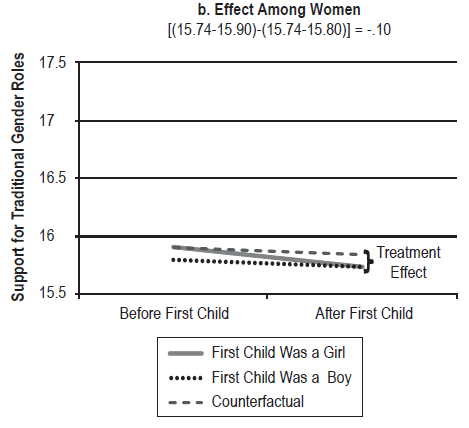
This second graph shows the average change in mothers’ attitudes. Notice that mothers start off with a much lower average level of support for traditional gender roles than fathers and appears to decrease over time.  These changes, though, are not statistically significant. So this study offers no evidence mothers’ ideologies change the way fathers’ do.

Jay-Z, then, may be experiencing what a lot of fathers experience: a change in their thinking about women inspired by looking into the eyes of their own baby daughter.

Cite: Shafer, Emily and Neil Malhotra. 2011. The Effect of a Child’s Sex on Support for Traditional Gender Roles. Social Forces 50, 1: 209-222.

Lisa Wade, PhD is an Associate Professor at Tulane University. She is the author of American Hookup, a book about college sexual culture; a textbook about gender; and a forthcoming introductory text: Terrible Magnificent Sociology. You can follow her on Twitter and Instagram.
Originally posted at Religion Bulletin.

Now that Denver has fallen out of the playoffs, I want to write an homage to a figure I, like so many others, find fascinating: Broncos quarterback Tim Tebow.  Carter Turner over at Religion Dispatches has suggested that the “real reason” for “Tebow fever” was the theological investment that atheists and theists alike had in watching Tebow succeed or fail.  I think that’s absolutely right: Tebow’s body became a sort of theological battleground for broader religious and cultural forces.  But I also think there’s an even more elementary reason, one that becomes apparent when we think about Tebow not just as a proxy for doctrine, but as a particular religious body.

Feminism, poststructuralism, and decolonial studies in the humanities have made scholars more and more aware of the importance of bodies.  Whereas the logocentric western tradition focused on words — the creations of the intellect — 21st century global scholarship sees words as a secondary function of embodiment.  In religious studies, scholars such as Talal Asad, Kimerer LaMothe, and Saba Mahmood have called on us to explore how bodies, through practices, are constituted as religious subjects.  Bodies become religious through performance, through embodied exercises that, through repetition, inscribe us with the modalities of a religious “ethics.”  But embodiment is more than just practices.  I here want to suggest a different direction for understanding the relationship between religion and bodies.

Here’s something I often ask my students to do: Look at this body.  How does religion converge on this body?

Let me tell you what I see, using my own bodily practice, martial arts, as a lens.  This is a body I would not want to fight.  It’s not just about dense muscle lines, the sheer evidence of physical strength, reach, and an intricately arranged posing that suggests bodily self-awareness and sharp muscular intelligence.  This body is compelling.  It draws the eye.  You want to watch it.

This is more dangerous than physical strength — the kind of strength you build on the bench press or the curl.  It’s a “presence.”  The kind of strength that stops bodies in their tracks without landing a punch.  And the kind of strength that draws allies, that rewrites the broader bodily landscape on which conflict happens.  This body has what we might call, following Max Weber, “charisma.”

This way of looking at bodies helps us think again about a fact that has become dramatically apparent in the past two years: Tebow is fascinating.  People love to talk about him, love to love him, love to hate him.  Tebow fever didn’t just happen.  It was and is something is felt–viscerally–by millions of bodies around the world.

On the one hand, Tebow is a leader–an emblematic body — for millions of Christians who see in him a dignification of their faith.  Faith here is not an abstract personal belief.  It is an identity formation, an Us.  Tebow is the champion of a certain Christian Us, an embodiment of values and a leader who rallies the believers.  As a champion, he doesn’t win through debate, he wins through charisma.  He is a hero, resplendent on the battlefield.

At the same time, Tebow is fascinating to other groups — to other bodies — that are frustrated with or skeptical of the Christian Us — and particularly the Christian Us that has managed to insinuate itself into the corridors of power in America through one (but only one) of its instantiations, the Christian Right, a major driver in contemporary Republican politics.  These bodies, as Turner pointed out, are interested in Tebow’s failure, the fall of the enemy’s flag.

My argument, however, is this: this profile of the divergent responses to the nexus of religious and cultural forces that converge on the image of Tebow’s body would be irrelevant and unread if Tim Tebow were a schlub–a homely, uninteresting, modest body, the kind of body that bus drivers drive past at the bus stop.  It is also an open question to me how we would be responding to Tebow if he were not a white body.  Those who want to challenge Tebow, to fight Tebow, to talk about Tebow are drawn in by the seductions of this image–the power of Tebow’s body — no less than those who are so ardently admiring of Tebow that criticism of him becomes a political rallying cry.  Tebow’s body is a magnetic body, a charismatic body.  It bends other bodies towards it–in both positive and critical ways.

This, then, is one of the main ways that religion happens — how identities, beliefs, and affects form and fuse: not through the advance of doctrine, but through the magnetism of religious bodies.

Thanks to William Eric Pedersen for talking this post out with me and pointing me in the direction of the unanswered question on race.

————————

Donovan O. Schaefer is an adjunct instructor in the Department of Religious Studies at Le Moyne College. His interests involve the relationship between religion, bodies, and emotion. In his dissertation, Animal Religion: Evolution, Affect, and Radical Embodiment, he argues for understanding religion in terms of a set of affective bodily practices that are shared by human and non-human animals.

If you would like to write a post for Sociological Images, please see our Guidelines for Guest Bloggers.

Lisa Wade, PhD is an Associate Professor at Tulane University. She is the author of American Hookup, a book about college sexual culture; a textbook about gender; and a forthcoming introductory text: Terrible Magnificent Sociology. You can follow her on Twitter and Instagram.

Cross-posted at Montclair SocioBlog.

What we don’t talk about when we don’t talk about class.  That was the title I wanted to use, but it was too long, and besides, there are already too many of these Raymond Carver variants.

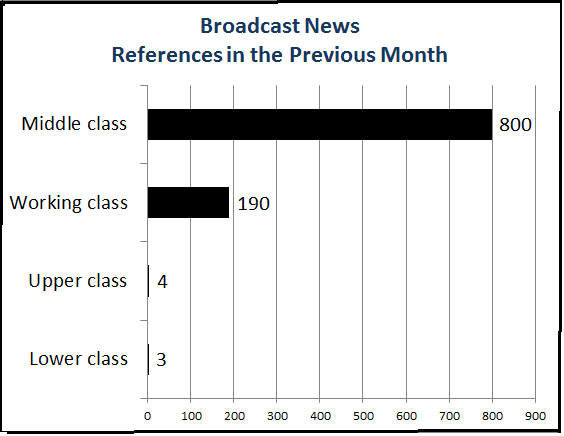
Class seems to have disappeared from public discourse, except for the Republicans’ insistence that to mention inequality at all is to engage in “class warfare.” The only class we hear about, whether from politicians or the media, is the middle class.  Here, for example, are the results of  a Lexis-Nexis search of news transcripts in the previous month.

On TV news, the upper and lower class do not exist.

So how do we talk about those at the top and bottom of society?  The discussion of inequality is now all about income.   While “lower class” and “upper class” had only three and four mentions, respectively, in this same period, income terms (high, upper, low, lower) numbered over 300.

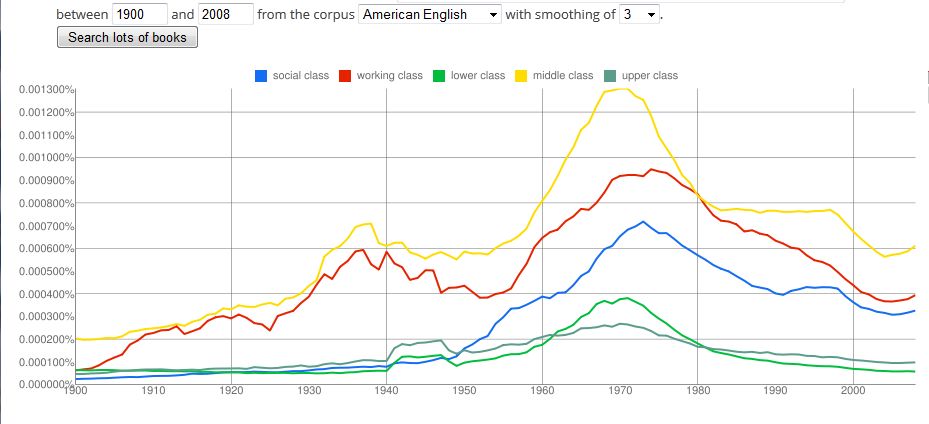
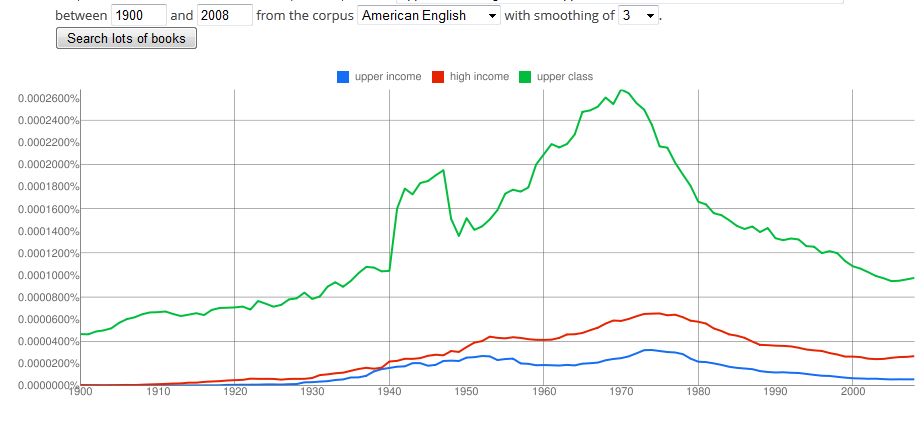
For some historical perspective, I looked at Google Ngrams for the frequency of class terms in books.

The pattern for upper class is similar — a large decline in class talk, a much smaller decrease in income talk — though class references still outnumber income references.

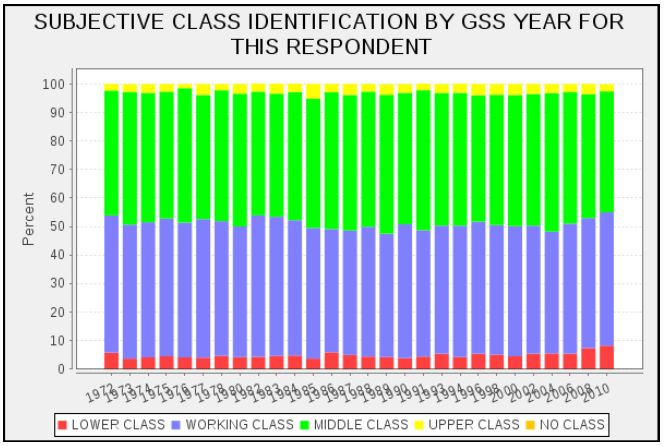
From the media, you get the impression that except for a handful of people at the top and the bottom, there really is only one class in America — the middle class — and that the working class has faded into history.  Yet the GSS subjective social class item (“Which class would you say you belong in?”) gets the same results as it did in 1972: a roughly equal split between “middle” and “working” that accounts for 9 out of 10 Americans.

Originally posted at Shameless.

Marilyn Monroe is often held up as the antidote to the idea that only thin can be beautiful. “Marilyn was a size 10/12/14,” goes a common refrain (though sizing basically means nothing these days, so what does that even prove?). There have been a couple Marilyn Monroe memes floating around Facebook in the past couple months, and both are troubling. The focus is on Marilyn’s curves, and how her swimsuit clad body is different from what movie stars look like today (oh, the tyranny of the “Best Beach Bodies!” issue). What’s supposed to be an empowering message to women – you don’t have to be a Victoria’s Secret model to be beautiful – is completely undermined by two much older memes: divide and conquer and the male gaze.

In the first photo, Marilyn is compared to another woman in a bikini, who is much thinner. The text reads: “This [pointing to Monroe] is more attractive than this [pointing to the other woman].” While I can totally get behind the title “fuck society,” and add “and its stupid expectations” for good measure, there’s nothing anti-establishment about what’s being done here. This is a common tactic, in which women are pitted against each other, so that we lose sight of the real problem: namely, society. If women are fighting amongst ourselves about who is more “beautiful,” if we compare ourselves to other women endlessly, we don’t have time to notice that we’re trapped in a hamster-wheel of low self-esteem. Society hopes that you’ll buy things, to try and make yourself feel better. In the meantime, it’s hoped that we as women won’t critically examine what beauty is, what’s being sold to us, and most importantly, who profits from all this. Fuck Society, sure, because society tells you that if you’re not extremely thin, you’re worthless. However, extremely thin women? They’re still people. Further, bodies are just bodies. They have no intrinsic worth, no moral value, other than what we assign them. The thought behind this comparison photo is to turn the dominant paradigm on its head, but what it really does is reinforce that for one woman to be good, another must be bad. And that kind of thinking isn’t going to get us anywhere.

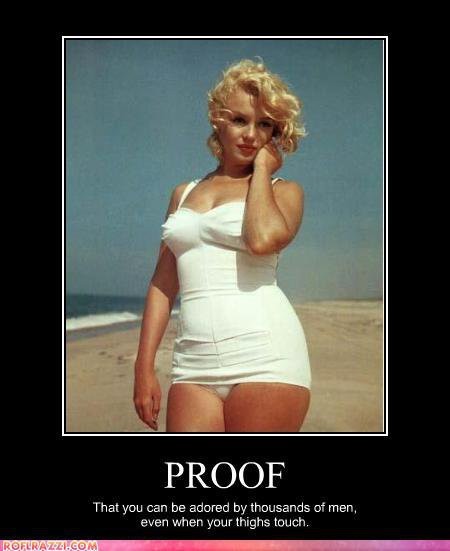
The second is the same photo of Marilyn, this time alone in the Motivational Poster style. The text reads: “PROOF: That you can be adored by thousands of men, even when your thighs touch.” From the start this would seem like a better message. No comparison photo, no pitting women against each other. For some reason, though, this photo troubles and angers me more than the first one does. Because here’s the thing: you are worth more than what men think of you. Marilyn Monroe was, to put it mildly, very sad, very often. She was a sex symbol, and thus, stopped existing as human being, a regular girl. Almost everything that fucked up Marilyn’s later life had to do with being “adored” by men. Men used her, or deified her (and that’s a hard come-down for those dudes when they found a human being in their bed the morning after). Political brothers purportedly passed her around like a toy. Conventional wisdom, political conspiracy aside, has it that Monroe killed herself. Being “adored by thousands of men” didn’t stop her demons from consuming her. It angers me to no end that, again, in the name of self-esteem we’re going to make a poster girl (literally) out of a woman who was notoriously down on herself.

I want very much for us to stop thinking that there is only one body type that is acceptable. I would prefer the focus be on health, rather than appearance. The Monroe Meme seems about the furthest thing from healthy. This is a woman who abused alcohol and sleeping pills later in her life, this is a woman who (probably) died due to depression. But, hey, as long as someone thinks she looks good, I guess that’s what matters.

Heather Cromarty has written for The Walrus Blog, and writes about books and bookish miscellany at In The Midst of Life, We Are in Debt, Etc. Follow her on Twitter: @la_panique.

Since outright hatred and discrimination of people because of their race is no longer socially acceptable in our post Civil-Rights era, many argue racism no longer exists.  But sociologists suggest that racism simply changed, becoming more implicit and indirect.

Eduardo Bonilla-Silva argues that the new racism entails individuals saying and doing things that perpetuate racial stereotypes and inequalities, but they do so in such a way that the offender is able to deny being explicitly racist.  One of the many types of new racist strategies Bonilla-Silva highlights is the use of racially charged code speak, or using indirect racial rhetoric and semantic moves to express an ideology that serves to reinforce white dominance over minorities.

The Daily Show’s Larry Wilmore illustrates the code speak implicit in presidential candidate Newt Gingrich’s suggestion that we combat poverty by hiring poor children to clean the restrooms at their schools.  In the clip below, Wilmore notes that “it’s 2011, and you can’t just call Black people lazy,” and then points out Gingrich’s racial code speak.  He notes Gingrich’s statement about “neighborhoods where they may not have that experience [of working]” is “code for inner-city, which is code for urban, which is code for Black.”   Gingrich’s statement about poor children having “no habit of showing up [to work] on Monday” is “code for shiftless, which is code for lazy, which is code for black.” Wilmore then plays more of Gingrich’s speech where the presidential candidate cites statistics about Black unemployment, thereby making his implicit racial assumptions explicit:

.
The clip also points out how racial ideology engages very different explanations for the causes of poverty depending on the race of those affected.  Wilmore notes, “when Black people are poor it’s their fault because they are lazy and on welfare, but down in poor Appalachia it’s not your fault; it’s China’s fault, or India’s fault, or all the money we’re spending on Black people on welfare.”

When John Stewart asks why this is important, Wilmore points out how the causes of poverty “matter to the solutions,” thereby pointing out Gingrich’s implicit prejudices of nonwhite inferiority with his proposal that Black poverty could be eliminated by hiring children to clean toilets (and Gingrich reaffirmed his support for this idea at a GOP primary debate last week, to wild crowd applause). Similarly, Rick Santorum is now defending himself after saying, “I don’t want to make black people’s lives better by giving them somebody else’s money,” ignoring the fact that most recipients of government aid are White and the vast majority of Blacks are employed and do pay taxes to support the social safety net citizens of all races use. In both cases, the message is clear: African Americans are deficient, with no work ethic, and the solution to poverty is entirely at the individual level, with no need for larger structural changes.

—————————-

Jason Eastman is an Assistant Professor of Sociology at Coastal Carolina University who researches how culture and identity influence social inequalities.

If you would like to write a post for Sociological Images, please see our Guidelines for Guest Bloggers.