Search results for The

The Women’s March in Washington had three times more people in attendance than did President Trump’s inauguration. Many have argued about the reasons for these numbers (see here, here, and here), and used them both individually and together to make claims about activism and political support. But something is missing from these conversations. In order to fully understand the differences in attendance at these events in D.C., and to avoid taking these numbers to mean something they do not, we must account for class and race.

Gender, education and race may have been the biggest rifts in voters this past presidential election, but class is part of this political shift. At least part of why people didn’t show up for President Trump’s inauguration in droves but did show up to the Women’s Marches is a story of class privilege and the cultural capital that comes with it. Upper middle class white women and urban dwellers from all classes had easy access to Women’s Marches, both in D.C. and around the country. Many of Trump’s voters would have had to fly to D.C. Because research shows that only about 50% of the population in the US flies each year, and because that tracks with income and education, Women’s March supporters may have been more likely to fly than Trump voters were. If we look at data from just the five counties with the largest vote share for Trump, we see that, except for Buchanan, Virginia, these locations present great travel distance. Further, President Trump received 4.1% of the vote in Washington, D.C., and lost in surrounding states by large percentages. As CNN points out, a trip to inauguration would be a long one for a critical mass of Trump supporters.

White voters from rural areas and those without a college education represent the largest demographics to turn out for Trump. Many of Trump’s supporters reside in more rural areas that are struggling economically. Cost and familiarity with travel, ease and options in taking time off of work, and geographic proximity to D.C. may have affected participation in Inauguration events. Sociologists talk about cultural capital—or the non-financial goods that help with social mobility beyond economic means. Such capital can include knowledge, skills, and education—things that are both material and symbolic. When Emily lived in rural Arkansas, many people she met had never left the state or in some cases even the county. Indeed, when she told a friend there that she flew home for Christmas and it cost $70, he was surprised that a plane ticket cost less than it did to fill up his truck, because he’d never flown before. Emily’s knowledge of air travel is a form of cultural capital, and one that could put her at an advantage in planning a trip to fly to Washington, D.C. for the March. There is an intimidation that comes from not having done that or been there before—your cultural capital can determine how well versed you are in navigating AirBnB and the slew of cheap flight websites that exist.

Why was the Women’s March so highly attended? Many have analyzed the mass turn-out in D.C., nationally, and internationally. For the first time, the Women’s March brought out highly educated, more affluent white women who have the forms of capital to plan and attend a weekend in D.C. Of course, there were many—millions, in fact—who did not go to D.C., but who showed support in sister marches around the country and globe. For many, their lack of attendance in D.C. could be due to the same barriers that perhaps inhibited many from attending the Inauguration. For others, their participation was possible because demographics likely to participate in Women’s Marches – LGBTQA+ folks and people of color – are more likely to reside in urban communities. But to compare these attendance rates without talking about class, and without talking about the mobilization of white women, muddies the realities of who is ready and willing to act at more local levels.

While the Women’s March may have kicked off a movement that has the tools in place for success, we need to remember that Trump’s path to success was unpredicted. To take his inauguration attendance numbers to mean that his initial supporters have changed their minds or that Trump has lost political support would be a potentially grave mistake. To take what is now the largest protest in U.S. history as evidence of mass, continued mobilization, that may also be inaccurate. White women are just starting to show up—will they continue to do so? In talking about the intersections of class and race, we remember who is able to mobilize and show support when, and we must bring these intersections to the fore in future conversations about mobilization and activism.

Sarah Diefendorf is a PhD candidate in Sociology at the University of Washington. Her research centers on sexuality, gender, and evangelical religious groups. You can follow her on Twitter here.

Emily Kalah Gade is a PhD candidate in Political Science at the University of Washington. Her research centers on political violence, civil resistance and militancy.
The 2017 Women’s March was a historic event.  Social media alone gave many of us the notion that something happened on an incredibly grand scale.  But measuring just how “grand” is an inexact science.  Women’s Marches were held around the world in protest of Trump on the day following his inauguration.  Subsequently, lots of folks have tried to find good ways of counting the crowds.  Photos and videos of the crowds at some of the largest marches are truly awe-inspiring.  And the media have gotten stirred up attempting to quantify just how big this march really was.

Think about it.  The image below is taken of some of the crowds in Los Angeles.  The caption Getty Images associates with the image includes the estimate “Hundreds of thousands of protesters…”  But, was it 200,000?  Or was it more like 900,000?  Do you think you could eyeball it and make an educated guess?  We’d bet you’d be off by more than you think.  Previous research has found, for instance, that march participants and organizers are not always the best source of information for how large a protest was.  If you’re there and you’re asked how many people were there, you’re much more likely to exaggerate the number of people who were actually there with you.  And that fact has spawned wildly variable estimates for marches around the U.S. and beyond.

More than one set of estimates exist attempting to figure this out.  The estimates that have garnered the most media attention (deservedly) are those produced by Jeremy Pressman and Erica Chenoweth.  They collected as many estimates as they could for marches all around the world to try to figure out just how large the protest was on a global scale.  Pressman & Chenoweth collected a range of estimates, and in their data set they classify them by source as well as providing the lowest and highest estimates for each of the marches for which they were able to collect data. You can see and interact with those estimates visually below in a map produced by Eric Compas (though some updates were made in the data set after Compas produced the map).

By Pressman & Chenoweth’s estimates, the total number of marchers in the U.S. was between 3,266,829 and 5,246,321 participants.  When they include marches outside the U.S. as well they found that we can add between 266,532 and 357,071 marchers to that number to understand the scale of the protest on an international scale.  That is truly extraordinary.  But, the range is still gigantic.  The difference between their lowest and highest estimate is around 2.1 million people!  Might it be possible to figure out which of these estimates are better estimates of crowd size than others?

Nate Silver at FiveThirtyEight.com tried to figure this out in an interesting way.  They only attempted to answer this question for U.S. marches alone.  And Silver and a collection of his statistical team produced their own data set of U.S. marches.  They collected as many crowd estimates as they could for all of the marches held in the U.S.  And there are lots of holes in their data that Pressman and Chenoweth filled.  March organizers collect information about crowd size and are eager to claim every individual who can be claimed to have been present.  But, local officials estimate crowd sizes as well because it helps to give them a sense of what they will need to prepare for and respond to such crowds.  As a part of this, some marches had estimates from march organizers, news sources, official estimates, as well as estimates from non-partisan experts (so-called crowd scientists)–this is especially true of the larger marches.  Examining their data, they discovered that for every march in which they had both organizer and official estimates, the organizers’ estimate was 50-70% higher than the officials’ estimates.  As Silver wrote: “Or put another way, the estimates produced by organizers probably exaggerated crowd sizes by 40 percent to 100 percent, depending on the city” (here).  The estimates Silver produced at FiveThirtyEight are mapped below.

You can interact with the map to see Nate Silver’s team estimate, but also the various estimates on which that estimate is based.  And you may note that the low and high estimates are often the same for Silver and for Pressman & Chenoweth (though not always).  Additionally, there were a good number of marches in FiveThirtyEight’s data set that lacked any estimates at all. And those marches are not visible on the map above.  Just to consider some of what is missing, you might note that there are no marches on the map immediately above in Puerto Rico, though Silver’s data set includes four marches there–all with no estimates.

Interestingly, Silver took a further step of offering a “best guess” based on patterned differences between types of estimates they found for marches for which they had more than a single source of data (more than one estimate).  For instance, where there were only organizers’ estimates, they discounted that estimate by 40%, assuming that it was exaggerated.  They discounted news estimates by 20% for similar reasons.  Sometimes, non-partisan experts relying on photographs and videos provide estimates were available, which were not discounted (similar to official estimates).

It might be possible then, as Pressman & Chenoweth collected many more estimates, to fine-tune Silver’s formula and possibly come up with an even more accurate estimate of crowd sizes at marches around the world based on the source of the estimate. It’s a fascinating puzzle and a really interesting and simple way of considering how to resolve it with a (likely) conservative measure.

By these (likely conservative) estimates, marches in the U.S. alone drew more than 3,000,000 people across hundreds of separate locations across the nation.  In the U.S. alone, FiveThirtyEight estimated that 3,234,343 people participated (though, as we said, some marches simply lacked any source of data in the data set they produced).  And that number, you might note, is strikingly close to Pressman & Chenoweth’s low estimate for the U.S. (3,266,829).  Even by this conservative estimate, this would qualify the 2017 Women’s March as certainly among the largest mass protests in U.S. history.  It may very well have been the largest mass protest in American history.  And in our book, that’s worth counting.

Tara Leigh Tober, PhD is a Lecturer in the Sociology Department at the University of California, Santa Barbara.  She studies the sociology of memory, is writing a book on how the Irish have remembered being neutral during WWII, and is presently engaged in a study on mass shootings in the U.S.  You can follow her on Twitter here.

Tristan Bridges, PhD is a professor at the University of California, Santa Barbara. He is the co-editor of Exploring Masculinities: Identity, Inequality, Inequality, and Change with C.J. Pascoe and studies gender and sexual identity and inequality. You can follow him on Twitter here. Tristan also blogs regularly at Inequality by (Interior) Design.

Originally posted at the Contexts blog.

Among the many forces contributing to the surprising Trump election was the shift of many White working class voters to vote for the upstart candidate. For years, these working-class families had been hurting; their incomes stagnated, good jobs became hard to find, and their health suffered. More importantly, entire working-class communities declined. It was not just personal economic misfortune, it was a class.

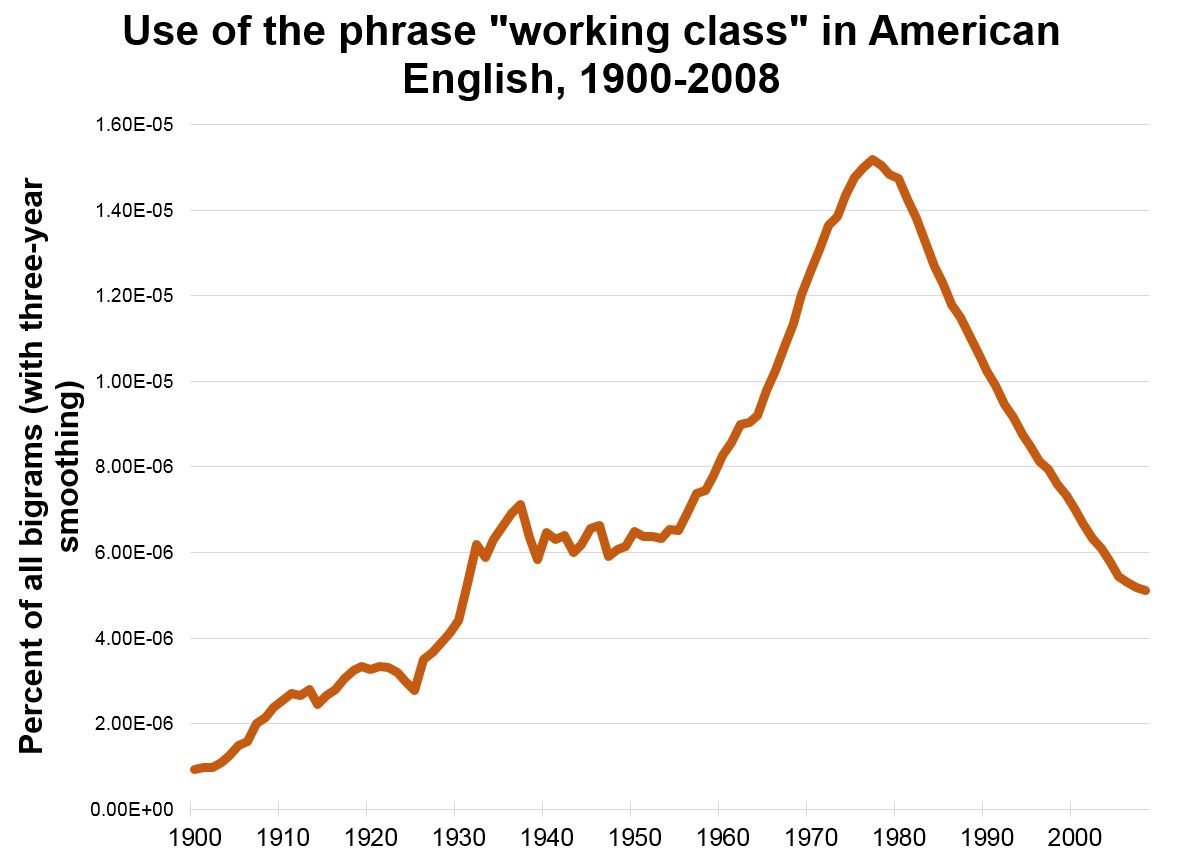
The problems of the White working class were not unknown, but they were not often addressed very directly. Sometimes, the most common advice was they should get more training or send their kids to college – advice that could sound more like a middle-class put-down than a realistic policy addressing their problems. But, for the most part, the working class was just ignored, a neglect that made them ripe for Trump’s appeals. This neglect was a general cultural phenomenon; a Google ngram count of the phrase “working class” in American books shows a spike in the Depression Thirties and an even stronger growth from the mid-1950s to the mid-1970s. But after the mid-1970s, there is a steady decline, implying a lack of discussion just as their problems were growing.  The implicit message seemed to have been that their problems didn’t matter.

vanf1

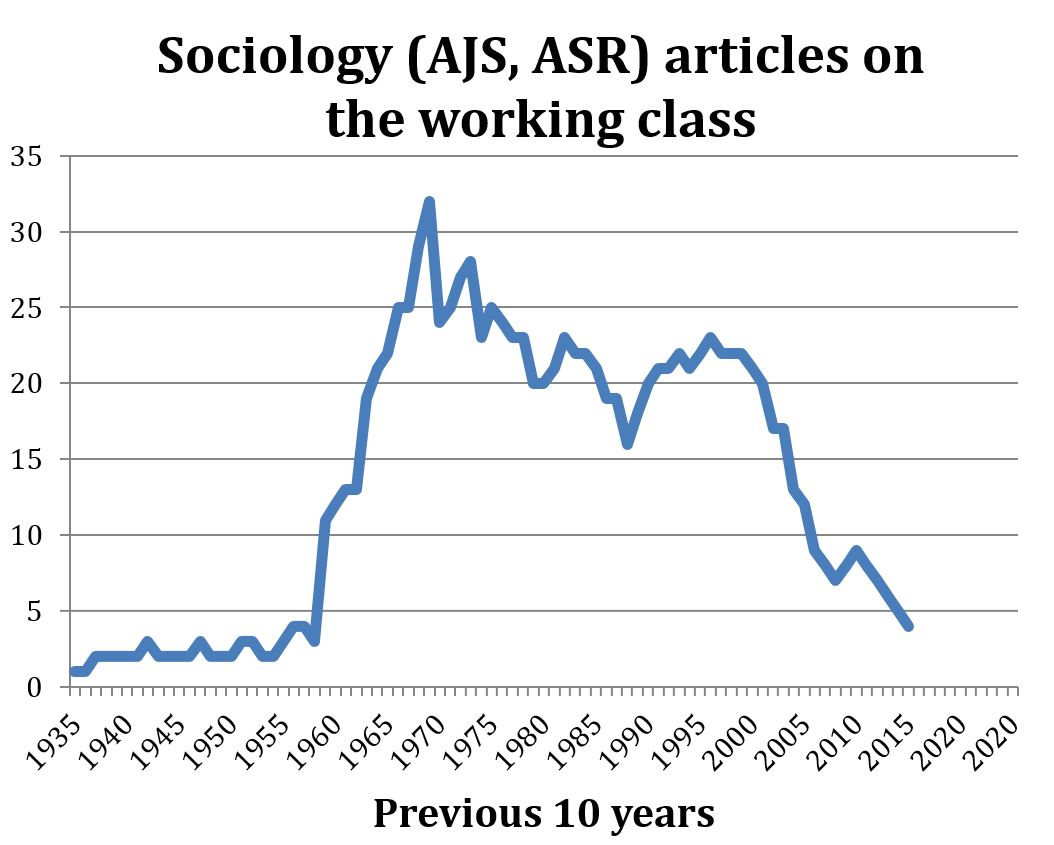
U.S. sociology was not immune from this broader cultural trend. A count of the frequencies of “working class” in the titles or abstracts of articles in the American Journal of Sociology and the American Sociological Review shows a quite similar if even more dramatic pattern: rapid growth in the 1960s, peaking in the 1959-1969 period, a steady interest for the next two decades and then an abrupt decline beginning in the 1990s. These articles on the working class were not insignificant; even through the 21st century, the authors include a number of ASA presidents. But overall, working-class issues seem to have lost their salience, as if even American sociology was also telling them that they didn’t matter.

vanf2

Perhaps the Trump election, which was in part a symptom of this neglect, may also produce its cure. Election post-mortems in the media have focused more attention on the white working class than they have received in years.  Academe may soon follow.  Arlie Hochshild’s Strangers in Their Own Land, and, in political science, Katherine Cramer’s The Politics of Resentment, are encouraging signs. But Trump was certainly dangerous medicine for what ails our professional discourse.

Reeve Vanneman, PhD is in the sociology department at the University of Maryland.

Gender gaps are everywhere.  When we use the term, most people immediately think of gender wage gaps.  But, because we perceive gender as a kind of omni-salient feature of identity, gender gaps are measured everywhere.  Gender gaps refer to discrepancies between men and women in status, opportunities, attitudes, demonstrated abilities, and more. A great deal of research focuses on gender gaps because they are understood to be the products of social, not biological, engineering.  Gender gaps are so pervasive that, each year, the World Economic Forum produces a report on the topic: “The Global Gender Gap Report.”

I first thought about this idea after reading some work by Virginia Rutter on this issue (here and here) and discussing them with her.  When you look for them, gender gaps seem to be almost everywhere.  As gender equality became something understood as having to do with just about every element of the human experience, we’ve been chipping away at all sorts of forms of gender inequality.  And yet, as Virginia Rutter points out, we have yet to see gender convergence on all manner of measures.  Indeed, progress on many measures has slowed, halted, or taken steps in the opposite direction, prompting some to label the gender revolution “stalled.”   And in many cases, the “stall” starts right around 1980.  For instance, Paula England showed that though the percentage of women employed in the U.S. has grown significantly since the 1960s, that progress starts to slow in the 1980s.  Similarly, in the 1970s a great deal of progress was made in desegregating fields of study in college.  But, by the early 1980s, about all the change that has been made had been made already.  Changes in the men’s and women’s median wages have shown an incredibly persistent gender gap.

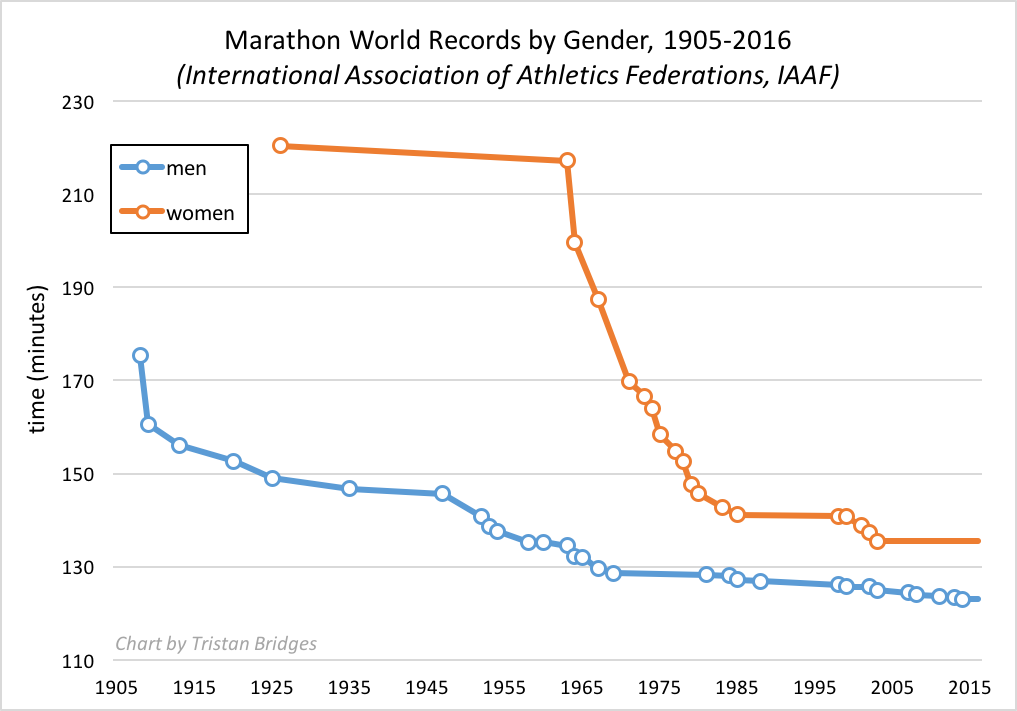
A set of gender gaps often used to discuss inherent differences between men and women are gaps in athletic performance – particularly in events in which we can achieve some kind of objective measure of athleticism.  In Lisa Wade and Myra Marx Ferree’s Gender: Ideas, Interactions, Institutions, they use the marathon as an example of how much society can engineer and exaggerate gender gaps.  They chart world record times for women and men in the marathon over a century.  I reproduced their chart below using IAAF data (below).

marathon-world-record-progression-by-gender

In 1963, an American woman, Merry Lepper, ran a world recording breaking marathon at 3 hours, 37 minutes, and 7 seconds.  That same year, the world record was broken among men at 2 hours, 14 minutes, and 28 seconds.  His time was more than 80 minutes faster than hers!  The gender gap in marathon records was enormous.  A gap still exists today, but the story told by the graph is one of convergence.  And yet, I keep thinking about Virginia Rutter’s focus on the gap itself. I ran the numbers on world record progressions for a whole collection of track and field races for women and men.  Wade and Ferree’s use of the marathon is probably the best example because the convergence is so stark.  But, the stall in progress for every race I charted was the same: incredible progress is made right through about 1980 and then progress stalls and a stubborn gap remains.

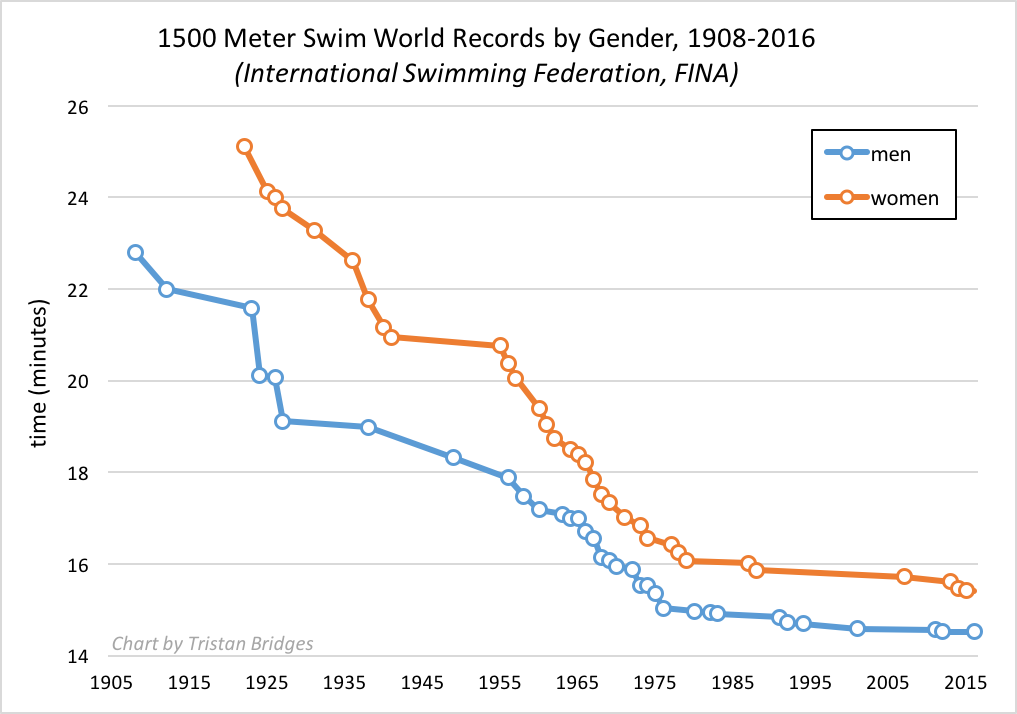
Just for fun, I thought about considering other sports to see if gender gaps converged in similar ways. Below is the world record progression for men and women in a distance swimming event – the 1500-meter swim.

1500-meter-swim-world-record-progression-by-gender

The story for the gender gap in the 1500-meter swim is a bit different.  The gender gap was smaller to begin with and was primarily closed in the 1950s and early 60s.  Both men and women continued to clock world record swims between the mid-1950s and 1980 and then progress toward faster times stalled out for both men and women at around that time.

One way to read these two charts is to suggest that technological innovations and improvements in the science of sports training meant that we came closer to achieving, possibly, the pinnacle of human abilities through the 1980s.  At some point, you might imagine, we simply bumped up against what is biologically possible for the human body to accomplish.  The remaining gap between women and men, you might suggest, is natural.  Here’s where I get stuck… What if all these gaps are related to one another?  There’s no biological reason that women’s entry into the labor force should have stalled at basically the same time as progress toward gender integration in college majors, all while women’s incredible gender convergence in all manner of athletic pursuits seemed to suddenly lose steam.  If all of these things are connected, it’s for social, not biological reasons.

Tristan Bridges, PhD is a professor at the University of California, Santa Barbara. He is the co-editor of Exploring Masculinities: Identity, Inequality, Inequality, and Change with C.J. Pascoe and studies gender and sexual identity and inequality. You can follow him on Twitter here. Tristan also blogs regularly at Inequality by (Interior) Design.

Counting the number of lesbian, gay, bisexual, and transgender people is harder than you might think.  I’ve written before on just how important it is to consider, for instance, precisely how we ask questions about sexuality.  One way scholars have gotten around this is to analytically separate the distinct dimensions of sexuality to consider which dimension they are asking about.  For research on sexuality, this is typically done by considering sexual identities as analytically distinct from sexual desires and sexual behaviors.  We like to imagine that sexual identities, acts, and desires all neatly match up, but the truth of the matter is… they don’t.  At least not for everyone.  And while you might think that gender might lend itself to be more easily assessed on surveys, recent research shows that traditional measures of sex and gender erase our ability to see key ways that gender varies in our society.

Gallup just released a new publication authored by Gary J. Gates.  Gates has written extensively on gender and sexual demography and is responsible for many of the population estimates we have for gender and sexual minorities in the U.S.  This recent publication just examines shifts in the past 5 years (between 2012 and 2016).  And many of them may appear to be small.  But changes like this at the level of a population in a population larger than 300,000,000 people are big shifts, involving huge numbers of actual people.  In this post, I’ve graphed a couple of the findings from the report–mostly because I like to chart changes to visually illustrate findings like this to students.  [*Small note: be aware of the truncated y axes on the graphs.  They’re sometimes used to exaggerate findings.  I’m here truncating the y axes to help illustrate each of the shifts discussed below.]

lgbt-demo-1

The report focuses only on one specific measure of membership as LGBT–identity.  And this is significant as past work has shown that this is, considered alongside other measures, perhaps the most conservative measure we have.  Yet, even by that measure, the LGBT population is on the move, increasing in numbers at a rapid pace in a relatively short period of time.  As you can see above, between 2012 and 2016, LGBT identifying persons went from 3.5%-4.1% of the U.S. population, which amounts to an estimated shift from 8.3 million people in 2012 to more than 10 million in 2016.

lgbt-demo-2-generations

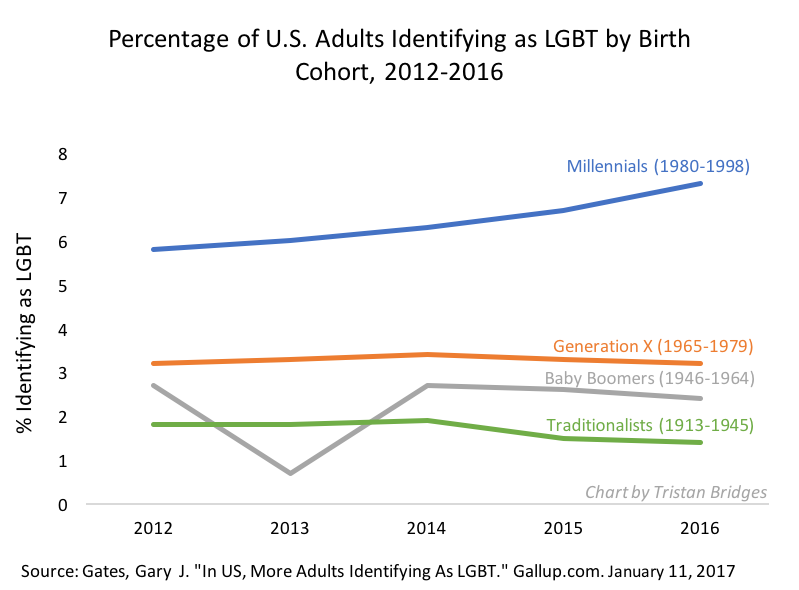
The report also shows that a great deal of that increase can be accounted for by one particular birth cohort–Millennials.  Perhaps not surprisingly, generations have become progressively more likely to identify as LGBT.  But the gap between Millenials and the rest is big and appears to be growing.  But the shifts are not only about cohort effects.  The report also shows that this demographic shift is gendered, racialized, and has more than a little to do with religion as well.

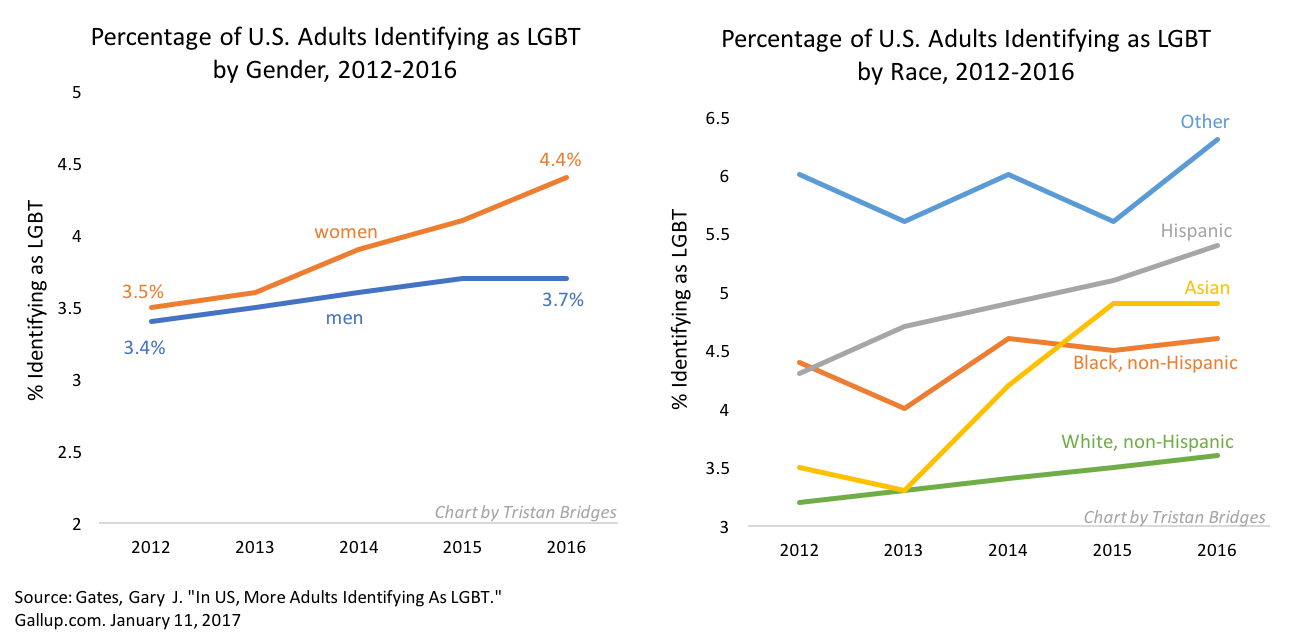
The gender gap between proportion of the population identifying as LGBT in the U.S. is growing.  The proportion of women identifying as LGBT has jumped almost a full percentage point over this period of time.  And while more men (and a larger share of men) are identifying as LGBT than were in 2012, the rate of increase appears to be much slower.  As Gates notes, “These changes mean that the portion of women among LGBT-identified adults rose slightly from 52% to 55%” (here).

lgbt-demo-3-gender-and-race

The gap between different racial groups identifying as LGBT has also shifted with non-Hispanic Whites still among the smallest proportion of those identifying.  As you can see, the shift has been most pronounced among Asian and Hispanic adults in the U.S.  Because White is the largest racial demographic group here, in actual numbers, they still comprise the largest portion of the LGBT community when broken down by race.  But, the transitions over these 5 years are a big deal.  In 2012, 2 of every 3 LGBT adults in the U.S. identified as non-Hispanic White.  By 2016, that proportion dropped to 6 out of every 10. This is big news.  LGBT people (as measured by self-identification) are becoming a more racially diverse group.

They are also diverse in terms of class.  Considering shifts in the proportion of LGBT identifying individuals by income and education tells an interesting story.  As income increases, the proportion of LGBT people decreases.  And you can see that finding by education in 2012 as well–those with less education are more likely to be among those identifying as LGBT (roughly).  But, by 2016, the distinctions between education groups in terms of identifying as LGBT have largely disappeared.  The biggest rise has been among those with a college degree.  That’s big news and could mean that, in future years, the income gap here may decrease as well.

There were also findings in the report to do with religion and religiosity among LGBT identifying people in the U.S.  But I didn’t find those as interesting.  Almost all of the increases in people identifying as LGBT in recent years have been among those who identify as “not religious.”  While those with moderate and high levels of religious commitment haven’t seen any changes in the last five years.  But, among the non-religious, the proportion identifying as LGBT has jumped almost 2 percentage points (from 5.3% in 2012 to 7.0% in 2016).

All of this is big news because it’s a powerful collection of data that illustrate that the gender and sexual demographics of the U.S. are, quite literally, on the move.  We should stand up and pay attention.  And, as Gates notes in the report, “These demographic traits are of interest to a wide range of constituencies.”  Incredible change in an incredibly short period of time.  Let the gender and sexual revolution continue!

Edit (1/17/17): The graph charting shifts by age cohort may exaggerate (or undersell) shifts among Millennials because the data does not exclude Millennials born after 1994.  So, some of those included in the later years here wouldn’t have been included in the earlier years because they weren’t yet 18.  So, it’s more difficult to tell how much of that shift is actually people changing identity for the age cohort as a whole as opposed to change among the youngest Millennials surveyed.

Tristan Bridges, PhD is a professor at the University of California, Santa Barbara. He is the co-editor of Exploring Masculinities: Identity, Inequality, Inequality, and Change with C.J. Pascoe and studies gender and sexual identity and inequality. You can follow him on Twitter here. Tristan also blogs regularly at Inequality by (Interior) Design.

If there’s one thing Americans can agree upon, it might be that people shouldn’t be indiscriminately firing guns crowds, no matter how angry they are. The shooting in the Ft. Lauderdale airport is just the latest example. Mass shootings are on the rise and I’m fearful that what we are seeing isn’t just an increase in violence, but the rise of a new habit, a behavior that is widely recognized as a way to express an objection to the way things are.

To register an objection to something about the world, a person or group needs to engage in an action that other people recognize as a form of protest. We know, in other words, what protest looks like. It’s a strike, a rally, a march, a sit-in, a boycott. These are all recognizable ways in which individuals and groups can stake a political claim, whereas other group activities — a picnic, a group bike ride, singing together — are not obviously so. To describe this set of protest-related tools, the sociologist Charles Tilly coined the phrase “repertoire of contention.” Activists have a stock of actions to draw from when they want to make a statement that others will understand.

A culture’s repertoire of contention is in constant evolution. Each tool has to be invented and conceptually linked to the idea of protest before it can play this role. The sit-in, for example, was invented during the early civil rights movement. When African American activists and their allies occupied white-only restaurants, bringing lunch counters to a halt to bring attention to the exclusion of black people, they introduced a new way of registering an objection to the status quo, one that almost anyone would recognize today.

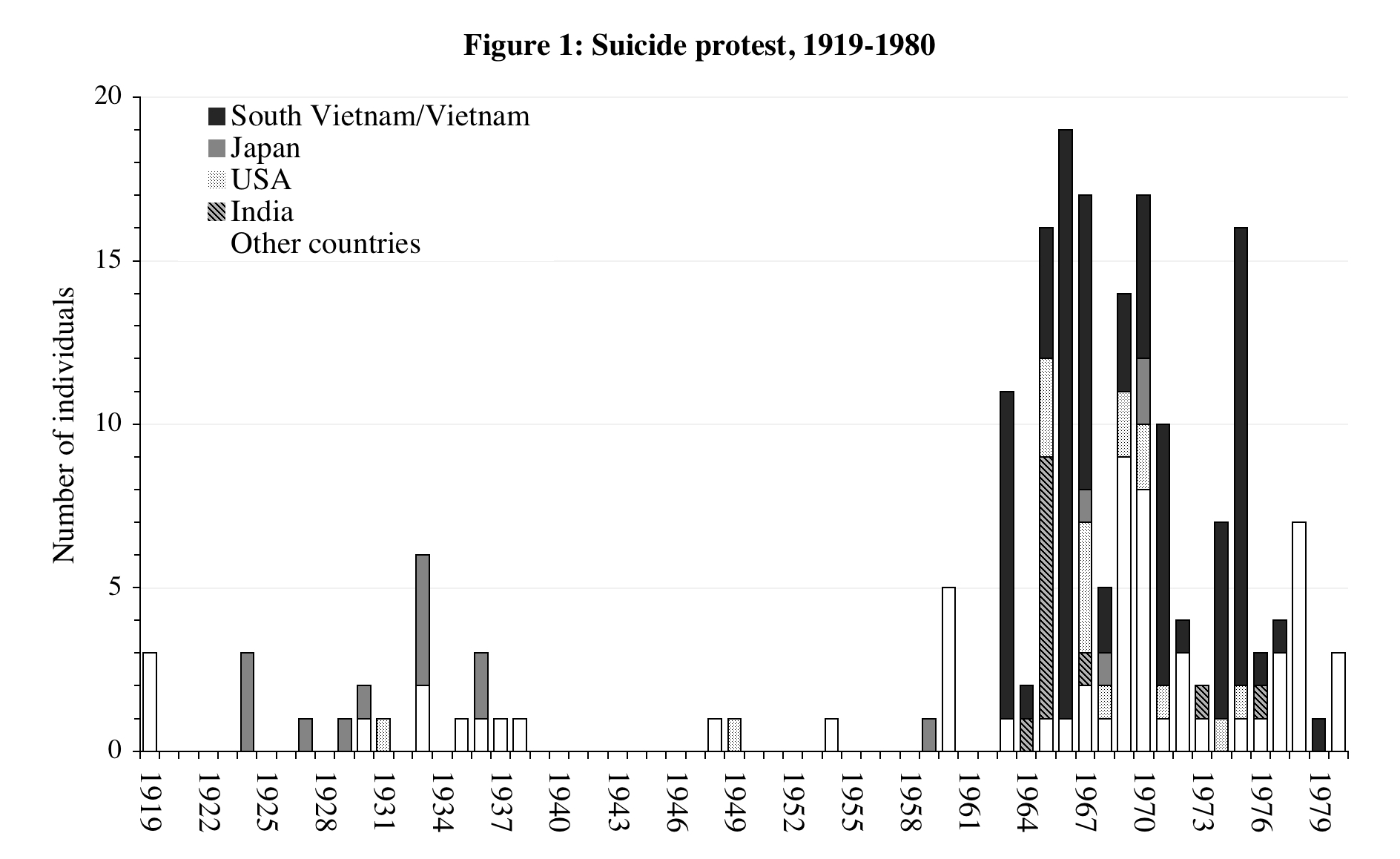
New ways of protesting are being invented every day: the hashtag, the hacktivist, and shutting down freeways are some newer ones. Some become part of the repertoire. Consider the image below by sociologist Michael Biggs, which shows how suicide as a form of protest “caught on”  in the 1960s:

2

I am afraid that mass murder has become part of the repertoire of contention. This is theoretically tricky – others have fought over what really counts as a social movement action – but it does seem quite clear that mass murder with a gun is a more familiar and more easily conceptualized way of expressing one’s discontent and then it was, say, pre-Columbine. If a person is outraged by some state of affairs, mass killing is a readily available way to express that outrage both technically (thanks to gun regulation) and cognitively (because it is now part of the recognized repertoire).

Dylann Roof wanted to register his discontent with the place of black people in American society, Robert Lewis Dear stormed a Planned Parenthood with a pro-choice message, Elliot Rodgers was angry about women’s freedom to reject him, Omar Matteen killed dozens to express his (internalized) disgust for homosexuality, Gavin Long communicated his sense of rage and helplessness in the face of black death by killing police. At some point each thought, “What can I do to make a difference?” And mass murder came to mind.

In the aftermath of such events, the news media routine contributes to the idea that mass murder is a form of protest by searching for an explanation above and beyond the desire to kill. That explanation often positions the rationale for the murder within the realm of politics, whether we call it terrorism, resistance, or prejudice. This further sends the message that mass murder is political, part of the American repertoire of contention.

The terrifying part is that once protest tools become part of the repertoire, they are diffused across movements and throughout society. It’s no longer just civil rights activists who use the sit-in; any and all activists do. Perhaps that’s why we see such a range of motivations among these mass murderers. It has become an obvious way to express an objection that the discontented can be sure others will understand.

Lisa Wade, PhD is an Associate Professor at Tulane University. She is the author of American Hookup, a book about college sexual culture; a textbook about gender; and a forthcoming introductory text: Terrible Magnificent Sociology. You can follow her on Twitter and Instagram.

1Will Davies, a politics professor and economic sociologist at Goldsmiths, University of London, summarized his thoughts on Brexit for the Political Economy and Research Centre, arguing that the split wasn’t one of left and right, young and old, racist or not racist, but center and the periphery. You can read it in full there, or scroll down for my summary.
——————————–

Many of the strongest advocates for Leave, many have noted, were actually among the beneficiaries of the UK’s relationship with the EU. Small towns and rural areas receive quite a bit of financial support. Those regions that voted for Leave in the greatest numbers, then, will also suffer some of the worst consequences of the Leave. What motivated to them to vote for a change that will in all likelihood make their lives worse?

Davies argues that the economic support they received from their relationship with the EU was paired with a culturally invisibility or active denigration by those in the center. Those in the periphery lived in a “shadow welfare state” alongside “a political culture which heaped scorn on dependency.”

Davies uses philosopher Nancy Fraser’s complementary ideas of recognition and redistribution: people need economic security (redistribution), but they need dignity, too (recognition). Malrecognition can be so psychically painful that even those who knew they would suffer economically may have been motivated to vote Leave. “Knowing that your business, farm, family or region is dependent on the beneficence of wealthy liberals,” writes Davies, “is unlikely to be a recipe for satisfaction.”

It was in this context that the political campaign for Leave penned the slogan: “Take back control.” In sociology we call this framing, a way of directing people to think about a situation not just as a problem, but a particular kind of problem. “Take back control” invokes the indignity of oppression. Davies explains:

It worked on every level between the macroeconomic and the psychoanalytic. Think of what it means on an individual level to rediscover control. To be a person without control (for instance to suffer incontinence or a facial tick) is to be the butt of cruel jokes, to be potentially embarrassed in public. It potentially reduces one’s independence. What was so clever about the language of the Leave campaign was that it spoke directly to this feeling of inadequacy and embarrassment, then promised to eradicate it. The promise had nothing to do with economics or policy, but everything to do with the psychological allure of autonomy and self-respect.

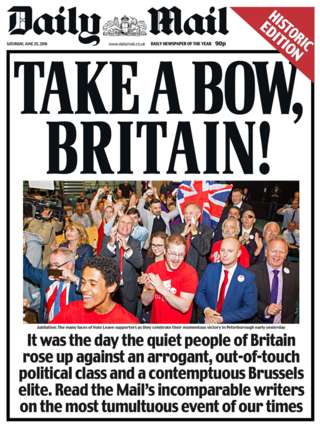
Consider the cover of the Daily Mail praising the decision and calling politicians “out-of-touch” and the EU “elite” and “contemptuous”:2

From this point of view, Davies thinks that the reward wasn’t the Leave, but the vote itself, a veritable middle finger to the UK center and the EU “eurocrats.” They know their lives won’t get better after a Brexit, but they don’t see their lives getting any better under any circumstances, so they’ll take the opportunity to pop a symbolic middle finger. That’s all they think they have.

And that’s where Davies thinks the victory  of the Leave vote parallels strongly with Donald Trump’s rise in the US:

Amongst people who have utterly given up on the future, political movements don’t need to promise any desirable and realistic change. If anything, they are more comforting and trustworthy if predicated on the notion that the future is beyond rescue, for that chimes more closely with people’s private experiences.

Some people believe that voting for Trump might in fact make things worse, but the pleasure of doing so — of popping a middle finger to the Republican party and political elites more generally — would be satisfaction enough. In this sense, they may be quite a lot like the Leavers. For the disenfranchised, a vote against pragmatism and solidarity may be the only satisfaction that this election, or others, is likely to get them.

Lisa Wade, PhD is an Associate Professor at Tulane University. She is the author of American Hookup, a book about college sexual culture; a textbook about gender; and a forthcoming introductory text: Terrible Magnificent Sociology. You can follow her on Twitter and Instagram.

1Botox has forever transformed the primordial battleground against aging. Since the FDA approved it for cosmetic use in 2002, eleven million Americans have used it. Over 90 percent of them are women.

In my forthcoming book, Botox Nation, I argue that one of the reasons Botox is so appealing to women is because the wrinkles that Botox is designed to “fix,” those disconcerting creases between our brows, are precisely those lines that we use to express negative emotions: angry, bitchy, irritated.  Botox is injected into the corrugator supercilii muscles, the facial muscles that allow us to pull our eyebrows together and push them down.  By paralyzing these muscles, Botox prevents this brow-lowering action, and in so doing, inhibits our ability to scowl, an expression we use to project to the world that we are aggravated or pissed off.

9781479825264_Full.jpg (200×300)

Sociologists have long speculated about the meaning of human faces for social interaction. In the 1950s, Erving Goffman developed the concept of facework to refer to the ways that human faces act as a template to invoke, process, and manage emotions. A core feature of our physical identity, our faces provide expressive information about our selves and how we want our identities to be perceived by others.

Given that our faces are mediums for processing and negotiating social interaction, it makes sense that Botox’s effect on facial expression would be particularly enticing to women, who from early childhood are taught to project cheerfulness and to disguise unhappiness. Male politicians and CEOs, for example, are expected to look pissed off, stern, and annoyed. However, when Hillary Clinton displays these same expressions, she is chastised for being unladylike, as undeserving of the male gaze, and criticized for disrupting the normative gender order. Women more so than men are penalized for looking speculative, judgmental, angry, or cross.

Nothing demonstrates this more than the recent viral pop-cultural idioms “resting bitch face.” For those unfamiliar with the not so subtly sexist phrase, “resting bitch face,” according to the popular site Urban Dictionary, is “a person, usually a girl, who naturally looks mean when her face is expressionless, without meaning to.” This same site defines its etymological predecessor, “bitchy resting face,” as “a bitchy alternative to the usual blank look most people have. This is a condition affecting the facial muscles, suffered by millions of women worldwide. People suffering from bitchy resting face (BRF) have the tendency look hostile and/or judgmental at rest.”

Resting bitch face and its linguistic cousin is nowhere near gender neutral. There is no name for men’s serious, pensive, and reserved expressions because we allow men these feelings. When a man looks severe, serious, or grumpy, we assume it is for good reason. But women are always expected to be smiling, aesthetically pleasing, and compliant. To do otherwise would be to fail to subordinate our own emotions to those of others, and this would upset the gendered status quo.

This is what the sociologist Arlie Russell Hochschild calls “emotion labor,” a type of impression management, which involves manipulating one’s feelings to transmit a certain impression. In her now-classic study on flight attendants, Hochschild documented how part of the occupational script was for flight attendants to create and maintain the façade of positive appearance, revealing the highly gendered ways we police social performance. The facework involved in projecting cheerfulness and always smiling requires energy and, as any woman is well aware, can become exhausting. Hochschild recognized this and saw emotion work as a form of exploitation that could lead to psychological distress. She also predicted that showing dissimilar emotions from those genuinely felt would lead to the alienation from one’s feelings.

Enter Botox—a product that can seemingly liberate the face from its resting bitch state, producing a flattening of affect where the act of appearing introspective, inquisitive, perplexed, contemplative, or pissed off can be effaced and prevented from leaving a lasting impression. One reason Botox may be especially appealing to women is that it can potentially relieve them from having to work so hard to police their expressions.

Even more insidiously, Botox may actually change how women feel. Scientists have long suggested that facial expressions, like frowning or smiling, can influence emotion by contributing to a range of bodily changes that in turn produce subjective feelings. This theory, known in psychology as the “facial feedback hypothesis,” proposes that expression intensifies emotion, whereas suppression softens it. It follows that blocking negative expressions with Botox injections should offer some protection against negative feelings. A study confirmed the hypothesis.

Taken together, this works point to some of the principal attractions of Botox for women. Functioning as an emotional lobotomy of sorts, Botox can emancipate women from having to vigilantly police their facial expressions and actually reduce the negative feelings that produce them, all while simultaneously offsetting the psychological distress of alienation.

Dana Berkowitz is a professor of sociology at Louisiana State University in Baton Rogue where she teaches about gender, sexuality, families, and qualitative methods. Her book, Botox Nation: Changing the Face of America, will be out in January and can be pre-ordered now.