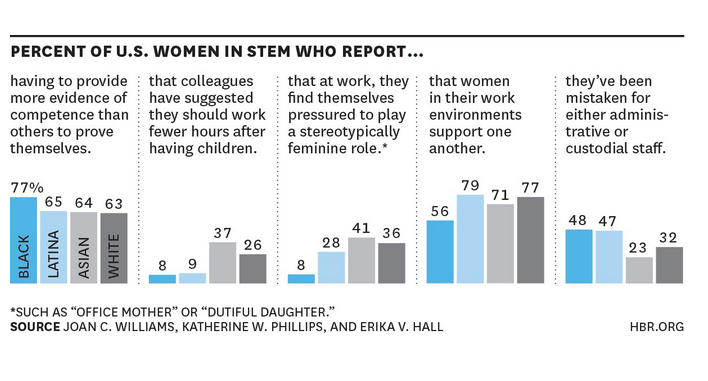
A new survey of 557 female scientists found widespread experiences of discrimination and alienation in the workforce that varied in interesting ways by race.7

While all types of women reported experiencing these forms of discrimination in large numbers — and 100% of a sub-sample of 60 interviewed for the study reported at least one — the race differences are interesting:

  • Black women were especially likely to need to prove and re-prove competence.
  • Asian and white women, especially, received pressure to withdraw from the workplace after having children.
  • Asian women were most likely to be pushed to perform a stereotypically feminine role in the office, followed by white and then Latina women. Black women rarely reported this.
  • Latina and white women were most likely to feel supported by other women in the workforce; Black women the least.
  • And almost half of Black and Latina women had been mistaken for janitors or administrative assistants, compared to a third of white women and a quarter of Asian women.

The study, by law professor Joan Williams and two colleagues, can be found here.

Lisa Wade, PhD is an Associate Professor at Tulane University. She is the author of American Hookup, a book about college sexual culture; a textbook about gender; and a forthcoming introductory text: Terrible Magnificent Sociology. You can follow her on Twitter and Instagram.

SocImages News:

Phew. What a month.

You like!  Here are our most appreciated posts this month:

Thanks everybody!

Editor’s pick:

Top post on Tumblr this month:

With over 15,000 likes and shares, I’m so happy to be helping bring awareness to this issue. At Tumblr, this month’s top post: Defensive architecture aimed at the homeless as a deliberate, considered kind of cruelty.

Social Media ‘n’ Stuff:

Finally, this is your monthly reminder that SocImages is on Twitter, Facebook, Tumblr, Google+, and Pinterest.  I’m on Facebook and most of the team is on Twitter: @lisawade, @gwensharpnv, @familyunequal, and @jaylivingston.

Finally…

Bye-bye June 2015; we’ll remember you forever.

12

Lisa Wade, PhD is an Associate Professor at Tulane University. She is the author of American Hookup, a book about college sexual culture; a textbook about gender; and a forthcoming introductory text: Terrible Magnificent Sociology. You can follow her on Twitter and Instagram.

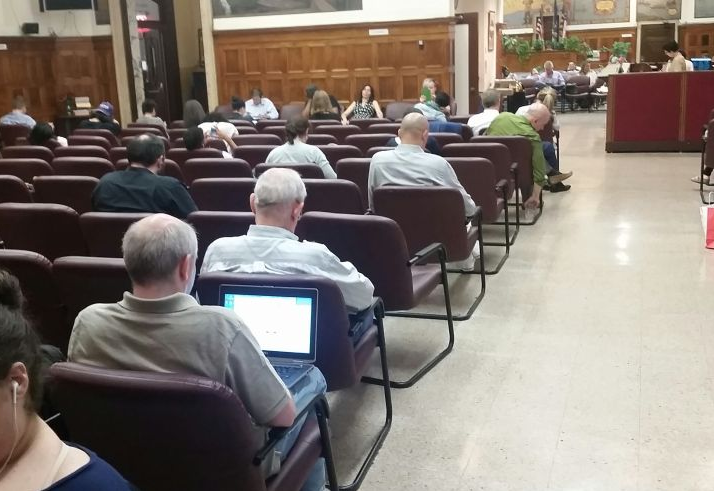
I was on jury duty this week, and the greatest challenge for me was the “David Brooks temptation” to use the experience to expound on the differences in generations and the great changes in culture and character that technology and history have brought.

I did my first tour of duty in the 1970s. Back then you were called for two weeks. Even if you served on a jury, after that trial ended, you went back to the main jury room. If you were lucky, you might be released after a week and a half. Now it’s two days.

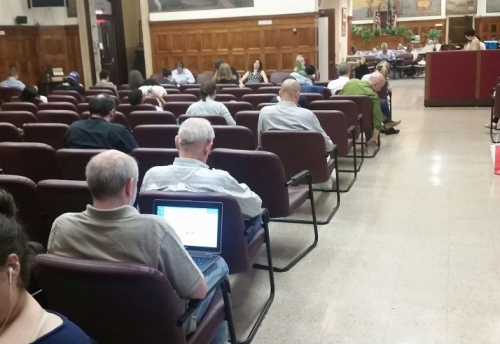
What most struck me most this time was the atmosphere in the main room. Now, nobody talks. You’re in a large room with maybe two hundred people, and it’s quieter than a library. Some are reading newspapers or books, but most are on their latops, tablets, and phones. In the 1970s, it wasn’t just that there was no wi-fi, there was no air conditioning. Remember “12 Angry Men”? We’re in the same building. Then, you tried to find others to talk to. Now you try to find a seat near an electric outlet to connect your charger.
2 (1)

I started to feel nostalgic for the old system. People nowadays – all in their own narrow, solipsistic worlds, nearly incapable of ordinary face-to-face sociability. And so on.

But the explanation was much simpler. It was the two-day hitch. In the old system, social ties didn’t grow from strangers seeking out others in the main jury room. It happened when you went to a courtroom for voir dire. You were called down in groups of forty. The judge sketched out the case, and the lawyers interviewed the prospective jurors. From their questions, you learned more about the case, and you learned about your fellow jurors – neighborhood, occupation, family, education, hobbies. You heard what crimes they’d been a victim of.  When judge called a break for bathroom or lunch or some legal matter, you could find the people you had something in common with. And you could talk with anyone about the case, trying to guess what the trial would bring. If you weren’t selected for the jury, you went back to the main jury room, and you continued the conversations there. You formed a social circle that others could join.

This time, on my first day, there were only two calls for voir dire, the clerk as bingo-master spinning the drum with the name cards and calling out the names one by one. My second day, there were no calls. And that was it. I went home having had no conversations at all with any of my fellow jurors. (A woman seated behind me did say, “Can you watch my laptop for a second?” when she went to the bathroom, but I don’t count that as a conversation.)

I would love to have written 800 words here on how New York character had changed since the 1970s.  No more schmoozing. Instead we have iPads and iPhones and MacBooks destroying New York jury room culture – Apple taking over the Apple. People unable or afraid to talk to one another because of some subtle shift in our morals and manners. Maybe I’d even go for the full Brooks and add a few paragraphs telling you what’s really important in life.

But it was really a change in the structure. New York expanded the jury pool by eliminating most exemptions. Doctors, lawyers, politicians, judges – they all have to show up. As a result, jury service is two days instead of two weeks, and if you actually are called to a trial, once you are rejected for the jury or after the trial is over, you go home.

The old system was sort of like the pre-all-volunteer army. You get called up, and you’re thrown together with many kinds of people you’d never otherwise meet. It takes a chunk of time out of your life, but you wind up with some good stories to tell. Maybe we’ve lost something. But if we have lost valuable experiences, it’s because of a change in the rules, in the structure of how the institution is run, not a because of a change in our culture and character.

Cross-posted  at Montclair Socioblog.

Jay Livingston is the chair of the Sociology Department at Montclair State University. You can follow him at Montclair SocioBlog or on Twitter.

All eyes are on the Confederate flag, but let’s not forget what enabled Roof to turn his ideology into death with such efficiency, as illustrated in this comic from Jonathan Schmock. Visit Schmock’s website here.

Lisa Wade, PhD is an Associate Professor at Tulane University. She is the author of American Hookup, a book about college sexual culture; a textbook about gender; and a forthcoming introductory text: Terrible Magnificent Sociology. You can follow her on Twitter and Instagram.

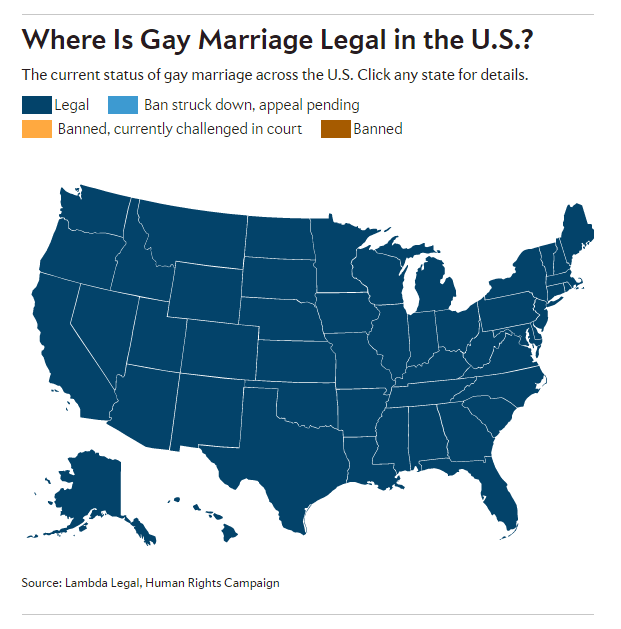
On June 26th, 2015, the United States Supreme Court ruled that bans on same-sex marriage violate the 14th Amendment of the Constitution. This is your image of the week:

5Source: Slate.


Lisa Wade, PhD is an Associate Professor at Tulane University. She is the author of American Hookup, a book about college sexual culture; a textbook about gender; and a forthcoming introductory text: Terrible Magnificent Sociology. You can follow her on Twitter and Instagram.

Legal status of same-sex marriage in the U.S.:

The social psychology of same-sex marriage:

Politicians on same-sex marriage:

Humor/commentary:

Changing public opinion on same-sex marriage:

Discourse:

The movement for same-sex marriage:

Lisa Wade, PhD is an Associate Professor at Tulane University. She is the author of American Hookup, a book about college sexual culture; a textbook about gender; and a forthcoming introductory text: Terrible Magnificent Sociology. You can follow her on Twitter and Instagram.

Flashback Friday.

My great-grandma would put a few drops of turpentine on a sugar cube as a cure-all for any type of cough or respiratory ailment. Nobody in the family ever had any obvious negative effects from it as far as I know. And once when I had a sinus infection my grandma suggested that I try gargling kerosene. I decided to go to the doctor for antibiotics instead, but most of my relatives thought that was a perfectly legitimate suggestion.

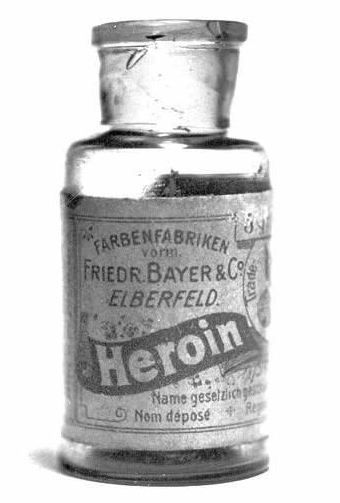
In the not-so-recent history, lots of substances we consider unhealthy today were marketed and sold for their supposed health benefits. Joe A. of Human Rights Watch sent in these images of vintage products that openly advertised that they contained cocaine or heroin. Perhaps you would like some Bayer Heroin?

Flickr Creative Commons, dog 97209

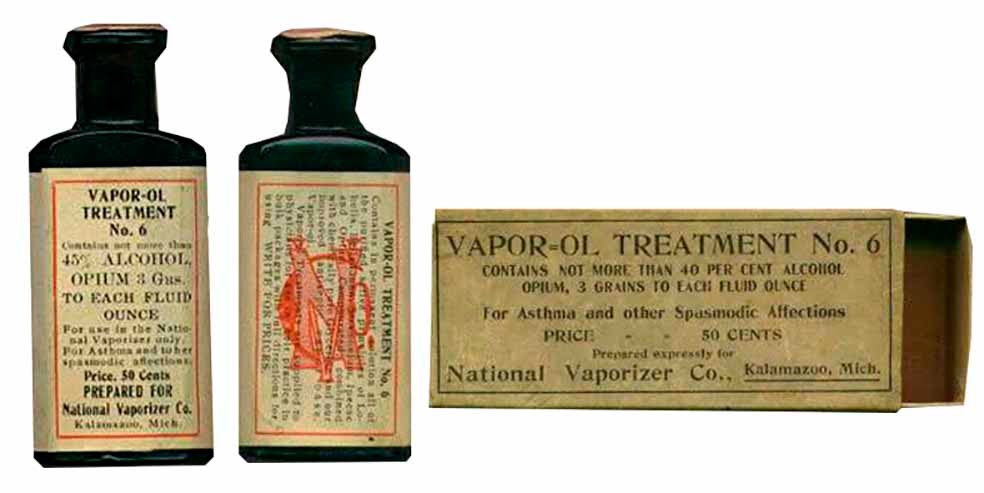
The Vapor-ol alcohol and opium concoction was for treating asthma:

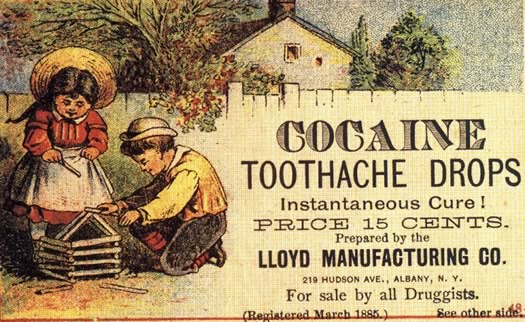
Cocaine drops for the kids:

A reader named Louise sent in a recipe from her great-grandma’s cookbook. Her great-grandmother was a cook at a country house in England. The recipe is dated 1891 and calls for “tincture of opium”. The recipe (with original spellings):

Hethys recipe for cough mixture

1 pennyworth of each
Antimonial Wine
Acetic Acid
Tincture of opium
Oil of aniseed
Essence of peppermint
1/2lb best treacle

Well mix and make up to Pint with water.

As Joe says, it’s no secret that products with cocaine, marijuana, opium, and other now-banned substances were at one time sold openly, often as medicines. The changes in attitudes toward these products, from entirely acceptable and even beneficial to inherently harmful and addicting, is a great example of social construction. While certainly opium and cocaine have negative effects on some people, so do other substances that remained legal (or were re-legalized, in the case of alcohol).

Often racist and anti-immigrant sentiment played a role in changing views of what are now illegal controlled substances; for instance, the association of opium with Chinese immigrants contributed to increasingly negative attitudes toward it as anything associated with Chinese immigrants was stigmatized, particularly in the western U.S. This combined with a push by social reformers to prohibit a variety of substances, leading to the Harrison Narcotic Act. The act, passed in 1914, regulated production and distribution of opium but, in its application, eventually basically criminalized it.

Reformers pushing for cocaine to be banned suggested that its effects led Black men to rape White women, and that it gave them nearly super-human strength that allowed them to kill Whites more effectively. A similar argument was made about Mexicans and marijuana:

A Texas police captain summed up the problem: under marijuana, Mexicans became “very violent, especially when they become angry and will attack an officer even if a gun is drawn on him. They seem to have no fear, I have also noted that under the influence of this weed they have enormous strength and that it will take several men to handle one man while under ordinary circumstances one man could handle him with ease.”

So the story of the criminalization of some substances in the U.S. is inextricably tied to various waves of anti-immigrant and racist sentiment. Some of the same discourse–the “super criminal” who is impervious to pain and therefore especially violent and dangerous, the addicted mother who harms and even abandons her child to prostitute herself as a way to get drugs–resurfaced as crack cocaine emerged in the 1980s and was perceived as the drug of choice of African Americans.

Originally posted in 2010.

Gwen Sharp is an associate professor of sociology at Nevada State College. You can follow her on Twitter at @gwensharpnv.

The governors of Virginia and South Carolina have now taken stands against the Confederate battle flag. So have honchos at Wal*Mart, Sears, Target, and NASCAR.

NASCAR! How could this cascade of reversals have happened so rapidly? Did these important people wake up one morning this week and say to themselves, “Gee, I never realized that there was anything racist about the Confederacy, and never realized that there was anything wrong with racism, till that kid killed nine Black people in a church”?

My guess is that what’s going on is not a sudden enlightenment or even much of a change in views about the flag. To me it looks more like the process of “pluralistic ignorance.” What these people changed was not their ideas about the Confederacy or racism but their ideas about other people’s ideas about these matters. With pluralistic ignorance (a term coined by Floyd Allport nearly a century ago) everyone wants X but thinks that nobody else does. Then some outside factor makes it possible for people to choose X, and everyone does. Everyone is surprised – “Gee, I thought all you guys wanted Y, not X .” It looks like a rapid change in opinion, but it’s not.

A few years ago in places like Ireland and Europe, people were surprised at the success of new laws banning smoking in pubs and restaurants. “Oh, the smokers will never stand for it.” But it turned out that the smokers, too, were quite happy to have rooms with breathable air. It’s just that before the laws were passed, nobody knew that’s how other people felt because those people kept smoking.

The same thing happened when New York City passed a pooper-scooper law. “The law is unenforceable,” people said. “Cops will never see the actual violation, only its aftermath. And do you really think that those selfish New Yorkers will sacrifice their own convenience for some vague public good?” But the law was remarkably effective. As I said in this post from 2009:

Even before the new law, dog owners had probably thought that cleaning up after their dogs was the right thing to do, but since everyone else was leaving the stuff on the sidewalk, nobody wanted to be the only schmuck in New York to be picking up dog shit. In the same way that the no-smoking laws worked because smokers wanted to quit, the dog law in New York worked because dog owners really did agree that they should be cleaning up after their dogs. But prior to the law, none of them would speak or act on that idea.

In South Carolina and Georgia and Bentonville, Arkansas and elsehwere, the governors and the CEOs surely knew that the Confederacy was based on racist slavery; they just rarely thought about it. And if the matter did come up, as with the recent Supreme Court decision about license plates, they probably assumed that most of their constituents and customers were happy with the flag and that the anti-flaggers were a cranky minority.

With the support for letting that flag fade into history, it looks as though for a while now many Southerners may have been uncomfortable with the blatant racism of the Confederacy and the post-Reconstruction era. But because nobody voiced that discomfort, everyone thought that other Southerners still clung to the old mentality. The murders in the Charleston church and the subsequent discussions about retiring the flag may have allowed Southerners to discover that their neighbors shared their misgivings about the old racism. And it allowed the retail giants to see that they weren’t going to lose a lot of money by not stocking the flag.

Cross-posted at Montclair SocioBlog.

Jay Livingston is the chair of the Sociology Department at Montclair State University. You can follow him at Montclair SocioBlog or on Twitter.