Saturday night, I went to the 7:30 showing of “Me and Earl and the Dying Girl.” The movie had just opened, so I went early. I didn’t want the local teens to grab the all the good seats – you know, that thing where maybe four people from the group are in the theater but they’ve put coats, backpacks, and other place markers over two dozen seats for their friends, who eventually come in five minutes after they feature has started.

That didn’t happen. The theater (the AMC on Broadway at 68th St.) was two-thirds empty (one-third full if you’re an optimist), and there were no teenagers. Fox Searchlight, I thought, is going to have to do a lot of searching to find a big enough audience to cover the $6 million they paid for the film at Sundance. The box office for the first weekend was $196,000 which put it behind 19 other movies.

But don’t write off “Me and Earl” as a bad investment. Not yet. According to a story in Variety, Searchlight is looking that “Me and Earl” will be to the summer of 2015 what “Napoleon Dynamite” was to the summer of 2004. Like “Napoleon Dynamite,” “Me and Earl” was a festival hit but with no established stars and debt director (though Gomez-Rejon has done television – several “Glees” and “American Horror Storys”). “Napoleon” grossed only $210,000 its first week, but its popularity kept growing – slowly at first, then more rapidly as word spread – eventually becoming cult classic. Searchlight is hoping that “Me and Earl” follows a similar path.

The other important similarity between “Napoleon” and “Earl” is that both were released in the same week as a Very Big Movie – “Harry Potter and the Prisoner of Azkaban” in 2004, “Jurassic World” last weekend. That too plays a part in how a film catches on (or doesn’t).

In an earlier post I graphed the growth in cumulative box office receipts for two movies – “My Big Fat Greek Wedding” and “Twilight.”  The shapes of the curves illustrated two different models of the diffusion of ideas.  In one (“Greek Wedding”), the influence came from within the audience of potential moviegoers, spreading by word of mouth. In the other (“Twilight”), impetus came from outside – highly publicized news of the film’s release hitting everyone at the same time. I was working from a description of these models in sociologist Gabriel Rossman’s Climbing the Charts.

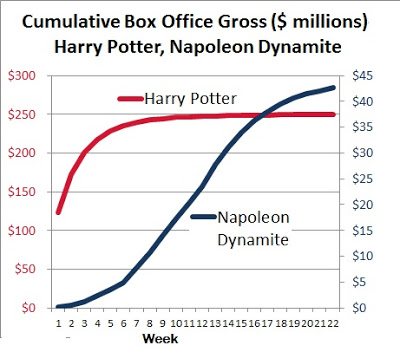
You can see these patterns again in the box office charts for the two movies from the summer of  2004 – “Harry Potter/Azkaban” and “Napoleon Dynamite.” (I had to use separate Y-axes in order to get David and Goliath on the same chart; data from BoxOfficeMojo.)
2

“Harry Potter” starts huge, but after the fifth week the increase in total box office tapers off quickly. “Napoleon Dynamite” starts slowly. But in its fifth or sixth week, its box office numbers are still growing, and they continue to increase for another two months before finally dissipating. The convex curve for “Harry Potter” is typical where the forces of influence are “exogenous.” The more S-shaped curve of “Napoleon Dynamite” usually indicates that an idea is spreading within the system.

But the Napoleon curve is not purely the work of the internal dynamics of word-of-mouth diffusion. The movie distributor plays an important part in its decisions about how to market the film – especially when and where to release the film. The same is true of “Harry Potter.”

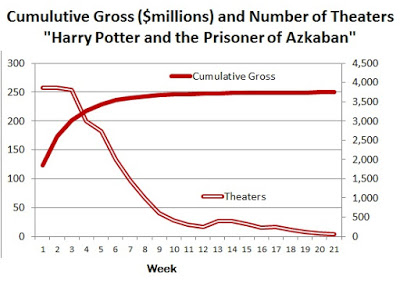
The Warner Bros. strategy for “Harry Potter” was to open big – in theaters all over the country. In some places, two or more of the screens at the multi-plex would be running the film. After three weeks, the movie began to disappear from theaters, going from 3,855 screens in week #3 to 605 screens in week #9.
4

“Napoleon Dynamite” opened in only a small number of theaters – six to be exact.  But that number increased steadily until by week #17, it was showing in more than 1,000 theaters.
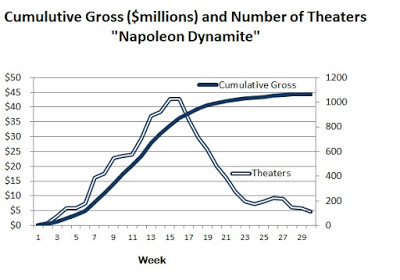
12

It’s hard to separate the exogenous forces of the movie business from the endogenous word-of-mouth – the biz from the buzz.  Were the distributor and theater owners responding to an increased interest in the movie generated from person to person? Or were they, through their strategic timing of advertising and distribution, helping to create the film’s popularity? We can’t know for sure, but probably both kinds of influence were happening. It might be clearer when the economic desires of the business side and the preferences of the audience don’t match up, for example, when a distributor tries to nudge a small film along, getting it into more theaters and spending more money on advertising, but nobody’s going to see it. This discrepancy would clearly show the influence of word-of-mouth; it’s just that the word would be, “don’t bother.”

Cross-posted at Montclair SocioBlog.

Jay Livingston is the chair of the Sociology Department at Montclair State University. You can follow him at Montclair SocioBlog or on Twitter.


Ah, capitalism.

The thing about our time is that we just might value individuality more than at any other point in the history of human life and, yet, at the same time, we have more capacity to mass produce goods and ideas than ever.

Enter: the marketing of mass-produced individuality. That is, the new Sex Pistols-themed Mastercard. Now available at virginmoney.com/virgin/credit-cards/rebellion.

Now that is a URL of the times.

Their slogan? “Bring a bit of rebellion to your wallet.”

2

I know almost nothing about punk music but I know that the Sex Pistols were foundational and that the message of the music was anti-establishment. So, the appearance of the band on credit cards with an APR of 18.9% is, sociologically speaking, hilarious.

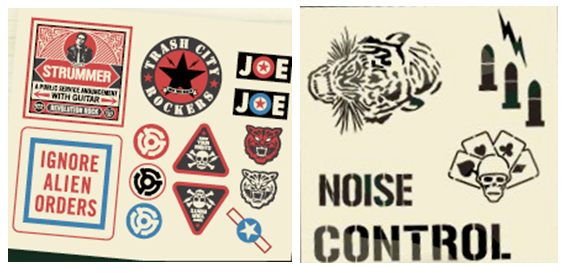
Hey, maybe you can buy a replica of a famous punk musician’s guitar with it! It comes pre-stressed, so it totally looks like you play it a lot and probably treat it like shit because who the fuck cares. And it also comes with some stickers that look vaguely anarchical and you can make it your own depending on which stickers you choose and where you put them!

3 4

Sociologist Brady Potts wrote a post about this guitar a few years ago. He asked: “What can we unpack from this guitar?” And wrote:

Pretty much the history of modernity. You start with “the guitar” – an instrument traditionally produced by artisans called luthiers. But this particular style of guitar – the Fender Telecaster – is the first commercially successful mass-produced solidbody electric guitar. (Henry Ford:Driving::Leo Fender:Rocking.) Introduced in 1950 as the Esquire… assembled on a factory line from mass-produced interchangeable parts, sold in stores and catalogs, heard most often via media and broadcast for most music consumers, the 1966 Fender Telecaster is truly a Modern guitar.

And now you can buy it with a Sex Pistols credit card. Nope, looks like they’re sold out. Sorry, you’ll just have to buy your identity somewhere else.

Thanks to @NotDrSnit for the tip!

Lisa Wade, PhD is an Associate Professor at Tulane University. She is the author of American Hookup, a book about college sexual culture; a textbook about gender; and a forthcoming introductory text: Terrible Magnificent Sociology. You can follow her on Twitter and Instagram.

Flashback Friday.

Back when I was in high school and college, I learned that one of the major things that separated humans from other species was culture. The ability to develop distinct ways of living that include an understanding of symbols, language, and customs unique to the group was a specifically human trait.

And, ok, so it turned out that other species had more complex communication systems than we thought they did, but still, other animals were assumed to behave according to instinct, not community-specific cultures.

But as with so many things humans have been convinced we alone possess, it’s turning out that other species have cultures, too. One of the clearest examples is the division of orcas into two groups with distinct customs and eating habits; one eats mammals while the other is pescetarian, eating only fish. Though the two groups regularly come in contact with each other in the wild, they do not choose to intermingle or mate with one another. Here’s a video:


Aside from the obvious implications for our understanding of culture, this brings up an issue in terms of conservation. Take the case of orcas. Some are suggesting that they should be on the endangered species list because the population has declined. What do we do if it turns out at some point that, while the overall orca population is not fully endangered, one of the distinct orca cultural groups is? Is it enough that killer whales still exist, or do we need to think of the cultures separately and try to preserve sufficient numbers of each? In addition to being culturally different, they are functionally non-interchangeable: each group has a different effect on food chains and ecosystems.

Should conservation efforts address not just keeping the overall population alive and functioning, but ensure that the range of cultural diversity within a species is protected? If this situation occurred, should we declare one orca culture as endangered but not the other? Are both ecological niches important?

I love these questions. If we recognize that creatures can have cultures, it challenges our sense of self, but also brings significantly more complexity to the idea of wildlife preservation.

Originally posted in 2010.

Gwen Sharp is an associate professor of sociology at Nevada State College. You can follow her on Twitter at @gwensharpnv.

Jennifer Pozner, Kat Lazo, Zerlina Maxwell, and Samhita Mukhopadhyay join Jay Smooth to discuss a few no-nos for the media this campaign season. Pozner sums it up:

Look, this matters. By focusing on personal, gendered, irrelevant details about women politicians, this conditions the American public to think that woman are ladies first [and] leaders only a distant second. Media play a serious role in keeping half the population out of the political talent pool.

Enjoy:

Lisa Wade, PhD is an Associate Professor at Tulane University. She is the author of American Hookup, a book about college sexual culture; a textbook about gender; and a forthcoming introductory text: Terrible Magnificent Sociology. You can follow her on Twitter and Instagram.

Lots of time and care consideration goes into the production of new superheroes and the revision of time-honored heroes. Subtle features of outfits aren’t changed by accident and don’t go unnoticed. Skin color also merits careful consideration to ensure that the racial depiction of characters is consistent with their back stories alongside other considerations. A colleague of mine recently shared an interesting analysis of racial depictions by a comic artist, Ronald Wimberly—“Lighten Up.”

“Lighten Up” is a cartoon essay that addresses some of the issues Wimberly struggled with in drawing for a major comic book publisher. NPR ran a story on the essay as well. In short, Wimberly was asked by his editor to “lighten” a characters’ skin tone — a character who is supposed to have a Mexican father and an African American mother.  The essay is about Wimberly’s struggle with the request and his attempt to make sense of how the potentially innocuous-seeming request might be connected with racial inequality.

In one panel of the cartoon, you can see Wimberly’s original color swatch for the character alongside the swatch he was instructed to use for the character.

Digitally, colors are handled by what computer programmers refer to as hexadecimal IDs. Every color has a hexademical “color code.” It’s an alphanumeric string of 6 letters and/or numbers preceded by the pound symbol (#).  For example, computers are able to understand the color white with the color code #FFFFFF and the color black with #000000. Hexadecimal IDs are based on binary digits—they’re basically a way of turning colors into code so that computers can understand them. Artists might tell you that there are an infinite number of possibilities for different colors. But on a computer, color combinations are not infinite: there are exactly 16,777,216 possible color combinations. Hexadecimal IDs are an interesting bit of data and I’m not familiar with many social scientists making use of them (but see).

There’s probably more than one way of using color codes as data. But one thought I had was that they could be an interesting way of identifying racialized depictions of comic book characters in a reproducible manner—borrowing from Wimberly’s idea in “Lighten Up.” Some questions might be:

  • Are white characters depicted with the same hexadecimal variation as non-white characters?
  • Or, are women depicted with more or less hexadecimal variation than men?
  • Perhaps white characters are more likely to be depicted in more dramatic and dynamic lighting, causing their skin to be depicted with more variation than non-white characters.

If any of this is true, it might also make an interesting data-based argument to suggest that white characters are featured in more dynamic ways in comic books than are non-white characters. The same could be true of men compared with women.

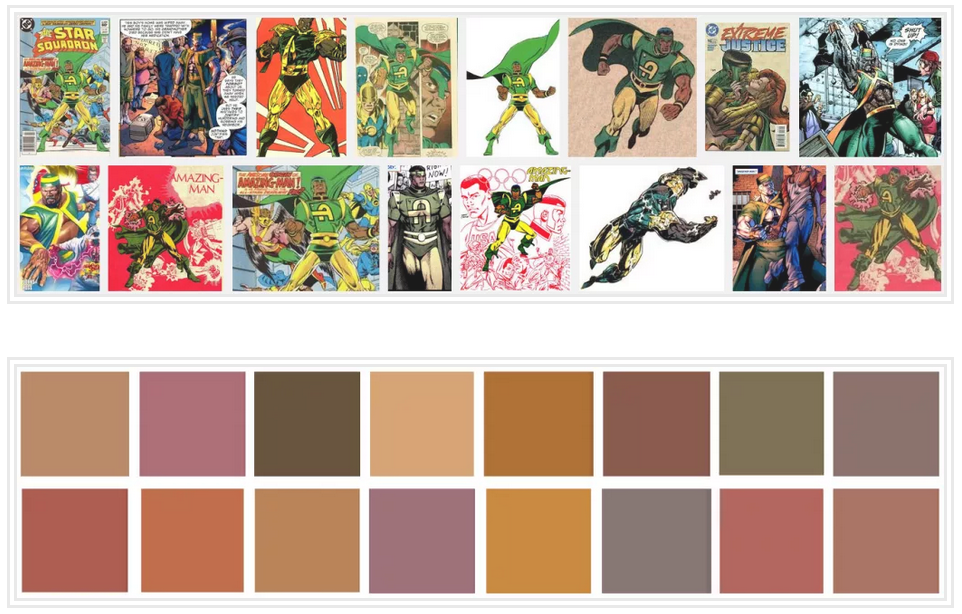
Just to give this a try, I downloaded a free eye-dropper plug-in that identifies hexadecimal IDs. I used the top 16 images in a Google Image search for Batman (white man), Amazing-man (black man), and Wonder Woman (white woman). Because many images alter skin tone with shadows and light, I tried to use the eye-dropper to select the pixel that appeared most representative of the skin tone of the face of each character depicted.

Here are the images for Batman with a clean swatch of the hexadecimal IDs for the skin tone associated with each image below:

2 (1)

Below are the images for Amazing-man with swatches of the skin tone color codes beneath:

2

Finally, here are the images for Wonder Woman with pure samples of the color codes associated with her skin tone for each image below:

3

Now, perhaps it was unfair to use Batman as a comparison as his character is more often depicted at night than is Wonder Woman—a fact which might mean he is more often depicted in dynamic lighting than she is. But it’s an interesting thought experiment.  Based on this sample, two things that seem immediately apparent:

  • Amazing-man is depicted much darker when his character is drawn angry.
  • And Wonder Woman exhibits the least color variation of the three.

Whether this is representative is beyond the scope of the post.  But, it’s an interesting question.  While we know that there are dramatically fewer women in comic books than men, inequality is not only a matter of numbers.  Portrayal matters a great deal as well, and color codes might be one way of considering getting at this issue in a new and systematic way.

While the hexadecimal ID of an individual pixel of an image is an objective measure of color, it’s also true that color is in the eye of the beholder and we perceive colors differently when they are situated alongside different colors. So, obviously, color alone tells us little about individual perception, and even less about the social and cultural meaning systems tied to different hexadecimal hues. Yet, as Wimberly writes,

In art, this is very important. Art is where associations are made. Art is where we form the narratives of our identity.

Beyond this, art is a powerful cultural arena in which we form narratives about the identities of others.

At any rate, it’s an interesting idea. And I hope someone smarter than me does something with it (or tells me that it’s already been done and I simply wasn’t aware).

Originally posted at Feminist Reflections and Inequality by Interior Design. Cross-posted at Pacific Standard. H/t to Andrea Herrera.

Tristan Bridges is a sociologist of gender and sexuality at the College at Brockport (SUNY).  Dr. Bridges blogs about some of this research and more at Inequality by (Interior) Design.  You can follow him on twitter @tristanbphd.

12Well done, Sociopress!

Lisa Wade, PhD is an Associate Professor at Tulane University. She is the author of American Hookup, a book about college sexual culture; a textbook about gender; and a forthcoming introductory text: Terrible Magnificent Sociology. You can follow her on Twitter and Instagram.

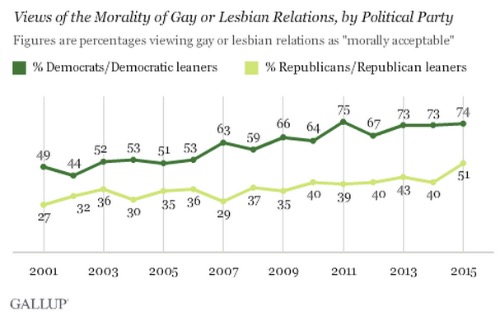
A Gallup poll of a random sample of Americans conducted in May finds that, for the first time, a majority of Republicans report that they believe that gay and lesbian relations are “morally acceptable.” This is your image of the week:

12

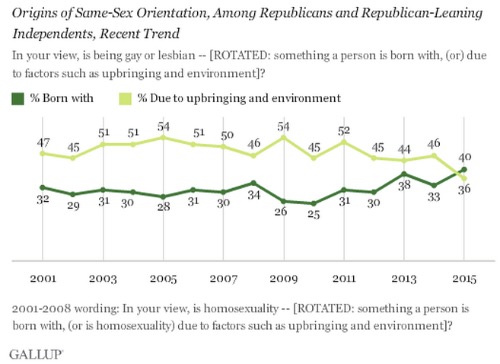
And this, showing that a plurality of Republicans — meaning more than not — think sexual orientation is inborn, not chosen or learned:

13

Now, to be fair, Gallup specifies a sampling error of ±4 percentage points. So, they’re 95% confident that at least 47% of Republicans now approve of gayness, but also as many as 55%. Also, I don’t know what “gay and lesbian relations” means — sexual relations? relationships? — and neither do the pollsters or the respondents, as far as I know, which is some interesting slippery question asking. Still, that’s the data. Here’s some skepticism, just in case you’ve got an eyebrow raised.

Lisa Wade, PhD is an Associate Professor at Tulane University. She is the author of American Hookup, a book about college sexual culture; a textbook about gender; and a forthcoming introductory text: Terrible Magnificent Sociology. You can follow her on Twitter and Instagram.

Flashback Friday.

Many sociologists argue that gender, as we know it, is not innate, but put on and performed. Certain moments of our lives, like weddings and quinceañeras, are opportunities to really emphasize femininity and masculinity; but gender is also performed in mundane ways every day in the ways that we talk, move, dress, and adorn ourselves.

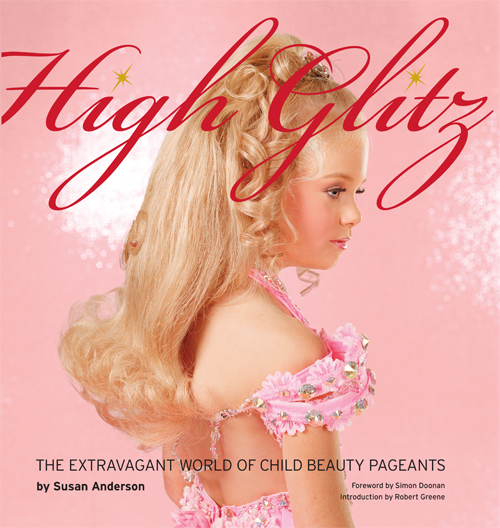
These photographs of child beauty pageant participants, taken by Susan Anderson and published in her book High Glitz, illustrate how much of feminine sexual allure is put on and performed.  These kids are adultified with make-up and they also often wear false teeth and hair extensions. You can browse additional images at Powerhouse Books.

HighGlitz_Jacket_060209

People often object to this sort of adornment on a child being unnatural, but when adult women use these same strategies — fake eyelashes, makeup, veneers, and hair extensions — it is no more natural. Adult women are, no less than those kids, performing femininity.

To take it one step further, as The Spinster Aunt does, if you react to the idea of child beauty pageants with horror, then than horror should be applied to the project of femininity itself, not just the fact that children are participants:

I submit that anyone who is uncomfortable with [the] Little Miss Perfect [pageant] is ethically obliged to be just as uncomfortable with femininity in general. Little Miss Perfect is merely one of a gazillion equally nauseating points on the Porno-Feminine Continuum within which all female citizens of the globe are confined by a culture of oppression.

So, if it’s troubling when girls do it (and, for that matter, also troubling to many when men do it), then why isn’t it troubling when women do it?

Originally posted in 2010.

Lisa Wade, PhD is an Associate Professor at Tulane University. She is the author of American Hookup, a book about college sexual culture; a textbook about gender; and a forthcoming introductory text: Terrible Magnificent Sociology. You can follow her on Twitter and Instagram.