Reminiscent of work by Anna Lappé and the Small Planet Institute‘s “Take a Bite out of Climate Change” initiative, I stumbled across  Food-Miles and the Relative Climate Impacts of Food Choices in the United States by Christopher L. Weber and H. Scott Matthews in Environmental Science and Technology. Looking past the fancy equations you see data presented like this snippet of Figure 1, documenting the green house gas emissions associated with household food consumption, allowing for a comparison of impacts between food groups.

The article presents data that systematically compares the life-cycle greenhouse gas emissions associated with food production against long-distance distribution, aka “food-miles,” finding that the production cycle accounts for the majority of emissions. In other words, changing the type of food you eat (e.g., less red meat) does more good for the environment than buying local.

The new National Review depicts Supreme Court nominee Sotomayor as a Buddha:

picture1

Many commentators have criticized the cover for using racial stereotypes.   They write as if the people at the National Review are ignorant (e.g., can’t tell the different between different races).   But it’s not an accident, it’s a purposefully racist joke.  Of all the commentary I’ve seen so far, Neil Sinhababu said it the most clearly (via):

…the joke actually depends on incongruities between the stereotypes of the nonwhite ethnicities involved. The Buddha-like pose and Asian features are tied to lofty pretensions of sagelike wisdom. And what sort of person is it who’s pretending to be some kind of sage? A Hispanic woman! As if.

The in-joke in this cover is for people who have already internalized a stereotype of Hispanic women as hotheaded and not that bright. Put one of them in the Buddha suit, and if you’ve absorbed the right racist stereotypes, the incongruity is hilarious.

I think the larger story here is not that the cover is racist, but that race-based criticism is fair game in contemporary U.S. politics.  The last election should have made this abundantly clear (see here, here, here, here, here, here, here, here, here, here, and herefor examples).

—————————

Lisa Wade is a professor of sociology at Occidental College. You can follow her on Twitter and Facebook.

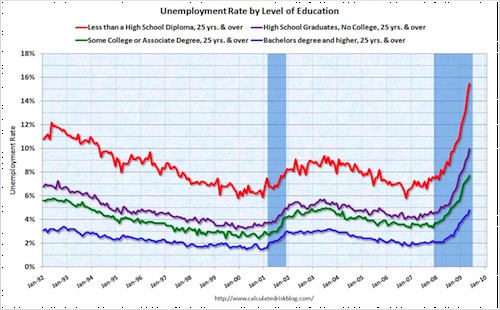
Matthew Ygelsias posted a graph showing that, for those 25 and older, education-level is correlated with rates of unemployment: the more educated you are, the less likely you are to find yourself unemployed. This relationship appears to be uninterrupted by the current recession.

Red = less than a high school diploma
Purple = high school graduate, no college
Green = some college
Blue = bachelors degree or higher

unemploymenteducation-1

—————————

Lisa Wade is a professor of sociology at Occidental College. You can follow her on Twitter and Facebook.


Nadya L. sent in a video, embedded below, produced by a Christian anti-pornography initiative. It uses the logic that all women involved in sex work are “somebody’s daughter” and, thus, men should not consume pornography.

Ross Rosenberg at Coilhouse points out that the video erases the possibility that participating in the production of porn does not, inherently, ruin women foreverandever (and, thus, dads and moms should not necessarily be disappointed when their daughter participates in sex work). More provocatively, he asks:

[Why is] the idea of that the object of ones lustful desires is ‘somebody’s daughter’… a functional deterrent…[?]… Really, what is this video talking about here? Is it a serenade to the sanctity of our children’s innocence; the preciousness of their safety or merely the thinking that, if someone masturbates to images of my daughter, she has embarrassed me. If this was your daughter, what shame would it bring down upon you, her father? [Why would it] …be terrible for you and your family if it was discovered that your daughter was a pornstar or a stripper?

In my Power and Sexuality course, I discuss sex work and empowerment. Instead of essentializing both femininity and sex work and arguing that all sex work is inherently oppressive to women, I suggest that social conditions (such as patriarchy) and institutional features (such as pro- versus anti-unionization measures) shape the work environment of sex workers in positive and negative ways. Instead of asking: “Is sex work oppressive to women?” I ask: “What makes sex work more and less oppressive to women?” I think the latter leads to a much more interesting conversation.

For more posts trying to think through the topic of sex work, see here, here, here, here, and here.

—————————

Lisa Wade is a professor of sociology at Occidental College. You can follow her on Twitter and Facebook.
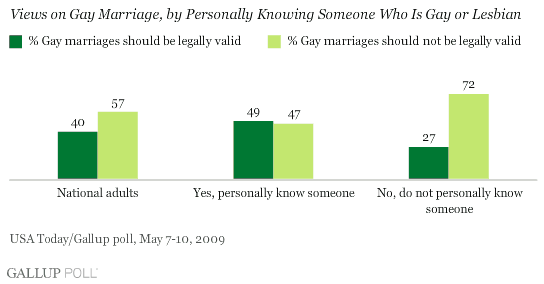
The contact hypothesis postulates that being near people of a different social group (e.g., race, class, sexual orientation, etc) translates into greater tolerance for that type of person. In other words, it’s harder to hate all Latinos (for example) when your neighbor is Latino and, damn it, you kind of like him.  Andrew Sullivan posted this figure:

6a00d83451c45669e2011570b1f019970b-800wi

Jose at Thick Culture suggests that this could be evidence for the contact hypothesis.  But he also asks whether it might also be true that less homophobic people are more likely to come into contact with gays and lesbians because of a third variable that correlates with both (like choosing to live in a big city), making the relationship spurious.

(What’s a spurious relationship?  Here’s one:  People who eat ice cream are more likely to drown.  Both incidence of ice cream eating and rates of drowning are related to summertime.  The relationship between ice cream and drowning is spurious.  That is, there is no relationship.  Yet they appear related because they are both related to a third variable.)

—————————

Lisa Wade is a professor of sociology at Occidental College. You can follow her on Twitter and Facebook.

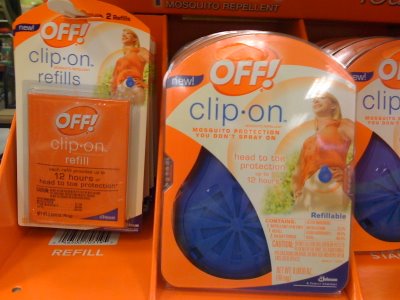
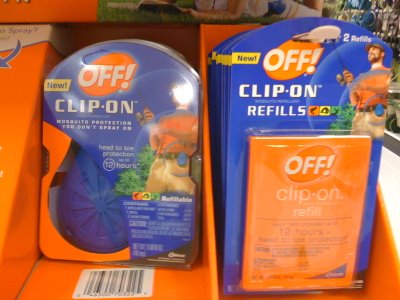
Z from It’s the Thought that Counts sent us this example of an identical product–mosquito repellent–packaged two different ways (found here). In the top example, the mostly blue package includes a male figure fishing and logos for hunting, camping, and fishing. In the bottom one, the mostly orange package includes a female figure, perhaps on a walk.

boys1
girls1

Rudbeckia Hirta explains:

Sold in the same anti-mosquito display. Same active ingredient. Same concentration of active ingredient. Same quantity in the package. Same price.

This reminds us that gender seems to be a salient variable no matter what the context, which goes to show how profoundly our psyches and cultures are organized by gender.

—————————

Lisa Wade is a professor of sociology at Occidental College. You can follow her on Twitter and Facebook.
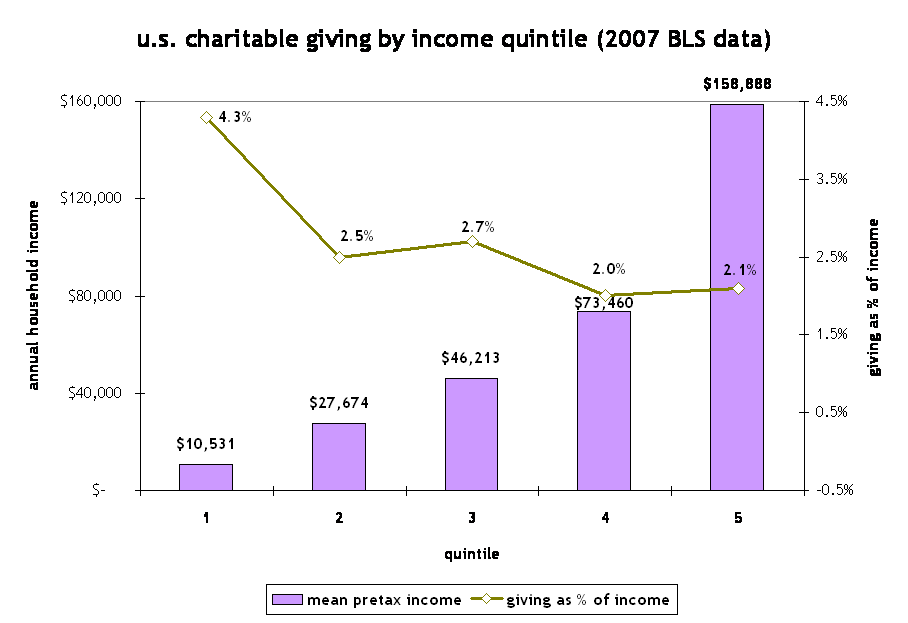
The graph below reveals the percent of before-tax income given to charity by class (separated into fifths):

giving

There is a positive correlation between income and absolute giving (the higher their income, the more money they donate), but a negative correlation between income and relative giving (as incomes go down, households donate a higher and higher percentage of their income).

From Chris Uggen’s weblog via.

—————————

Lisa Wade is a professor of sociology at Occidental College. You can follow her on Twitter and Facebook.
Eric Stoller sent us a photo he took at Borders recently of two doodle books, one targeting boys and one targeting girls:

3540853922_5e9f9b178a

In Eric’s post about the books at his blog, he says,

The Boys’ Doodle Book features the following images on its cover: triceratops, ogre, tiger, superman, rocket, skull & crossbones, octopus, boy w/slingshot, mouse, train, kite, dragon, knight, shark, excavator, dog and a cowboy.

The Girls’ Doodle Book in comparison has a different cover color and a variety of differing images than the Boys cover including: crown, pony, castle, sun, microphone, ice cream cone, frog/prince, purse/bag, rabbit, cupcake, starfish, unicorn, fish, cat, toothpaste, dragon, ballerina and a mermaid.

I’m surprised that the Girls’ Doodle Book didn’t have a pink colored cover given the overall stereotypical and gendered nature of the doodles on the cover. Boys like fire, machines, spikes and death, while Girls like food, animals typically associated with non-violence, dancing/arts and hygiene. I’m not saying that there is anything inherently wrong with any of the doodles. What I am saying is that gender-based stereotypes are being perpetuated in overt contrast with these two books.

Thanks for sending the image along, Eric!

NEW! Laurel O. found another example, the Girls’ and Boys’ versions of How to Be the Best at Everything:

51pWbTEBJ3L._BO2,204,203,200_PIsitb-sticker-arrow-click,TopRight,35,-76_AA240_SH20_OU15_

Picture 1

Laurel’s kids’ school sent home an order form for books. The descriptions of these two:

The boys’ book description says “Learn how to lasso like a cowboy, juggle one-handed and more” whereas the girls’ book says “Design your own clothes, host the best sleepover, and lots more.”

NEW! (July ’10): Gaby K sent in an example of British coloring books aimed at boys and girls. We see a lot of the typical gendered stuff: girls like cupcakes and perfume and butterflies, while boys like trucks and bugs and rockets. Gaby also points out that the girls’ version has a passive Russian nested doll while the boys’ has a robot with apparently movable joints: