In the documentary Dreamworlds 3: Desire, Sex, and Power in Music Video, Sut Jhally investigates how images of sex and violence, and sexualized violence against women, are used in music videos, and how music videos help shape ideas of what is sexy. Here’s a clip:
The entire, unabridged version of the film is available here.
Elle sent in a link to the video for Lady Gaga’s song “Paparazzi,” which features one extended scene of sexualized violence (starting at about 1:45) and several other glimpses of women throughout the video who appear to be dead (it’s really worth watching the entire video–it’s something else):
Of course, Lady Gaga would probably argue that this video is in fact opposing violence against women, since in the end the evil paparazzi boyfriend gets killed. But there’s the same imagery Sut Jhally discusses: the mixture of sexuality with violence and hints of brutality, and of injured or dead women in glamorous, sexy clothing. Notice that in the opening sequence, the “normal” sex doesn’t look too much different than the violence that follows.
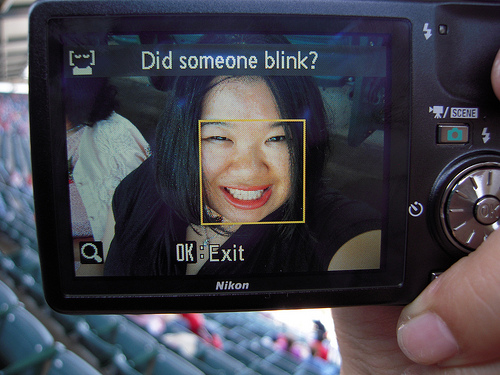
Toban B., Elisabeth, and Mark sent us a link to a post at jozjozjoz about the Nikon S630 digital camera. As Joz explains, “As I was taking pictures of my family, it kept asking ‘Did someone blink?’ even though our eyes were always open.”
Apparently the camera perceives “Asian” eyes as closed.
Does anyone know about how cameras are programmed to do things like recognize blinking? Does the program include specific measurements to look for to define an eye as open or closed and then prompt the user with a question about blinking? It would seem that the program doesn’t know how to deal with Asian features, which makes me wonder about the “typical” faces or facial features used to write the program–who was used as the “neutral” model?
Anybody know more about how these types of programs are written and how specifications are chosen to provide the camera a baseline for determining that the face in a photo requires “fixing” of some sort?
UPDATE:Commenter Elizabeth says,
I just got back from vacation with a friend who has this camera (we are three white women) and after every photo, it asked us, “Did someone blink?” It became a running joke because the sensor asked this question whether or not there was a person (or blinking person) in the shot.
Several of our other commenters had some info on how face-recognition programs work and what the problem might be, and that a) they generally suck and b) might suck slightly more for some groups than others, but still are overall pretty crappy at this point no matter what.
NEW!Racialicious posted about the Microsoft Natal game, which seems to have some problems recognizing the movements of people with dark skin (and maybe dreadlocks):
Research into the issue resulted in a study concluding that near-infra-red cameras did indeed struggle to read movements from those with darker skin. However, Microsoft has responded to these worries, telling Gamezine that all ethnicities will be able to use the technology.
The post has a really good discussion about race and “neutral” avatars in games, including some in which you have to pay extra to get a non-White character.
I’ve suggested that the fact that men do not feel compelled to wear make-up is a “triumph of gender ideology over capitalism” (see here). Companies that sell make-up, after all, have halved their profits by giving up on selling to men. We should expect, then, a tug-of-war between the profit motive and a gender ideology that suggests that men and women are opposite. On the one hand, if men and women are opposites, then the requirement that women primp and preen (with the help of dozens of products) would imply that men do not. On the other hand, if they accept this gender binary, companies lose half their customers.
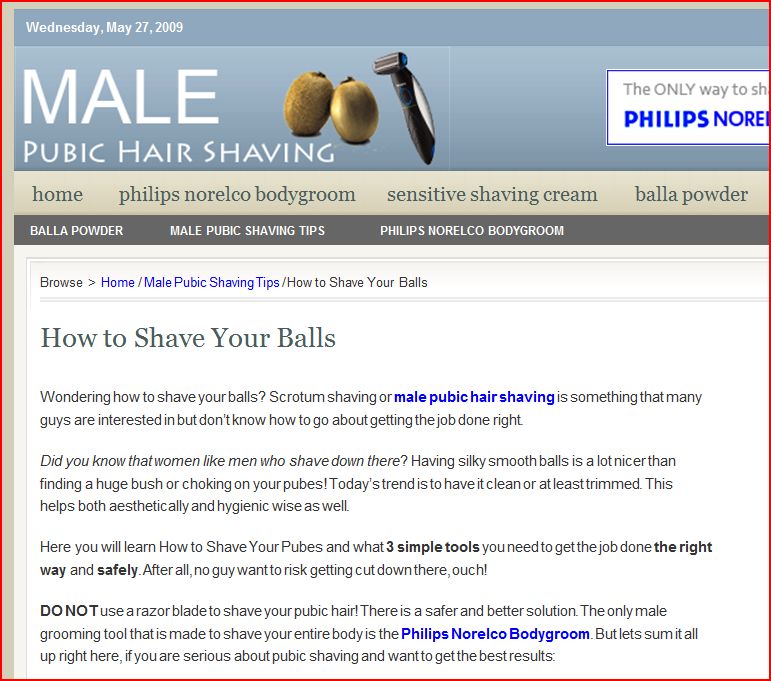
Accordingly, Gwen and I were shocked to see an ad at Jezebel, sent in by Frank D., overtly marketing scrotum shaving.
We have seen this a bit with products aimed at men and their hair already (see here, here, and here), but I’m still surprised to see this. I can’t imagine anything harder to shave on anyone’s body, male or female.
So how are they trying to convince men to do it?
They are using the same tactics that they use against women. They are either (1) shaming men into thinking that they are disgusting and no woman (or man) will have them unless they alter their body (see here, here, and here) or (2) naturalizing shaving such that it is just a fun thing that all men inevitably participate in (see here, here, here, and here).
Did you know that women like men who shave down there? Having silky smooth balls is a lot nicer than finding a huge bush or choking on your pubes! Today’s trend is to have it clean or at least trimmed. This helps both aesthetically and hygienic wise as well.
They are also using a gendered logic. We’ve seen this with other examples of companies trying to sell self-maintenance to men. They hyper-masculinizing the product. For examples, see our posts on hair product for men (with “stand tough” hair gel), make-up for men ( with “blo-job bronzing powder”). We see this with other feminized products and activities too (for example, ice skating and chocolate). In this case, they don’t say, “If you don’t shave your balls, you won’t be pretty.” They say, “When there’s no underbrush, the tree looks taller.”
Yeah, no. I’m not paraphrasing:
One thing we might discuss is whether this this represents a “female gaze” that matches the “male gaze” that requires women to always be a pleasurable object for others to view… or that, alternatively, this is just the male gaze being applied to men. Some of the marketing for men’s body shaving appears to be clearly marketed towards gay men (see this website, especially here).
Another interesting thing to consider is the extent to which the social invisibility of the pubic area facilitates marketer manipulation. If you’re straight, unless you’re willing to ask a partner, you have to trust the advertisers to tell you what “today’s trend” is. What a great deal for the companies.
Oh, and, I’m wondering which you think is going to win this tug-of-war: the companies with their profit motive or gender ideology and a resistance to the feminization of men?
In response to Gwen’s post on butts, I offer you crotches. We’re being super highbrow today.
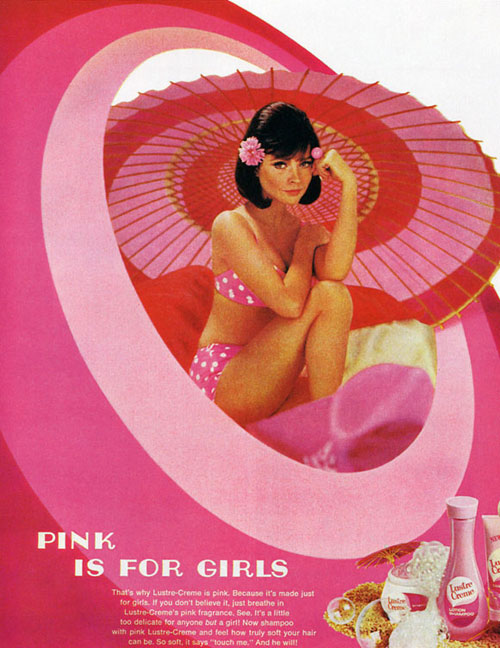
The following not-safe-for-work ads place a product (or copy) at a woman’s crotch. Are they promising sexual access? Just trying to draw attention? Using shock tactics? I don’t know.
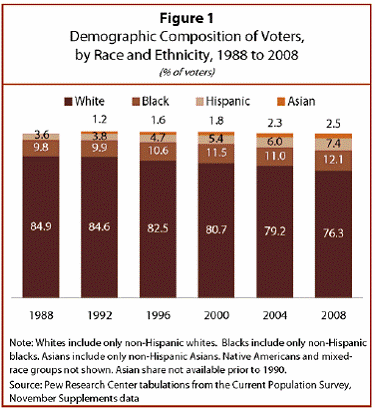
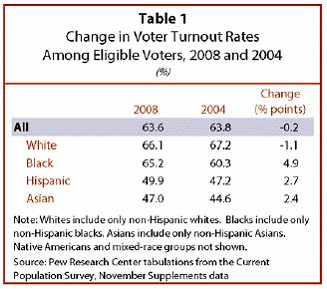
Thomas Sander at the Social Capital Blog writes: “Obviously the $1,000,000 question is whether these behavioral changes are likely to continue beyond the Obama candidacy.” I think the answer to this, at least as far as racial composition goes, is yes. What we see here is a two decade long trend, not a blip inspired by Obama.
Michael G., Sarahjane C., and Marlow sent us this commercial, designed for a small market, advertising a furniture store called The Red House. It was produced by Rhett McLaughlin and Link Neal. It is a real commercial, though it was designed to self-consciously spoof the many poorly-produced and weirdly-sloganed commercials that we’ve all seen advertising local small businesses on late night television. Word on the street is that the commercial has been maligned as racist. What do you think?
McLaughlin and Neal felt obliged to respond to the accusations of racism in another video. In it, they make a distinction between “racist” and “racial” and suggest that the video only seems racist if any and all talk that acknowledges race is considered bad.
This is an example of how the internet operates as a public sphere and can facilitate discussion about difficult topics. Without youtube, attention to this commercial would have remained local and/or restricted to a two minute discussion on the nightly news. Instead, the commercial has been viewed over 1.2 millions times and the response has been viewed over 50,000 times (as of today). Blogs all over the internet have picked up on the controversy and people are chiming in. I wouldn’t say that the discussion is all that sophisticated, but it is really interesting to see so many Americans discussing racism at all.
Then again, maybe the commercial has gotten so much attention because most people conclude that it is not racist. That is, are race and racism more likely to be widely discussed when the collective conclusion is “not racism”? Do we see such wide discussion of clearly racist material?
What do you think? Is this an example of the revolutionary power of the internet? Or just business as usual?
About Sociological Images
Sociological Images encourages people to exercise and develop their sociological imaginations with discussions of compelling visuals that span the breadth of sociological inquiry. Read more…