Chris Uggen, at our sibling Context blog Public Criminology, posted an interesting graph showing that background checks for gun sales during the period from November to April for each year from 1999-2000 to 2008-2009. We see that they’ve increased significantly this November-April compared to previous years:

guns

Background checks should serve as a decent proxy for gun sales, keeping in mind that not everyone who requests a check will eventually purchase a gun, not everyone who gets a gun bothers to go through legal channels and get a background check, and people who get a background check might then buy multiple guns.

Anyway, it appears that the reason for the jump in sales may be the election of President Obama (although as Chris points out, it’s possible the recession or some other factor could be driving it). When I mentioned this to a couple of friends, they assumed it meant some crazy White people were preparing for a race war. I presume that is true for some people, and that some of them are my relatives. However, there’s another explanation, which is what most news stories I googled report and which, having talked to a number of very right-leaning individuals I happen to know, seems more likely to me: with a Democratic controlled Congress and a Democratic President, many people are convinced that gun control is right around the corner, and they are taking advantage of the period before guns can be outlawed to stock up, with the hopes that after guns are outlawed, they can either hide them or maybe people who bought theirs before the law was passed get to keep them.

I haven’t seen as much news coverage of it, but in addition to gun sales, apparently bullet sales have gone up. My friends and family members who have guns have been complaining about the increasing price of bullets, as well as their scarcity. I was recently with a friend who is a police officer and needed to buy some bullets for shooting practice, and when he asked at Wal-Mart, the price was much higher than usual (I don’t remember the specific price, just that he said it was high) and they only had one specialty kind in stock; the rest of the shelf was bare.

So anyway, it’s sort of an interesting social trend that appears likely to be related to Obama’s election and the fear of liberals taking away guns (something I find highly unlikely), though I’m open to other explanations.

And as for why I don’t object to my friends and relatives having guns and buying bullets, I have a friend who is a police officer, so he has to have a gun while at work, and I gave up long ago on my family members, who are mostly ranchers and hunters; I’ve settled for being happy that my grandma shoots a lot fewer things than she used to.

UPDATE: In response to my story about going to Wal-Mart with my friend and checking on the price of bullets, Jeremiah says,

I question the veracity of this anecdote. In all my years of firearm ownership, only the most n00b newbz buy retail ammo for ‘practice.’ Everyone else buys repacked rounds at a HUGE discount.

People call me dumb or question my interpretation frequently enough, but being called an outright liar is new. I did, indeed, go to Wal-Mart with my friend Clint, who is a cop, and he went to the gun section and asked about bullets. I just called him and asked what kind he was looking for; he said he asked about .22 bullets, and I asked what he needed them for. He said “just for practice.” I didn’t think to clarify if he meant official practice at the firing range, or informal practice as in “a group of my friends and I are going to drive to a field and shoot at stuff.”

Point being, I am many things: crazy, bossy, sometimes overdramatic, a bit cranky. I am not, however, a liar.

UPDATE TWO: Joshua provides more information on background checks:

In states like Georgia, without a mandatory waiting period (the majority of states), the background check occurs at the time of purchase. The dealer makes a phone call, gives your identifying information, and in most cases gets an instant answer. At that point, you purchase the gun and away you go. The idea that someone would “request a background check” and then not purchase a gun seems questionable to me, because it is the act of attempting to purchase a gun that triggers the background check.

There are many legal channels for buying a gun without a background check. Only gun dealers are required to perform background checks. In most states, non-dealers can sell or give away guns just like they can sell any other possession. No background check is required for so-called private-party sales. There are limits on the number of guns a person can sell before they become a de facto dealer. A few states amend the federal requirements by requiring all gun sales to go through a dealer, who typically charges a small fee for the service.

Also, in states who issue concealed-carry permits, and whose permit requirements meet federal minimum standards, people who have a permit can buy firearms without a background check. The thinking is that the federal minimum standards mean that a permit-holder has already been vetted to a much higher degree than the NICS check system does, and at that point, NICS is redundant. This serves as an incentive for states to meet the federal recommended standards for carry permits.

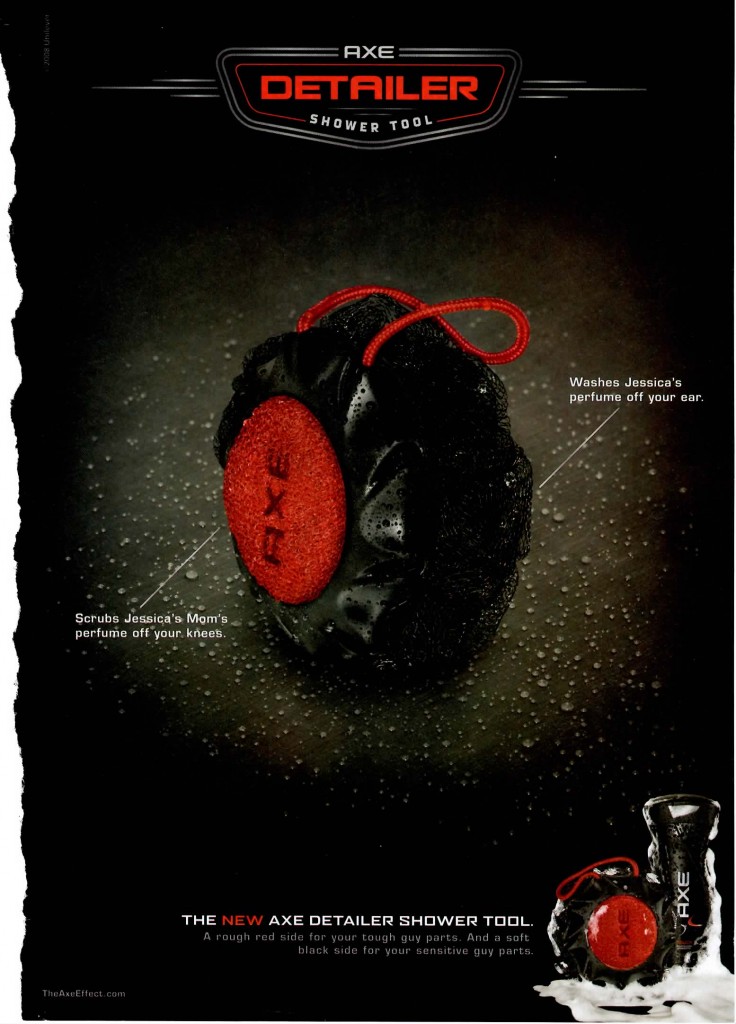
The following is a print ad from those one-trick ponies over at Axe Body Spray in an ongoing effort to market shower products to men.

axe

The text pointing to the black part of the “Axe Detailer Shower Tool” (the name of which is worth a post all by itself) says:

“Washes Jessica’s perfume off your ear.”

The text pointing to the red part of the “Tool” says:

“Scrubs Jessica’s Mom’s perfume off your knees.”

I guess the take-home message is that you can exfoliate, but still be masculine enough to have a creepy three-way sexual relationship with women who are related to each other by blood.

By the way, what’s up with that?  The heterosexual male fantasy of being sexually serviced by two women is so common as to have become a cliché, but what about the less-frequently endorsed but still prevalent fantasy about those women being sisters (or better yet, identical twins!) or a mother-daughter pair?  Is it simple attraction (i.e., if you’re attracted to one woman in a family, it’s likely you’ll be attracted to other women who look/act like her)?  Is it the taboo element?  Or does the power to coerce women into an incestuous situation serve as its own reward?

Still, Axe got one thing right with this product.  When I think about a guy who would buy this sponge in the hopes of securing sexual relations with a woman and her mother, I can’t help but think of him as a, well…tool.


Jason S. sent in this clip of a convention for (parents of) infants, toddlers, and tweens called Baby and Tweens Celebration L.A. It’s an example of the hyper-consumerist mentality that now surrounds child-raising, at least for the upper-middle classes and higher. It’s also an example of the way that young children, especially young girls, are encouraged by some forces to think of themselves as “princesses.” Many parents (literally) buy into this idea of what a (girl) child should be like. It has not been this way throughout history and is not this way across cultures.

[youtube]https://www.youtube.com/watch?v=HR6DpbDoyuc[/youtube]

Related posts: baby couture magazine, babies are born 2 shop, future trophy wife and milf t-shirts, boob job piggy bank, Strawberry Shortcake in the City, bangs for baby, beauty spending over a lifetimemodernizing the fairy tale, and girl culture.

—————————

Lisa Wade is a professor of sociology at Occidental College. You can follow her on Twitter and Facebook.

Lisa Wade, PhD is an Associate Professor at Tulane University. She is the author of American Hookup, a book about college sexual culture; a textbook about gender; and a forthcoming introductory text: Terrible Magnificent Sociology. You can follow her on Twitter and Instagram.

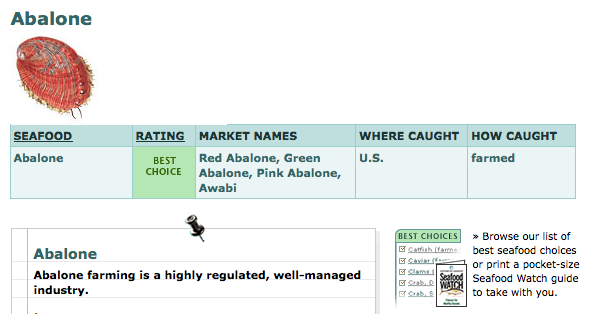
Mary M., of the fantastic blog Cooking with the Junior League, mentioned in one of her blog posts that the Monterey Bay Aquarium has a handy seafood guide that provides information on how various types are raised/caught, whether it is overfished, and the environmental impact. This page lets you click on different species and get detailed information about it; here’s a screenshot of part of the listing for abalone:

picture-1

Or you can go to their U.S. map and click on a region to download a pdf guide to buying seafood in your region.

Also see our post on the Consumer Reports eco-labeling website and the interactive map of factory farms.

NEWS!

One of our posts inspired a comic at Faulty Logic.  Neat!

FROM THE ARCHIVES:

One year ago Gwen wrote an extensive post about the 1968 Olympic medalists Tommie Smith and John Carlos, who used their medal ceremony to try to draw attention to racism and poverty in the U.S.  Her post does an excellent job of describing and analyzing the protest and its aftermath.  Visit it here.

NEWLY ENRICHED POSTS:

A representative from Reynold’s Kitchens sent us an email in response to our post on their new, recycled Reynold’s Wrap.  See her commentary here.  We’ve also added a link to a second source suggesting that our original post was wrong.  Check it out.

We added two commercials for Malibu Rum to our post about the commodification of Jamaica and “island culture.”

Jay Smooth followed up on his excellent commentary about Asher Roth’s use of the term “nappy headed hos” and black rappers’ materialism. This time his video features Dan Charnas, a hip-hop industry insider. See their discussion about white privilege and racial humility here.

We added another ad to our post about how Axe products are marketed to men.

Jody B. sent in a Progressive Insurance commercial that many believe features two gay men. We added it to our earlier post about an Argentinian bank commercial that positively features a transgender individual; both could be useful for a discussion of when and how corporations choose to associate themselves with minority or marginalized groups, knowing it might offend other segments of society.

We added another image that calls into question the idea that there are clear differences in facial features by race to our post comparing President Obama to his grandfather.

Of course, there’s always more stuff shaped like boobs (scroll way down until you see the NEW! section).

OKAY FINE!

So the truth is we didn’t do much behind your back this month and, in fact, you may have noticed that we didn’t exactly keep up our normal prodigious Sociological Images schedule.  But we have been doing stuff and, in case you are interested, it involved cows, lizards, and gators!  After the jump (because most of you could care less) are some non-sociological images of things we’ve been up to behind your back this month.

more...

Natasha L. sent in a link to the site The Plunge, a wedding planning site for men. She says,

I’m getting married in a month.  My facebook knows this, and usually gives me wedding-related ads.  Today it had one that said, “Give us your fiance, and we’ll give you a groom.  A wedding site written by men.”

Here’s one page:

picture-1

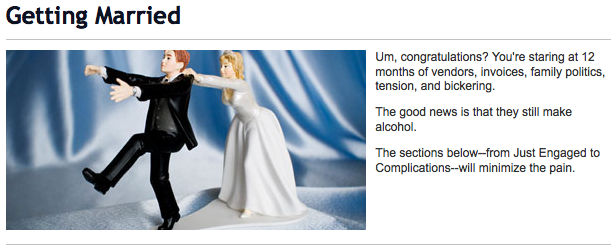
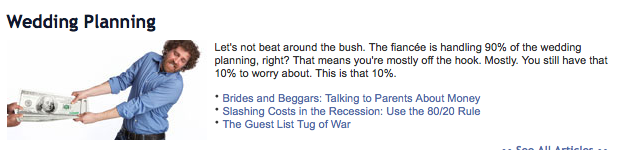
The site accepts the whole “wedding planning is women’s responsibility, and your wife is going to turn into an insane bridezilla” and “this is the end of your life, buddy” ideas so popular in our culture at the moment; this isn’t a site advocating for men to really be involved in planning weddings, or interested in them. The tone is of a fellow guy who knows how annoying it is that you have to pretend to go through all this shit and pretend you care:

picture-22

picture-3

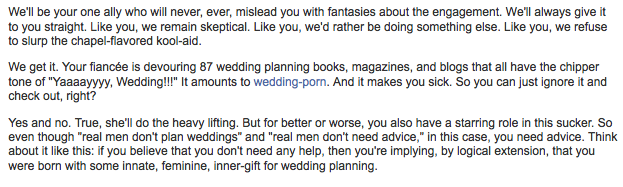
How do you try to convince men that it’s ok for them to read something as stereotypically feminine as a wedding planning website? By implying that not reading it is unmanly, of course! Notice the last paragraph here:

picture-4

So it’s actually masculine to read the planning site, because by doing so, you are showing that you are clueless about weddings, unlike women–since our “innate, feminine” selves know immediately how to plan them. That’s why you never see wedding magazines or websites designed for women–we instinctually know how to plan them, so there’s no market.

Well, ok, there is a site for women. Here The Plunge differentiates itself from The Knot:

picture-6

The site gives you helpful tips for avoiding “emasculation”:

picture-7

There’s a whole page on tips for convincing a woman to take your last name if she’s reluctant to do so. Of course, since this is an enlightened period, The Plunge first tells you that you should maybe just accept your bride-to-be’s wishes…

picture-8

…but then provides a whole list of tactics, including playing on her future mom-ness by pointing out the kids will have a different name than her and that will be confusing and weird (who’s ever heard of children with a different name than one of their parents?). If she tries to turn the argument back on you by saying that if it’s no big deal to change last names, why don’t you take hers, then…

picture-9

What I find tiresome about this site is that it pretends

NOTE: Apparently WordPress didn’t post everything I wrote at the end, which is why the post ends abruptly with the above half-written sentence. I’m sure what I originally wrote was brilliant. I know I mentioned that what I hate is that the site pretends to reject all this traditional wedding stuff, but it really totally buys into the idea that weddings are women’s things, and men should do as little as possible. And it’s pretty selective about what parts of modern weddings and marriage it criticizes–it can point out how absurd some of the prices of things are, but not equally mention that it might be stupid to get hung up on your bride-to-be not wanting to take your name?

I don’t remember what else I said, except pointing out that the site helpfully provides tips for if you sleep with someone else before your wedding. Their advice: do not come clean about it, unless a) it happened repeatedly or b) it was with someone the bride knows and she’s gonna find out. Also, it’s not quite as bad to cheat with a stripper as a “random girl.”

Hans Rosling helps us understand country-by-country carbon dioxide emissions and talks about what we can expect, and hope, from China:

Found at GapMinder.

—————————

Lisa Wade is a professor of sociology at Occidental College. You can follow her on Twitter and Facebook.


In the documentary Dreamworlds 3: Desire, Sex, and Power in Music Video, Sut Jhally investigates how images of sex and violence, and sexualized violence against women, are used in music videos, and how music videos help shape ideas of what is sexy. Here’s a clip:

The entire, unabridged version of the film is available here.

Elle sent in a link to the video for Lady Gaga’s song “Paparazzi,” which features one extended scene of sexualized violence (starting at about 1:45) and several other glimpses of women throughout the video who appear to be dead (it’s really worth watching the entire video–it’s something else):

Of course, Lady Gaga would probably argue that this video is in fact opposing violence against women, since in the end the evil paparazzi boyfriend gets killed. But there’s the same imagery Sut Jhally discusses: the mixture of sexuality with violence and hints of brutality, and of injured or dead women in glamorous, sexy clothing. Notice that in the opening sequence, the “normal” sex doesn’t look too much different than the violence that follows.

Other examples of sexualized or glamorized violence: strangling a woman with your necktie, suffering women as a turn-on, murder in a Wrangler’s ad, photo shoot with Rene Russo, t-shirts trivialize violence against women, is it a passionate embrace or an attack?, condom ads, ad for “The Tudors,” women’s discomfort is fashionable, Hunting for Bambi, the infamous Dolce & Gabbana ad, and “American’s Next Top Model.”