Last week CHGS and several other centers and departments at the University of Minnesota voiced their concern and condemnation regarding a Nazi-themed dinner that took place in the Minneapolis restaurant Gasthof zur Gemütlichkeit. The Jewish Community Relations Council of Minnesota and the Dakotas (JCRC) and the Minnesota Rabbinical Association (MRA), also responded to this disturbing event and sent a public letter to the restaurant’s owner.
The news and photographs of the gathering – Nazi flags and men clad in SS and Wehrmacht uniforms – were shocking. But even more worrying was to discover how many people, who posted their comments on the Star Tribune website or emailed and voice-mailed the Center, were ready to defend the Nazi re-enactors and the restaurant that hosted the party. Their response reveals an astounding lack of common sense and a failure to understand the gravity of the case.
How “innocent” was this re-enactment? Were the participants and the restaurant owner really unaware of the implications and effects of the symbols they were displaying? One hopes that all of Gasthof’s cards will soon be on the table.
- Star Tribune Commentary: Minneapolis group ‘plays’ Nazi: Sorry, it’s no trifle
- Jewish Community Relations Council: Letter to owner of Gasthof
Alejandro Baer is the Stephen Feinstein Chair and Director of the Center for Holocaust and Genocide Studies. He joined the University of Minnesota in 2012 and is an Associate Professor of Sociology.
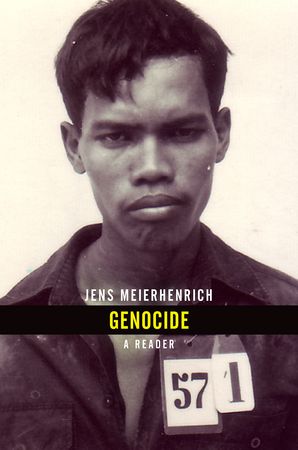 Genocide is a phenomenon that continues to confound scholars, practitioners, and general readers. Notwithstanding the carnage of the twentieth century, our understanding of genocide remains partial. Disciplinary boundaries have inhibited integrative studies and popular, moralizing accounts have hindered comprehension by advancing simple truths in an area where none are to be had.
 In the past month two significant events occurred in two of Africa’s on-going conflicts. The National Transitional council members in Central Africa Republic elected former Bangui (the nation’s capital) mayor,
 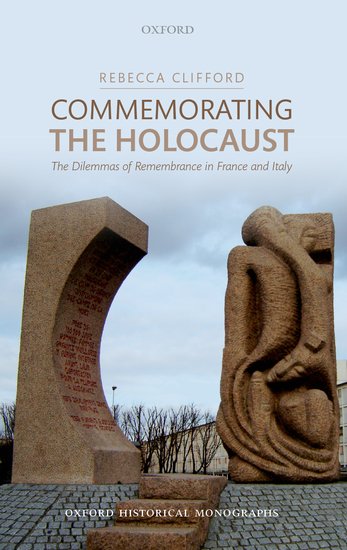 Commemorating the Holocaust: The Dilemmas of Remembrance in France and Italy reveals how and why the Holocaust came to play a prominent role in French and Italian political culture in the period after the end of the Cold War. By charting the development of official, national Holocaust commemorations in France and Italy, Rebecca Clifford explains why the wartime persecution of Jews, a topic ignored or marginalized in political discourse through much of the Cold War period, came to be a subject of intense and often controversial debate in the 1990s and 2000s.
 Noemi Schory, a documentary film director and producer, was the Schusterman Visiting Artist in Residence at the Center for Jewish Studies 2013 Fall Semester. Schory taught The Holocaust in Film: Recent Israeli and German Documentaries Compared and spoke at various film screenings and events on campus and in the community. Schory produced the award-winning documentary film “
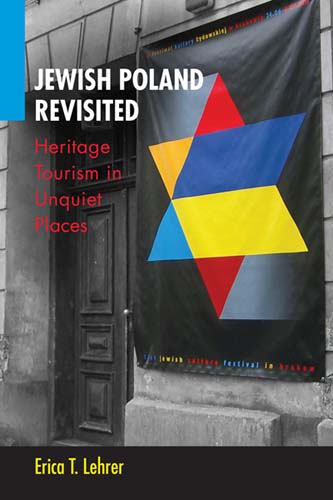 Since the end of Communism, Jews from around the world have visited Poland to tour Holocaust-related sites. A few venture further, seeking to learn about their own Polish roots and connect with contemporary Poles. For their part, a growing number of Poles are fascinated by all things Jewish. Erica T. Lehrer explores the intersection of Polish and Jewish memory projects in the historically Jewish neighborhood of Kazimierz in Krakow. Her own journey becomes part of the story as she demonstrates that Jews and Poles use spaces, institutions, interpersonal exchanges, and cultural representations to make sense of their historical inheritances.