Archive: 2011

Chris Baraniuk, who writes one of my favorite blogs, the Machine Starts, is experiencing the current riots in London first hand (they’ve spread to other cites). His account of both the rioting mobs of destruction as well as those mobs trying to clean up the aftermath imply the ever complex pathways in which what I have called “augmented reality” takes form. [I lay out the idea here, and expand on it here]

We are witnessing both the destructive and the constructive “mobs” taking form as “augmented” entities. The rioters emerged in physical space and likely used digital communications to better organize. The “riot cleanup” response came at augmentation from the reverse path, organizing digitally to come together and clean up physical space. Both “mobs” flow quite naturally back and forth across atoms and bits creating an overall situation where, as what so often occurs, the on and offline merge together into an augmented experience.

The rioting mob first realized itself in physical meat-space more...


Two French performance artists, Marion Laval-Jeantet and Benoît Mangin, recently personified Haraway’s cyborg in a piece they call “May the Horse Live in Me.” The performance, which included a blood transfusion from a horse and walking on hoove-like stilts, attempts to represent the centaur myth.

more...

A group of volunteers are raising awareness about the lost art of letter writing by handwriting and snail mailing messages that people send them via e-mail. Those who request a snail mail letter can even request that the volunteer letter-writer includes a doodle along with the text. Volunteers and those who utilize the service talk about how hand written letters are more meaningful than messages sent through e-mail. They claim that hand written letters are more personal and represent time, care, and effort.

There are several interesting and related going on here. I will talk about each one in turn: more...

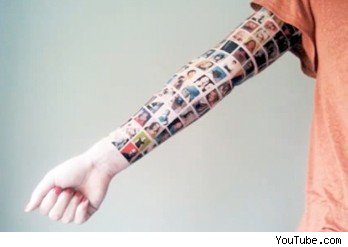
A "Fakebook" Sleeve

Just as we might have expected, the much-tweeted Facebook sleeve tattoo that I wrote about before has turned out to be a hoax. More specifically, it was a marketing campaign for the company Pretty Social. The company allows you to create custom handbags, stickers, and other products emblazoned with the profile pictures of your (digital) friends.

Nonetheless, the viral video itself made its way around the Internet, serving as but another case of tattoos as advertising. Much has been written on the topic already (Bengsston et. al 2005; McKelvey 1999; Kosut 2005), but I want to theorize further the use of tattooing in marketing as it relates to the phenomena of brand tattoos and lifestyle consumption and the repercussions these trends have for understandings of consumer culture. more...

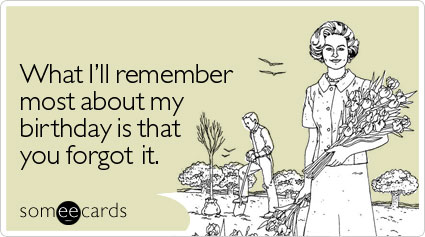
Sometimes, we forget birthdays… (Image Credit: Someecards.com)

Last Tuesday, Slate’s editor David Plotz wrote about a social experiment he performed last July.

I was born on Jan. 31, but I’ve always wanted a summer birthday. I set my Facebook birthday for Monday, July 11. Then, after July 11, I reset it for Monday, July 25. Then I reset it again for Thursday, July 28. Facebook doesn’t verify your birthday, and doesn’t block you from commemorating it over and over again. If you were a true egomaniac, you could celebrate your Facebook birthday every day. (You say it’s your birthday? It’s my birthday too!)

Plotz’s Facebook wall was filled by well-wishers on all three of his “birthdays.” He writes,

My social network was clearly sick of me. I received only 71 birthday wishes on July 28, down from more than 100 on my first two fake birthdays. And even more skeptics caught on to the experiment: 16 doubters, compared with 9 from three days earlier.

more...

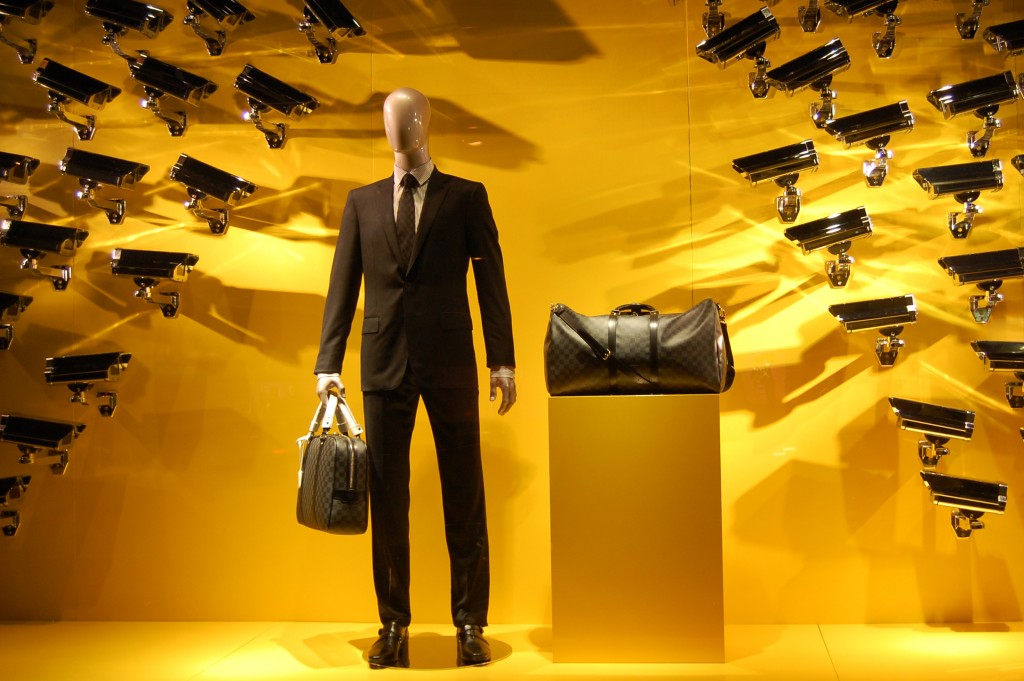
Most of us here at Cyborgology have written at least one post about augmented warfare and revolution. I suggested that the panopticon has moved to the clouds, and PJ warns that we may soon see it descend into a fog. In the wake of the Arab Spring, we have all commented on what it means to have an augmented revolution (also here, here, and here). The Department of Defense is well aware of this global trend, and is dumping lots of money into understanding how to maintain what I will call online superiority. Just as nations fight for ground, air, and sea superiority in a given conflict, they must now maintain a presence in online meeting spaces. Surveillance and intelligence efforts have always been a part of warfare, and monitoring and disrupting information flows has always been a tactical advantage. While previous engagements in informational warfare have been about information exchange, what we see now are efforts to gain online superiority in order to directly disrupt physical, financial, or tactical resources.

more...

The recent and popular Hipstamatic war photos depict contemporary soldiers, battlefields and civilian turmoil as reminiscent of wars long since passed. War photos move us by depicting human drama taken to its extreme, and these images, shot with a smartphone and “filtered” to look old, create a sense of simulated nostalgia, further tugging at our collective heart strings. And I think that these photos reveal much more.

Hipstamatic war photographs ran on the front page of the New York Times [the full set] last November, and, of course, fake-vintage photos of everyday life are filling our Facebook, Tumblr and Twitter streams. I recently analyzed this trend ina long essay called The Faux-Vintage Photo, which is generating a terrific response. I argue that we like faux-vintage photographs because they provide a “nostalgia for the present”; our lives in the present can be seen as like the past: more important and real in a grasp for authenticity.

If faux-vintage photography is rooted in authenticity, then what is more real than war? If the proliferation of Hipstamatic photographs has anything to do with a reaction to our increasingly plastic, simulated, Disneyfied and McDonaldized worlds, then what is more gritty than Afghanistan in conflict? In a moment where there is a shortage of and a demand for authenticity (the gentrification of inner-cities, “decay porn” and so on), war may serve as the last and perhaps ultimate bastion of authenticity. However, as I will argue below, war itself is in a crisis of authenticity, creating rich potential for its faux-vintage documentation. more...

Via Next Nature.

I recently met with the marketing department of a local organization. They asked to speak with me about social media, and how they could incorporate it into their “branding.” I know nothing about branding (or marketing) but I love to talk about social media, and I wanted to support my community, so I agreed.

The meeting attendants included: two marketing executives, their 21 year old intern, and me. We sat down at a table in a coffee shop. The three of them looked at me expectantly with blank yellow note pads and poised pens.

We began with the two (middle aged) marketing executives asking about the isolation caused by social media, and wondering if we should be “weeping” over the demise of our culture. Specifically, one of the executives described a “sad” situation, in which a group of students were waiting for the bus, engrossed with their phones and oblivious to each other.

I gently calmed their dystopian fears and explained the fallacy of digital dualism. The 21 year old intern immediately relaxed and chimed in. “We are being social” she said in reference to the bus stop phone incident.

The second marketing executive was unconvinced. She referenced a recent family trip, where her two teenage sons were on their iphones, missing the historic landmarks that the family had traveled to see. This time, I did not need to say a thing. The intern informed us all that looking at their phones in no way means that they missed the historic landmarks. “We are used to a lot of things going on around us at the same time, it’s how we do things” she said. The executives looked at me questioningly. I backed up the intern, explaining that the re-articulation of an experience is part of the experience for many youth today (although this is debatable).

You think you have been given the most difficult task of your life – hiring the best SEO Company to provide various on-page and off-page optimization services to your company. There is the internet today to help you ease your work. You open your PC or laptop, type relevant keywords on Google to get the list of dozens of companies promising to offer the best SEO services. You randomly pick up a few companies and start calling them up to gather necessary details about each one. But, as you speak with the customer support team, you get exhausted knowing the same things over and again. I mean all the SEO companies are saying the same things. Surely, it will make your job all the more difficult. As a potential customer, how you are going to hire the best SEO firm for your company?Click here if you want to get more about the raleigh seo.

Instagram is one of the most preferred social media used for sharing images while offering a great platform for businesses to share their products’ images, ideas and interacting with people all over the world. With this website, bloggers can share their opinions with alluring images and business owners get the opportunity to advertise the services and products that they offer. Instagram helps you market your business effectively in a cost effective manner. Key market players of different niches also use this platform to showcase their services and products to reach maximum target customers instantly. Search engine optimization, or SEO, allows you to promote your product by increasing traffic to your website via Internet marketing. By implementing SEO Adelaide techniques on your product website, you can gain better visibility in search engine results. Increasing the search engine results ranking can bring in higher quantities of traffic to the site, which advertises your product to a greater number of potential customers. This can be done at no cost to yourself, but you can enhance your efforts by paying for some services.

For instance, you can share photos containing snapshot of any even of your company, satisfied customers using your services or products, or any other relevant pictures. To promote your brand on Instagram and to reach thousands of followers in a day, it is necessary to have many targeted followers. An Instagram account without followers can’t be used to advertise your brand. The more genuine followers you have, the more the impact of your promotion efforts will be.

You can get only a bunch of followers by using proven strategies such as following others, posting interesting photos, leaving genuine comments on other people’s photos, sharing your posts on other social networking sites, tagging your photos, and using # tags. Additionally, these strategies are time consuming and will take many months and even years to collect any particular number of genuine followers. There is an effective way that can help you reach your goals of getting a large volume of followers within a short period of time – Buy instagram followers helpwyz.com

Buying followers is the best strategy to get many Instagram followers quickly. Even if you have started Instagram, you can get thousands of genuine like in a day or two. The targeted followers you buy will help you promote your brand and increase popularity on Instagram. Additionally, when people will see that you have a large following, they will be encouraged and will follow you to keep up with your interesting posts.

more...

The always impressive Information is Beautiful created this graphic about technology and distraction. It is also currently featured at the MoMA exhibit Talk to Me.

See it big.