Archive: 2011

QR codes line the bulletin boards of many college campuses.

Lisa Wade over at our sister blog Sociological Images sent us an email from one of her readers, Steve Grimes, who shared this image and some interesting thoughts about how Quick Response codes or, QR codes can contribute to inequality. That is, QR codes such as these serve to make certain content and information “exclusive” to those who have smartphones. He states,

There is a general thinking that technology can create a level playing field (an example of this is can be seen with the popular feelings about the internet). However, technology also has a great ability to create and widen gaps of inequality.

In a practical sense the company may be looking for students who are tech savvy. They may also want to save on ink toner (might be a stretch). So using the matrix barcode may serve that purpose. However, the ad also shows how technology can exclude individuals; primarily in this case, students without smart phones. One may think that being on a college campus every student would have a smart phone. However, when you look at the prices of most smart phones along with the prices for the plans of a carrier (usually somewhere $75-150 per month) one can see that not every student may have one. Especially considering the other things that they may have to pay for that are a bit pressing to their environment (books, food, etc). more...
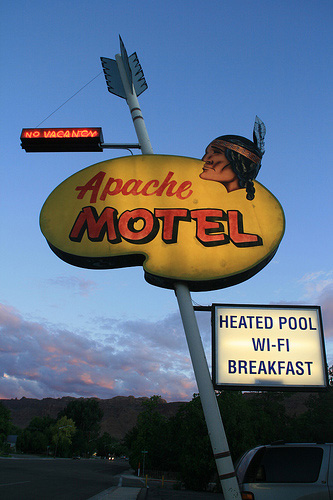

The Apache has its priorities straight: Wi-Fi & coffee.

The annual meetings of the American Sociological Association were held this past week in Las Vegas. More than 5,000 sociologists converged from departments around the world to meet face-to-face in a massive conference hotel. Planning such an event is a massive undertaking with a vast array of logistical issues; yet, one facet of the meeting, Wi-Fi access (or, rather, its inadequacy), sparked a major debate.

First, we should mention that as conference organizers who have run up against the limits of a venue’s Wi-Fi infrastructure, we understand the difficulties in getting people reliably connected. During last Spring’s Theorizing the Web conference, the Wi-Fi crashed under such heavy pressure. However, we were working with a classroom building on a campus, not a massive conference hotel that already has Wi-Fi access built in. It is now the norm for major conference venues to have Wi-Fi available at a price. While the relatively small Theorizing the Web conference might not have a budget for universal Wi-Fi access, ASA could easily spread the cost over the massive number of those paying for registration (or even make a separate Wi-Fi registration fee). more...

My attention was directed today (via Twitter, appropriately), to this post about the competing ASA Bingo Cards.  I don’t have a lot to say about the deeper meaning of “gentle ribbing” or negativity, whatever you want to call it, in the original card.  However, I do think that the “chronically hip grad student” square was not just, as Nathan Jurgenson asserted, a mainstream culture-embedded dig at hipsters, but also an indication of a general discomfort among less technologically savvy sociologists at the increasing use of technology to augment professional scholarly activities, often though not always by colleagues younger than themselves.

In particular, I suspect that the characterization of Twitter as “like passing notes during a talk, only if those notes were posted on a giant whiteboard behind the speaker so that everybody but her could read them” is quite accurate in terms of how the unfamiliar (and vaguely suspicious) think about Twitter.  Twitter users think they’re better than us, just like those iPad-using hipster grad students, and they’re trash talking about it where we can’t see them. While it makes sense, I think it’s a very misguided analogy.

The critical difference between notes, or for that matter late-night trash talk at the hotel bar, and Twitter is that Twitter creates more...

Just a quick link I came across over the weekend before the hurricane knocked out my power. In the video below, we see Chloe Holmes displaying her new prosthetic hand, a $62,000 piece of technology that allows her to move each digit independently of one another through sensors embedded in the sleeve. Chloe lost her fingers at age 3 as a result of septicemia, a complication from chicken pox.

YouTube Preview Image

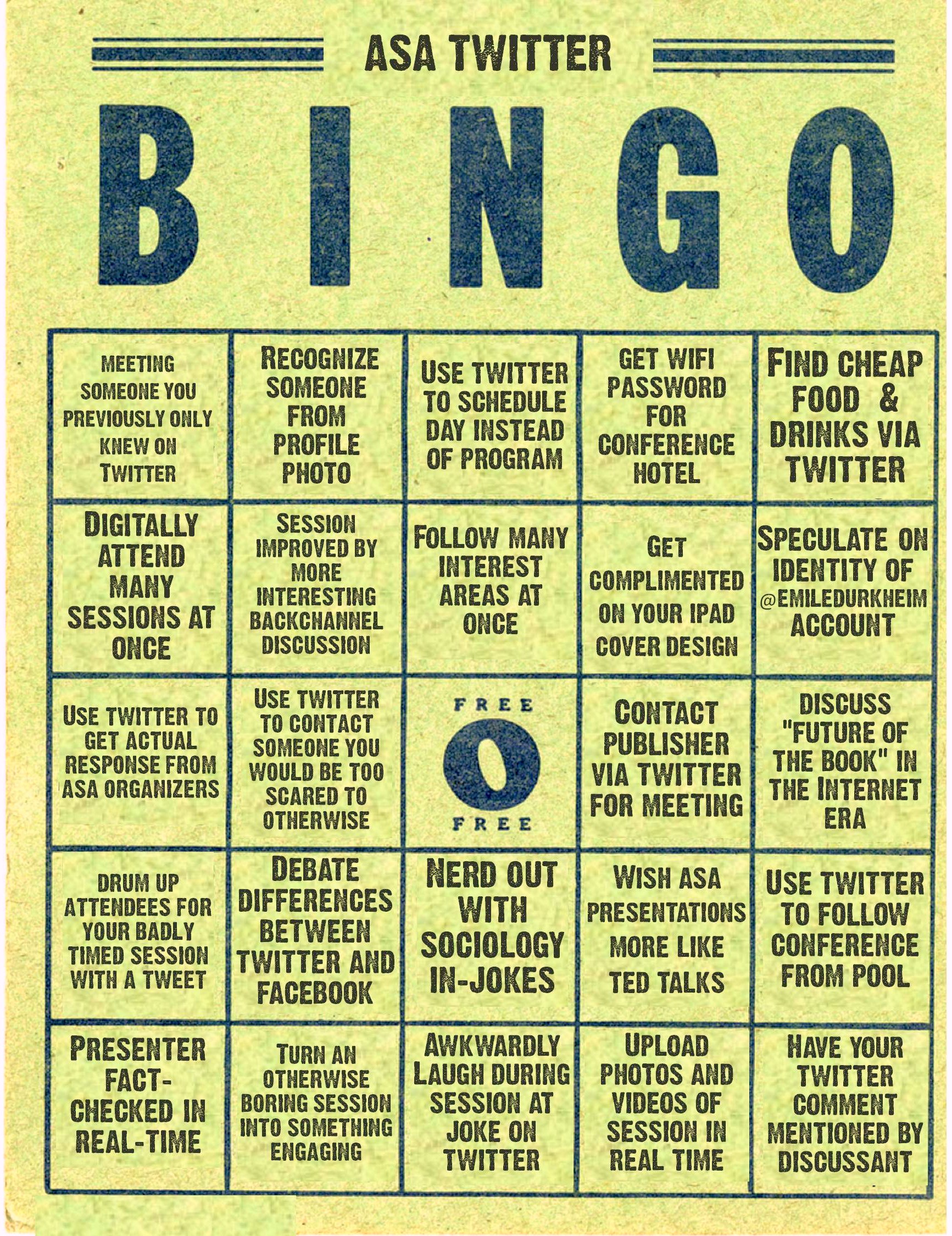
Conference Twitter Bingo Card created by Jessie Daniels and Nathan Jurgenson

There was a popular “bingo card” for the annual meetings of the American Sociological Association held last week in Las Vegas. It poked a bit of fun at sociologists and the meeting itself. Nathan Jurgenson’s reaction was that the card itself revealed much about the sociological discipline and the problems with the annual meetings. He wrote a post here on Cyborgology calling for a more positive bingo card that might be helpful to improve the conference experience rather than just complaining about what is wrong. It is easy to be annoyed, much harder to be constructive.

CUNY sociologist Jessie Daniels responded to this call, and, toegther, we have created a more constructive and useful Bingo card that looks specifically at how to improve a conference by augmenting one’s experience with Twitter.

The card describes how conferences in general benefit from engagement on both the physical and digital levels. Conversations taking place move onto the web, and discussions in the “backchannel” flow back into physical space. In fact, we noted this trend during the Theorizing the Web conference this past spring, calling it an “augmented conference.”

More on Twitter use at the ASA 2011 meetings.

Here are some summary statistics for the American Sociological Association annual meetings held this past week in Las Vegas. These statistics begin August 1st through the 25th.

TwapperKeeper archive URL: <http://twapperkeeper.com/hashtag/asa2011>

Total tweets: 3475
Total twitterers: 559
Total hashtags tweeted: 344
Total URLs tweeted: 336 more...

Like many others, I learned about the recent East Coast earthquake via Twitter. In fact, it has been demonstrated that the news traveled faster on Twitter than did the actual waves of the quake. For instance, many in New York City found about about the earthquake on Twitter from friends in DC before feeling the rumbling themselves.

See this cool video made by Eric Fischer and follow the quake-tweets represented by green dots travel north from the epicenter in Virginia up through and past New York City:

Twitter has even capitalized on this by making a commercial: more...

British performance artist Alice Newstead is gaining attention for her recent performance inside LUSH cosmetics in San Francisco. The performance has become part of an increasing vocal outcry over the sale of shark fin soup in California. The proposed bill, AB376, has passed the California assembly and now awaits a Senate vote. more...

During my short time in Vegas I listened to and partook, in many formal, informal, academic and recreational conversations about technology and social media. This often resulted in debates over the digital/actual split (or lack thereof).  Those who espoused the digital/actual split did so with a clear privileging of the “actual” (i.e. physical).  This debate is in line with much of the work done on this blog, and in particular with a few recent comment threads (especially here, but also here). In response to this, I’ve devised a list of reasons why this split is so vehemently maintained by some, and why the digital is de-valued. more...

I have archived trials and tribulations surrounding WiFi access at the 2011 American Sociological Association with the hope it might encourage ASA to give higher priority to this issue at future events:

#ASA2011 folks: RT if you’d be willing to pay higher registration fees to have wifi @ #ASA2012
pjrey
August 15, 2011

more...